wayground logo

Free Printable Worksheets

NEW

Font size

S
M
L
XL
Worksheets

CH 3 Atoms

Total questions: 69

Worksheet time: 1hrs 3mins

Name
Class
Date
1.
The principles of atomic theory recognized today were conceived by 
a)
Avogadro
b)
Bohr
c)
Dalton
d)
Rutherford
2.
According to Dalton's atomic theory, atoms
a)
are destroyed in chemical reactions
b)
can be divided
c)
of each element are identical in size, mass, and other properties
d)
of different elements cannot combine
3.
Dalton's atomic theory helped to explain the law of conservation of mass because it stated that atoms
a)
could not combine
b)
could not be created or destroyed 
c)
all have the same mass
d)
were invisible
4.
Experiments with cathode rays led to the discovery of the 
a)
proton
b)
nucleus
c)
neutron
d)
electron
5.
A positively charge particle is a(n)
a)
proton
b)
neutron
c)
electron
d)
positron
6.
The mass of a neutron is 
a)
about the same as that of a proton
b)
about the same as that of an electron
c)
double that of a proton
d)
double that of an electron
7.
The smallest unit of an element that can exist either alone or in combination with other such particles of the same or different elements is the
a)
electron
b)
proton
c)
neutron
d)
atom
8.
Atoms of the same element that have different masses are called
a)
moles
b)
isotopes
c)
nuclides
d)
neutrons
9.
A boron isotope consists of  5 protons, 5 electrons and 7 neutrons. Its mass number is
a)
10
b)
11
c)
12
d)
2
10.
What is the atomic number for oxygen?
a)
8
b)
16
c)
6
d)
10
11.
An atom of calcium has 20 protons and 20 neutrons. What is its mass number?
a)
20
b)
40
c)
60 
d)
80
12.
The number of atoms in a mole of any pure substance is called
a)
its atomic number
b)
Avogadro's number
c)
its mass number 
d)
its gram-atomic number
13.
Who discovered the nucleus by bombarding gold foil with positively charged particles and noting that some particles were widely deflected?
a)
Dalton
b)
Millikan
c)
Mendeleev
d)
Rutherford
14.
How many atoms are present in 6.00 mol of chlorine atoms?
a)
4.82 x 10>24
b)
3.61 x 10>24
c)
9.97 x 10>-24
d)
1.28 x10>26
15.
How many moles of Al are equivalent to 1.6 x 10>22 atoms?
a)
0.027
b)
9.6 x 10>45
c)
2.6 x 10>47
d)
0.72
16.
How many moles of water (H2O) are in 14 grams?
a)
3.9 x 10>22
b)
4.7 x 10>23
c)
252
d)
.78
17.
Particles in an atom that are neutral and have no charge are 
a)
negatrons 
b)
electrons 
c)
neutrons 
d)
protons 
18.
The isotope uranium-235 has 92 protons and 142 neutrons. Its mass number is
a)
92
b)
235
c)
143
d)
impossible to tell
19.
What scientist is best known for his "Plum Pudding" model of the atom?
a)
J.J. Tomson
b)
Ernest Rutherford
c)
John Dalton
d)
Democritus
20.
What are the 3 particles that make-up the atom?
a)
protons, neutrons, and isotopes
b)
neutrons, isotopes, and electrons
c)
positives, negatives, and electrons
d)
protons, neutrons, and electrons
21.

What does the 1.00794 stand for?

a)

mass number

b)

atomic number

c)

average atomic mass

d)

number of protons

22.
What particle uniquely identifies an element?
a)
Number of Valence Electrons
b)
Number of Protons
c)
Number of Electrons
d)
Atomic Mass
23.
How many neutrons in:
Calcium - 45
a)
45
b)
20
c)
65
d)
25
24.
How many protons in Sulfur - 35?
a)
35
b)
16
c)
51
d)
19
25.

I mole =

a)

6.673 * 10-11

b)

6.022 * 1023

c)

6.022 * 10-23

d)

6.673 * 1011

26.

Where do you find the molar mass of an element?

a)

The solubility rules

b)

The periodic table

c)

The polyatomic ion list

d)

The activity series

27.
What is the molar mass of H2O?
a)
6.02 x 10²³
b)

16.02 g/mole

c)

18.02 g/mole

d)

15.99999 g/mole

28.

How many atoms are in 1 mole of Iodine (I)?

a)

6.022 x 10²³

b)

4.022 x 10²³

c)

6.022 x 1025

d)

4.022 x 1025

29.

How many atoms of S are in 0.250 mol S

a)

 1.506 x 10²³ S atoms

b)

3.011 x 10²³ S atoms

c)

9.033 x 10²³ S atoms

d)

6.022 x 10²³ S atoms

e)

1.204 x 1024 S atoms

30.

Convert 25 g of NaBr to molecules

a)

102.96 molecules

b)

0.24 molecules

c)

1.45x10²³ molecules

d)

2.34 x 10²⁰molecules

31.
What did Democritus, Dalton, Thomson, Rutherford, and Bohr all have in common?
a)
They were all cool dudes.
b)
They each identified new isotopes of atoms.
c)
They each contributed to the development of the atomic theory.
d)
They each designed a new building.
32.
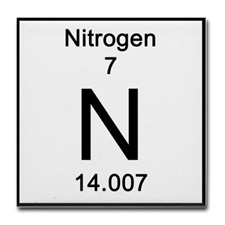
What is the number of protons that the element in this image contain?
a)
14
b)
7
c)
15
d)
18
33.

Which answer choice correctly describes the location and charge of electrons in an atom.

a)

negative and inside the nucleus

b)

negative and outside the nucleus

c)

postitive and inside the nucleus

d)

no charge and inside the nucleus

34.

In Rutherford's experiments, most of the particles

a)

were absorbed by the foil

b)

passed through the foil

c)

combined with the foil

d)

didn't make it to the foil

35.

The atomic mass of an element listed in the periodic table is the

a)

average atomic mass for the element as found in nature.

b)

relative atomic mass of the most abundant radioactive isotope.

c)

mass number of the least abundant isotope.

d)

average number of electrons.

36.

An aluminum isotope consists of 13 protons, 13 electrons, and 14 neutrons. Its mass number is

a)

40

b)

13

c)

27

d)

14

37.

Chlorine has atomic number 17 and mass number 35. It has

a)

35 protons, 35 electrons, and 17 neutrons.

b)

18 protons, 18 electrons, and 17 neutrons.

c)

17 protons, 17 electrons, and 18 neutrons.

d)

35 protons, 17 electrons, and 35 neutrons.

38.

Avogadro’s number is useful for

a)

counting atoms.

b)

counting large objects.

c)

locating an atom’s electrons.

d)

none of the above

39.

How much effect do commonly found isotopes have on the average atomic mass of an element?

a)

less than rarely found isotopes

b)

same as rarely found isotopes

c)

no effect on atomic mass

d)

more than rarely found isotopes

40.

What is the amount of nickel, which has an average atomic mass of 58.7 u, present in 525 g nickel?

a)

28.0 mol

b)

8.90 mol

c)

525 mol

d)

58.7 mol

41.

What is the mass of 2.5 mol of Ca, which has a molar mass of 40 g/mol?

a)

2.5 g Ca

b)

20.0 g Ca

c)

40.0 g Ca

d)

100.0 g Ca

42.

Find the molar mass of CaCO3CaCO_3   

a)

100.09g

b)

100g

c)

100.2g

d)

101g

43.

Find the number of moles in 75 grams of NaHCO3NaHCO_3   

a)

89mol

b)

0.90mol

c)

0.89mol

d)

84mol

44.
What is the mole used for? 
a)
To measure the amount of grams in a substance
b)
To measure the amount of atoms or molecules in a substance
c)
To measure the amount of energy in a substance
d)
To measure the amount of bonding in a substance 
45.

What units are used for molar mass?

a)

gramsmole\frac{grams}{mole}  

b)

molesatom\frac{moles}{atom}  

c)

AMUAMU  

d)

degrees Fahrenheit

46.

How many moles of oxygen atoms are in 31.998 grams of oxygen?

To solve this problem you should...

a)

multiply by 1 mole6.022x1023\frac{1\ mole}{6.022x10^{23}}  

b)

multiply by  1 mole15.999 g\ \frac{1\ mole}{15.999\ g}  

c)

multiply by 6.022x10231 mole\frac{6.022x10^{23}}{1\ mole}  

d)

multiply by 15.999 g1 mole\frac{15.999\ g}{1\ mole}  

47.

How many moles of oxygen atoms are in 3.011 x 10^23 atoms of oxygen?

To solve this problem you should...

a)

multiply by 1 mole6.022x1023\frac{1\ mole}{6.022x10^{23}}  

b)

multiply by  1 mole15.999 g\ \frac{1\ mole}{15.999\ g}  

c)

multiply by 6.022x10231 mole\frac{6.022x10^{23}}{1\ mole}  

d)

multiply by 15.999 g1 mole\frac{15.999\ g}{1\ mole}  

48.
The molar mass of an element is the mass of one ____ of the element.
a)
atom
b)
molecule
c)
mole
d)
gram
49.
How many moles are in 4.5x1024 particles?
a)

7.47 particles

b)

7.47mol

c)
2.71x1047 mol
d)
2.71x1047 particles
50.

How many molecules are there in 5.9 moles of NaCl?

a)

3.5x1024 molecules

b)

9.80x10⁻²⁴ molecules

c)

1.02x10²³ molecules

d)

6.02x10²³ molecules

51.

What is the molar mass of Hydrogen, H2?

a)

1.01 moles

b)

2.02 grams

c)

2.02 g/mol

d)

1.01 g/mol

52.

Which of the following dimensional analysis setups will correctly convert 4.00x10²³atoms of cobalt to moles of cobalt? How many moles of colbalt are there?

a)

setup B : 0.664 mol Co

b)

setup A: 2.41x1047mol Co

c)

setup A : 0.664 mol Co

d)

setup B: 2.41x1047mol Co

53.
How many moles are in 3.01 x 10²² atoms of magnesium?
a)
0.0500 moles
b)
1.81 x 1046 moles
c)
5.00 x 10²¹ moles
d)
5.00 moles
54.
How many molecules are present in 25 g of NaBr?
a)
102.96 molecules
b)
0.24 molecules
c)
1.45x10²³ molecules
d)
2.34 x 10²⁰molecules
55.
What is the mass of 54.3x1045molecules of BeO?
a)
3.27x1070 g
b)
9.01 x10²²g
c)
2.25 x1024 g
d)
1.31 x1069g
56.
24.1% of all the isotopes of a an element have a mass of 75.23 amu, 48.7% have a mass of 74.61 amu, and 27.2% have a mass of 75.20 amu.
What is the average mass of this element?
a)
74.92 amu
b)
24.97 amu
c)
75.01 amu
d)
74.51 amu
57.
4.35% of all X atoms have a mass of 39.946 amu. 83.79% have a mass of 41.941 amu, 9.50% have a mass of 42.941 amu, and 2.36% have a mass of 43.939 amu. What is the average atomic mass of atom X?
a)
41.97 amu
b)
42.19 amu
c)
10.43 amu
d)
40.04 amu
58.
An element has two naturally occurring isotopes. One is 10.013 amu and is 19.9% abundant. The other is 11.01 amu and is 80.1% abundant. What is the average atomic mass? What element is it?
a)
9.012, Beryllium
b)
12.011, Carbon
c)
6.941, Lithium
d)
10.812, Boron
59.

Compute the average atomic mass for this element.

a)
27.977
b)
28.09
c)
28.976
d)
The average mass cannot be determined from provided information.
60.
An isotope has three forms.  30% have a mass of 4 amu, 20% have a mass of 5 amu and 50% have a mass of 3 amu.  Average atomic mass will be closest to
a)
2 amu
b)
3 amu
c)
4 amu
d)
5 amu
61.

Which is the best nuclear symbol for a potassium atom with 21 neutrons?

a)
b)
c)
d)
62.

Which of the following is the nuclear symbol for lithium-6

a)
b)
c)
d)
63.

The hyphen notation of an atom of calcium with 20 protons, 20 electrons, and 22 neutrons is

a)

calcium - 20

b)

calcium - 40

c)

calcium - 62

d)

calcium - 42

64.

The number 84 in strontium - 84 represents

a)

the atomic number

b)

the mass number

c)

the average atomic mass

d)

the number of electrons

65.
Atom 1 has Mass=12  Protons=6
Atom 2 has Mass= 14 Electrons=6
Are these atoms isotopes of each other or different elements?
a)
Different Elements - Mg & Si
b)
Different Elements - Ar & Ca
c)
Isotopes of Carbon
d)
Isotopes of Magnesium
66.
Matter can not be created nor destroyed: it can only be
a)
Destroyed a little bit
b)
Invisible
c)
Transformed, changed
d)
None of the above
67.

Which of the models of a chemical reaction best represents the Law of Conservation of Mass?

a)

A

b)

B

c)

C

d)

D

68.

Which one of the following pair of substances illustrates law of multiple proportions?

a)

Calcium oxide and calcium hydroxide

b)

Sodium chloride and sodium bromide

c)

Carbon monoxide and carbon dioxide

d)

None of the above

69.

2 elements C & D combines to form a compound CD. The same compound is obtained from different experiment. give the law in accordance to above observation

a)

law of conservation of mass

b)

law of constant proportion

c)

law of multiple proportion