wayground logo

Free Printable Worksheets

Font size

S
M
L
XL
Worksheets

Worms and Mollusks Review

Total questions: 67

Worksheet time: 1hrs 6mins

Name
Class
Date
1.
Which phylum of worms has a bilateral symmetry, one-way digestive system, respiration through skin, hydrostatic skeleton and segmented body?
a)
Annelida
b)
Platyhelminthes
c)
Nemotoda
d)
Nemertea
2.
A stiff hair, bristle or bristle like process or part on an organism
a)
Ganglia
b)
Setae
c)
Parapodia
d)
Nephridia
3.
Which structure is NOT associated with digestion?
a)
Gizzard
b)
pharynx
c)
nephridia
d)
crop
4.
Which of the following is a thickened segment of the earthworm’s body is used in reproduction?
a)
Septa
b)
Setae
c)
Clitellium
d)
Ganglia
5.

Which of the following is a structure related to excretion in worms?

a)

Ganglia

b)

Gizzard

c)

Nephridia

d)

Crop

6.
Which phylum includes hookworms, pinworms, and heart worms?
a)
Platyhelminthes
b)
Nematoda
c)
Annelida
7.
Which of the following phyla contains  mostly parasitic roundworms?
a)
Annelida
b)
Cnidara
c)
Nematoda
d)
Platyhelminthes
8.
Which of the following phyla contains mostly parasitic flatworms?
a)
Annelida
b)
Cnidaria
c)
Nematoda
d)
Platyhelminthes
9.
Which of the following phyla includes tapeworms, liver flukes, and planarians?
a)
Annelida
b)
Cnidaria
c)
Nematoda
d)
Platyhelminthes
10.
Which of the following phyla includes  earthworms, leeches, and polychaetes?
a)
Annelida
b)
Cnidaria
c)
Nematoda
d)
Platyhelminthes
11.
What is structure A?
a)
flame cell
b)
pharynx
c)
ganglion
d)
ocelli
12.
Earthworms have setae, which are like bristles that help them ___.
a)
move
b)
eat
c)
reproduce
13.
Flat worms can reproduce 
a)
sexually 
b)
asexually
c)
both sexually and asexually
14.
Which of these is a common way that parasitic worms can be transmitted? 
a)
fecal-oral contact
b)
arthropod vectors
c)
consuming contaminated food or water
d)
all of these are ways you can get worms! 
15.

Annelids are hermaphrodites. Define this term.

a)

They have three tissue layers.

b)

They have a body cavity.

c)

They produce both egg and sperm.

d)

They can regenerate lost body parts.

16.

What type of symmetry do Platyhelminthes bodies have?

a)

bilateral

b)

radial

c)

asymmetrical

d)

both asymmetrical and radial

17.
Which phylum is the first to exhibit a closed circulatory system?
a)
Platyhelminthes
b)
Nematoda
c)
Annelida
18.

Worms take in oxygen through their

a)

lungs

b)

skin

c)

hearts

d)

mouth

19.

What word means the "front" of the worm?

a)

dorsal

b)

ventral

20.
The three main phlya of worms include
a)
roundworms, tube worms, and flat worms
b)
roundworms, flatworms, and segmented worms
c)
flatworms, segmented worms, and marine worms
21.
The structure that a planarian extends for feeding
a)
crop
b)
proglottid
c)
scolex
d)
pharynx
22.
In a complete digestive tract
a)
the food moves only one way
b)
nutrients are able to be absorbed more efficiently
c)
the anterior end contains the mouth; the posterior end contains the anus
d)
all of these
23.
Round worms and segmented worms normally reproduce through this kind of reproduction.
a)
sexual
b)
asexual
c)
budding
d)
conjugation
24.
Worms have this kind of symmetry.
a)
asymmetry
b)
radial symmetry
c)
bilateral symmetry
25.
Which statements are true about the earthworm's circulatory system?
a)
It's a closed system.
b)
The blood flows in vessels.
c)
Nutrients can be delivered efficiently throughout the worm
d)
All of these
26.
Which of the following organisms has a closed circulatory system 
a)
round worms
b)
flatworms 
c)
segmented worms
d)
sponges 
27.

A system where blood is not in vessels, but spreads over the organs in some areas is called a(n)______ system.

a)

closed circulatory system

b)

fluid-filled

c)

open circulatory

d)

water vascular

28.

Gastropods have a ______, a tongue-like organ that works like a file.

a)

crop

b)

radula

c)

setae

d)

spiracle

29.

The class of mollusks with the most specialized members are the ______.

a)

bivalves

b)

cephalopods

c)

pseudopods

d)

gastropods

30.

Like mollusks, segmented worms have a ______.

a)

body cavity for organs

b)

crop

c)

mantle

d)

muscular foot

31.

What structures do tapeworms have for attaching themselves to the intestinal lining of their host? (multiple answers possible)

a)

suckers

b)

pharynx

c)

hooks

d)

silk glands

32.

How does a tapeworm get its nutrition?

a)

Through its mouth and complex digestive system.

b)

Absorbs food in the host's intestine directly through its skin.

33.

Which of the following are true of worms in Phylum Nematoda? (multiple answers possible)

a)

they are very flat

b)

they have a two-way, incomplete digestive system

c)

they are hermaphrodites

d)

they move with thrashing, snake-like movements

34.

A single organism that has both testes and ovaries is called _____________________ .

a)

hermaphroditic

b)

dioecious

c)

heterotrophic

d)

homozygous

35.

The extendable throat of a planarian is the _____________ .

a)

intestine

b)

acetabulum

c)

pharynx

d)

gizzard

36.

Which of the following are true of worms? (multiple answers possible)

a)

they are unicellular

b)

they are vertebrates

c)

they have long, narrow bodies

d)

they have bilateral symmetry

37.

Which name best describes an organism that lives in or on another and feeds from that organism's tissues or fluids?

a)

decomposer

b)

host

c)

parasite

d)

scavenger

38.

They two eyespots of a planarian are _________________ .

a)

posterior

b)

ventral

c)

anterior

d)

lateral

39.
How is the body of an Earthworm divided?
a)
Compartments/septa
b)
Long tubes
c)
One large section
d)
Layers
40.
Organs in the digestive system (mouth, pharynx, esophagus, crop, gizzard, intestine, anus)
a)
Phylum Platyhelminthes
b)
Phylum Nematoda
c)
Phylum Annelida
41.
Known as "Round Worms"
a)
Phylum Platyhelminthes
b)
Phylum Nematoda
c)
Phylum Annelida
42.
Which of the following do all worms have in common?
a)
They are all coelomates.
b)
They are all bilateral
c)
They all have a complete digestive tract.
d)
They are all parasitic.
43.
Earthworms have ___ sets of muscles that help them move.
a)
1
b)
2
c)
3
d)
4
44.
Earthworms don't have teeth to grind their food so they use another organ to do so. It is called a ___.
a)
crop
b)
gizzard
c)
intestine 
d)
esophagus 
45.

Name the THREE groups of Mollusks.

a)

Gastropods

b)

Arthropods

c)

Cephalpods

d)

Bivalves

e)

Crab

46.

What is a radula?

a)

A Tounge like sturcture used to scrape plant matter into easy to eat pieces.

b)

A part used to make protection.

c)

the fancy way to say "Tentacle"

d)

Movment

47.

To which group of mollusks does this squid belong?

a)

cephalopod

b)

bivalve

c)

gastropod

48.

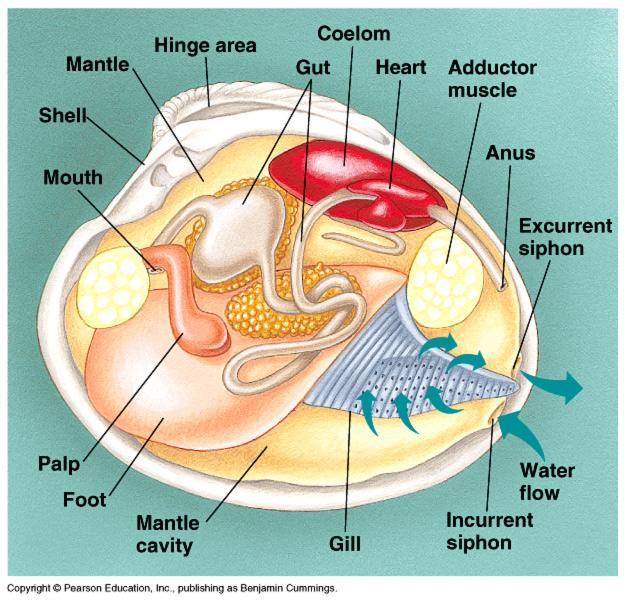
To which group of mollusks this clam belong?

a)

Gastropods

b)

Cephalopods

c)

Bivalves

d)

Arthropods

49.
Which part of the Mollusk body is specialized for burrowing, feeding, and movement?
a)
trochophores
b)
visceral mass
c)
mantle
d)
foot
50.
Which part of the Mollusk body is the tissue covering the body and secretes the shell?
a)
Mantle
b)
Trochophore
c)
Foot
d)
Visceral Mass
51.
Which class of Mollusks have the most advanced nervous system?
a)
Gastropods
b)
Bivalves
c)
Cephalopods
d)
arthropods
52.
What type of symmetry do Molluscs have?
a)
Asymmetrical
b)
Bilateral
c)
Radial
53.
What is the meaning of Gastropod?
a)
Soft-bodied
b)
Stomach foot
c)
Head-footed
d)
Two-shelled
54.

What are filter feeders?

a)

A large pile of living organisms and the animals that live among them.

b)

An organism that attaches onto another organism and feeds off of it.

c)

Animals that feed by removing tiny bits of food from the water.

d)

Animals that use sunlight to obtain nutrients.

55.

All of the following are Bivalves, EXCEPT:

a)

Clams

b)

Mussels

c)

Snails

d)

Oysters

e)

Scallops

56.
What does Cephalopod mean?
a)
means "2-shells"
b)
means "head-foot"
c)
means "stomach-foot"
d)
means "soft bodied"
57.
Which group of cephalopods has ability to flatten body to fit in small spaces and change skin to blend with surroundings?
a)
Cuttlefish
b)
Nautilus
c)
Squid
d)
Octopuses
58.

Organs that are in contact with blood supply and specialized for gas exchange.

a)

fin

b)

radula

c)

bivalve

d)

gills

59.

Which TYPE of mollusk has two shells?

a)

Bivalve

b)

Gastropod

c)

Cephalopod

60.
Which mollusk class would you see organisms moving using
"jet propulsion"?
a)
Gastropoda
b)
Cephalopoda
c)
Bivlavia
d)
Oligochaeta
61.
Which class of mollusks is shown in the picture?
a)
Gastropoda
b)
Molluska
c)
Bivalia
d)
Polychaeta
62.
Which larva identifies mollusks and annelids?
a)
Planula
b)
Trochophore
63.
Which class of mollusks do snails and slugs belong to?
a)
Gastropoda
b)
Bivalvia
c)
Cephalopoda
d)
Hirudinea
64.
Which of the following is the correct description of reproduction in Mollusks?
a)
Mostly asexual
b)
Budding
c)
Regeneration
d)
Mostly sexual
65.
Mollusks are vertebrates?
a)
True
b)
False
66.
How do water-dwelling Mollusks breathe?
a)
radula
b)
mantle
c)
gills
d)
foot
67.
What type of circulatory system do Mollusks have?
a)
Open
b)
Closed