
 Worksheets
Biology EOC Practice Exam 16 - 17
Total questions: 66
Worksheet time: 5hrs 37mins
Name
Class
Date
1.
An experiment is performed on plants to see how different liquids affect plant growth. Each plant in the experiment is given a different liquid; water, apple juice, or milk. Each plant has the same amount of soil, sunlight, and listens to the same music. In this investigation, the independent variable is ...
a)
The type of plant
b)
The amount of sunlight
c)
The type of music
d)
The type of liquid
2.
Which statement correctly identifies the difference between laws and theories?
a)
Laws are a statement of fact, while theories are a statement of opinion.
b)
Laws explain why phenomena exist, while theories explain how.
c)
Laws are a prediction of phenomena, while theories are an explanation.
d)
Laws describe phenomena, while theories explain why phenomena exist.
3.
Scientific theories are based on
a)
general assumptions of how systems work.
b)
mathematical principles that can be proven true.
c)
large amounts of data collected over time.
d)
observations from within only one scientific discipline.
4.
What is the best definition of the term "theory," as it is used in science?
a)
A guess about something that has occurred in nature.
b)
a comprehensive set of ideas explaining a phenomenon in nature.
c)
based on verifiable laws and can be proven true.
d)
a hypothesis that uses laws and observation to make an assumption.
5.

Which macromolecule is shown?
View Figure 1 (if not visible)
View Figure 1 (if not visible)
a)
lipid
b)
protein
c)
nucleic acid
d)
carbohydrate
6.

Which macromolecule is shown?
View Figure 2 (if not visible)
View Figure 2 (if not visible)
a)
lipid
b)
protein
c)
nucleic acid
d)
carbohydrate
7.

Which macromolecule is shown?
View Figure 4 (if not visible)
View Figure 4 (if not visible)
a)
lipid
b)
protein
c)
nucleic acid
d)
carbohydrate
8.
A scientist analyzing an unknown substance has determined that it consists of carbon, hydrogen and oxygen. During experimentation, she determines that the substance is soluble in oil but not in water. Which of the following macromolecules is the unknown substance most likely to be?
a)
Carbohydrates
b)
lipid
c)
nucleic acid
d)
protein
9.
How does an enzyme influence a biological reaction?
a)
It increases the net energy difference between reactants and products.
b)
It decreases the activation energy necessary to initiate the chemical change.
c)
It increases the kinetic energy of reactants, thereby increasing their tendency to collide.
d)
It decreases the kinetic energy of reactants, enabling them to undergo chemical change more easily.
10.
Which of the following structures would be present in a plant cell, but not in an animal cell?
a)
A. nucleus, mitochondria, chloroplasts
b)
B. chloroplasts, cell wall, central vacuole
c)
C. cell wall, mitochondria, Golgi apparatus
d)
D. central vacuole, Golgi apparatus, nucleus
11.
Which of the following statements correctly explains the role of lysosomes within a cell?
a)
A. The lysosome prepares fats and lipids for transport throughout the cell by sorting and encasing them.
b)
B. The lysosome uses oxygen to convert sugar into chemical energy and also controls the metabolism of the cell.
c)
C. The lysosome breaks down molecules that are not needed within the cell and returns some of the products of digestion to the cell for later use.
d)
D. The lysosome isolates water and other molecular compounds and stores them so they can be used later by the cell, or expels them as waste products.
12.
A person with swollen gums rinses his mouth with warm salt water, and the swelling decreases. Which has occurred?
a)
The swollen gums have absorbed the saltwater solution.
b)
The saltwater solution lowers the temperature of the water in the gums.
c)
The salt in the solution has moved against the concentration gradient.
d)
The excess water has moved out of the gums.
13.
A scientist treats a cell with a chemical that destroys the ribosomes. As a result, which cell process will be stopped?
a)
Osmosis
b)
Protein Synthesis
c)
Photosynthesis
d)
Cellular Respiration
14.
Some peeled pieces of apple were placed in distilled water and some in very salty water. The cells in the apple pieces will…
a)
Lose water in both solutions
b)
Gain water in both solutions
c)
Lose water in the distilled water and gain water in the salty water
d)
Gain water in the distilled water and lose water in the salty water
15.
To help patients recover bodily fluids quickly during an illness, doctors have to know how cells behave in their environment. Doctors have confidence in what they know about how cells behave because
a)
cell theory has been tested, refined and observed to be true over hundreds of years
b)
large medical institutions have conducted their own experiments justifying the cell theory
c)
the basics of the cell theory have not changed much since the original experiments
d)
what we know about the cell theory has been published in reputable journals
16.
Which of the following best describes the polar nature of water molecules?
a)
Ionic compounds dissolve easily in water
b)
The volume of water decreases by nearly half when it is frozen
c)
Water molecules repel each other
d)
Water molecules repel most other substances
17.
As food travels through the digestive system, it is exposed to a variety of pH levels. The stomach has a pH of 2 due to the presence of hydrochloride acid (HCl), and the small intestine has a pH ranging from 7 to 9. HCl converts pepsinogen into pepsin, an enzyme that digests proteins in the stomach. Which of the following most likely happens to pepsin as it enters the small intestine?
a)
It becomes inactive.
b)
It begins to replicate.
c)
It's shape changes to engulf large proteins.
d)
It's activity increases to digest more proteins.
18.

A fertilized egg undergoes several stages before it is successfully implanted. The diagram below shows these stages as the fertilized egg travels through the female reproductive system.
In which of the following structures of the female human reproductive system is the blastocyst implanted during normal human development?
In which of the following structures of the female human reproductive system is the blastocyst implanted during normal human development?
a)
ovary
b)
uterus
c)
vagina
d)
amniotic sac
19.

The part of the diagram where cleavage and fertilization occurs is known as the -
a)
uterus
b)
vagina
c)
oviduct
d)
ovary
20.

The diagram below shows the relationship between photosynthesis and cellular respiration and the organelles in which they occur.
Which statement describes how photosynthesis and cellular respiration are interrelated?
Which statement describes how photosynthesis and cellular respiration are interrelated?
a)
Oxygen is produced during cellular respiration and stored during photosynthesis.
b)
Carbon dioxide and water released by cellular respiration are used in photosynthesis.
c)
Photosynthesis releases the energy that is stored during the process of cellular respiration.
d)
Glucose is used during cellular respiration to produce food that is broken down during photosynthesis.
21.
According to the theory of endosymbiosis, the ancestor of modern mitochondria is best described as which of the following?
a)
A virus that formed a symbiotic relationship with another virus
b)
A virus that formed a symbiotic relationship with a cell
c)
A prokaryote that formed a symbiotic relationship with another cell
d)
A eukaryote that formed a symbiotic relationship with another cell.
22.
Miller and other scientists have shown that:
a)
life on early Earth required material from space
b)
cells survived in the primitive atmosphere
c)
amino acids and sugars could be produced from inorganic molecules
d)
simple cells can be produced in a laboratory
23.
Which of the following was probably not present in the atmosphere of the primitive Earth?
a)
methane
b)
oxygen
c)
water
d)
carbon dioxide
24.
The Miller-Urey experiment of 1953 was designed to test the hypothesis that lightning supplied the energy needed to turn atmospheric gases into organic molecules such as amino acids. Which of the following describes why the Miller-Urey theory is widely accepted today?
a)
Amino acids spontaneously form from molecules in the atmosphere today
b)
Organic molecules are present today in extremely high concentrations
c)
The process of synthesizing organic molecules from a mixture of gases has been successfully modeled in the laboratory
d)
No other alternative hypotheses have been introduced
25.

A food chain is illustrated below:
The arrows represented most likely indicate
The arrows represented most likely indicate
a)
A. Energy released from metabolism into the environment as heat.
b)
B. Oxygen released from metabolism produced by cellular respiration.
c)
C. The absorption of energy from the environment that has been created.
d)
D. The transport of glucose away from the organism through photosynthesis.
26.

A pond ecosystem is shown in the diagram below. Which statement describes an interaction that helps maintain the dynamic equilibrium of this ecosystem?
Which statement describes an interaction that helps maintain the dynamic equilibrium of this ecosystem?
Which statement describes an interaction that helps maintain the dynamic equilibrium of this ecosystem?
a)
The frogs make energy available to this ecosystem through the process of photosynthesis.
b)
The algae directly provide food for both the rotifers and the catfish.
c)
The green-backed heron provides energy for the mosquito larvae.
d)
The catfish population helps control the populations of water boatman and waterfleas.
27.

The diagram below shows the cycling of nutrients in an ecosystem.
The removal of which of the following groups would cause an immediate decrease in the amount of energy flowing through the system?
The removal of which of the following groups would cause an immediate decrease in the amount of energy flowing through the system?
a)
Producers
b)
Consumers
c)
Decomposers
d)
Inorganic nutrients
28.
Hummingbirds need large amounts of energy to flap their wings between 60 and 200 times per second. Their wings beat so rapidly that it is difficult to see them move. They often appear suspended in air for extended periods of time without changing their location. Hummingbirds have long bills and grooved tongues to reach into flowers to feed on flower nectar. They also feed on insects. Which term best describes the ecological relationship between hummingbirds and insects?
a)
mutualism
b)
parasite-host
c)
predator-prey
d)
commensalism
29.

J-Shaped curves
a)
show a decline after an increase
b)
display populations that have reached carrying capacity
c)
represent exponential growth
d)
does not depend on the numbe rof resources
30.
The maximum population size of a species that the environment can sustain indefinitely, given the food, habitat, water and other necessities available in the environment.
a)
sparse population
b)
environmental
c)
carrying capacity
d)
dense population
31.
Which of these best explains the difference between the way animals and plants exchange gases with their environment?
a)
Animals use only photosynthesis, while plants use both photosynthesis and respiration
b)
Animals use only respiration, while plants use both photosynthesis and repiration
c)
Animals use both photosynthesis and respiration, while plants use only respiration
d)
Animals use both photosynthesis and respiration, while plants only use photosynthesis
32.
Polar bears swim across large expanses of ocean while hunting for seals, their main source of food. The bears use sea ice as a resting spots during their long swims. However, the sea ice is rapidly melting as a result of global warming. Which statement describes what most likely happen if global warming continues at its present rate?
a)
Polar bear and seal populations will both increase
b)
Polar bear populations will decrease, and seal populations will increase.
c)
Polar bear populations will increase, and seal populations will decrease.
d)
Polar bear populations will decrease, and seal populations will remain the same
33.
Which statement BEST describes an advantage of asexial reproduction for a population of organisms?
a)
The population can increase in number more rapidly.
b)
the population can develop greater genetic diversity
c)
the population can maintain the same number of organisms
d)
the population can adapt more quickly to a changing environment
34.
Organisms classified as fungi have unique characteristics. Which of the following characteristics is found only in organisms classified in the kingdom fungi?
a)
single cells without a nucleus
b)
multicellular with chloroplasts
c)
multicellular filaments that absorb nutrients
d)
colonies of single, photosynthetic cells that reproduce asexually
35.

The diagram represents possible evolutionary pathways of certain organisms. Which species is most closely related to species L?
a)
species E
b)
species F
c)
species G
d)
species I
36.

Some characteristics of a recently discovered organism are listed in the following table. Based on the given characteristics, this organism would be classified in which kindgom?
a)
eubacteria
b)
fungi
c)
plantae
d)
protista
37.
In 1990, Carl Woese introduced the three domain system for classifying living things, after the advancement of DNA analysis allowed for a comparison of species genetic code. Which of the following is the best explanation for why domains were added to the previous system of classification?
a)
The old system of classification was wrong and needed to be corrected.
b)
New species are evolving too quickly to keep up with the old system of classification
c)
Domains have always been included, they were just made official recently.
d)
Some organisms, which were previously characterized together, were determined to be genetically very different.
38.
Which technique would most likely be used by forensic scientists?
A gene cloning
B gene therapy
C DNA fingerprinting
D karyotyping
A gene cloning
B gene therapy
C DNA fingerprinting
D karyotyping
a)
A
b)
B
c)
C
d)
D
39.
Which is one reason scientists produce transgenic organisms?
A to create new species of organisms
B to control microorganisms in the soil
C to prevent habitats from being destroyed
D to treat certain types of diseases
A to create new species of organisms
B to control microorganisms in the soil
C to prevent habitats from being destroyed
D to treat certain types of diseases
a)
A
b)
B
c)
C
d)
D
40.
Before mitosis begins, which happens before the nucleus starts dividing?
A The cytoplasm separates.
B The DNA replicates.
C The sister chromatids separate.
D The homologous chromosomes cross over.
A The cytoplasm separates.
B The DNA replicates.
C The sister chromatids separate.
D The homologous chromosomes cross over.
a)
A
b)
B
c)
C
d)
D
41.
A strand of DNA has these bases: AGC CAT GTA TAC What is the complementary DNA strand?
A. ACG GAT CTA TAG
B. TCG GTA CAT ATG
C. TGC CTA GAT ATC
D. UCG CUA CAU AUG
A. ACG GAT CTA TAG
B. TCG GTA CAT ATG
C. TGC CTA GAT ATC
D. UCG CUA CAU AUG
a)
A
b)
B
c)
C
d)
D
42.
A segment of DNA has this sequence:
ATA GCA CAT GTA
What is the mRNA sequence transcribed from this segment?
A. TAT CGT GTA CAT
B. TAT GCT CTA GAT
C. UAU CGU GUA CAU
D. UAU GCU CUA CAU
ATA GCA CAT GTA
What is the mRNA sequence transcribed from this segment?
A. TAT CGT GTA CAT
B. TAT GCT CTA GAT
C. UAU CGU GUA CAU
D. UAU GCU CUA CAU
a)
A
b)
B
c)
C
d)
D
43.

Which of the following is the correct matching of brain lobe regions?
a)
White=parietal, Pink=temporal, Blue=frontal, & Green=occipital
b)
White=frontal, Pink=parietal, Blue=occipital & Green=temporal
c)
White=temporal, Pink=occipital, Blue=frontal & Green=parietal
d)
White=frontal, Pink=occipital, Blue=temporal, & Green=parietal
44.
Hemophilia is a sex-linked, recessive trait. Which of the following describes the probability of hemophilia in the offspring of a man who does not have hemophilia and a woman whose father is a hemophiliac?
a)
Each of their sons will have hemophilia.
b)
None of their daughters will have hemophilia.
c)
Their sons have a 25% chance of having hemophilia.
d)
There is a 50% chance that their daughters will have hemophilia.
45.
Alleles for the A and B blood cell antigens are codominant. The condition where no antigens are present on the blood cells (type O blood) is a recessive trait. Which set of parents can most likely produce a child with type O blood?
a)
one parent with type AB blood, and the other parent with type A blood
b)
one parent with type AB blood and the other parent with type O blood
c)
one parent with heterozygous type A blood, and the other parent with type O blood
d)
one parent with homozygous type A blood, and the other parent with homozygous type B blood
46.
One of the parents of a child has phenylketonuria (PKU), which is caused by recessive alleles. The other parent does not have the PKU alleles. What is the chance that the couple will have a child with phenylketonuria?
a)
0%
b)
50%
c)
75%
d)
100%
47.

This diagram shows a pedigree for a recessive genetic disorder. What is the genotype of individual 6?
a)
XH XH
b)
XH Xh
c)
XH Y
d)
Xh Y
48.

This diagram shows a diploid cell with two pairs of homologous chromosomes. Due to independent assortment, what is the possible genetic make-up of gametes produced by this organism?
a)
SsTt
b)
Ss, Tt
c)
S, s, T, t
d)
ST, St, sT, st
49.

The table lists the trials for fruit color where allele R exhibits incomplete dominance over allele R'. Heterozygous fruit have orange phenotypes. What percent of offspring are expected to have an orange phenotype if the parent plants are orange (RR') and yellow (R'R')?
a)
25%
b)
50%
c)
75%
d)
100%
50.
A human baby boy inherits a recessive allele from his mother. In which circumstance would he most likely show the trait coded for by the recessive allele?
a)
The baby inherits the dominant allele from his father.
b)
The allele is on an autosomal chromosome and the baby is a twin
c)
The allele is on the X chromosome.
d)
The allele is on the Y chromosome.
51.

Which produces egg cells and female hormones?
a)
cervix
b)
fallopian tube
c)
vagina
d)
ovaries
52.

Which serves as a temporary storage of sperm cells before they are released in the urethra?
a)
Testes
b)
Epididymis
c)
Prostate gland
d)
Cowper's gland
53.

Where does fertilization usually take place?
a)
ovary
b)
fallopian tube
c)
cervix
d)
vagina
54.
What is the name of the development stage when the egg is first fertilized?
a)
zygote
b)
blastula
c)
morula
d)
gastrula
55.
What do the testes produce?
a)
seminal fluid
b)
sperm
c)
eggs
d)
progesterone
56.
Which of the following is NOT a non-specific defense mechanism?
a)
skin
b)
antimicrobial proteins
c)
antibodies
d)
mucous membranes
57.
How do human diseases caused by bacteria and diseases caused by viruses react to antibiotics?
a)
Neither responds to antibiotics
b)
Both respond to antibiotics.
c)
Viral diseases respond to antibiotics; bacterial diseases do not.
d)
Bacterial diseases respond to antibiotics; viral diseases do not.
58.
Jim was told that he might need to go on medication if his blood pressure continues to be high. What causes blood pressure?
a)
cholesterol in the blood
b)
stress that exercise puts on heart muscle
c)
contraction of the ventricles in the heart
d)
removal of oxygen from the blood
59.
What is the body's first line of defense against infection by foreign organisms?
a)
antibodies
b)
lymph nodes
c)
white blood cells
d)
the skin
60.

When an area of a chromatid is exchanged with the matching area on a chromatid of its homologous chromosome, _________________ occurs
a)
crossing over
b)
mutagenesis
c)
hybridization
d)
fertilization
61.
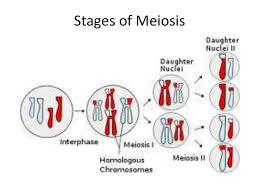
Which process and type of resulting cells are represented in the diagram?
a)
meiosis, which produces body cells
b)
mitosis, which produces body cells
c)
meiosis, which produces body cells
d)
meiosis, which produces gametes
62.

Changes in an ecosystem over a long period of time are shown in the diagram below.
These changes will most likely lead to a:
These changes will most likely lead to a:
a)
stable ecosystem that can last for many years
b)
loss of heterotrophs that cannot be recovered
c)
long-term rise in environmental temperatures
d)
forest consisting of only producers and decomposers
63.

The diagram below shows how an area progresses over time after a forest fire.
What process is illustrated by the diagram in boxes 4-8 after the forest fire?
What process is illustrated by the diagram in boxes 4-8 after the forest fire?
a)
pioneer speciation
b)
primary succession
c)
secondary succession
d)
ecosystem boundaries
64.
After a volcano erupts and destroys an ecosystem, a few organisms are able to begin growing from the decaying organic matter left behind. What do we call those organisms that are able to grow in little or no soil that first appear?
a)
adaptors
b)
pioneer species
c)
non-vascular plants
d)
decomposers
65.

Scientists have found evidence that about 2.4 million years ago a gene regulating jaw muscles mutated and may have led to the more graceful human jaw we see today. The diagram below shows the skulls of 3 hominid species.
Which statement below most closely explains the link between jaw size and hominid evolution?
Which statement below most closely explains the link between jaw size and hominid evolution?
a)
The jaws of hominids evolved to be smaller and less protruding over time.
b)
The jaws of hominids evolved to be larger and more protruding over time.
c)
There appears to be no change in the jaws of hominids over time.
d)
The jaws of hominids changed over time due to a change in brain size.
66.
A small portion of the population that is geographically isolated from the rest of the population runs the risk of -
a)
genetic drift
b)
mutation rate
c)
natural selection
d)
genetic variation
100 %

