wayground logo

Free Printable Worksheets

Font size

S
M
L
XL
Worksheets

Mineral Properties and Identification

Total questions: 67

Worksheet time: 1hrs 27mins

Name
Class
Date
1.
How light reflects off of a mineral is called the mineral's 
a)
luster
b)
streak
c)
cleavage
d)
fracture
2.
The color of a mineral in powder form is called the mineral's 
a)
hardness
b)
specific gravity
c)
luster
d)
streak
3.
Diamond has a hardness of ___ on Mohs Hardness Scale.
a)
1
b)
5
c)
8
d)
10
4.
Dull, silky, waxy, pearly, and earthy are terms that best describe which property of minerals?
a)
luster
b)
color
c)
streak
d)
cleavage
5.
How do you test the hardness of a mineral? 
a)
Throw it against a wall
b)
Step on it
c)
Scratch Test
d)
Kick it until it breaks
6.
What mineral is used for pencils?
a)
Graphite
b)
Galena
c)
Magnetite
d)
Quartz
7.

What mineral is salt and is used to flavor our tables and melt ice on our roads?

a)
quartz
b)
sulfur
c)
halite
d)
calcite
8.
A naturally occurring, inorganic solid with a crystal structure and a definite chemical composition is referring to
a)
density
b)
streak
c)
mineral
d)
non silicate mineral
9.
The solid, geometric form of a mineral produced by a repeating pattern of atoms
a)
crystal
b)
density
c)
element
d)
fracture 
10.
A mineral's resistance to being scratched is called?
a)
streak
b)
luster
c)
hardness
d)
heft
11.

Are there minerals in soil?

a)

Yes

b)

No

12.

Are soil and sand minerals?

a)

yes

b)

no because they're basically liquid

c)

no because there are no crystals

d)

no because they're mixtures not compounds

13.

-the name of the scale used to determine a mineral's hardness.

a)

Miller's scale of hardness

b)

The Scale of Hardness

c)

Mohs scale of hardness

d)

Mineral Hardness Scale

14.
A substance composed of a single kind of atom
a)
element
b)
compound
15.
Which is NOT a property used for identifying minerals?
a)
Streak
b)
Hardness
c)
Taste
d)
Color
16.

This property is NOT very useful in identifying a mineral:

a)

Color

b)

Luster

c)

Hardness

d)

Streak

17.
What is the relationship between a rock and a mineral?
a)
Rocks are made up of minerals.
b)
Minerals are made up of rocks.
c)
Rocks are on the Earth's surface. Minerals are found underground.
d)
Rocks and minerals are different names for the same thing.
18.
Gneiss is a rock because it
a)
is hard and round.
b)
has crystals.
c)
is made of minerals.
d)
has mass.
19.
Minerals are made of one or more
a)
minerals.
b)
sediments.
c)
elements.
d)
rocks.
20.
What is the color of a mineral in powdered form called?
a)
Gas
b)
Fracture
c)
Streak
d)
Liquid
21.
Which of the following properties does the Mohs scale measure?
a)
Luster
b)
Hardness
c)
Density
d)
Streak
22.
Which mineral property is being shown here?
a)
luster
b)
hardness
c)
streak
23.
How much a mineral resists scratching is
a)
Streak
b)
Fracture
c)
Hardness
d)
Cleavage
24.

Which mineral would scratch calcite but not scratch apatite?

a)

fluorite

b)

gypsum

c)

talc

d)

topaz

25.

Quartz can be scratched by Topaz.

a)

True

b)

False

26.
Can a penny scratch fluorite?
a)
Yes 
b)
No 
27.
What can scratch Talc?
a)
Gypsum
b)
Diamond
c)
Quartz
d)
All of them
28.

Whether or not a mineral will float in water is based on its _________.

a)

Luster

b)

Hardness

c)

Cleavage

d)

Density

29.

You look at a mineral to find this property. Many minerals can have more than one.

a)

Luster

b)

Cleavage

c)

Color

d)

Streak

30.

The mineral's ability to reflect light. It can be metallic, pearly, glassy, silky, or dull.

a)

Luster

b)

Color

c)

Fracture

d)

Density

31.
Use Moh's hardness scale to answer the question. A penny has a hardness of 3.5. Which mineral has a hardness most similar to a penny?
a)
Fluorite
b)
Talc
c)

Diamond

d)
Quartz
32.
A mineral is a living object
a)
True
b)
False
33.
What do all rocks have in common?
a)
same size
b)
same color
c)
contain minerals
d)
same shape
34.
Minerals have different properties to help scientists identify them.  Which is NOT a property used to identify minerals?
a)
color
b)
hardness
c)
size
d)
luster
35.

a naturally occurring, non-living solid that has a specific chemical make-up and a repeating structure.

a)

rock

b)

mineral

c)

stone

d)

mountain

36.

Scientists use mineral ________________ to identify and classify minerals.

a)

pieces

b)

names

c)

properties

d)

structures

37.
  • the way a mineral's surface reflects light.
a)

streak

b)

luster

c)

color

d)

hardness

38.
Helium balloons rise on earth because
a)
helium is less dense than air
b)
helium is more dense than air
c)
helium is cooler than air
d)
helium is warmer than air
39.

In this image, the VOLUME of A is _____ the volume of B

a)

equal to

b)

greater than

c)

less than

40.

What happens to the density of the balloon if volume is doubled?

a)

The density is cut in half.

b)

The density stays the same.

c)

The density doubles.

d)

Not enough information to tell.

41.

As a substance is COOLED its VOLUME...

a)

increase

b)

decreases

c)

remains equal

42.

As a substance is COOLED it's DENSITY...

a)

increase

b)

decreases

c)

remains equal

43.

As a substance is HEATED it's DENSITY...

a)

increase

b)

decreases

c)

remains equal

44.

Which box has a higher density?

a)

A

b)

B

c)

They are the same

45.
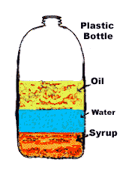
Which liquid is the least dense?
a)

oil

b)

water

c)

syrup 

46.
What units are used to measure Density?
a)
cm3/g
b)
g
c)
g/cm3
d)
cm3
47.
A crayon has a mass of 10g and volume of 5 mL. What is the density?
a)
30 g/mL
b)
15 g/mL
c)
1 g/mL
d)
2 g/mL
48.
Why does ice float?
a)
Liquid water is less dense than solid water.
b)
Solid water is less dense than liquid water.
c)
Gaseous water is less dense than solid water.
d)
Liquid water is less dense than gaseous water.
49.
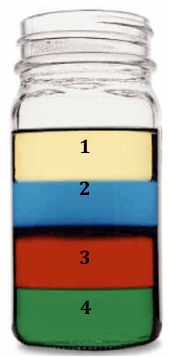
Put the liquids in order from most dense to least dense?
a)
4, 3, 2, 1
b)
1, 2, 3, 4
c)
3, 4, 2, 1, 
d)
4, 3, 1, 2
50.
What is the formula for density?
a)
density = mass x volume
b)
density = mass / volume
c)
density = mass + volume
d)
density = mass - volume
51.

Frank has an block of metal. It has a mass of 16 g, and a volume of 2cm3. What is its density?

a)
8 g/cm3
b)
2 g/cm3
c)

1/8 g/cm3

d)

32 g/cm3

52.
Jack has a rock. The rock has a mass of 14g and a volume of 2cm3. What is the density of the rock?
a)
7 mL
b)
7 g/cm3
c)
28 g/cm3
d)
1/7 g/cm3
53.
Why do some substances float on water?
a)
they are warmer than water
b)
they are cooler than water
c)
they are more dense than water
d)
they are less dense than water
54.
What is the measuring unit for mass?
a)
centimeter 
b)
millimeter 
c)
grams 
d)
pounds
55.
Which units of measurement are used for volume?
a)
grams
b)
centimeters
c)
grams/milliliter
d)
milliliter
56.
What units are used to measure Density?
a)
cm3/g
b)
g
c)
g/cm3
d)
cm3
57.
What is this tool to get volume?
a)
triple beam balance
b)
ruler
c)
thermometer
d)

graduated cylinder

58.
What is this tool to get mass?
a)
triple beam balance
b)
ruler
c)
thermometer
d)

graduated cylinder

59.
An object with which of the following densities will float on water?
a)
0.7 g/cm3
b)
1.2 g/cm3
c)
3.5 g/cm3
d)
11.4 g/cm3
60.

Can scratch 8, but is scratched by 10. What am I?

a)

Topaz

b)

Corundrum

c)

Diamond

61.

Can Scratch 1, but gets scratched by 3. What am I?

a)

Talc

b)

Gypsum

c)

Fluorite

62.

Can scratch Talc, but gets scratched by Calcite. What is the minerals hardness?

a)

4

b)

3

c)

2

d)

1

63.

If a mineral can SCRATCH another one, it is -

a)

harder than the mineral

b)

weaker than the mineral

c)

the same mineral

64.

Bigger Numbers on the Mohs Scale scratch the lower numbers.

a)

True

b)

False

65.

According to the chart, which is harder apatite or fluorite?

a)

Apatite

b)

Fluorite

66.

Which can a masonry drill bit not scratch?

a)

Gypsum

b)

Fluorite

c)

Quartz

d)

Corundum

67.

You can scratch glass with this mineral-

a)

Orthoclase

b)

Apatite

c)

Fluorite

d)

Calcite