Worksheets
Review 2025 atom, density, metric test
Total questions: 64
Worksheet time: 34mins
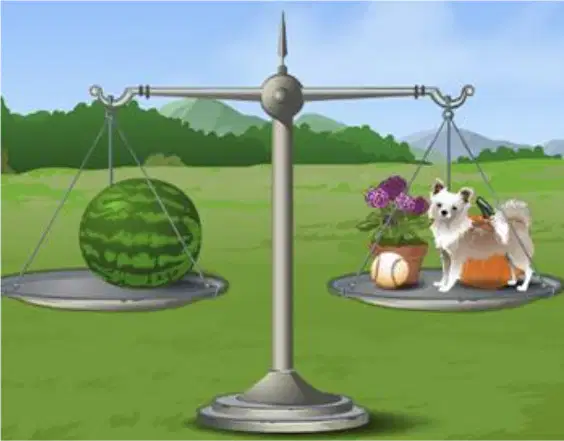
A watermelon is balanced by a dog, a pumpkin, a flowerpot, and a baseball as shown. Which statement or statements are true?
The mass of the watermelon is equal to the mass of the flowerpot, baseball, dog and pumpkin combined.
The weight of the watermelon is equal to the weight of the flowerpot, baseball, dog and pumpkin combined.
Both A and B are true.
Neither A or B is true.
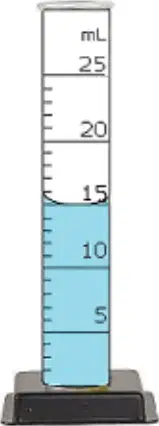
What is the correct volume of the blue liquid in the graduated cylinder?
16 ml
15.1 ml
15 ml
18 ml
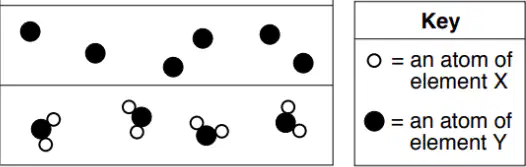
Which model best represents the arrangement of atoms in a compound? The key shows: open circle = an atom of element X; filled circle = an atom of element Y. Choose A, B, C, or D based on the models shown.
A
B
C
D
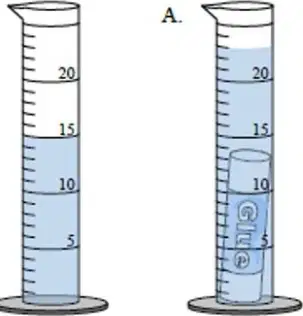
What is the volume of the glue stick? Use the water displacement shown: the left cylinder labeled "Empty" shows the initial water level; the right cylinder labeled "glue" shows the final water level after the glue stick is added.
8 ml
23 ml
23 cm3
8 cm3
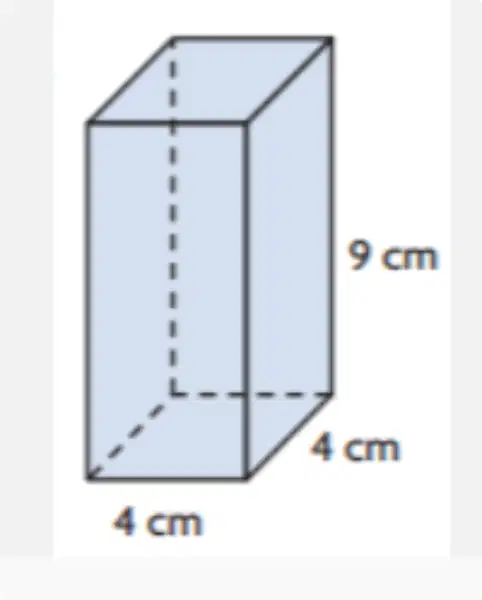
Calculate the volume of this rectangular prism. Dimensions are labeled 4 cm, 4 cm, and 9 cm.
144 cm
144 cm3
17 cm
17 cm3
Define matter.
Anything that has mass only.
Anything that has volume only.
Anything that does NOT have mass or volume
Anything that has mass and volume
A science book has a length of 10.7 cm, a width of 5.4 cm, and a height of 7.9 cm. What is the volume of the book? ROUND TO THE NEAREST TENTH
24 ml
24 cm3
456.5 ml
456.5 cm3
All matter is made up of ______________________.
cells
atoms
elements
compounds
What option is used to find the volume of irregular shaped obkect
water
graduated
water displacement
beaker
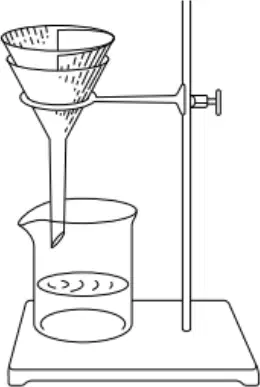
The diagram below represents equipment used to separate solids from a liquid. What type of separation technique being modeled for this mixture.
dissolving
conducting
melting
filtering
The density of a 6 gram chunk of iron is 7.8 g/cm3. What would be the density of an 18 gram chunk of iron? (THINK BEFORE YOU ANSWER)
10.2 g/cm3
7.8 g/cm3
23.4 g/cm3
2.3 g/cm3
What are the three main parts of an atom
Cells, tissues, organs
Protons, neutrons, electrons
Solids, liquids, gases
Metals, nonmetals, metalloids
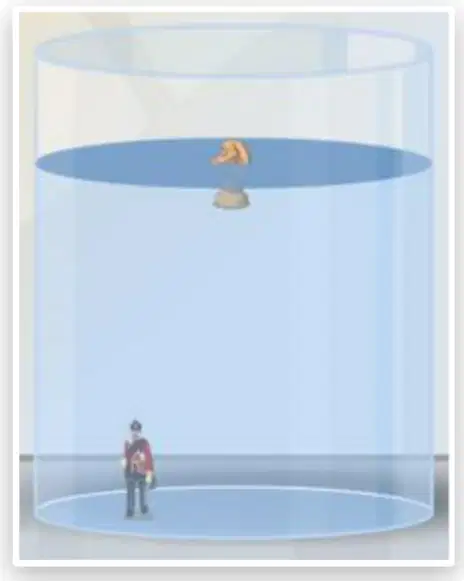
According to the picture, which is the least dense?
the chess piece
the toy soldier
the liquid in the container
We cannot figure it out.
is the gravitational force exerted on an object.
mass
volume
force
weight
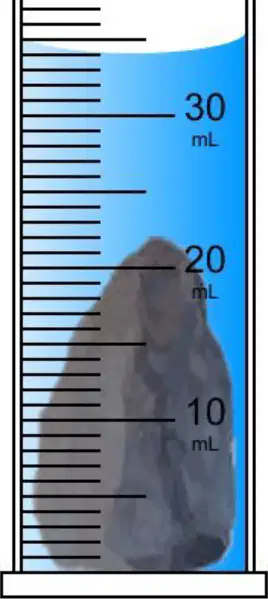
A graduated cylinder contains 20.0 mL of water. After a rock is placed in the cylinder, the level rises as shown below. What is the volume of the rock?
14 cm3
22 cm3
34 cm3
38 cm3
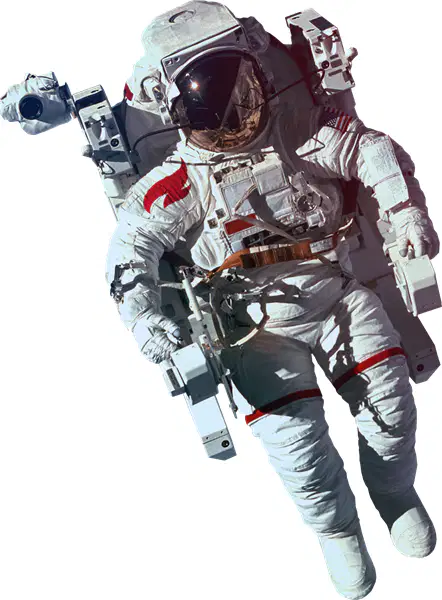
Pretend an astronaut were to visit a different planet where the gravity is half that on Earth. His mass on that planet would be
half his Earth mass
the same as his Earth mass
twice his Earth mass
zero
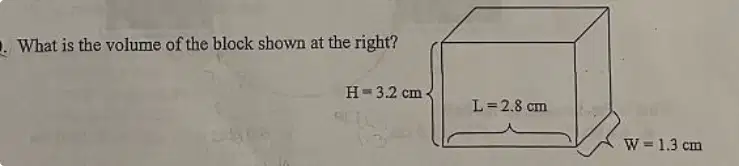
What is the volume of the block below?
11.6 ml
7.3 ml
11.6 cm3
7.3 ml
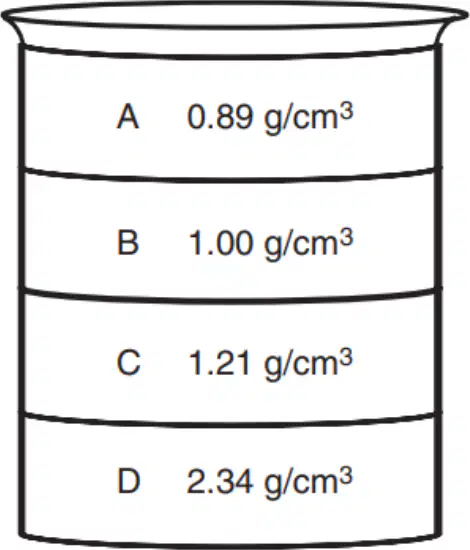
The diagram below shows a tall beaker with four different liquids and their densities. If a ball that has a density of 1.73 g/cm3 is placed in the beaker, where will the ball come to rest?
on top of liquid A
between liquids B and C
between liquids C and D
on the bottom of the beaker
How are elements different from compounds?
elements are bigger
compounds are made from two or more elements
elements can be broken apart easily
compounds have only one type of atom
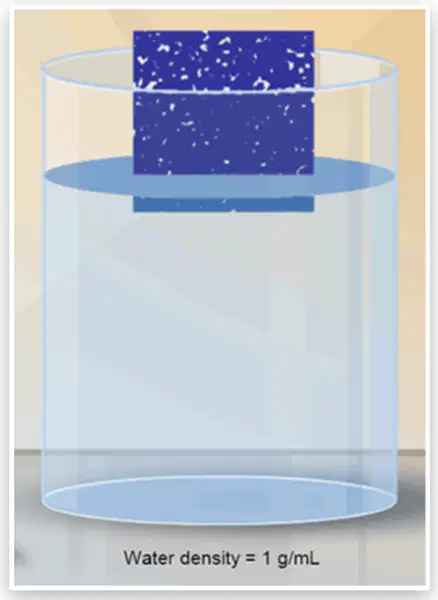
Which of the following statements about the density of the blue object is true? Water density = 1 g/mL.
The blue object has a density less than 1 g/cm3.
The blue object has a density of exactly 1 g/cm3.
The blue object has a density greater than 1 g/cm3.
The blue object has a density greater than 1 g/cm3.
Fill in the blank: The greater the amount of matter that is packed into a given space, the greater the ____________. (2.5 Points)
mass
density
volume
temperature
The mass of a mystery liquid is 30 g and its volume is 5 ml. Calculate its density. (2.5 Points)
6 g/ml
35 g/ml
25 g/ml
5 g/ml
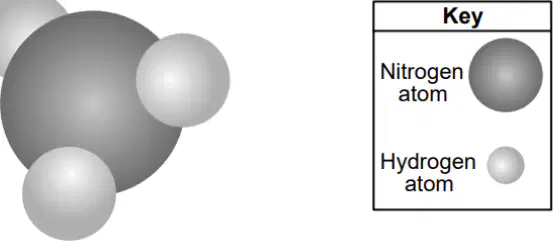
The model below represents a molecule of ammonia gas. Ammonia gas would be classified as a (2.5 Points)
mixture
atom
element
compound
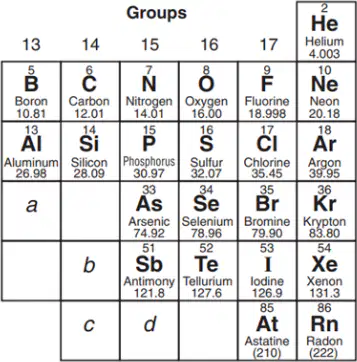
Helium and Oxygen are examples of a ____________. (2.5 Points)
atom
element
compound
mixture
Which statement compares molecules and compounds correctly? (2.5 Points)
All molecules are elements
All compounds are molecules but not all molecules are compounds
Molecules are larger than compounds
Compounds cannot form molecules
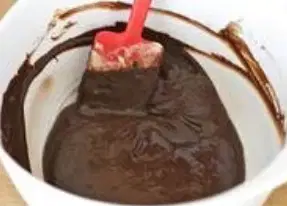
What is the definition of a homogeneous mixture? (2.5 Points)
A substance that can be easily separated into its parts, and those parts keep their original properties.
Something that is mixed or blended together so well that all of the ingredients will not separate out, even over time.
Basic building blocks of all life. Made of proton, neutron, and electrons.
Chemical substances made up of two or more elements that are chemically bound together.
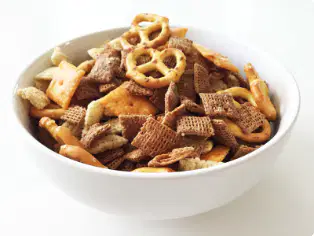
What is the definition of a heterogeneous mixture? (2.5 Points)
A substance that can be easily separated into its parts, and those parts keep their original properties.
Something that is mixed or blended together so well that all of the ingredients will not separate out, even over time.
Basic building blocks of all life. Made of proton, neutron, and electrons.
Chemical substances made up of two or more elements that are chemically bound together.
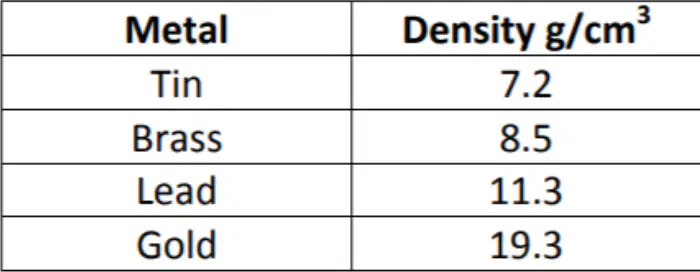
The table provides identities of a substance based on density. A sample of an unknown substance has a mass of 28.8 grams and a volume of 4 cm3. Based on its density, it could be which of the following substances? (2.5 Points)
gold
lead
iron
tin
Which unit of the metric system is used for measuring MASS? (2.5 Points)
pounds
grams
kilometer
ounces
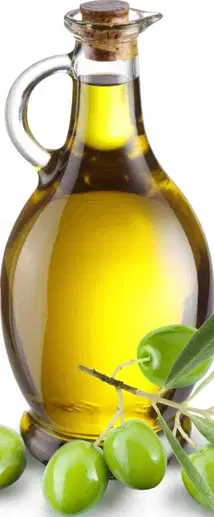
Is olive oil a homogenous mixture or a heterogenous mixture? (2.5 Points)
heterogenous mixture
homogenous mixture
A group of SAME atoms that are bonded together is called (2.5 Points)
element
compound
atom
mixture
A chair has a MASS of 10 kilograms on Earth. What is the mass of the chair on Mercury? (2.5 Points)
10 kilograms
more than 10 kilograms
less than 10 kilograms
not enough information

How long is the line below? (2.5 Points)
85 cm
8.5 mm
8.5 cm
85 km
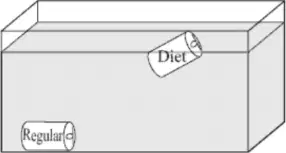
The diagram below shows what occurred when a can of diet soda and a can of regular soda were dropped into a container of water. The can of regular soda sank to the bottom of the container, but the can of diet soda floated. Which of the following statements best explains this observation? (2.5 Points)
The can of regular soda is less dense than the can of diet soda
The can of regular soda is more dense than the can of diet coke
The can of regular soda has a larger volume than the can of diet soda
The can of regular soda has a smaller volume that the can of diet soda
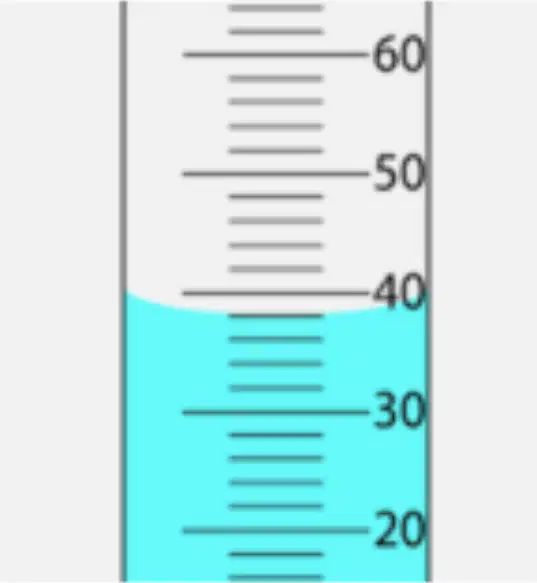
The dip that you use to measure liquid volume is called the (2.5 Points)
dip
meniscus
water
graduated cylinder
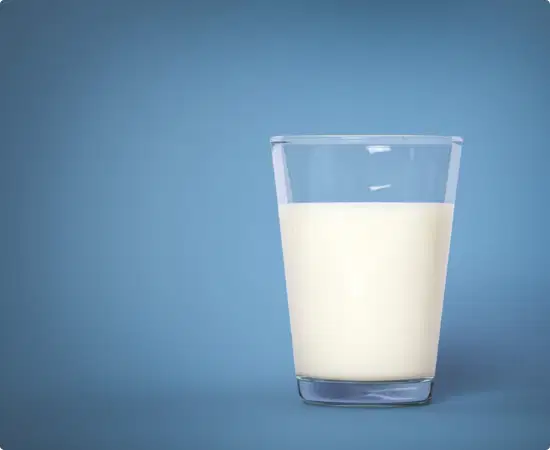
Is milk a homogenous mixture or a heterogenous mixture? (2.5 Points)
heterogenous mixture
homogenous mixture
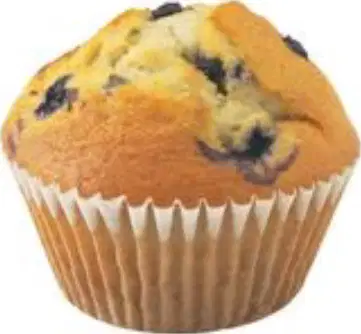
Is a blueberry muffin a homogenous mixture or a heterogenous mixture? (2.5 Points)
heterogenous mixture
homogenous mixture
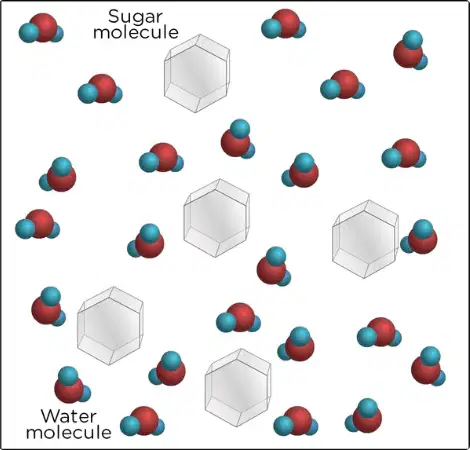
One characteristic that salt water and sugar-water have in common is, at room temperature, they are (2.5 Points)
gases
elements
a mixture
a compound

What is the length of the red line? (2.5 Points)
12 cm
11 cm
11.6 cm
11.4 cm
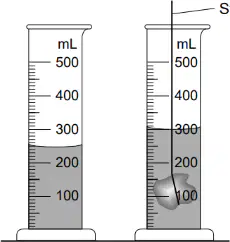
The diagram below represents a graduated cylinder containing water before and after a rock suspended on a string is lowered into it. What is the approximate volume of the rock suspended in the graduated cylinder? (2.5 Points)
50 ml
100 ml
250 ml
300 ml
Which unit of the metric system is used for measuring VOLUME? (2.5 Points)
ounces
meter
Liter
cups
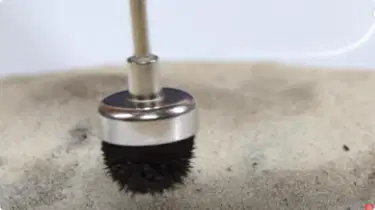
Which tools are best for separating a mixture of sand, iron filings, and water? (2.5 Points)
hot plate and a filter
tweezers and a filter
filter and a magnet
hot plate and a magnet
When two or more atoms join together, what do they form?
An element
A molecule
A proton
A nucleus
Which subatomic particle is neutral with no electric charge?
Proton
Neutron
Electron
Nucleus
What are the building blocks of everything in the universe called?
Molecules
Compounds
Atoms
Elements
Which larger particle found in the nucleus has a positive charge?
Electron
Neutron
Proton
Molecule
When atoms of different elements join together chemically, what do they make?
A compound
A proton
An isotope
A nucleus
What term describes when the same exact atoms are bonded together?
Compound
Molecule of an element
Mixture
Ion
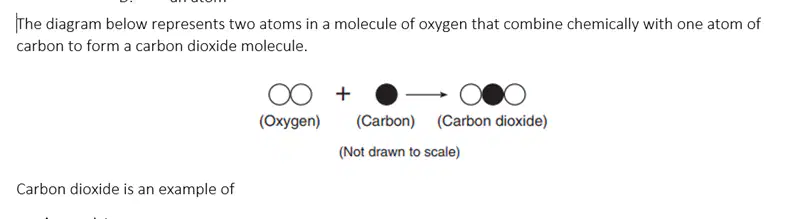
A model shows two oxygen atoms bonded as O2, which then react with one carbon atom to form CO2. Carbon dioxide is an example of a:
Mixture
Molecule
Compound
Element
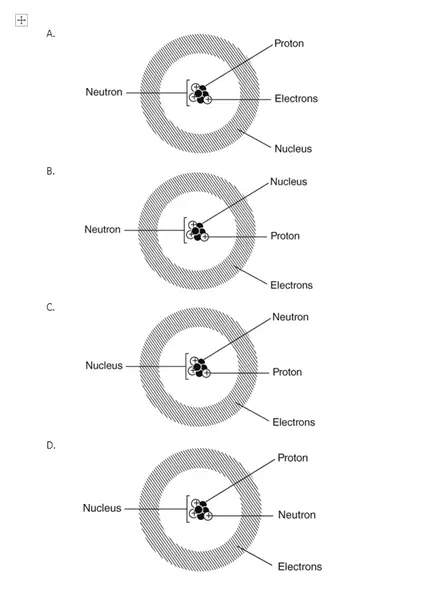
Which Bohr model of the atom is correctly labeled if full black circles = negative charge (−) and clear circles = positive charge (+)?
A
B
C
D
What is the name of the chart that outlines all of the elements known in the universe?
Scientific square
Periodic table
The squares
Science Element Table
An element of oxygen has an atomic number of 8. How many protons are in one atom of oxygen?
4
8
16
2
Which is the best definition of matter?
Anything that can be found in a classroom
Time and sound
Anything that takes up space and has mass
Anything that has heat, sound, and space
Which one of these examples is not a heterogeneous mixture?
oil and water
pepperoni pizza
chocolate cookies
water and sugar
Which one of these examples is not a homogeneous mixture?
iced tea
rice and beans
salt an water
lemonade

What does a represent?
Proton
Neutron
Electron