
 Worksheets
Changes in Energy on the Molecular Level
Total questions: 60
Worksheet time: 37mins
Name
Class
Date
1.

These molecules represent which state of matter?
a)
Solid
b)
Liquid
c)
Gas
2.

What phase change is happening between point B and C?
a)
Condensating
b)
Melting
c)
Evaporating
3.

What phase change is occurring between points D and E?
a)
Freezing
b)
Evaporating
c)
Melting
4.
Describe the molecules in a gas.
a)
Tightly compact, vibrating
b)
Close together, slightly moving
c)
Far apart, moving fast
5.

As thermal energy increases, what happens to the movement of the molecules?
a)
Increases
b)
Decreases
c)
Stays the same
6.

If the movement of the atoms increases, you can assume the temperature was _________.
a)
Increased
b)
Decreased
c)
Not Changes
7.
The transfer of thermal energy from one object to another is known as ______.
a)
Kinetic Energy
b)
Heat
c)
Potential Energy
8.

The sun transfers heat to the Earth by _________.
a)
Radiation
b)
Convection
c)
Conduction
9.

What phase change would be presented by letter C?
a)
Freezing
b)
Melting
c)
Evaporating
d)
Condensating
10.

These molecules represent which state of matter?
a)
Solid
b)
Liquid
c)
Gas
11.

What phase change would be presented by letter A?
a)
Melting
b)
Freezing
c)
Evaporating
d)
Condensing
12.
What phase change would be presented by letter B?
a)
Melting
b)
Freezing
c)
Evaporating
d)
Condensing
13.
What are the melting and boiling points of water?
a)
-10C and 110C
b)
0C and 110C
c)
10C and 100C
d)
0C and 100C
14.
To change a solid to a liquid, what do you add?
a)
heat
b)
water
c)
cold
d)
mass
15.
Which state of matter has a definite shape?
a)
solid
b)
liquid
c)
gas
d)
plasma
16.
Which state of matter take up ALL the space inside a container?
a)
solid
b)
liquid
c)
gas
d)
all of the above
17.
What is happening in the statement below?
The ice cube melted.
The ice cube melted.
a)
Matter is changing from a liquid to a solid.
b)
Matter is changing from a liquid to a gas.
c)
Matter is changing from a solid to a liquid.
d)
Matter is changing from a gas to a liquid.
18.
When heat is added to a solid, it ______________.
a)
freezes
b)
evaporates
c)
melts
d)
condenses
19.
When heat is added to a liquid, it ______________.
a)
freezes
b)
evaporates
c)
melts
d)
condenses
20.
Liquids and gases are similar because __________________________.
a)
they both take the shape of their container
b)
they both have their own shape
c)
liquids pour and gases don't
d)
liquids take the shape of the container but gases have their own shape
21.

The drops of water that appear on the outside of a glass of cold juice on a warm day are an example of?
a)
Sublimation: A solid turning into a gas.
b)
Condensation: A gas changing to a liquid.
c)
Evaporation: A liquid changing to a gas.
d)
Deposition: A gas changing to a solid.
22.

Are humans made of matter?
a)
yes
b)
no
c)
I don't understand the question.
d)
maybe
23.

What are 3 of the states of matter?
a)
solids, liquids, and gases
b)
solids, liquids, and solids
c)
liquids, gases, and density
d)
density, volume, and mass
24.

Freezing point and melting point are the same temperature.
a)
True
b)
False
c)
It depends on the substance
25.

A substance that has a definite shape and volume.
a)
evaporation
b)
gas
c)
liquid
d)
solid
26.

Anything that has mass and takes up space is called ______.
a)
atom
b)
compound
c)
matter
d)
molecule
27.
The property of a substance that determines whether or not it is a solid, liquid or gas.
a)
states of material
b)
states of mass
c)
states of matter
d)
states of minerals
28.
the temperature at which it transforms from the solid state into the liquid state.
a)
boiling point
b)
melting point
c)
density
d)
viscosity
29.
temperature at which it transforms from the liquid state into the gas state.
a)
boiling point
b)
melting point
c)
density
d)
viscosity
30.
has definite volume and a definite shape
a)
solid
b)
liquid
c)
gas
d)
plasma
31.
a state of matter with no definite shape or volume
a)
solid
b)
liquid
c)
gas
d)
plasma
32.
a state of matter with no definite shape or volume
a)
solid
b)
liquid
c)
gas
d)
plasma
33.
The total energy of a substance’s particles due to their movement or vibration.
a)
chemical energy
b)
thermal energy
c)
heat
d)
chemical reaction
34.
the change in state from a solid to a liquid
a)
melting
b)
boiling
c)
evaporation
d)
condensation
35.
the change in state from a liquid to a solid
a)
melting
b)
freezing
c)
evaporation
d)
condensation
36.
the process that occurs when vaporization takes place only on the surface of a liquid
a)
melting
b)
boiling
c)
evaporation
d)
condensation
37.
The temperature at which a substance changes from a liquid to a gas.
a)
melting
b)
boiling
c)
evaporation
d)
condensation
38.
The change of state from a gas to a liquid
a)
melting
b)
boiling
c)
evaporation
d)
condensation
39.
the change in state from a solid directly to a gas without passing through the liquid state
a)
melting
b)
sublimination
c)
evaporation
d)
condensation
40.
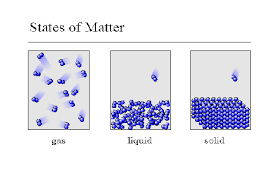
At higher temperatures
a)
particles in an object have less energy
b)
particles in an object move faster
c)
a gas contracts
41.
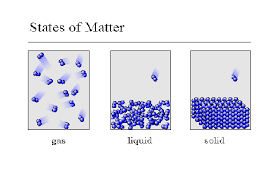
A gas
a)
has a definite shape but no definite volume
b)
has a definite volume but no definite shape
c)
has fast-moving particles
42.
Freezing
a)
Solid to gas
b)
Liquid to solid
c)
Gas to solid
d)
Liquid to gas
43.
Boiling
a)
liquid to gas
b)
gas to solid
c)
gas to liquid
d)
solid to liquid
44.
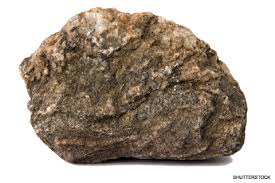
Which state of matter has tightly packed molecules?
a)
solid
b)
liquid
c)
gas
45.
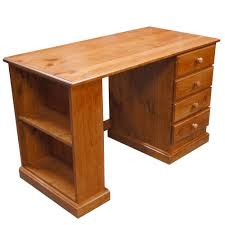
Which state of matter has a definite shape?
a)
solid
b)
liquid
c)
gas
46.
What is happening when my ice cream changes from a solid to a liquid?
a)
freezing
b)
melting
c)
burning
d)
evaporation
47.
Define a liquid.
a)
Indefinite shape, indefinite volume
b)
Definite shape, definite volume
c)
Found in stars
d)
Definite volume, indefinite shape
48.
The state of matter that has no definite size or shape is
a)
Solid
b)
Liquid
c)
Gas
49.
Particles (molecules) in a ______________________ have more energy than the other states of matter.
a)
gas
b)
solid
c)
liquid
50.
What term describes a solid changing to a gas?
a)
Deposition
b)
Sublimation
c)
Evaporation
d)
Freezing
51.
What is condensation?
a)
gas to solid
b)
gas to liquid
c)
liquid to solid
d)
solid to liquid
52.
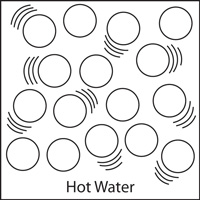
The speed of the molecules determines the _____.
a)
volume
b)
density
c)
pressure
d)
temperature
53.
Which has a greater distance between particles?
a)
Solid
b)
Liquid
54.
The slower the particles in a substance move,
a)
the colder it is.
b)
the warmer it is.
c)
the more energy it has.
d)
the less energy it has.
55.
Thermal energy is...
a)
heat energy.
b)
the energy of motion
c)
energy of nuclear processes.
d)
an indication of physical change.
56.

The molecules in the picture are tightly held together with little movement. They have shape and energy. Therefore, the picture represents _________.
a)
solid
b)
liquid
c)
gas
d)
plasma
57.
When the temperature of matter decreases the particles ...
a)
speed up and move farther apart
b)
speed up and move closer together
c)
slow down and move farther apart
d)
slow down and move closer together
58.
When the temperature of matter increases the particles...
a)
speed up and move closer
b)
speed up and move farther apart
c)
slow down and move closer together
d)
slow down and move farther apart
59.
Molecules are closest together in a
a)
Solid
b)
Liquid
c)
Gas
d)
plasma
60.

If the tops were removed from the cylinders, the following would happen:
a)
The solid would fly out of the container
b)
The liquid would fly out of the container.
c)
The gas would fly out of the container.
d)
They ALL would fly out of the container.
100 %

