wayground logo

Free Printable Worksheets

Font size

S
M
L
XL
Worksheets

Science Review

Total questions: 60

Worksheet time: 1hrs 1mins

Name
Class
Date
1.
An example of potential energy could be...
a)
a blanket
b)
a boy running
c)
unused matches
d)
a girl jumping
2.

A park is home to a large number of robins, squirrels, and rabbits. The robins and squirrels live in the park’s trees. The robins feed on earthworms and insects that live on the ground. The squirrels eat the acorns produced by the park’s oak trees. The rabbits hide in the bushes and feed on the grass. Which factor would directly limit the number of robins and squirrels that could live in this park?

a)

number of acorns

b)

number of robins

c)

number of squirrels

d)

number of trees

3.
A food chain is shown.
Plants -> Grasshoppers -> Mice -> Snakes -> Hawks
Which sentence correctly describes a relationship between two of the organisms in this food chain?
a)
The grasshoppers are producers, and the plants are consumers
b)
THe grasshoppers are prey, and the plants are predators
c)
The mice are producers, and the snakes are consumers
d)
The mice are prey, and the snakes are predators
4.

Which terms best describe the blue particles

a)

Proton

b)

Neutron

c)

Electron

d)

Neutral

e)

Negative

5.

The smallest part of an element, that still have the properties of that element is

a)

atom

b)

nucleus

c)

a molecule

d)

a compound

6.

What causes spring tides?

a)

The Moon's and Sun's gravity

b)

Mar's and the Sun's gravity

c)

The Moon's and Mar's gravity

d)

The Sun's gravity

7.

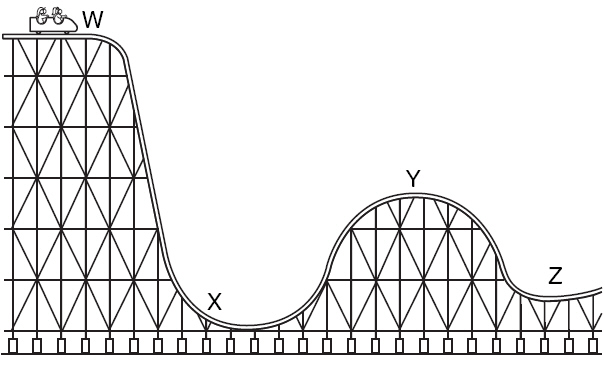
At which point is potential energy greatest?

a)

W

b)

X

c)

Y

d)

Z

8.
Changing liquid to a gas is called
a)
evaporation
b)
condensation
c)
melting
d)
freezing
9.

At which point is the kinetic energy the greatest?

a)

W

b)

X

c)

Y

d)

Z

10.
Which level has the most energy available?
a)
producer
b)
primary consumer
c)
secondary consumer
d)
tertiary consumer
11.

Which food chain is represented in this food web?

a)

python --> rat --> grasshopper --> corn

b)

lavenders --> butterfly --> dragonfly --> thrush

c)

flowering plant --> butterfly --> frog --> dragonfly

d)

mangoes --> fruit fly --> dragonfly --> eagle
12.

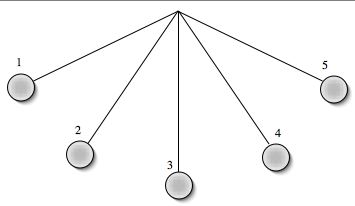
When a pendulum swings, at which point is kinetic energy greatest?

a)

1

b)

2

c)

3

d)

4

13.
What is the volume of the rock? The water level is displaced from 20 mL to 23 mL with the rock.
a)
3 mL
b)
23 mL
c)
20 mL
d)
43 mL
14.
The ____________ is the most photosynthetic part of a plant.
a)
leaf
b)
flower
c)
roots
d)
stem
15.
The leaf structure that allows carbon dioxide to enter the leaf and Oxygen to exit the leaf is...
a)
phloem
b)
stomata
c)
vein
d)
stem
16.
What causes nighttime and daytime on Earth?
a)
the Moon revolving around the Earth
b)
the Earth rotating around the Sun
c)
the Earth rotating on its tilted axis
d)
the Sun rotating on its axis
17.
What are the products of photosynthesis?
a)
water and carbon dioxide
b)
oxygen and glucose
c)
oxygen and carbon dioxide
d)
oxygen and water
18.
Why are plants important to life on Earth?
a)
They make our world more beautiful
b)
They make the planet look green
c)
They use carbon dioxide and give us oxygen
d)
They provide shade for insects
19.
In 24 hours, earth has night and day as a result of what two things?
a)
the revolution of the earth and its tilt
b)
the revolution of the earth and its rotation
c)
the rotation of the earth and its tilt
d)
the rotation of the moon and the earth
20.
What causes moon phases?
a)
the rotation of the Moon 
b)
the rotation of the Earth
c)
the revolution of the Moon around the Earth
d)
the tilt of the Earth around the sun
21.
Which statement about photosynthesis is correct?
a)
Plants get the energy they need for photosynthesis from water.
b)
Plants get the energy they need for photosynthesis from soil.
c)
Plants get the energy they need for photosynthesis from sunlight.
d)
Plants do not require energy to perform photosynthesis.
22.

What tool is this?

a)

sieve

b)

filter

23.

A consumer that eats only plants is called...

a)

an omnivore

b)

a carnivore

c)

an autotroph

d)

an herbivore

24.

Which pair of organisms has a predator and prey relationship?

a)

squirrel and rabbit

b)

corn plant and crow

c)

flowering plant and bee

d)

mouse and snake

25.

If I have a mixture of wooden blocks and metal blocks. What is a fast way to separate them?

a)

relative density (put them in water)

b)

filter

c)

sieve

26.
A producer?
a)
Eats other plants and animals
b)
Makes its own food
c)
Eats dead plants or animals
d)
Makes toys for kids
27.
How would you separate the ingredients of mixture Z?
a)
Water
b)
A magnet
c)
A sieve
d)
My hands
28.
The word PHYSICAL PROPERTY means...
a)
Solid, Liquid, and Gas
b)
The way matter is described
c)
How much matter is in an object
d)
The ability to sink or float
29.

involves how a substance will interact with something else

a)

physical change

b)

chemical change

c)

chemical property

d)

physical property

30.

a characteristic that you can observe directly or measure with a tool such as mass, size, shape, color, texture, and volume

a)

chemical property

b)

physical property

c)

chemical change

d)

physical change

31.

Raising livestock, such as sheep and cattle, results in the production of large amounts of methane gas. Methane has the same effect in the atmosphere as carbon dioxide. As more livestock are raised to provide food for humans, what is the most likely effect of the increase in methane?

a)

acid rain

b)

ozone thinning

c)

water pollution

d)

global warming

32.
Approximately how many days will it take for this moon phase to appear again?
a)
3-4 days
b)
6-7 days
c)
13-14 days
d)
27-28 days
33.
If a blue catfish is introduced and eats the large fish who eat the smaller fish, what will happen to the population of the smaller fish?
a)
Increase
b)
Decrease
c)
Stay the same
d)
No affect on smaller fish
34.

Invasive species alter the ecosystem by _____ in number quickly. This leads to _____ food for the native species.

a)

increasing, less

b)

increasing, more

c)

decreasing, less

d)

decreasing, more

35.
A full moon occurs on the 12th day.  When does the next New Moon occur?
a)
5th
b)
12th
c)
19th
d)
26th
36.
Students have an assignment to make ice. They have a beaker of water that is at room temperature. They place the beaker in the freezer. What are the physical changes that will happen to the water? 
a)
The water will change from a liquid to a solid
b)
The water will change from a liquid to a gas
c)
The water will change from a solid to a liquid
d)
The water will change from a gas to a liquid
37.
What moon phase occurs 3-4 days after a waxing crescent?
a)
First Quarter
b)
Waxing Gibbous
c)
Full Moon
d)
Waning Gibbous
38.

Some constellations or patterns of stars are visible from different places on Earth only during a part of the year. Why are certain patterns of stars not visible everywhere on Earth all year long?

a)

Sun's rotation

b)

Earth's rotation

c)

Sun's revolution

d)

Earth's revolution

39.
Is sugar (C12H22O11) an element or a compound?
a)
Element
b)
Compound
40.

Which of the following rows shows the phases of the moon that would be seen on day 14 and day 21?

a)
b)
c)
d)
41.
What is sugar?
a)
element
b)
compound
c)
mixture
42.

Which one is heterogeneous?

a)

Black coffee

b)

Fruit salad

c)

Cake

d)

Sugar cookie

43.

On January 21st, 2026 a full moon will occur. What will be the moon phase on February 1, 2026

a)

First Quarter

b)

Full Moon

c)

Last Quarter

d)

New Moon

44.

Which is an example of a compound?

a)

Na

b)

2Na

c)

Cl

d)

NaCl

45.

Which biome has conifer trees or evergreens? These trees have needles that are coated in a waxy substance and drop cones.

a)

deciduous forest

b)

desert

c)

coniferous forest (taiga)

d)

tropical rain forest

46.

What type of separating would you use to separate a mixture that has something that is metal? 

a)

Filtration

b)

Chromatography

c)

Magnetic Attraction

d)

Sifting

47.

Which of the following is not a compound?

a)

HCl

b)

Cl2

c)

NaCl

d)

CO2

48.
A fifth grade class has collected empty cans for recycling. They have several large bins with aluminum and steel cans, all mixed together. The two types of cans must be separated. Which of the following techniques could the students use to separate the two types of cans?
a)
Place the cans in water, and the aluminum cans will float
b)
Use a magnet to find and remove the steel cans
c)
Crush the cans to make them easier to carry
d)
Test the cans for their ability to conduct electricity
49.

If the position marked W on the diagram above represents the constellation Cepheus in June, then the position marked Y represents the constellation Cepheus in

a)

March

b)

May

c)

September

d)

December

50.

All matter is made of what

a)

energy

b)

atoms

c)

electrons

d)

compounds

51.
SOLUBILITY is when a substance....
a)
Has the ability to melt
b)
Has the ability to disappear 
c)
Has the ability to sink
d)
Has the ability to dissolve in water
52.

Which biome is the coldest?

a)

tundra

b)

desert

c)

grassland

d)

savanna

53.

Which biome has the worst soil because so much vegetation grows there that are the nutrients are in the trees and plants?

a)

tundra

b)

desert

c)

tropical rain forest

d)

grassland

54.
Element is a
a)
pure substance
b)
compound
c)
mixture
d)
molecule
55.
What does this image represent?
a)
Atom
b)
Element
c)
Molecule
d)
Marshmallows
56.
Bonds between atoms in a molecule form as a result of the sharing  of?
a)
formulas
b)
electrons
c)
atoms
d)
chemicals
57.
A tiny, negatively charged particle that moves around the nucleus of an atom
a)
electron
b)
condense
c)
acid
d)
diffusion
58.

Which of the following is a method of separating solutions?

a)

hand seperation

b)

filtering

c)

screening

d)

evaporation

59.
What happens when sand and water are mixed together?
a)
sand will settle to the bottom
b)
water will change physical properties
c)
the cup will get really cold
60.

Which process would you use to separate solid particles from larger particles in a mixture with filter paper in a funnel to trap solids so that the liquids will pass through.

a)

Chromatography

b)

Magnetic Attraction

c)

Filtration

d)

Floatation

e)

Sifting