
 Worksheets
Unit 2 Exam Review Day 2
Total questions: 65
Worksheet time: 2hrs 49mins


A student see's bubbles begin to form within a mixture. the student believes this is a good sign that a chemical reaction has taken place. Explain why the bubbles are good evidence of a chemical reaction.
Bubbles are cool.
Bubbles are evidence of a chemical reaction because they indicate the presence of air.
Bubbles are REALLY cool
Bubbles are evidence of a chemical reaction because they indicate that a new substance (gas) has formed.

Hint: Bike is rusting. Is this a chemical reaction?
yes
no
Which observation is NOT evidence that a chemical reaction took place?
Crystals dissolve
A precipitate forms
The bottom of the beaker feels warm to the touch
Bubbles begin to form in the water
Light forms
An increase or decrease in _________________and the production of light are both signs that a chemical reaction may have occurred.
atoms
temperature
odor
molecule
What is PROOF that a chemical change has occured?
a new substance with different properties is created.
you can put the reactants back together
the substance changes state, solid to liquid or liquid to solid.
What do all chemical changes have in common?
Energy is absorbed and it feels cold.
Energy is released and it feels hot.
Gas bubbles are produced.
New substances form.
A teacher tells students to describe the physical properties of 10 mL of vinegar and 10 mL of milk. The teacher then pours the vinegar and milk into the same beaker. The students are surprised to see a white solid substance form within the beaker as the two substances are combined.
What occurs within the beaker as the teacher mixes the vinegar and milk?
A physical change that creates a new substance.
A physical combination that produces a solid.
A chemical change that produces a precipitate.
A corrosive reaction between two liquids.
3.Marie has a balloon with a small amount of baking soda in it. She fits the open end of the balloon over a graduated cylinder containing some vinegar. As she lifts the end of the balloon the baking soda pours into the vinegar causing bubbling and fizzing to occur. Marie observes the balloon began to "fill" up. Based on these observations, which of these can Marie determine about the new substance formed by mixing baking soda with vinegar?
only a physical change occurred.
a chemical reaction occurred producing a gas.
a chemical reaction occurred producing a solid.
no chemical reaction took place.
Before going to school, a student cuts a ripe apple into six slices and places them in a plastic bag. During lunch, the student observes that the apple slices now have brown spots. Which of the following indicates a chemical change in the apple?
cutting the apple into six slices.
placing the slices in a plastic bag.
unexpected color change of the apple.
removing the brown spots with a knife.

Which of the columns below shows only chemical changes?
Column A
Column B
Column C
Column D

A teacher fills a bottle half-full of vinegar. He places baking soda in a paper napkin tied to a rubber stopper. When he shakes the bottle, the vinegar reacts with the baking soda producing bubbles. When the bubbles fill the bottle, the stopper is forced off the top of the bottle. Why does this happen?
The gas created in the reaction takes up more room than the space in the bottle.
The temperature of the bottle changes which makes the stopper become too loose.
The string, napkin, and stopper make the reaction happen too fast.
There is too much vinegar left in the bottle.

A student has two clear liquids, Liquid A and Liquid B. One beaker is filled with Liquid A and Liquid B is added drop by drop. The student recorded the data shown in the table below. What conclusion can be drawn from her observations?
A precipitate formed
Temperature increased
Color changed
Mass increased

At a cold football game, Robert uses an instant hand-warmer to keep his hands warm. He shakes the hand-warmer to mix the two chemicals inside the pouch which instantly releases heat. What evidence indicates that a chemical change has occurred?
The contents in the hand-warmer melted.
The contents in the hand-warmer dissolved.
The contents in the hand-warmer changed temperature.
The contents in the hand-warmer mixed.

A student has two clear liquids, Liquid A and Liquid B. One beaker is filled with Liquid A and Liquid B
is added drop by drop. The student recorded data from her observations in the table below. What evidence that a chemical change has occurred can be found in her observations? Select TWO correct answers
A precipitate formed
Temperature increased
Color changed
Mass increased
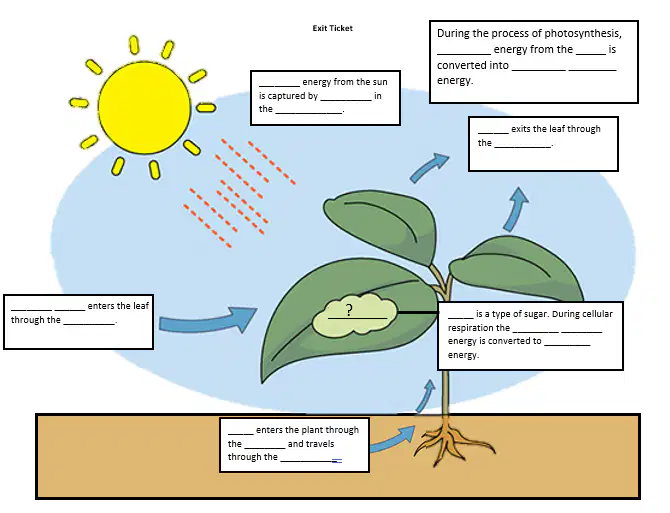
________ energy from the sun is captured by __________ in the ______________.
Light, chlorophyll, leaves
Heat, mitochondria, roots
Sound, ribosomes, stems
Magnetic, nucleus, flowers
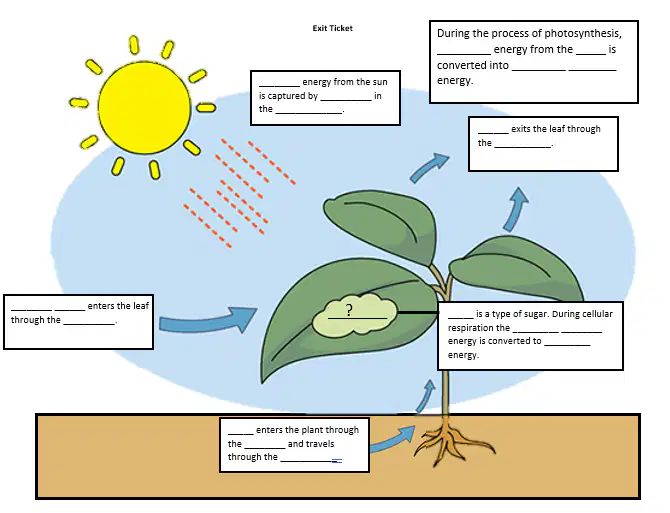
______ exits the leaf through the ___________.
Oxygen, stomata
Carbon dioxide, stomata
Water, xylem
Glucose, phloem
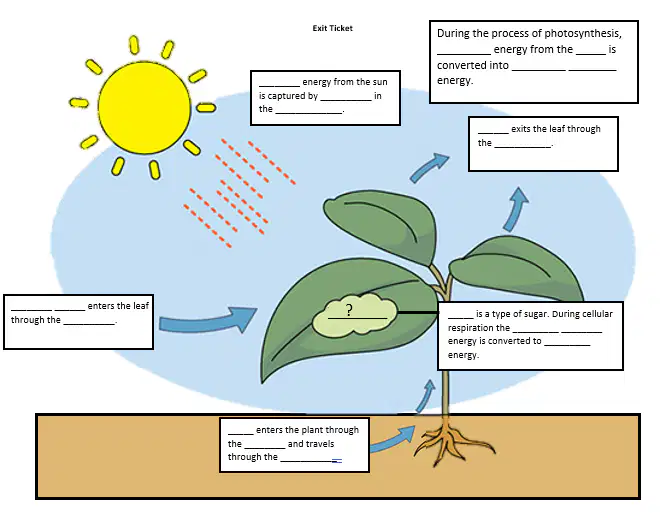
________ ______ enters the leaf through the ___________.
Carbon dioxide, stomata
Oxygen, veins
Water, cuticle
Nitrogen, epidermis
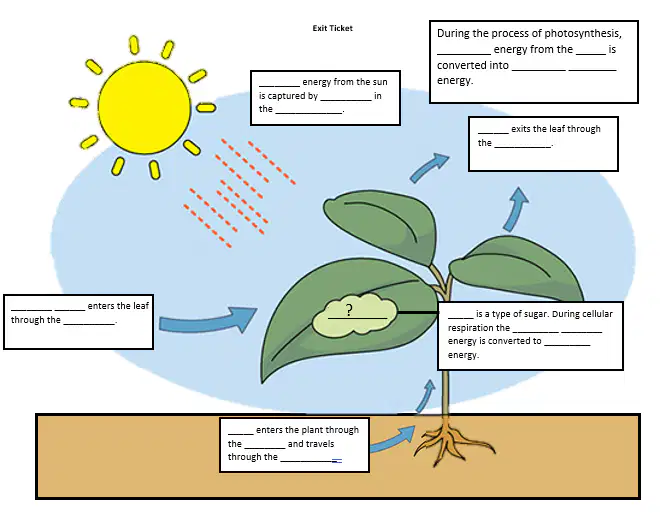
______ enters the plant through the _______ and travels through the ____________ .
Water, roots, xylem
Oxygen, leaves, phloem
Carbon dioxide, stem, xylem
Minerals, flowers, phloem
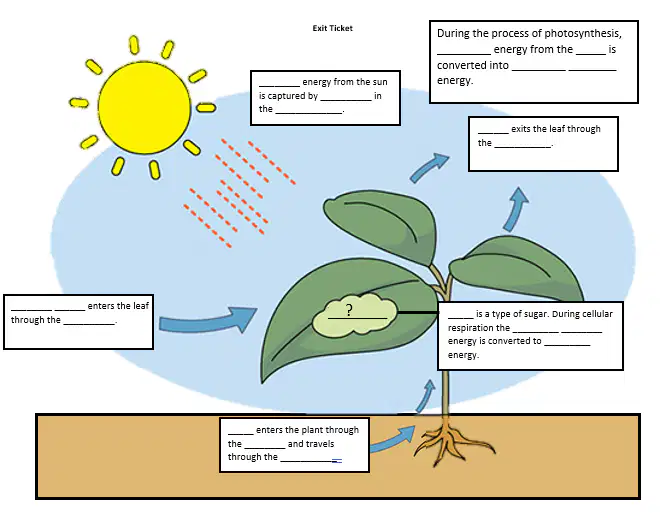
During the process of photosynthesis, ________ energy from the _____ is converted into ________ ________ energy.
light, sun, chemical, food
heat, moon, electrical, water
sound, earth, mechanical, air
kinetic, fire, thermal, gas
How does most of the water needed by the plant get into its leaves?
It enters through the stomata
The roots absorb it and then it travels up the xylem
It's made during a chemical reaction in the stem
The flowers capture water and deliver it to the leaves

Exit: Carbon dioxide
Exit: Glucose
Exit: Oxygen
Exit: Water vapor

__________ energy from the sun is changed into __________ energy during photosynthesis
What is kinetic energy?
The energy an object has due to its motion.
The energy an object has due its chemical composition.
The energy an object has due to its atomic structure.
What is potential energy?
The energy an object has due to its position or condition.
The energy an object has due to its chemical composition.
The energy an object has due to its atomic structure.
When does an object have NO kinetic energy?
When it's at rest.
When it's moving very slowly.
When it has no electrical charge.
Select all of the objects that have potential energy. (You may click more than one answer!)


Select all of the objects that have kinetic energy. (You may click more than one object!)


The law of Conservation of Energy states ..
Energy can created or destroyed but not transformed
Energy cannot be created or destroyed, it can only transformed
Energy can't be created, destroyed or transformed

what type of cell is shown? Which structure would you help you identify the cell?
Animal, presence of nucleus and cell membrane
Animal, presence of chloroplast and cell wall
Plant, presence of nucleus and cell membrane
Plant, presence of chloroplast and cell wall
Who is the scientist that studied plants under a microscope and realized all plants are made of cells?
Hooke
Virchow
Schwann
Schleiden
When an organism is made up of more than one cell it is called ____________.
unicellular
organelle
multicellular
organism
The basic unit that makes up all living things is called ____.
cells
unicellular
organelle
organism
What is the name of the scientist who studied animal cells and realized all animals are made of cells?
Leeuwenhooke
Schwann
Virchow
Hooke
Which statement completes the cell theory: All living things are made of cells; the cell is the basic unit of life; ______.
Cells are only found in plants
Cells arise from pre-existing cells
Cells are too small to observe
Cells are made of atoms only
A living, or once-living, organism in an ecosystem is a/an ---
abiotic factor.
biotic factor.
Bio means _________.
non-living
not/without
written word
living

A producer?
Eats other plants and animals
Makes its own food
Eats dead plants or animals
Makes toys for kids
Abiotic means
living
nonliving
During a school project on planetary science, students are asked to model Earth's axial tilt. What is the correct angle in degrees they should use for Earth's axis?
23.5 degrees
45 degrees
90 degrees
180 degrees



