
 Worksheets
Revision on Ch.14
Total questions: 70
Worksheet time: 2hrs 30mins
Inside a cell, amino acids link together to from proteins. This is called . . .
DNA
sequence
protein synthesis
messenger RNA
transfer RNA
carries copies of instruction for the assembly of amino acids into proteins from DNA to the ribosomes in the cytoplasm
DNA
sequence
protein synthesis
messenger RNA
transfer RNA
carries amino acids to the ribosome during protein synthesis
DNA
sequence
protein synthesis
messenger RNA
transfer RNA
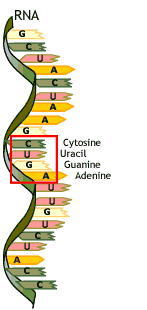
What will the RNA strand code for?
AGC CGA
TCG GCT
ACG GTC
UCG GCU
TCG CUA
Amino acid are .....
the unit that make up proteins
the unit that remove proteins
the unit that change forms into chain

How many nitrogen bases does DNA have?
1
2
3
4
Which nitrogen base pairs with adenine in DNA?
Uracil
Cytosine
Guanine
Thymine
What are proteins made from?
Lipids
Amino acids
Nucleic acids
Carbohydrates
Which of the following is the complementary mRNA sequence to this DNA strand: AACTGAA
UUGACUU
TTGACTT
AACTGAA
AACUGAA
Genetic information is passed from the nucleus to the cytoplasm through
RNA
DNA
Proteins
None of the above
All are types of RNA EXCEPT
mRNA
tRNA
rRNA
pRNA

nitrogen bases are organized into a ______________ on genes
DNA
sequence
protein synthesis
messenger RNA
transfer RNA
What are genes?
Sections of lipids found in the cytoplasm
Sections of proteins found in the nucleus
Sections of DNA found on chromosomes
Sections of RNA found on chromosomes
Which sugar is found in RNA instead of DNA?
Deoxyribose
Ribose
Glucose
Fructose
Codon is .......
A sequence of three bases that code for one amino acid
mRNA codon: C-T-A --> anticodon will be G-A-U
A sequence of two bases that code for one amino acid
mRNA codon: C-A --> anticodon will be G-U
A sequence complementary to the corresponding codon in mRNA sequence (mRNA codon: C-T-A --> anticodon will be G-A-U)
(a)
During translation, what is the function of the ribosome?
A) To transcribe DNA into mRNA.
B) To synthesize tRNA molecules.
C) To facilitate the binding of tRNA to mRNA.
D) To replicate DNA strands.
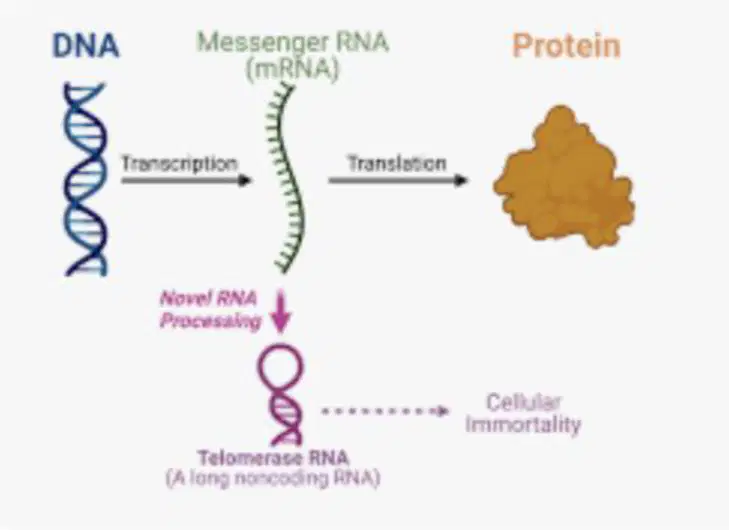
Which process involves Messenger RNA (mRNA) carrying instructions from DNA to synthesize proteins?
Transcription
Translation

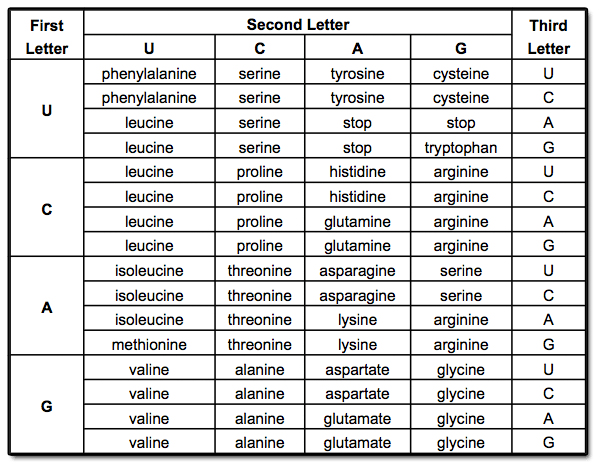
What is the correct sequence of amino acids?
AUG UAC AGU UAG
Met, Tyr, Ser, Stop
Tyr, Ser, Stop Met
Met, Iso, Glu, Stop
Stop, Met, Iso, Tyr
The subunits that DNA and RNA are built with are called
nucleotides
amino acids
hydrocarbons
monosaccharides

The main function of tRNA is to
carry a message
form the ribosomes
transfer amino acids
string together DNA and RNA
Which of the following sequences best describes the flow of information that takes place when a gene directs the synthesis of a protein?
protein --> RNA --> DNA
DNA --> mRNA --> tRNA --> protein
DNA --> amino acid --> RNA --> protein
DNA --> tRNA --> mRNA --> protein
During translation amino acids are assembled into a chain called a
codon
tRNA strand
amino acid chain
polypeptide chain
Translation occurs in the (a) of the cell.
Which of the following processes occurs in the ribosome during protein synthesis?
A) Transcription
B) Replication
C) Translation
D) Mutation
Explain the process of transcription in genetic coding.
Transcription occurs in the cytoplasm
Transcription is the process where RNA polymerase reads the DNA template strand and synthesizes a complementary RNA strand.
Transcription is the process of DNA replication
Transcription involves the synthesis of DNA from RNA
How do point mutations differ from frameshift mutations?
Point mutations involve the insertion of nucleotides, while frameshift mutations affect a single nucleotide.
Point mutations affect a single nucleotide, while frameshift mutations involve the insertion or deletion of nucleotides.
Point mutations affect multiple nucleotides, while frameshift mutations involve the substitution of nucleotides.
Point mutations involve the deletion of nucleotides, while frameshift mutations affect a single nucleotide.
Changes in the DNA sequence that affect genetic information are known as:
replications
transformations
mutations
prokaryotes
A mutation that involves a single nucleotide is called:
chromosomal mutation
point mutation
inversion
translocation
Mutation can be harmful and beneficial too.
true
false
What are the effects of Harmful Mutation?
Antibiotic-resistant
Cancer
Genetic disorder
What is this type of Mutation?
It refers to any change in the sequence of DNA, which has no further impact on the amino acid sequence in a protein or in the functions performed by a protein. There is no phenotypic indicator of mutation.
Missense Mutation
Silent Mutation
Point Mutation
What is this type of Mutation?
Are generally much more serious and often more deadly than point mutations. Even though only a single nitrogen base is affected, as with point mutations, in this instance, the single base is either completely deleted or an extra one is inserted into the middle of the DNA sequence. This change in sequence causes the reading frame to shift.
Frameshift Mutation
Deletion Mutation
Insertion Mutation
...................... are substances that cause mutation.
Carcinogens
Bacteria
Mutagens

Which type of mutation does the model demonstrate?
Deletion
Substitution
Insertion
Translocation
The mutated DNA segment is TTCGCAAG. This is an example of ___ mutation.
Mutation: ATC GCAT
What mutation occurred?

A point mutation where one nucleotide base replaces an original nucleotide base
Inversion Mutation
Chromosomal Mutation
Translocation
Substitution Mutation
Mutations that involve parts of or all of
a chromosome
Replication
Deletion Mutation
Chromosomal Mutation
Transcription

Part of a chromosome is reversed.
Inversion Mutation
Deletion Mutation
Translocation
Point Mutation

Failure of homologous chromosomes
to separate during meiosis.
Results in gametes with either one extra or one missing chromosome.
Translocation
Nondisjunction
Replication
Transcription
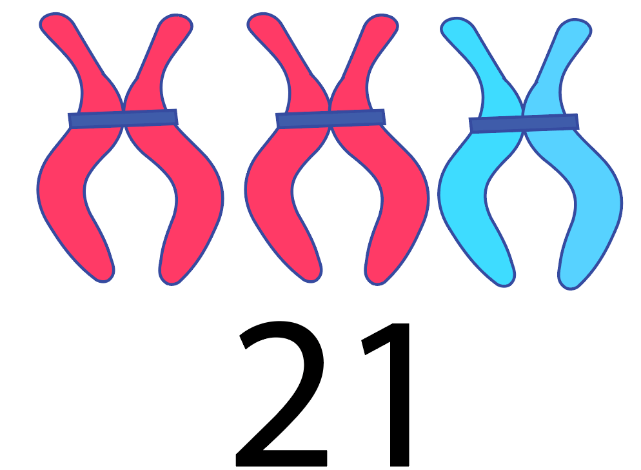
Condition caused by nondisjunction at pair 21 during meiosis.
Individuals have an extra chromosome
at pair 21, or a total of 47 chromosomes.
Also called Trisomy 21.
Cystic Fibrosis
Translocation
Hemophilia
Down Syndrome

A point mutation where DNA adenine (A)
is replaced by thymine (T) resulting in a single amino acid change during translation(affects blood cell
shape and function)
Encephelitis
Hemophilia
Sickle Cell Anemia
Influenza
A mutation is defined as:
A change in the cell's structure
Anything that changes in an embryo
Any change in the physical features of a human
A change in the DNA sequence
All the genes in both a prokaryotic cell and a eukaryotic cell are expressed at the same time.
True
False
Prokaryotes regulate gene expression primarily
in order to maintain homeostasis
in response to changing environmental conditions
during development as cells specialize
Prokaryotes do not regulate gene expression. All genes are always on.
One way to regulate the expression of a gene is to control the formation of mRNA. This is called ___ control.
transcriptional
translational
post-transcriptional
post-translational
In order for a gene to be expressed, ___ must bind to the gene's ___, a specific sequence of nucleotides at one end of the gene, thus initiating transcription.
DNA polymerase, promotor
DNA polymerase, operator
RNA polymerase, promotor
RNA polymerase, operator
An operon is
a genetic on/off switch in prokaryotes
a genetic on/off switch in eukaryotes
a group of related genes and the associated gene switches in prokaryotes
a group of related genes and the associated gene switches in eukaryotes
Eukaryotes need to regulate their genes
during cell specialization that occurs during development
in order to maintain homeostasis
both a and b
neither a or b

Gene regulation is the process that is used to:
help make sugars for cells in plants.
make glycosomes in cells.
turn genes on and off.
Not sure, need help.
In eukaryotes, DNA is tightly coiled around ____ in chromatin
Histones
Whey
Casein
Hemoglobin
What is the inducer in the lac operon?
cAMP
glucose
lactose
CRP
When will a lac operon be activated?
Glucose is low and lactose is present
Glucose is high and lactose is absent
both glucose and lactose is high
both glucose and lactose is low
What is the role of the TATA box in eukaryotic genes?
Code for liver enzymes
Regulate gene expression
Help position RNA polymerase
Activate other genes
What do Hox genes determine in fruit flies?
The identities of each body segment
The breakdown of protein products
The stability of mRNA
The exit of mRNA molecules from the nucleus

What causes mutations?
Mutagens in the environment
UV rays from the sun
Gamma rays and X-rays
All of the above.
A mutation can be...
harmful
helpful
neutral
harmful, helpful, or benign(neutral)

