
 Worksheets
Energy Unit Review
Total questions: 69
Worksheet time: 1hrs 25mins
The ultimate/original source of all energy is from
the sun
carbohydrates
ATP
lipids
Which plant cell organelle uses light energy to produce sugar in the process of photosynthesis?
chloroplast
mitochondria
nucleus
ribosome
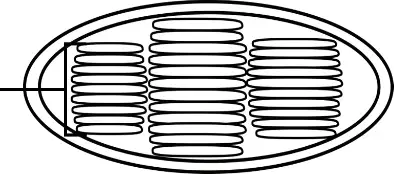
What is the name of a stack of thylakoids, which is pictured in the image below?
stroma
matrix
grana
membranes
Which of these organisms does NOT do photosynthesis?
algae
bacteria
plants
animals
Why is the presence of chlorophyll in plants important?
It assembles the sugar.
It creates ATP to power the process.
It captures water to be used in the process.
It is a pigment that absorbs solar energy.
The process of photosynthesis can be represented by the equation:
light + C6H12O6 + O2 → CO2 + H2O
O2 + H2O → light + C6H12O6 + CO2
light + C6H12O6 + CO2 → O2 + H2O
light + CO2 + H2O → C6H12O6 + O2
Which statement accurately describes the energy needs for photosynthesis and cellular respiration?
Solar energy is needed for cellular respiration but not for photosynthesis.
Chemical energy in the form of glucose is needed for both cellular respiration and photosynthesis.
Chemical energy in the form of glucose is needed for photosynthesis, and solar energy is needed for cellular respiration.
Solar energy is needed for photosynthesis, and chemical energy in the form of glucose is needed for cellular respiration.
During the light-dependent reactions, sunlight is absorbed. Where in the chloroplast does this occur?
matrix
thylakoid membrane
inner membrane
stroma
Ultimately photosynthesis produces the sugar glucose. Glucose is made during the second step of photosynthesis which takes place in the stroma of chloroplasts. This second step of photosynthesis that produces glucose is called:
the Krebs cycle
the light-independent reactions
the light-dependent reactions
glycolysis
During photosynthesis, different gases move in and out of plant cells. Which phrase best represents the net flow of gases involved in photosynthesis?
Carbon dioxide moves in; oxygen moves out.
Oxygen moves in; carbon dioxide moves out.
Carbon dioxide moves in; nitrogen moves out.
Oxygen moves in; nitrogen moves out.
The process of cellular respiration:
uses sunlight to create food
breaks down food molecules to release stored energy
must occur before plants are able to carry out photosynthesis
is performed only by organisms that are incapable of photosynthesis
Which step of cellular respiration takes place in the cytoplasm?
electron transport chain
Krebs cycle
light reactions
glycolysis

A biomass pyramid of an ecosystem is shown. Which statement provides the best explanation for the difference in biomass of organisms found at each trophic level?
A. Organisms at higher trophic levels have less energy available to them than organisms at lower trophic levels.
B. Organisms at higher trophic levels require smaller habitats than organisms at lower trophic levels.
C. Organisms at lower trophic levels provide less energy than organisms at higher trophic levels.
D. Organisms at lower trophic levels outcompete organisms at higher trophic levels.
This organelle produces energy for cells by undergoing the process of cellular respiration, which creates ATP.
the nucleus
the endoplasmic reticulum
the mitochondria
the chloroplast
Which organisms complete cellular respiration?
plants only
animals only
both plants and animals
neither plants nor animals
Which of these word formulas for cellular respiration is correct?
oxygen + sugar → energy + carbon dioxide + water
carbon + sugar → energy + carbon dioxide + water
nitrogen + sugar → energy + carbon dioxide + water
hydrogen + sugar → energy + carbon dioxide + water
Both aerobic and anaerobic respiration yields a net gain of ATP molecules to be used as energy for living things. The step of cellular respiration that produces the highest number of ATP is ________.
glycolysis
fermentation
electron transport chain
the Krebs cycle
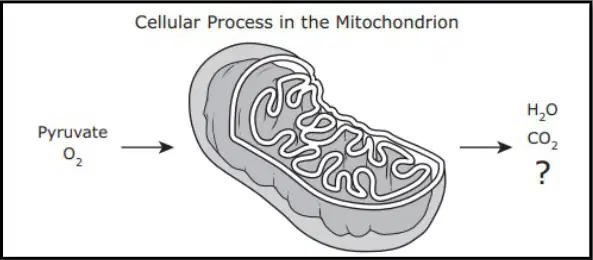
The diagram shows molecules that a mitochondrion uses and produces during a cellular process. Which other molecule is created in this process?
DNA
RNA
C6H12O6
ATP
The ATP molecule is the universal energy source for cellular activities. Which of these processes is used to break down glucose into ATP that is usable by the cell?
chemosynthesis
photosynthesis
cellular respiration
transpiration
All of these are steps in cellular respiration except:
light-independent reactions
electron transport chain
glycolysis
Krebs cycle
Respiration involves the breakdown of sugar. This process results in the production of energy for the cell. In order for cells to produce the MOST energy, what gas should be present?
oxygen
nitrogen
water vapor
carbon dioxide
If a cell needs to spend energy, an ADP molecule is created. What has occurred that allows this ADP molecule to exist?
ATP loses a phosphate
ATP binds to a ribose
ATP gains a phosphate
ATP gains a nucleotide
In a study of physical endurance, researchers observed significant increases in the heart rates and breathing rates of participants immediately after they engaged in strenuous exercise. Which statement best explains the increase in the heart rate and the breathing rate during exercise?
The water concentration in the blood increases.
Body cells require increased oxygen as energy is expended.
Muscle cells increase in temperature and require fluid to reduce the temperature.
An increase in muscle activity causes increases in glucose levels in red blood cells.
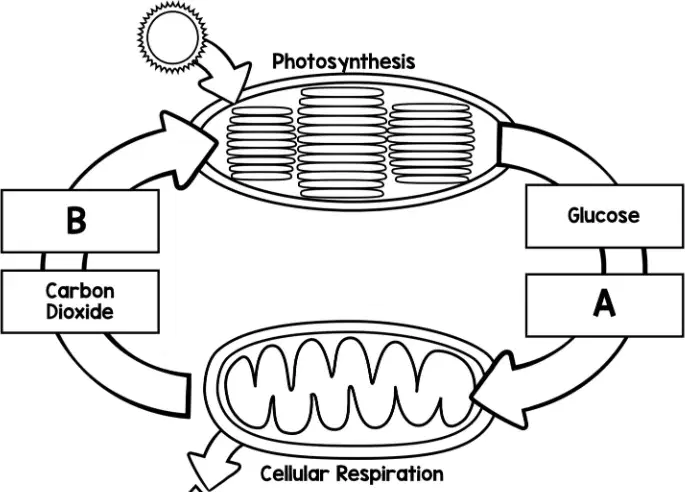
Using the information provided by this diagram, what could be represented by the letter A?
oxygen
water
cellular energy
energy from sunlight
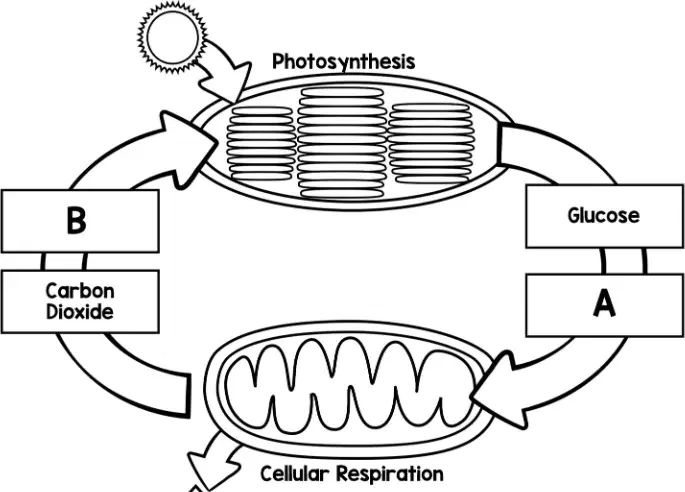
Using the information provided by the diagram above, what could be represented by the letter B?
oxygen
water
cellular energy
energy from sunlight

Use the diagram below to answer the following questions. Which of following statements would be correct regarding the diagram above?
A. Photosynthesis and cellular respiration occur in the same organelle.
B. Cellular respiration gets energy directly from sunlight.
C. The products of photosynthesis are used in cellular respiration.
D. Carbon dioxide is produced by photosynthesis.
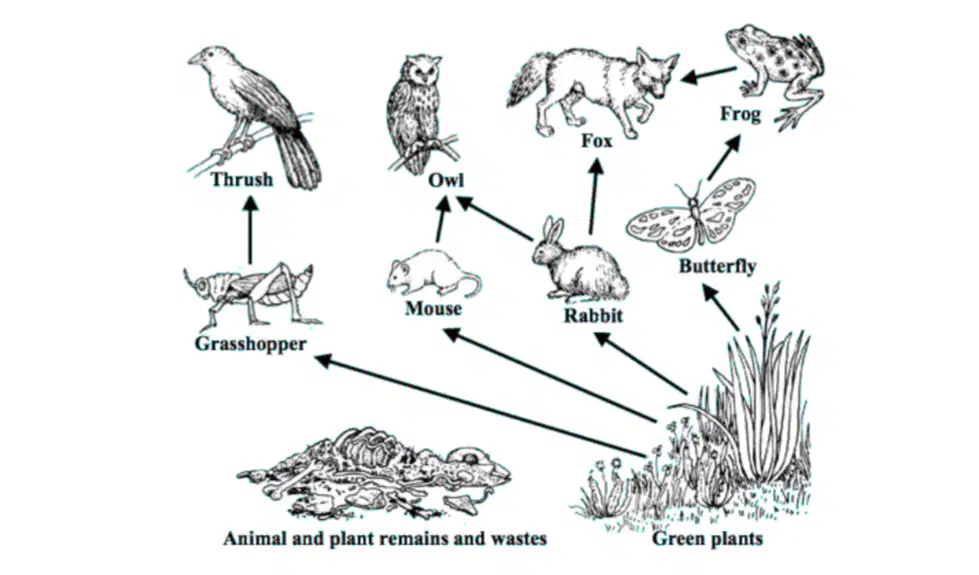
Which food chain arranges components of this food web according to energy flow?
mouse → owl → rabbit → fox
butterfly → frog → fox → green plants
green plants → butterfly → frog → fox
green plants → mouse → owl → rabbit
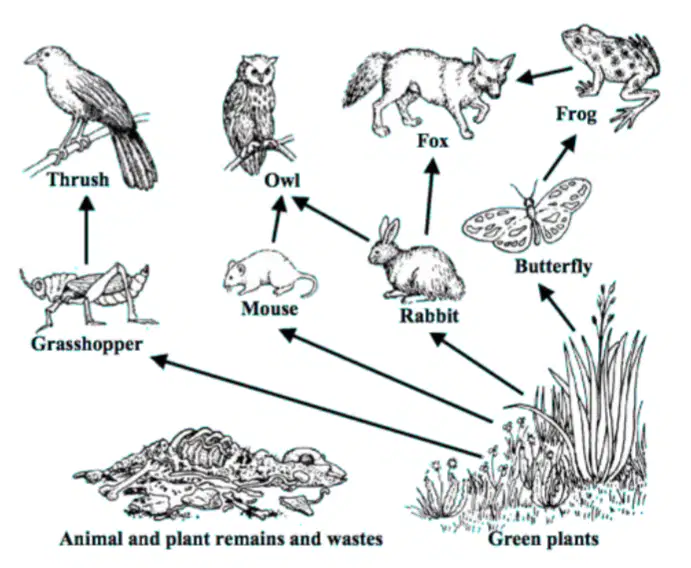
Suppose the green plants in this food web contains 23,333 kCal of energy. How much energy will the secondary consumer receive?
23,333 kCal
2,333.3 kCal
233.3 kCal
23.3 kCal
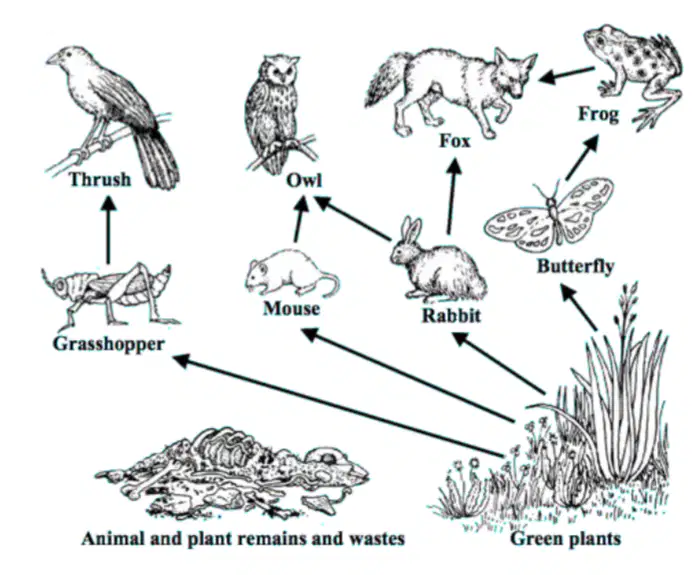
Which of the following can be said about the ecosystem that this food web represents?
There are more foxes than green plants.
There are more owls than mice.
There are more butterflies than foxes.
There are more frogs than green plants.
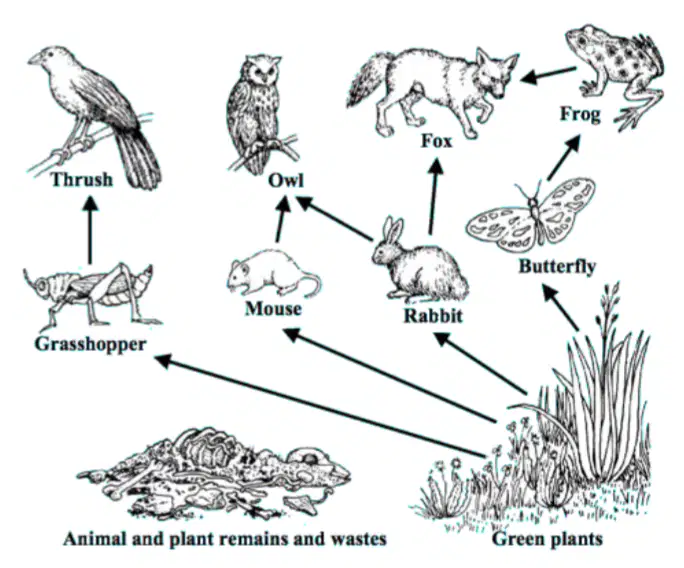
A large decrease in the rabbit population would most likely cause which of the following?
The green plant population would increase, while the fox population would decrease.
The fox population would increase, while the green plant population would decrease.
The mouse population would increase, while the owl population would decrease.
The owl population would increase, while the mouse population would decrease.
Diego decides one day to run a marathon without any training. After ten minutes has elapsed and Diego has run half a mile, he begins to feel pain in his thighs. He is also breathing very rapidly. What is causing the pain in Diego’s legs?
The weather must have been too hot to run.
Too much oxygen was getting to the cells, causing them to cramp.
The build-up of carbon dioxide caused the muscles to begin cramping.
Lactic acid build-up in his muscles due to lack of oxygen to his cells is causing the pain.
Which of the following statements is NOT true regarding fermentation?
Fermentation is an aerobic process.
Fermentation is an anaerobic process.
Fermentation is an inefficient process.
Fermentation includes alcoholic fermentation and lactic acid fermentation.
Energy from food, such as glucose, must be transformed into the form of _________ before it can be used by cells.
ATP
DNA
RNA
Glucose
According to the law of conservation of matter, matter is not created or destroyed. Yet, in an energy pyramid, the amount of biomass decreases as we move up the pyramid. Why?
Matter is decomposed at different levels in a food chain.
Matter is recycled at each level of the food chain and returned back to the producers.
Matter is taken back by the producers after it is left unused by consumers at each level.
Matter changes to other forms, like heat energy, that might not continue to be a part of the same food chain.
Label the energy pyramid
Where do you have the MOST energy?
Listed in the Item Bank are some important labels for sections of the image below. Drag and drop each label to the corresponding area it identifies in the image
0.1%
1%
Producer
Consumer
100%
10%
Use the words to fill in the blanks below. Identify the process as Photosynthesis or Cellular Respiration
Carbon Dioxide
Sugar
oxygen
Water
Energy (ATP)
Cellular respiration
Sunlight
Photosynthesis

Which row in the chart below shows the substances represented by X and Y?
1
2
3
4
A student is going to test elodea plants and their rate of photosynthesis. The student knows that increasing the amount of light the plant gets increases the rate of photosynthesis. The student wants to test how the amount of CO2 in the water will change the rate. So the students adds different amounts of baking soda (CO2) to three vials and leaves a fourth vial with no baking soda at all. Just like their other photosynthesis experiment, they will count the number of bubbles the plant produces. -- What is the independent variable in this study?
The amount of water
The amount of light
The amount of CO2
The number of bubbles per minute
Label the diagram
Select the organelle that performs photosynthesis.
Label the image with the inputs & outputs:
Glucose (C6H12O6)
Oxygen (O2)
Carbon Dioxide (CO2)
A food pyramid is shown to represent the transfer of energy in a food chain. Label the amount of energy available to each trophic level if producers have 10,000 kJ of energy.

Look at the diagram. If the Cattails have 20,000 kilocalories of energy, match how much energy will be passed to each consumer.
Snake
20
Hawk
2
Grasshopper
2,000
Blue Bird
200


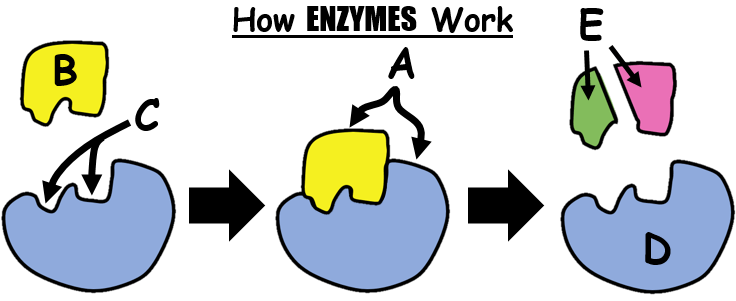
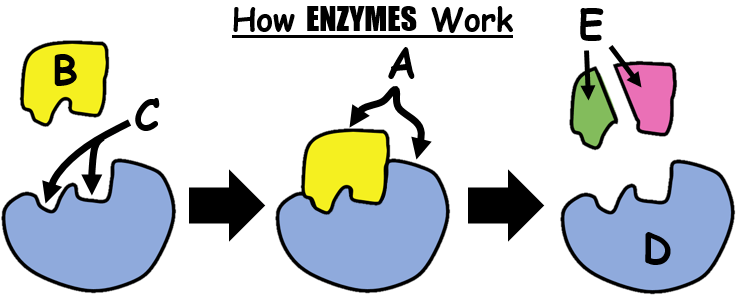
Enzymes are an example of
Lipids
Carbohydrate
Protein
Nucleic Acid
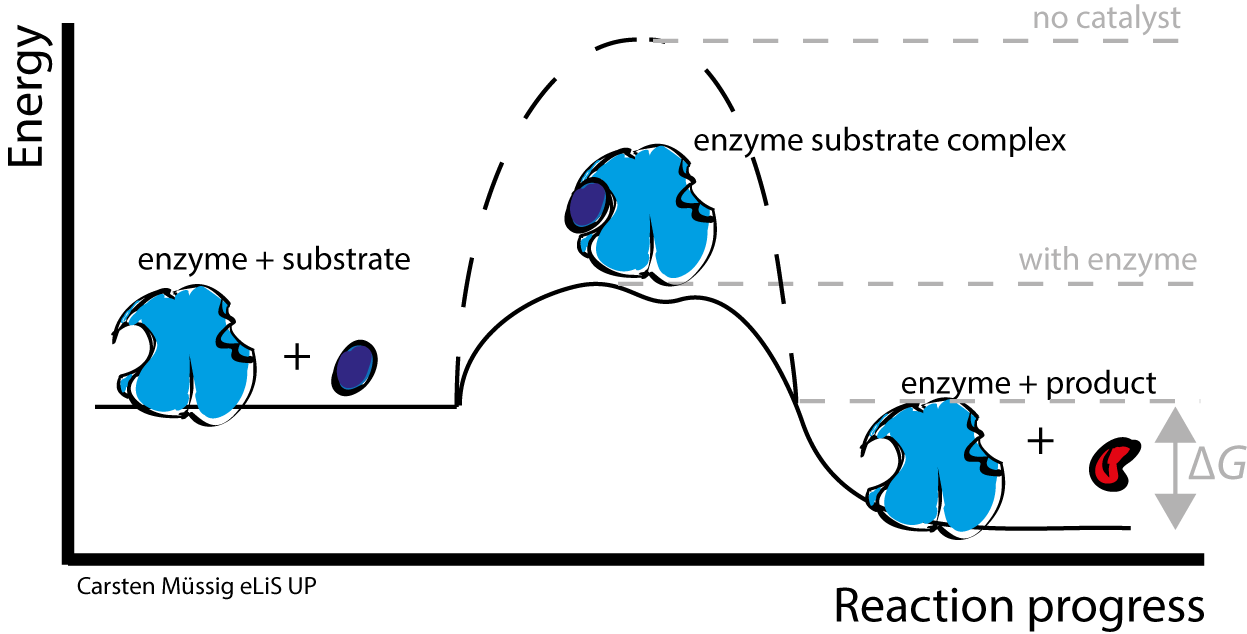

What is the optimum temperature for this enzyme?
20 degrees Celsius
45 degrees Celsius
52 degrees Celsius
64 degrees Celsius
In the lock-and-key model of enzyme action, the __________ fits into the __________ of the enzyme.
product; substrate
active site; product
substrate; active site
active site; substrate
Which of the following is a direct product of the light-independent reactions of photosynthesis?
ATP
Oxygen
Water
Glucose
What is the main function of the Krebs cycle in cellular respiration?
To produce glucose from carbon dioxide
To generate ATP and electron carriers
To convert ADP to ATP using light energy
To absorb sunlight for energy
Which molecule acts as the final electron acceptor in the electron transport chain during aerobic respiration?
Carbon dioxide
Glucose
Oxygen
Water

