
 Worksheets
Ch. 3 Matter
Total questions: 67
Worksheet time: 1hrs 9mins
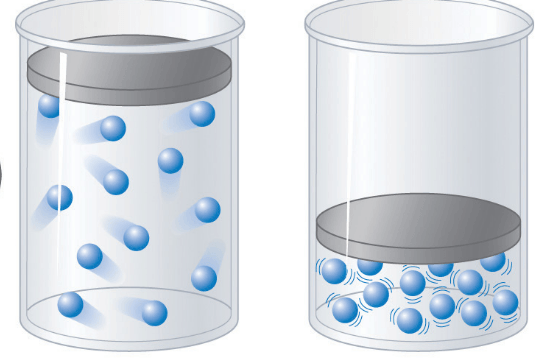
The faster the gas particles move...
the lower the force with which they collide with the walls of their container.
the greater the force with which they collide with the walls of their container.
has no impact on the force with which they collide with the walls of their container.
When the temperature of a gas at constant volume is increased...
the pressure of the gas decreases.
the pressure remains the same.
the pressure of the gas increases.
the pressure can either increase or decrease.
Charle's Law shows that the volume of a gas is....
inversely proportional to its temperature.
directly proportional to its temperature.
unrelated to its temperature
independently related to its temperature.
Charles's Law relates which 2 variables?
pressure and volume
temperature and pressure
temperature and volume
amount and volume
Which of these factors affects Viscosity?
Temperature
Colour
Taste
The ___________ of a fluid refers to its “thickness,” or its resistance to flow.
temperature
colour
taste
viscosity
As temperature increases ,viscosity of liquid _______________.
increases
stays the same
decreases
If an object sinks in a fluid, _____.
the density of the fluid is greater than the density of the object
the density of the fluid is equal to the density of the object
the density of the fluid is less than the density of the object
density has nothing to do with whether an object sinks or floats, only which state of matter the object is

Which phase of matter has no definite shape or volume?
Solid
Liquid
Gas
All of the above
Which phase of matter has a definite volume and takes the shape of its container?
Liquid
Solid
Gas
None of these

A small chunk of matter is made only from Gold atoms. This is an example of a:
Mixture
Compound
Element
Solution
What is the phase change of a solid to a liquid?
freezing
melting
boiling
condensation
Change from Liquid to Solid is called ...
fusion
Freezing
sublimation
evaporation
Change from liquid to gas is called....
expansion
evaporation
condensation
sublimation
Most matter ____ when heated.
condenses
contracts
expands
solidifies
The most common state of matter in the universe is ____.
solid
liquid
gas
plasma
Bernoulli's principle explains why ____.
heated objects expand
boats float
planes fly
heat of fusion exists
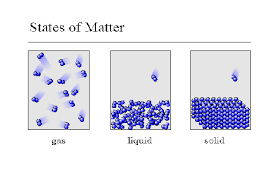
What are the three states of matter?
solid, volume, mass
solid, liquid, gas
density, volume, mass
density, gas, volume

Any material that can flow and that takes the shape of its container is called a ___.
solid
fluid
glass
wood

The force exerted on a given area
pressure
muscle
potential
velocity

What is the equation to calculate pressure?
pressure = gravity ∕ weight
pressure = newtons ∕gravity
pressure = force∕ area
pressure = motion⁄ particles
The term fluids generally applies to:
solid and liquid
liquid and gas
solid and plasma
water only
Density is:
the weight of a fixed mass of something.
the volume of a fixed weight of something.
the weight of a fixed volume of something.
the mass of a fixed volume of something.
The upward force that fluids exert on all matter.
Pascal
Fluid
Atmospheric
Buoyant
The principle that states that the buoyant force of an object in a fluid is an upward force equal to the weight of the volume of the displaced fluid.
Bernoulli’s
Archimedes’
Hodder’s
Nelson's
Why do some substances float on water?
because they are less dense than water
because they are more dense than water
because they are warmer than water
because they are cooler than water
A unit of pressure is called a
bernoulli
pascal
pound
meter

States that the buoyant force of an object is equal to the weight of the fluid displaced by the water. This explains why big ships float.
archimedes principle
bernoulli's principle
pascal's law

When pressure is applied to a confined fluid, the increase in pressure is transmitted equally to all parts of the fluid. This fact is called________.
Pascal's Principle
Newton's Principle
Archimedes' Principle
Bernoulli's Principle

If an object floats, the volume of displaced water is equal to the volume of
the entire object
the portion of the object that is above water
the portion of the object that is submerged
exactly half of the object

The flight of a hot air balloon can be best characterized by this....
Charles Law
Bernoulli Principle
Capillary Effect
Boyles Law
The theoretical point at which all molecular motion stops is called ____.
the boiling point
absolute zero
the melting point
the freezing point
Compared to most substances, water is unusual because it ____ when it changes from a liquid to solid state.
expands
contracts
melts
diffuses
The amount of energy needed to change a material from a solid to a liquid is called the heat of ____.
condensation
evaporation
fusion
vaporization
The amount of energy needed to change a material from a liquid to a gas is called the heat of ____.
condensation
evaporation
fusion
vaporization
According to ____, if you decrease the volume of a container of gas and hold the temperature constant, the pressure of the gas will increase.
Bernoulli's principle
Boyle's law
Charles's law
Archemedes' principle
According to ____, the volume of a gas increases with increasing temperature, as long as pressure does not change.
Bernoulli's principle
Boyle's law
Charles's law
Archemedes' principle
According to ____, the buoyant force on an object in a fluid is equal to the weight of the fluid displaced by the object.
Bernoulli's principle
Boyle's law
Charles's law
Archemedes' principle
According to ____, as the velocity of a fluid increases, the pressure exerted by the fluid decreases.
Bernoulli's principle
Boyle's law
Charles's law
Archemedes' principle
According to ____, pressure applied to a fluid is transmitted unchanged throughout that fluid.
Bernoulli's principle
Pascal's principle
Charles's law
Archemedes' principle
What is the greatest benefit of using hydraulics?
The multiplication of speed
The multiplication of operating time
The multiplication of fuel efficiency
The multiplication of force
The idea that matter is made up of small particles that are in constant motion is ____.
Bernoulli's principle
heat of fusion
Charles's law
the kinetic theory of matter
Increasing ____ raises the boiling point of a liquid.
temperature
the amount of liquid
pressure
volume
As the temperature of a gas increases, the volume of the gas will ____ if the pressure remains the same.
decrease
increase
remain the same
contract
As the volume of a gas decreases, the pressure of the gas will ____ if the temperature remains the same.
decrease
increase
remain the same
contract
Fluid pressure is always directed ____.
up
down
sideways
in all directions
After a hot shower, the bathroom mirror appears wet because of
vaporization
condensation
sublimation
deposition
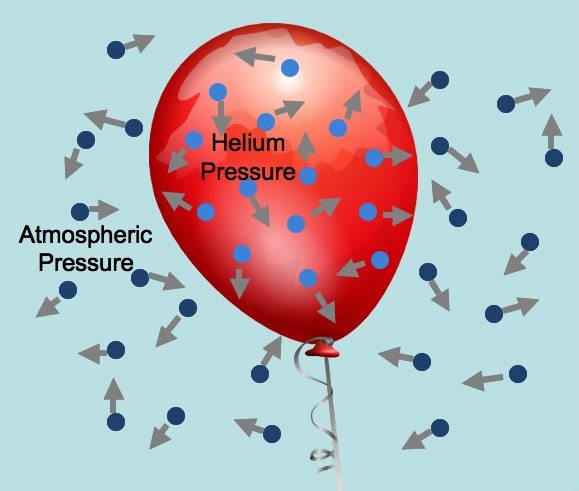
Increasing the number of particles in a container causes gas pressure to
increase
decrease
stay the same

Why does this picture demonstrate the Law of Conservation of Mass?
the number of atoms of each element are the same on both sides
they start out separate and end up combined
the same elements are used
it doesn't demonstrate the Law of Conservation of Mass
When a log is burned, what happens to the wood?
The mass stays the same, but becomes smoke and ash.
It disappears.
The mass changes as it goes away.
Nothing. You're imagining things.
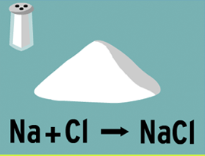
When sodium and chlorine combine to form sodium chloride, sodium chloride is the:
Originator
Reactant
Product
Produce

