
 Worksheets
AP Bio Review of Unit 6
Total questions: 63
Worksheet time: 48mins
How can a person's muscle cells have the same exact DNA sequences as their nerve cells even though they look and perform completely different?
The two different cells become mutated
The proteins expressed in each cell are different
They actually have different DNA in the two types of cells.
The genome of the different cells changes
What does a promoter do?
it allows a gene to be transcribed
it creates a DNA segment
it is another word for ribosomes
it is another word for RNA
Translation is a process where:
a polypeptide sequence is produced from a sequence of rRNA codons.
a polypeptide sequence is produced from a sequence of tRNA codons.
a polypeptide sequence is produced from a sequence of mRNA codons.
a DNA nucleotide sequence is used to produce mRNA codon sequence.
A mutation within the promoter region has occurred. What would potentially happen to transcription rate?
Mutated promoters decrease the rate of transcription.
Mutated promoters increase the rate of transcription.
Mutated promoters can increase or decrease the rate of transcription.
Mutated promoters cease transcription of the adjacent gene.
Attachment of ______ groups to ______ will cause promotion of gene expression due to looser DNA.
acetyl, DNA
methyl, DNA
acetyl, histones
methyl, histones
All of the following occur before mature RNA is formed except:
Addition of a poly-A tail
Addition of a 3' cap
Addition of a release factor
Removal of introns
Alternative splicing
The protein that functions in unwinding DNA strands before replication occurs is called:
Topoisomerase
Single-strand binding proteins
Helicase
Ligase
Spliceosome

What type of gene control is shown in this image?
processing control
transcriptional control
post translational control
mRNA stability control
What is the function of the poly-A tail in mRNA?
to add modified guanine to the 3' end of the mRNA
to indicate the site of translational termination
to code for the binding of RNA polymerase to the DNA
to help protect the mRNA from degradation so it can exist longer in the cytoplasm

5'-AUG-UCU-UCG-UUA-UCC-UUG-3'
Prokaryotes have plasmids. What are plasmids?
large extra-chromosomal, double-stranded, linear DNA molecules
large extra-chromosomal, double-stranded, circular DNA molecules
small extra-chromosomal, double-stranded, circular DNA molecules
small extra-chromosomal, double-stranded, linear DNA molecules
Which enzyme is responsible for relaxing supercoiling in front of the replication fork?
helicase
DNA polymerase
topoisomerase
ligase
Describe the difference between the synthesis of the leading and lagging strands.
directionality: leading = 3' -> 5', lagging = 5' -> 3'
synthesis continuity: leading = discontinuous & lagging = continuous
directionality: leading = 5' -> 3', lagging = 3' -> 5'
synthesis continuity: leading = continuous & lagging = discontinuous
Identify which molecule binds to the promoter region
Ligase
Topoisomerase
Helicase
RNA polymerase
In the trp operon, __ acts as a __ and helps the repressor bind to the operator.
tryptophan, corepressor
tryptophan, inducer
lactose, corepressor
lactose, inducer
Which of the following are types of post-transcriptional control of genes in eukaryotes?
alternative RNA splicing or processing
gene silencing through RNA interference
destruction of ubiquitin tagged proteins
all of the above

Which of the following polypeptides is coded for by the following
mRNA sequence:
AUG GUU AAA CGA CAA UCC
Val, Lys, Phe, Gly, Ser
Met Asp, Phe, Ala, Arg
Met, Val, Lys, Arg, Gln, Ser
Ile, Gln, Lys, Asp, Gln, Ser
In his transformation experiments, what did Griffith observe?
Mixing a heat-killed pathogenic strain of bacteria with a living nonpathogenic strain can convert some of the living cells into the pathogenic form.
Infecting mice with nonpathogenic strains of bacteria makes them resistant to pathogenic strains.
Cytosine makes up 38% of the nucleotides in a sample of DNA from an organism.
Approximately what percentage of the nucleotides in this sample will be thymine?
12%
24%
31%
38%

If a mutation results in a defective enzyme A. Which of the following would be a consequence of that mutation?
an accumulation of A and no production of B and C
an accumulation of A and B and no production of C
no production of either enzyme
an accumulation of A, B & C
A frameshift mutation could result from
a base insertion only.
either an insertion or a deletion of a base.
a base deletion only.

Which enzyme was used to produce the molecule in the Figure?
ligase
restriction enzyme
helicase
topoisomerase

The segment of DNA shown in the figure has restriction sites I and II, which create restriction fragments A, B, and C. Which of the gels produced by electrophoresis shown below best represents the separation and identity of these fragments?


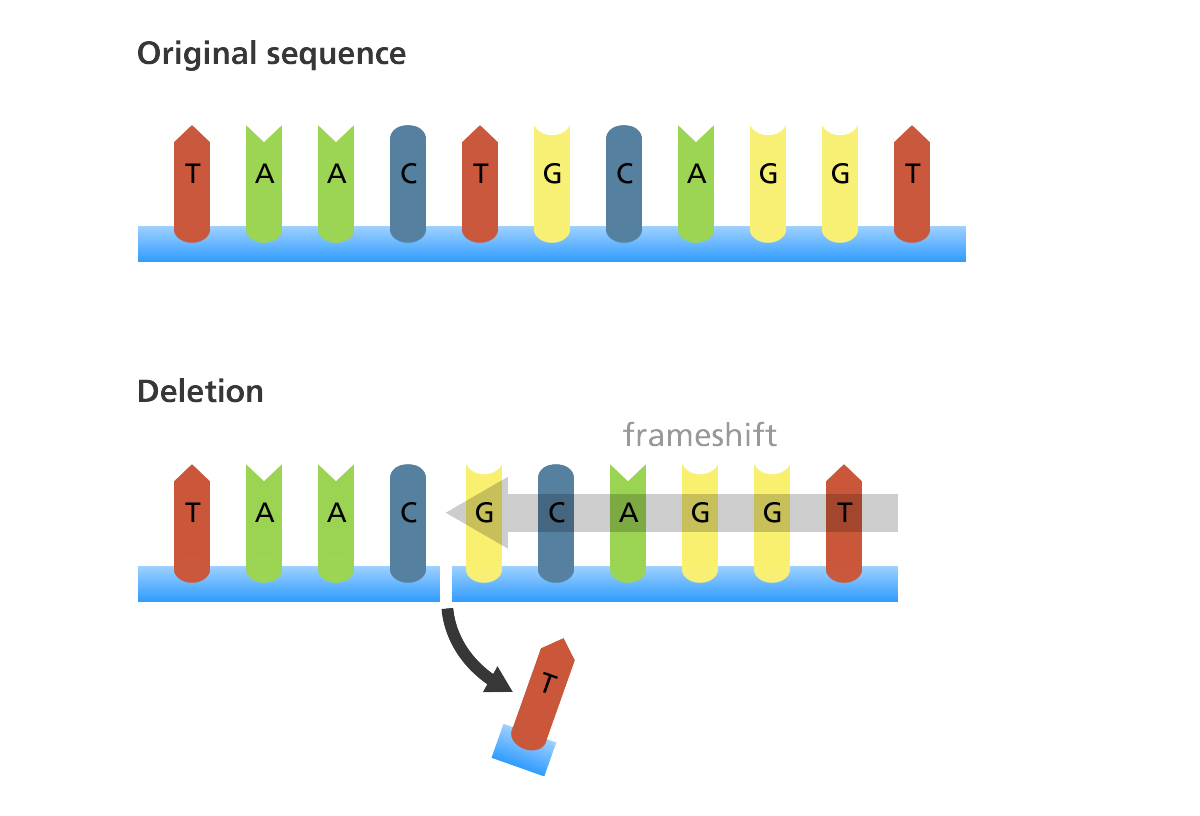

What type of mutation is this?
Nonsense mutation
Missense mutation
Silent mutation
Frameshift mutation
T-G-A-C-C-A
T-G-A-G-C-A
AGA-TTC-ATA-GCG
Mutant-
AGA-TTC-AAT-AGC-G
Elongation continues until a __________ enters the ribosome's A site. This signal tells translation to end immediately.
start codon
stop codon
anticodon
terminator


An argument in favor of food biotechnology is that it
provides foods that cure viral diseases.
provides more food to feed a growing population.
provides a cash crop for low income nations.
biotech foods are not controversial

What is a GMO?
An organism that has had its DNA modified by humans
An organism missing a chromosome
Epigenetics
A genetically identical organism

DNA can be cut, in order to insert it in a different organism, using
prescription enzymes
digestive enzymes
restriction enzymes
transcription enzymes

When human DNA is inserted into a bacterial plasmid so that the bacteria will make insulin, the plasmid is referred to as
transformed DNA
bacterial DNA
recombinant DNA
transcribed DNA
This is the practice of producing a genetically identical cell or organism
Cloning
Gel Electrophoresis
Genetic Engineering
DNA Fingerprinting
This is the practice of cutting DNA and separating it by the size of the pieces
Cloning
Gel Electrophoresis
Genetic Engineering
DNA Fingerprinting
What is the name of the international effort to sequence all of the DNA from a human?
The Gene Sequencing Project
The DNA Fingerprinting Project
The Nuremberg Trials
The Human Genome Project

Which kitten is most likely the offspring of this cat?
1
2
3
4
What is the process in which an unspecialized stem cell turns into a specialized body cell?
DNA Replication
Differentiation
Respiration
Genetic Modification
During gel electrophoresis, the _______ pieces of DNA move farthest down the gel
lightest
heaviest
ugliest
deadliest
What does transgenic mean?
An organism that can change its genes at will
A stem cell that can differentiate into anything
An organism that has had another species' DNA put in it
A bacteria that reproduces asexually
Which of the following is true for both bacteria and viruses?
both contain genetic material
can be killed using antibiotics
have a cell membrane
have a protein coat
Which statement is true about viruses?
Viruses can eat and metabolize food.
Viruses can reproduce only using a host cell.
Viruses can reproduce on their own at any time.
Viruses contain DNA, so they are alive.
One important way to control the spread of viruses in through
the use of vaccines
drinking a lot of tea
the use of other types of bacteria
the use of antibiotics
Which of these is characteristic of both viruses and bacteria?
They get their energy from their environment.
They can reproduce on their own.
They can form crystals and become dormant.
They contain proteins and nucleic acids.
Which of the following is a risk of overusing antibiotics to treat infections?
Bacteria may become resistant to antibiotics.
Antibiotics increase the rate of infection.
Antibiotics cause other diseases to develop.
Antibiotics only work once.

What do viruses need to reproduce?
Genetic material
A host cell
Bacteria
Insulin
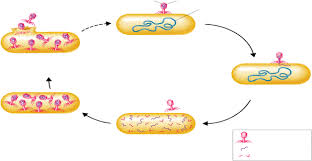
Which viral life cycle kills its host cell by lysing (bursting)?
Lysogenic Cycle
Lytic Cycle
Binary Fission
Conjugation
Which is most often used to destroy bacteria?
vaccine
antibiotics
vitamins
water

