
 Worksheets
Honors Biology Final Exam Review
Total questions: 60
Worksheet time: 33mins
What is the function of the Golgi apparatus?
Protein synthesis
Packaging and distribution of proteins
Energy production
DNA replication
What is the function of the nucleus?
Energy production
Protein synthesis
Storage of genetic information
Waste removal
What is the function of the ribosome?
Protein synthesis
Energy production
Packaging of proteins
Storage of genetic information
What is the function of the lysosome?
Protein synthesis
Energy production
Digestion and waste removal
Storage of genetic information
What is the function of the peroxisome?
Protein synthesis
Breakdown of fatty acids and detoxification
Energy production
Storage of genetic information
What is the function of the endoplasmic reticulum?
Protein synthesis and lipid production
Energy production
Storage of genetic information
Waste removal
What is the function of the cell membrane?
Energy production
Protein synthesis
Regulating the movement of substances in and out of the cell
Storage of genetic information
What are the two reasons why cells need to divide?
Growth and repair
Energy production and waste removal
Protein synthesis and lipid production
Storage of genetic information and detoxification
What is Interphase?
The phase where the cell divides
The phase where the cell grows and replicates its DNA
The phase where the cell produces energy
The phase where the cell removes waste
What is a diploid cell? How many chromosomes would this be for humans?
A cell with one set of chromosomes; 23 chromosomes
A cell with two sets of chromosomes; 46 chromosomes
A cell with two sets of chromosomes; 23 chromosomes
A cell with one set of chromosomes; 46 chromosomes
What is a haploid cell? How many chromosomes would this be for humans?
A cell with one set of chromosomes; 23 chromosomes
A cell with two sets of chromosomes; 46 chromosomes
A cell with two sets of chromosomes; 23 chromosomes
A cell with one set of chromosomes; 46 chromosomes
How many and what type of cells are made during mitosis?
Two diploid cells; identical
Two haploid cells; identical
Four diploid cells; non-identical
Four haploid cells; non-identical
Fill in the blank: Meiosis I is all about breaking apart (a) .
Fill in the blank: Meiosis II is all about breaking apart (a) .
Describe what happens during prophase.
Chromosomes line up in the middle of the cell.
Chromosomes condense and the nuclear envelope breaks down.
Sister chromatids are pulled apart to opposite ends of the cell.
The cell membrane pinches in to divide the cell into two.
Describe what happens during metaphase.
Chromosomes condense and the nuclear envelope breaks down.
Chromosomes line up in the middle of the cell.
Sister chromatids are pulled apart to opposite ends of the cell.
The cell membrane pinches in to divide the cell into two.
Describe what happens during anaphase.
Chromosomes condense and the nuclear envelope breaks down.
Chromosomes line up in the middle of the cell.
Sister chromatids are pulled apart to opposite ends of the cell.
The cell membrane pinches in to divide the cell into two.
Describe what happens during telophase.
Chromosomes condense and the nuclear envelope breaks down.
Chromosomes line up in the middle of the cell.
Sister chromatids are pulled apart to opposite ends of the cell.
The nuclear envelope re-forms around each set of chromosomes.
Describe what happens during cytokinesis.
Chromosomes condense and the nuclear envelope breaks down.
Chromosomes line up in the middle of the cell.
Sister chromatids are pulled apart to opposite ends of the cell.
The cell membrane pinches in to divide the cell into two.
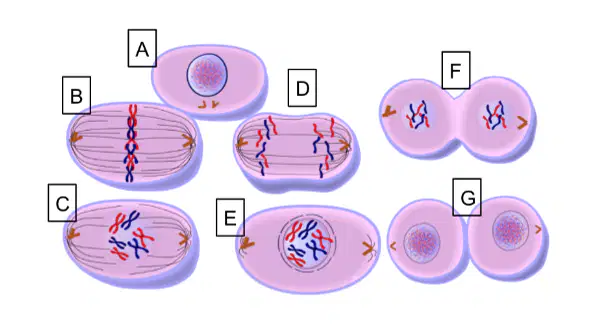
Put the phases of mitosis in order.
A, B, C, D, E, F, G
A, E, C, B, D, F, G
A, D, B, C, E, F, G
A, B, D, C, E, F, G
How many and what type of cells are made during meiosis?
Two diploid cells; identical
Two haploid cells; identical
Four diploid cells; non-identical
Four haploid cells; non-identical
In snapdragons, flower color is controlled by incomplete dominance. The two alleles are red (R) and white (W). The heterozygous genotype is expressed as pink (RW). What is the phenotype of a plant with the genotype RR?
Red
White
Pink
Yellow
In snapdragons, flower color is controlled by incomplete dominance. The two alleles are red (R) and white (W). The heterozygous genotype is expressed as pink (RW). What is the phenotype of a plant with the genotype WW?
Red
White
Pink
Yellow
In snapdragons, flower color is controlled by incomplete dominance. The two alleles are red (R) and white (W). The heterozygous genotype is expressed as pink (RW). What is the phenotype of a plant with the genotype RW?
Red
White
Pink
Yellow
Predict the offspring when two pink Four o’clock flowers (RW) are crossed. What is the predicted genotypic ratio for the offspring?
1:2:1
3:1
1:1
2:1
Predict the offspring when two pink Four o’clock flowers (RW) are crossed. What is the predicted phenotypic ratio for the offspring?
1 red: 2 pink: 1 white
3 red: 1 white
1 red: 1 white
2 red: 1 pink
Human blood type is controlled by 3 alleles in which A (I^A) and B (I^B) are codominant, and both are dominant over O(i). What are the possible genotypes for Type A blood?
I^A I^A or I^A i
I^A I^B
I^B I^B or I^B i
ii
Human blood type is controlled by 3 alleles in which A (I^A) and B (I^B) are codominant, and both are dominant over O(i). What are the possible genotypes for Type B blood?
I^A I^A or I^A i
I^A I^B
I^B I^B or I^B i
ii
Human blood type is controlled by 3 alleles in which A (I^A) and B (I^B) are codominant, and both are dominant over O(i). What are the possible genotypes for Type AB blood?
I^A I^A or I^A i
I^A I^B
I^B I^B or I^B i
ii
Human blood type is controlled by 3 alleles in which A (I^A) and B (I^B) are codominant, and both are dominant over O(i). What are the possible genotypes for Type O blood?
I^A I^A or I^A i
I^A I^B
I^B I^B or I^B i
ii
Why must males inherit a sex-linked trait from their mothers?
Because males have two X chromosomes.
Because males have one X and one Y chromosome.
Because males have two Y chromosomes.
Because males do not inherit any X chromosomes.
Both the mother and the father of a male hemophiliac appear to be normal. From whom did the son inherit the allele for hemophilia? What are the genotypes of the mother, the father, and the son?
The son inherited the allele from his father; Mother: X^H X^H, Father: X^H Y, Son: X^h Y
The son inherited the allele from his mother; Mother: X^H X^h, Father: X^H Y, Son: X^h Y
The son inherited the allele from his mother; Mother: X^H X^H, Father: X^H Y, Son: X^H Y
The son inherited the allele from his father; Mother: X^H X^h, Father: X^h Y, Son: X^H Y
A woman is color blind. What are the chances that her sons will be color blind? If she is married to a man with normal vision, what are the chances that her daughters will be color blind? Will they be carriers?
Sons: 0%, Daughters: 50% color blind, 50% carriers
Sons: 50%, Daughters: 0% color blind, 100% carriers
Sons: 100%, Daughters: 50% color blind, 50% carriers
Sons: 100%, Daughters: 0% color blind, 100% carriers
Why is the idea that an individual can evolve incorrect?
Because evolution occurs in individuals, not populations.
Because evolution occurs in populations, not individuals.
Because evolution is a rapid process.
Because evolution does not involve genetic changes.
What were Darwin’s two main ideas about evolution in his book The Origin of Species?
Natural selection and genetic drift
Natural selection and inheritance of acquired traits
Natural selection and common descent
Genetic drift and common descent
What idea did Jean Baptiste Lamarck contribute to Darwin’s theory of evolution?
Natural selection
Inheritance of acquired traits
Genetic drift
Mutation theory
What is the difference between an analogous structure and a homologous structure?
Analogous structures have a common evolutionary origin, while homologous structures do not.
Analogous structures perform similar functions but do not have a common evolutionary origin, while homologous structures have a common evolutionary origin but may perform different functions.
Analogous structures are found only in plants, while homologous structures are found only in animals.
Analogous structures are always larger than homologous structures.
How do fossils help support the theory of evolution?
Fossils show that all species have remained unchanged over time.
Fossils provide evidence of past organisms and show changes in species over time.
Fossils are only found in certain parts of the world, indicating isolated evolution.
Fossils disprove the theory of evolution by showing no transitional forms.
Identify two other field studies that help support evolution from a common ancestor.
Astronomy and Geology
Paleontology and Comparative Anatomy
Meteorology and Oceanography
Botany and Zoology
What is the difference between microevolution and macroevolution?
Microevolution refers to changes within a species, while macroevolution refers to changes that result in the formation of new species.
Microevolution occurs over long periods of time, while macroevolution occurs over short periods of time.
Microevolution is driven by natural selection, while macroevolution is driven by artificial selection.
Microevolution only occurs in plants, while macroevolution only occurs in animals.
How do scientists use Hardy-Weinberg Equilibrium to determine if evolution is occurring?
By measuring the physical traits of organisms in a population.
By comparing the genetic makeup of a population to the expected genetic makeup if no evolution is occurring.
By observing the behavior of organisms in a population.
By studying the fossil record of a population.
What are the five mechanisms of evolution?
Natural selection, mutation, gene flow, genetic drift, and non-random mating.
Natural selection, artificial selection, gene flow, genetic drift, and random mating.
Natural selection, mutation, gene flow, genetic drift, and random mating.
Natural selection, mutation, gene flow, genetic drift, and artificial selection.
Describe the Bottleneck Effect and the Founders Effect.
The Bottleneck Effect occurs when a population's size is reduced for at least one generation, while the Founders Effect occurs when a new colony is started by a few members of the original population.
The Bottleneck Effect occurs when a new colony is started by a few members of the original population, while the Founders Effect occurs when a population's size is reduced for at least one generation.
The Bottleneck Effect and the Founders Effect both refer to the same phenomenon of population reduction.
The Bottleneck Effect occurs only in plants, while the Founders Effect occurs only in animals.
What is the key role of mutations in evolution?
Mutations always have a negative impact on organisms.
Mutations provide genetic variation, which is essential for evolution.
Mutations prevent evolution by maintaining genetic stability.
Mutations only occur in response to environmental changes.
What are the two ways in which genetic variation can be introduced into a population?
Natural selection and artificial selection.
Gene flow and genetic drift.
Mutation and gene flow.
Genetic drift and non-random mating.
What type of traits does natural selection act upon?
Traits that are acquired during an organism's lifetime.
Traits that are inherited and affect an organism's fitness.
Traits that are neutral and do not affect an organism's fitness.
Traits that are only present in the environment.
In order for mutations to enter a population’s gene pool, what type of cell must carry that mutation?
Somatic cell
Germ cell
Skin cell
Muscle cell
What impacts the frequency of a new mutation in a population?
Natural selection
Genetic drift
None of the above
All of the above
Natural selection acts upon a(n) __________________________, whereas evolution acts upon a(n) __________________________.
Individual, population
Population, individual
Species, community
Community, species
What is phylogeny?
The study of physical traits
The evolutionary history of a species or group of species
The classification of organisms
The study of ecosystems
What is a phylogenetic tree?
A diagram that shows the physical traits of organisms
A chart that shows the genetic makeup of organisms
A branching diagram that represents the evolutionary history of a group of organisms
A table that lists the species in an ecosystem
What is a cladogram?
A diagram that shows the physical traits of organisms
A chart that shows the genetic makeup of organisms
A branching diagram that represents the evolutionary relationships among species
A table that lists the species in an ecosystem
On a cladogram, what does a node represent?
A common ancestor
A mutation
A physical trait
A genetic sequence
What happens at each node?
A new species is formed
A common ancestor is identified
A mutation occurs
A physical trait is observed
What is a clade?
A group of species that share a common ancestor
A physical trait shared by multiple species
A genetic sequence found in multiple species
A mutation that occurs in a population
What is the difference between a shared derived trait and a shared ancestral trait?
A shared derived trait is found in the common ancestor, while a shared ancestral trait is not
A shared derived trait is a new trait that appears in a clade, while a shared ancestral trait is found in the common ancestor
A shared derived trait is a physical trait, while a shared ancestral trait is a genetic trait
A shared derived trait is found in multiple species, while a shared ancestral trait is found in only one species
Match the following parts of the cell.

Mitochondria

Chloroplast

Nucleus

Cell Membrane
Match the following
Sorts, modifies and packages proteins
Golgi
Controls what enters and exits the cell
Cell Membrane
Stores and protects the DNA, the cell's instruction manual
Nucleus
Provides cell's energy in the form of ATP for cell's movement and function
Mitochondria
site of protein synthesis. Does not have a membrane
Ribosome


Structure (C) is a ____.

