wayground logo

Free Printable Worksheets

NEW

Font size

S
M
L
XL
Worksheets

Motion Test Review- IPC

Total questions: 60

Worksheet time: 2hrs 0mins

Name
Class
Date
1.
Which runner stopped for a rest?
a)
Albert
b)
Bob
c)
Charlie
2.
How long did one of the runner's rest?
a)
8 seconds
b)
13 seconds
c)
5 seconds
d)
50 seconds
3.
What is happening at A?
a)
Stationary
b)
Accelerating
c)
Slower steady speed; moving away from the starting position
d)
Steady speed; returning to start position
4.
Which runner had a head start?
a)
A
b)
B
c)
C
5.
At what time did runner A pass runner B?
a)
0 seconds
b)
1 second
c)
2 seconds
d)
3 seconds
6.
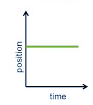
What does this graph represent?
a)
Constant Speed
b)
Acceleration
c)
Not moving
7.
Describe the motion
a)
Slow to fast;   Negative direction
b)
Fast to slow;   Negative direction
c)
Fast to slow;   Positive direction
d)
Slow to fast;   Positive direction
8.

What is the average speed of the object at 20 seconds?

a)

1.2 m/sec

b)

.2 m/sec

c)

5 m/sec

d)

4 m/sec

9.

What is the speed of the object at 3 hours?

a)

0 mi/hr

b)

24 mi/hr

c)

2.5 mi/hr

d)

6 mi/hr

10.

What is the displacement of the object at 45 seconds?

a)

7 m

b)

13 m

c)

.16 m

d)

6.4 m

11.

How long did it take the object to travel 6 miles?

a)

.33 hours

b)

3 hours

c)

12 hours

d)

2 hours

12.

from 3rd second to 5th second, the object is

a)

moving at a constant speed

b)

speeding up

c)

not moving

d)

slowing down

13.
On a distance vs. time graph, the steeper the slope _____
a)
the slower the speed
b)
the faster the speed
c)
less acceleration
d)
greater acceleration
14.

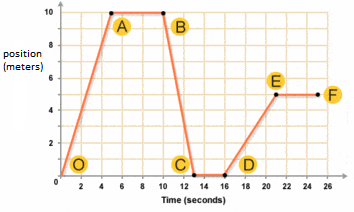
What is happening at E?

a)

Stationary

b)

Accelerating

c)

Fast steady speed; moving away from the starting position

d)

Steady speed; returning to start position
15.
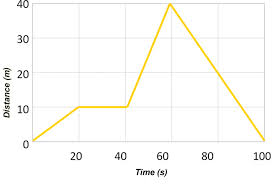
How long did it take this object to travel back to its reference/starting point?
a)
20 s
b)
30 s
c)
60 s
d)
100 s
16.

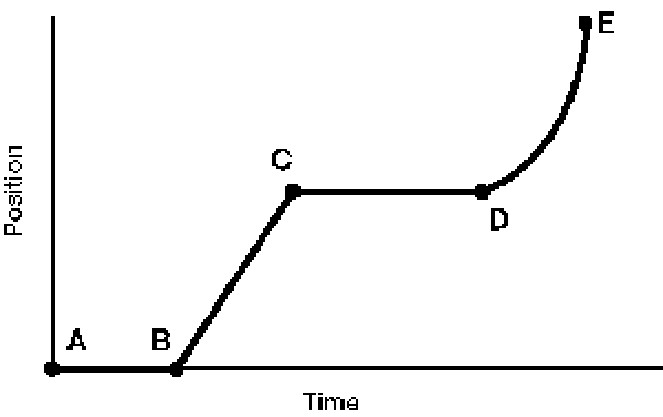
What is happening in this graph from point B to C?

a)

The object is going down a hill.

b)

The object is returning to its starting location.

c)

The object is slowing down.

d)

The object is staying still.

17.
The speed of the object is changing during interval:
a)
A-B
b)
B-C
c)
C-D
d)
D-E
18.
On a position-time graph, the position (distance) is plotted on the ____ axis. 
a)
x
b)
y
19.

What is the shape of a velocity graph for constant velocity?

a)

diagonal line

b)

flat line

c)

parabola

20.

How fast is this object going at 1 second?

a)

20 cm/s

b)

30 cm/s

c)

-40 cm/s

21.

When is this object stopped?

a)

1 second

b)

3 seconds

c)

4 seconds

d)

6 seconds

22.

When does this object change direction?

a)

1 second

b)

2 seconds

c)

3 seconds

d)

4 seconds

23.

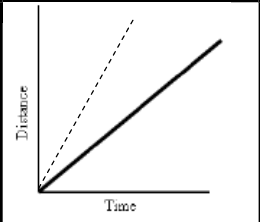
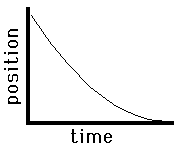
Which graph shows an object that doesn't move in the beginning?

a)
b)
c)
24.

On this graph, what is the change in velocity between 5 seconds and 8 seconds of time.

 Δv=νfvi\Delta v=\nu f-vi  

a)

25 m/s Right

b)

-25 m/s Left

c)

25 m/s/s Right

d)

30 m/s/s Right

25.

On this graph, what is the acceleration between 5 seconds and 8 seconds of time. 

 α=(νfνi)Δt\alpha=\frac{\left(\nu f-\nu i\right)}{\Delta t}  

a)

8.3 m/s/s Right

b)

-8.3 m/s/s Left

c)

-8.3 m/s Left

d)

8.3 m/s Right

26.

According to this graph did the object ever have a constant velocity?

a)

Yes, from 1 second to 5 seconds.

b)

Yes, from 8 seconds to 10 seconds

c)

No the object never had a constant velocity.

d)

Yes, from 1-5 seconds and 8-10 seconds

27.

According to the data in the graph, when is the object moving to the right with increasing velocity.

a)

a

b)

b

c)

c

d)

d

28.

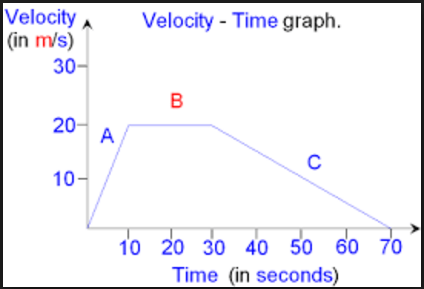
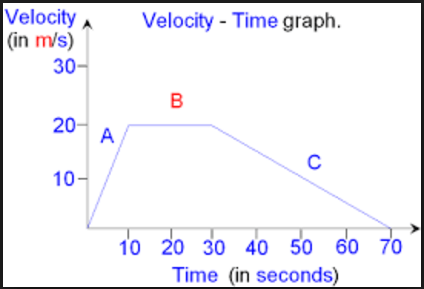
This is a velocity-time graph. What is the object doing in segment A?

a)

Speeding up

b)

Slowing down

c)

Constant Velocity

d)

Not moving

29.
This is a velocity-time graph.  What is the object doing in segment B?
a)
Positive acceleration
b)
Negative acceleration
c)
Constant Velocity
d)
Not moving
30.

This is a velocity-time graph. What is the object doing in segment C?

a)

Speeding up

b)

Slowing down

c)

Constant Velocity

d)

Not moving

31.

Describe the motion of the object in the graph

a)

Moving with constant speed

b)

Speeding up

c)

Not moving

32.
What is this graph showing?
a)
Constant Speed
b)
Acceleration (speeding up)
c)
Deceleration (slowing down)
d)
No motion
33.
Which graph shows the object standing still?
a)
A
b)
B
c)
C
d)
D
34.
Which graph represents zero acceleration (constant velocity)?
a)
A
b)
B
c)
C
d)
D
35.
Which graph represents the greatest acceleration?
a)
A
b)
B
c)
C
d)
D
36.

What is occurring on this distance vs time graph?

a)

speeding up in the positive direction

b)

moving at a constant speed in the positive direction

c)

not moving

d)

moving at a constant speed in the negative direction

37.

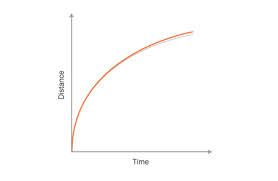
What is occurring on this distance vs time graph?

a)

Negative acceleration

b)

moving at a constant speed in the positive direction

c)

positive acceleration

d)

negative net force

38.
Polar bears are extremely good swimmers.  If a polar bear is swimming with an average of 2.6 m/s, how far will it have traveled after 120 seconds?
a)
46.2 m
b)
120 m
c)
312 m
d)
456.3 m
39.
Tree sloths are the slowest moving mammals.  On average, their velocity is 0.743 m/s.  How long does it take a tree sloth moving at this velocity to travel 22.3 m?
a)
16.6 s
b)
30.0 s
c)
0.03 s
d)
143.7 s
40.
What is the speed of a car that traveled 32 m in 2 seconds?
a)
64 m/s
b)
34 m/s
c)
16 m/s
d)
0.0625 m/s
41.
65 miles per hour North is an example of an object's what?
a)
Speed
b)
Velocity
c)
Average Speed
d)
Constant Speed
42.
10 miles per hour is an example of an object's what?
a)
Velocity
b)
Speed
c)
Acceleration
d)
Inertia
43.
What is speed?
a)
how far you go
b)
how much distance is covered over a period of time
c)
how fast you accelerate
d)
the change in the location of a object
44.
The correct equation to calculate speed is
a)
distance/time
b)
time/distance
c)
distance x time
d)
distance/time2
45.
What is velocity?
a)
the quickness of an object
b)
the location of an object
c)
acceleration
d)
speed in a specific direction
46.
How far will a person go if they jog for 2 hours at a speed of 12 km/hr?
a)
6 km
b)
0.5 km
c)
10 km
d)
24 km
47.
How long would it take for a car to travel a distance of 200 kilometers if it is traveling at a velocity of 55 km/hr? 
a)
20 min
b)
11,000 min
c)
3.6 hrs
d)
5 hrs 
48.
John took 90 minutes to bicycle to his grandmother's house, a total of six kilometers.  What was his speed (pay attention to units)? 
a)
540 km/hr
b)
.066 km/hr
c)
4 km/hr
d)
9 km/hr
49.
A girl is pedaling her bicycle at a speed of 0.10 km/min.  How far will she travel in two hours? (pay attention to units) 
a)
20 km 
b)
.2 km
c)
3 km 
d)
12 km 
50.
If you are test-driving a Bugatti Veyron and you go from 0 km/s to 124 km/s in 3.7 seconds, what was your acceleration?
a)
33.5 m/s2
b)
0.03 m/s2
c)
-33.5 m/s2
d)
-0.03 m/s2
51.
A plane lands on the runway and slows from 758 km/hr to 30 km/hr in 0.013 hours. What is the plane's acceleration?
a)
56,000 m/s2
b)
17857 m/s2
c)
-17857 m/s2
d)
-56,000 m/s2
52.
A sports car can go from 0 to 60 mph in 14 seconds. What is the acceleration?
a)
4.29 m/s2
b)
-4.29 m/s2
c)
2.33 m/s2
d)
-2.33 m/s2
53.
A marble rolling at 10 m/s slows to 2 m/s in 16 seconds. What is the acceleration of the marble?
a)
0.5 m/s2
b)
2 m/s2
c)
-0.5 m/s2
d)
-2 m/s2
54.
What is the final velocity of a rocket that travels for 4 seconds, has an initial velocity of 12 km/s and an acceleration of 2 km/s2?
a)
-4 km/s
b)
10 km/s
c)
4 km/s
d)
-10 km/s
55.
A golf ball accelerates off a tee at 15m/s2, changing its velocity from 0m/s to 50 m/s down the fairway. How long did it take the golf ball to accelerate?
a)
750 seconds
b)
35 seconds
c)
0.3 seconds
d)
3.3 seconds
56.
Acceleration is defined as the CHANGE in 
a)
time it takes for one place to move to another place. 
b)
velocity of an object.
c)
distance divided by the time interval 
d)
velocity divided by the time interval 
57.
In each of the following cases, determine where the car has no acceleration ?
a)
A car shortly after a stoplight turns green.
b)
A car approaching a red light
c)
A car with the cruise control set at 80 km/h
d)
A car turning a curve at a constant speed
58.
The SI unit for acceleration is
a)
mph
b)
ft/sec2
c)
m/s2
59.
A negative acceleration means that your object is _____. 
a)
not accelerating
b)
not moving
c)
speeding up 
d)
slowing down 
60.

A marble rolls steadily at a speed of 1 m/sec in one direction for 2 minutes. What property of the marble changes?

a)

acceleration

b)

speed

c)

position

d)

velocity