
 Worksheets
Earth and Space Review
Total questions: 70
Worksheet time: 2hrs 44mins

Name this cartoon character who lives under the sea.
Jacob Star
Patrick Star
Jordan Star
Theodore Star
two spheres are 1 meter apart. If the distance between the two spheres was increased to 2 meters, how would the gravitational attraction change?
it would decrease by a factor of 4
it would decrease by a factor of 2
it would increase by a factor of 4
it would increase by a factor of 2

in this diagram, 4 pairs of metal spheres of equal size sit on a level surface the same distance apart. Which pair of metal spheres has the greatest gravitational attraction between them?
a
b
c
d
what happens to the force between two objects if the mass of both objects is doubled?
there would be no change
the force would be cut in half
the force would be 2 times greater
the force would be 4 times greater
What happens to the force between two objects if the mass of one object is doubled?
there is no change
the force would be 4 times greater
the force would be cut in half
the force would be 2 times greater
if the distance between the Earth and the moon were to decrease, what would be the resulting impact of the gravitational force between the Earth and the moon?
the force on the moon would increase, Earth would decrease
The force on Earth would increase, the moon would decrease
The force between both would increase
The force between both would decrease
according to Kepler's first law, which of the following accurately describes the orbits of the planets?
ellipse with the sun offset from the center
circle with the sun offset from the center
ellipse with the sun in the middle
circle with the sun in the middle
According to Kepler's Laws, what happens to the speed of orbiting objects as they get closer to the sun?
slows down
speeds up
remains steady
inertia keeps it from changing
Kepler's 1st Law states that
objects orbit in an ellipse shape
objects move faster as they come closer to the object they are orbiting
planets further from the sun orbit slower than those that are closer
objects in motion stay in motion, objects at rest stay at rest
for every action there is an equal and opposite reaction
Kepler's 2nd Law states that
objects orbit in an ellipse shape
objects move faster as they come closer to the object they are orbiting
planets further from the sun orbit slower than those that are closer
objects in motion stay in motion, objects at rest stay at rest
for every action there is an equal and opposite reaction
Kepler's 3rd Law states that
objects orbit in an ellipse shape
objects move faster as they come closer to the object they are orbiting
planets further from the sun orbit slower than those that are closer
objects in motion stay in motion, objects at rest stay at rest
for every action there is an equal and opposite reaction
What is the last step in planet formation?
differentiation into layers
froze rock crust
collisions with asteriods
atmosphere creation through outgassing
Which two characteristics do all Jovian planets have
in common?
large diameters and low densities
large diameters and high densities
small diameters and low densities
small diameters and high densities
Why do scientists believe the inner solar system has terrestrial planets?
Planetesimals containing metal compounds formed toward the nebula’s warmer center
Gravitational forces attracted planetesimals made out of ice toward the center of the nebula.
Lighter planets form toward the center of a solar system similar to how a planet’s core forms.
The sun’s gravitational force attracts planets with less mass toward the solar system’s center.

What is it called when one planet spins completely around on its axis?
orbit
revolution
rotation
pattern

What are groups of stars that form patterns in the sky called?
diagrams
telescope
astronomers
constellations
What are small rocky objects in the sky that orbit the sun are called?
stars
planets
comets
meteors
What is the main source of Earth's energy?
the moon
the sun
the oceans
the trees
The farther a planet is from the sun, the
less time it will take to revolve around the sun
more time it will take to revolve around the sun
distance does not play a role

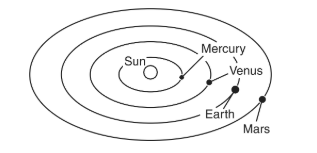
Which planet of those shown will take the least amount of time to revolve around the Sun?
Mercury
Venus
Earth
Mars

Where is the planet moving faster?
around segment A
around segment B
around either segment - the speed doesn't change
impossible to know
Which of the following is one of Kepler's Laws of Planetary Motion?
Planets move on elliptical orbits with the Sun at one focus.
The gravitational force between two objects decreases as the distance increases.
An object in motion remains in motion.
Inner planets orbit in a different direction than outer ones.

Looking at the image, which scenario (A - D) would provide the best opportunity for an observer to detect an exoplanet via the Transit Method?
Select the best possible answer!!!
A
B
C
D
What are planets outside our solar system officially called?
Ecoplanets
Exoplanets
Alien Worlds
Exoworlds

Based on the provided Light Curve of the exoplanet Kepler-4b, what is the exoplanet's approximate orbital period?
~ 3 Days
~2 Days
~4 Days
~5 Days
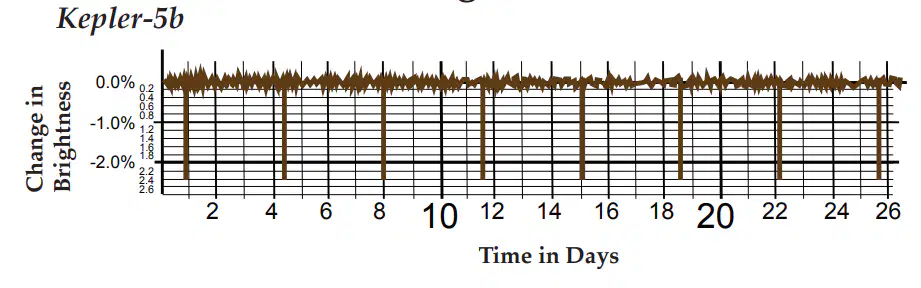
Based on the Light Curve depicting exoplanet Kepler-5b, what is the approximate orbital period of the exoplanet?
~ 3.5 Days
~ 4.5 Days
~5.5 Days
~2.5 Days
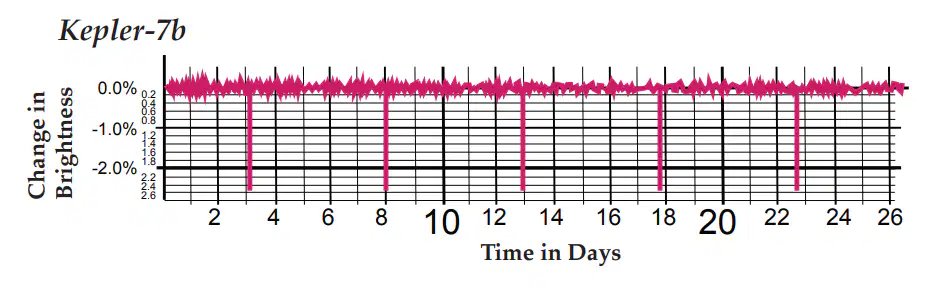
Based on the provided Light Curve of the exoplanet Kepler-7b, what is the exoplanet's approximate orbital period?
~ 2 Days
~ 3 Days
~ 4 Days
~ 5 Days

Based on the provided Light Curve, the exoplanet Kepler-9b is depicted by the green line and Kepler-9c is depicted by the brown line. Which exoplanet is larger in size?
Kepler-9b
Kepler-9c
They are the same size
On the continuous spectrum, which color has the longest wavelength
Blue
Green
Red
Yellow
As energy increases, frequency __________.
increases
decreases
As energy increases, wavelength __________.
increases
decreases

A scientist has a gas canister that contains a mixture of unknown gases. In order to identify which gases are in the mixture, they look at the spectrum of visible light emitted from it when it is heated. This is shown in the figure. Also shown in the figure are the emission spectra of several pure, gaseous elements. Which of the five elements does the mixture contain?
helium, oxygen, nitrogen, and argon
oxygen, hydrogen, and nitrogen
hydrogen, helium, and nitrogen
hydrogen and argon

Which class of star has the lowest temperature?
O
M
A
G

The absorption lines in the spectrum for Galaxy A are shifted toward the _____ end of the spectrum when compared to the lines for the Milky Way.
red
blue

The absorption lines in the spectrum for Galaxy B are shifted toward the _____ end of the spectrum when compared to the lines for the Milky Way.
red
blue

The absorption spectrum of a star is shown at the top of the image. When compared with the spectra of the pure gases below, which elements are present in the star?
hydrogen
helium
sodium
lithium

What is the name of the cloud that a star is formed in?
Nebula / Stellar Nursery
Supernova
Main Sequence
Dwarf

When a Red Giant runs out of fuel, it become a:
Supernova
Solar Nebula/stellar nursery
White Dwarf
Main Sequence Star
A small White Dwarf has a diameter similar to:
The Sun
The Earth
The Moon
A basketball

What is a protostar?
A star that has died
A smaller than average star
A big, blue star that is on the main sequence of the HR diagram
A contracting mass of gas which represents an early stage in the formation of a star


Low-mass stars like our Sun will never explode.
True
False
Luminosity is
The measure of brightness of a star.
The temperature of a star.
The mashing of atoms to create heat and light.
What is a planetary nebula?
A nebula that creates protostars.
A nebula that forms after a red giant blows off its outer layers.
The end stage of a massive star.

What is a supernova?
The measure of brightness of a star.
Something that only low mass stars can do.
A star that explodes, creating a great amount of light and energy.
What is the most common type of star?
Supergiant
Main Sequence
Red Giant
White Dwarf
What type of star is the Sun?
Supergiant
Red Giant
Main Sequence
White Dwarf
When a Red Giant runs out of fuel, it become a:
Supernova
Nebula
White Dwarf
Main Sequence Star
Which fundamental force is the strongest?
strong nuclear
weak nuclear
electric
gravity
The force that explains radioactive beta decay
strong nuclear
weak nuclear
electric
gravity


Use the Hertzsprung-Russell Diagram to answer the following question. Spica is a _____
Hot and Bright Star
Cool and Bright Star
Hot and Dim Star
Cool and Dim Star
Which unit of measurement is used to measure distances within our solar system?
inches
kilometers
miles
Astronomical units
The distance light can travel in one year is ______________
15,000 kilometers
1 light-year
15 Astronomical Units
6,000 miles
True or False: The universe is expanding.
True
False
A popular theory of the origin of the universe is _____________
adaptive structuration theory
heliocentric theory
theory of relativity
big bang theory

