
 Worksheets
10 Forces
Total questions: 68
Worksheet time: 2hrs 40mins
The action or process of moving or being moved:
motion
speed
distance
velocity
What two things do you need to determine speed (select both)?
distance
time
velocity
direction
A car is driven for 3 hours. What else do you need to know to describe this car’s speed?
The road the car in driven on
The direction the car is driven
The distance the car is driven
The direction and the distance the car is driven
The pace an object travels in a certain amount of time:
speed
acceleration
velocity
motion
What information is needed to determine how fast a truck is traveling?
direction and mass
distance and time
size and speed
time and weight
An object's speed is unchanging over its entire distance covered:
constant speed
acceleration
average speed
velocity
24km/hr South is an example of:
speed
direction
velocity
acceleration
What does velocity include? (click as many as you need to answer)
speed
direction
distance
height
Morgan walks 10 kilometres South. Trevor walks 10 kilometres North in the same amount of time. They have:
different average speeds
different velocities
same velocity
same motion
What is the speed of a runner who runs 400 meters in 40 seconds?
10 meters/second
40 meters/second
100 meters/second
1,600 meters/second
Calculate the velocity of a cyclist traveling 100km south over a period of 5 hours.
20km/h south
10km/h south
10km/h
20km/h
A trip takes 10 hours. The distance is 816 km. Calculate the average speed.
8 km/hr
81.6 km/hr
.012 km/hr
61.8 km/hr
How fast is a train moving if it travels 32km in 4 hours?
8km/h
8m/s
128m/s
128km/h
How far does a car driving 50 m/s for 10 seconds travel?
500m
50m/s
5km
5m
How long will your trip take if you travel 350 km at an average speed of 80 km/hr?
80 hours
.22 hours
4.38 hours
6 hours
How long does it take to travel 60km when going at a speed of 5km/h?
12s
12h
.08h
300km/h

The average speed of this object between points C and D is:
.375 km/s
.375 m/s
2.67 km/s
2.67 m/s
The average speed between 4 and 16 minutes is:
5.2 km/s
.192 m/s
.181 km/s
5.5 km/s
To calculate the average speed for the journey from A to C:
(distance A-B) + (distance B-C) divided by (time A-B + time B-C)
(distance 0-C) divided by (time 0-C)
(distance A-B x time A-B) + (distance B-C x time B-C) divided by (time A-B + time B-C)
(distance A-C) divided by (time A-C)

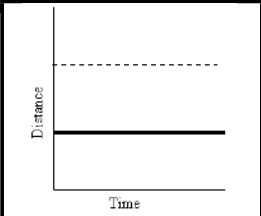
Which graph shows an object not moving?
Graph A
Graph B
Graph C
Graph D

Which graph shows an object moving at a constant rate?
Graph A
Graph B
Graph D
Graph E
A change in velocity over time is:
a scalar
speed
acceleration
motion
Acceleration of an object happens when things:
slow down
go faster
change direction (turn)
all of the above
Acceleration is the rate of change in:
force
distance
velocity
displacement
Hitting the brakes on a bike reduces its speed. This is called
acceleration
deceleration
negative acceleration
velocity
The SI unit for acceleration is
km/h/h
m/s
m/s2
A bowling ball rolls at a/an:
constant speed
average speed
top speed
constant velocity

Which graph shows an object increasing speed?
Graph A
Graph B
Graph D
Graph E

Which graph shows an object slowing down?
Graph A
Graph B
Graph C
Graph E

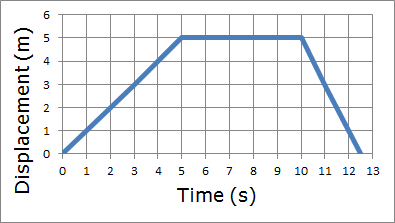
Which graph shows an object going back to the start position?
Graph A
Graph B
Graph C
Graph D

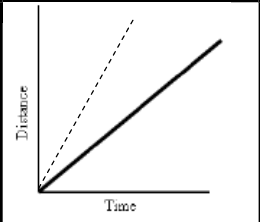
Jo watches a red car cover 2 metres every second. Which graph would represent this?
Graph A (upper left)
Graph B (bottom left)
Graph C (upper right)
Graph D (bottom right)

A car starts from a stoplight and is traveling with a velocity of 10 m/s east in 20 seconds. What is the acceleration of the car?
.5 m/s/s
.5 m/s
2 m/s/s
2 m/s
A ball is rolled at a velocity of 12 m/sec. After 36 seconds, it comes to a stop. What is the acceleration of the ball across that time?
3 m/s/s
-3 m/s/s
.33 m/s/s
-.33 m/s/s


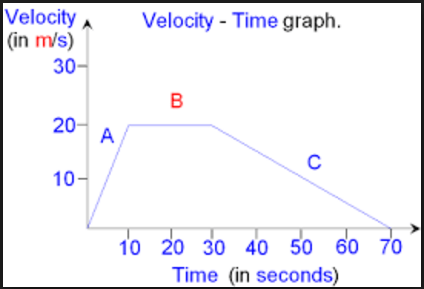
During which interval is the object travelling at a constant velocity?
B to C
D to E
F to G
It's travelling at constant velocity during all intervals shown.


An object is moving at a constant speed. The object changes direction and continues moving at the same speed. What caused the object to change direction?
Inertia
Momentum
Interia and gravity
An external force acted upon it




What type of motion ticker tape X is?
Constant velocity
Constant acceleration
Constant deceleration


When objects remain in the same place, what is acting?
Gravity
Friction
Balanced forces
Unbalanced forces

An unbalanced force is when objects move in one direction because the force is greater for that direction.
True
False
What is an example of a balanced force?
A person pushing a car across the road
Two people pushing opposite sides of a box with equal force
A boat slowing down on a lake
For an object to be moved, which is true?
Objects with less mass require less force
Objects with less mass require more force
Objects with more mass require less force
Imagine a person pushing a box across the floor. What will increase the speed of the box moving?
The person applying less force to the box
The person applying a greater force to the box
Adding more mass to the box
An automobile you are riding in suddenly stops, why does your body continue to go forward?
An object in motion stays in motion.
Gravity pulls your body towards the earth.
Friction makes your body slow down.
If you push a tennis ball, a bowling ball, and a basketball with the same amount of force, which one will go farthest?
Bowling ball
Tennis ball
Basketball
It is much more difficult to move a dresser full of clothes than an empty dresser. Why?
An object in motion stays in motion.
It takes more force to move an object with more mass.
It takes more friction to move the empty dresser.
A force of 90N is applied to each cart below, which one will accelerate the fastest?
The cart that weighs 5 kg.
The cart that weighs 10 kg.
The cart that weighs 12 kg.
The cart that weighs 15 kg.
The force exerted on a body depends upon... begins which of Newton's Laws?
First
Second
Third
Universal Gravitation
If a magician pulls a table cloth from under a table of dishes, the dishes stay in place. The reason for this:
Based on Newton's First Law, the dishes will stay in place due to inertia, the resistance to force.
Based on Newton's First Law, the dishes will stay in place due to the force of inertia
Based on Newton's Second Law, the dishes will stay in place due to inertia, the resistance to force.
Based on Newton's Third Law, the dishes will stay in place due to the force of inertia.
A body will remain in a state of rest or uniform motion... begins which of Newton's Laws?
First
Second
Third
Universal Gravitation

What is the net force shown in the diagram?
50N right
950N
50N left
150N left
For every action there is an equal... begins which of Newton's Laws?
First
Second
Third
Universal Gravitation

The amount of time it takes to move once you realise you need to act.
Reaction time
Braking time
Reaction distance
Braking distance

