
 Worksheets
APES Midterm Review
Total questions: 65
Worksheet time: 39mins
Which of the following is an abiotic component?
an eagle
a rock
a tree
a human
a virus
A population is...
All members of one species in one area
All members of all species that live in one area
All of the living and nonliving things in an area
None of these


The kangaroo rat is able to get all of the water it needs through its food and therefore, never needs to drink liquid. This animal has adapted to survive in which biome?
Forest
Tundra
Desert
Grassland

One characteristic feature of the tundra is that only the surface thaws in the summer and refreezes in the winter, leaving a permanently frozen subsoil. This characteristic is known as
Hoarfrost
Glaciation
Permafrost
Crystallization

Which biome covers most of the land mass near Earth's equator?
Desert
Grassland
Tropical rainforest
Temperate forest


The rain forest soil is
poor and rocky
frozen soil
thick and nutrient rich
thin and nutrient poor

What is the single most important difference between the marine, freshwater, and estuary biomes?
Salinity (dissolved salt)
Sunlight
Oxygen
Amount of Water

The kind of wetland formed where saltwater and fresh water meet is called
bog
estuary
swamp
marsh

An ecosystem where water covers the soil or water is near the surface of the soil is called
a desert
an ocean
an estuary
a wetland

Plants with spines and waxy leaves are well suited for life in which environment?
Desert
Temperate forest
Grassland
Tropical Rainfroest
Gas that makes up 78% of our atmosphere.
Oxygen
Nitrogen
Hydrogen
Carbon Dioxide
Which nutrient is not cycled through the atmosphere?
What is the formula for atmospheric nitrogen?
N
N2
NH3
NO3
Organisms that need nitrogen to survive.
only plants
only animals
only bacteria
all living things
Plants and animals cannot use nitrogen directly from the air.
True
False
What is the process of combining nitrogen gas with other elements to make nitrogen into usable compounds?
nitrogen composition
nitrogen fixation
ammonia
denitrification
What process occurs when dead plant and animal matter decomposes and nitrogen is released back into the atmosphere?
Assimilation
Fixation
Ammonification
Denitrification
What converts nitrogen gas into a usable form for plants and animals?
bacteria
rain
fungi
car exhaust
How is nitrogen "fixed" into a usable form for plants?
Through action of bacteria only
Through lightning only
Through action of bacteria and lightning
Through photosynthesis
How do animals get the nitrogen they need?
From the air they breathe
From the water they drink
From the food they eat
From the sun

__________ primary productivity is the total amount of energy that producers convert to chemical energy in organic molecules per unit of time.
Net
Total
Gross
Secondary

__________ primary productivity = the organic materials that remain after photosynthetic organisms in the ecosystem have used some of these compounds for their cellular energy needs (cellular respiration).
Gross
Total
Net
Secondary

The total quantity of all living matter in an area is called:
Troposphere
Net Primary Productivity
Biomass
Ecosystem

Ecological efficiency from one trophic level to the next is generally:
1%
10%
75%
90%

critical animal
pioneer species
Two male Giraffes are fighting over the last green leaf of a tree that is dying.
Intraspecific Competition
Mutualsim
Predation
Commensalism
Interspecific Competition
If you are an organism whose realized niche is to break down organic matter from the ecosystem into nutrients, you are probably a ____________.
Producer
Herbivore
Primary consumer
Decomposer
Ecosystems and living organisms create buffers against natural disasters, thereby preventing possible damage.
Provisioning
Regulating
Supporting
Cultural
Walking and playing sports in green space is not only a good form of physical exercise but also lets people relax.
Provisioning
Regulating
Supporting
Cultural
Ecosystems control pests and diseases through the activities of predators and parasites. Birds, bats, flies, wasps, frogs and fungi all act as natural controls.
Provisioning
Regulating
Supporting
Cultural
A(n) ______ in species diversity is associated with a(n) ________ in the functions an ecosystem provides.
increase; decrease
decrease; increase
decrease; unobserved change
decline; decline
What is is the study of how and why plants and animals live where they do?
Evolution
Adaptive Radiation
Biogeography
Biogeology
The theory of island biogeography suggests that species richness is affected by which of the following factors?
I. island distance from mainland
II. how the island is formed
III. island size
II only
III only
I and III
II and III
Which of the following is true about island biodiversity?
Small islands are more likely to have more immigrated species
Small islands have higher biodiversity than large islands
Small islands have more resources and as a result may have more species
Small islands have fewer resources and as a result may have fewer species
What prediction is correct about island biogeography?
Smaller islands have more resources, and will have more biodiversity
Larger islands have more space for resources, but will have less biodiversity due to competition
Islands closer to mainland will be more diverse due to more successful dispersal.
There is more diversity far away from the mainland because some species fly.

a lot of parenting


Population increases at a constant rate over time.
Exponential Growth
Logistic Growth
Stable Growth
Strategic Growth
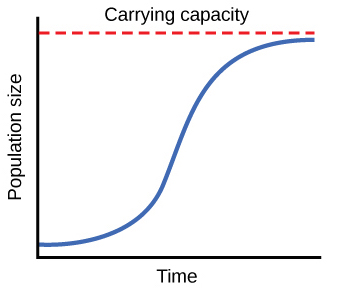

What point on the graph represents the carrying capacity?
A
B
C
D
What factor describes when populations decrease because animals are moving out of a population?
Emigration
Limiting Factors
Immigration
Exponential Growth

