
Font size
S
M
L
XL
 Worksheets
REG S1 Final - Zoology
Total questions: 63
Worksheet time: 32mins
Name
Class
Date
1.
Sponges are considered
a)
Monoblastic with only one germ layer
b)
Diploblastic with two germ layers
c)
Triploblastic with three germ layers
d)
Quadroblastic with four germ layers
2.
Sponges have what type of symmetry
a)
Bilateral symmetry
b)
Radial symmetry
c)
Asymmetry
d)
Antiparallel symmetry
3.
Archaeocytes are also known as this because they have irregular shapes
a)
Pinacocytes
b)
Choanocytes
c)
Sclerocytes
d)
Amoebocytes
4.
In addition to gathering food, what other processes are choanocytes (collar cells) important for?
a)
Contraction; regulating the surface area of the sponge
b)
Respiration; gas exchange using their flagellum
c)
Circulation; carrying the nutrients to all parts of the sponge
d)
Digestion; breaking down food
5.
Sponges are broken down into different classes based on
a)
Their primary method of reproduction
b)
The type of spicule composition in their skeleton
c)
What body form they exhibit
d)
Whether they live in saltwater, brackish water, or freshwater
6.
When sperm are released into the water by one sponge and taken into the canal system of another to be fertilized it is called
a)
Internal Fertilization
b)
External Fertilization
7.
Which term best describes an adult sponge?
a)
Sessile
b)
Sedentary
c)
Burrowing
d)
Free-swimming
8.
Which term best describes a sponge larva (baby)?
a)
Sessile
b)
Sedentary
c)
Burrowing
d)
Free-swimming
9.
Sponges are able to repair injuries and restore lost parts using what process?
a)
Regeneration
b)
Cell Recognition
c)
Reaggregation
d)
Somatic Embryogenesis
10.
What is unique about the newly discovered Harp sponge?
a)
It can grow to be several meters in height and diameter
b)
It was found in the deepest part of the ocean
c)
It is a carnivore and doesn’t feed like other sponges
d)
Its spicules have seven rays and are different from all other sponges
11.
The process a sponge uses to eat and digest its food is called
a)
Pinocytosis
b)
Phagocytosis
c)
Exocytosis
d)
Leukocytosis
12.
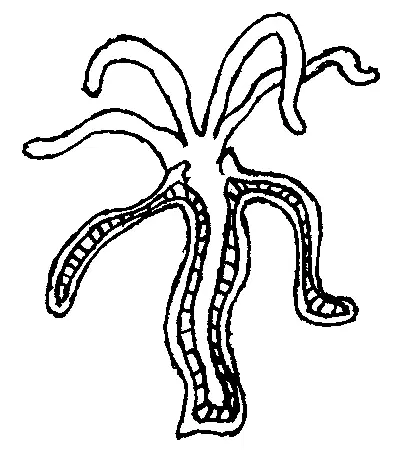
What type of symmetry does a hydra have?
a)
Asymmetry
b)
Bilateral
c)
Radial
13.
What is the advantage of asymmetry?
a)
Can catch prey from all directions
b)
Lower energy consumption
c)
Sensory organs concentrated at one end of the body
14.
What is the advantage of radial symmetry?
a)
Can sense predators from all directions
b)
Higher energy consumption
c)
Sensory organs concentrated at one end of the body
15.
What is the advantage of bilateral symmetry?
a)
Can sense prey from all directions
b)
Lower energy consumption
c)
Good muscular control for movement
16.
Why is a lack of genetic variation a disadvantage for asexually reproducing organisms?
a)
Competition is too high within the population
b)
Offspring are identical and share the same weaknesses
c)
They are unable to find mates
17.
Why was it a bad idea for oyster fishermen to cut up the predator sea stars and throw them back in the ocean?
a)
The sea stars reproduce and become an even bigger problem
b)
The sea stars decay in the water and hurt the oyster population
c)
Oysters will eat the sea star remains
18.
What is the main advantage of asexual reproduction?
a)
It takes less time and energy than sexual reproduction
b)
It is easier to find a mate than sexual reproduction
c)
Organisms have higher genetic diversity than sexual reproduction
19.
Why did primitive cultures feel it was important to classify organisms?
a)
For knowledge; so they could become better educated about the living world around them
b)
For safety; so they could determine what organisms were safe to consume and interact with
c)
For conservation; so they could use their resources wisely and not have to worry about running out
d)
For religion; they worshiped the land and many forms of life around them
20.
Who was the first scientist to (try to) classify living organisms?
a)
Ernst Mayr
b)
Charles Darwin
c)
Carolus Linnaeus
d)
Aristotle
21.
Which of the following is NOT a goal of a systematic zoologist
a)
to discover all species of animals
b)
to save all species of animals from extinction
c)
to reconstruct their evolutionary relationships
d)
to communicate those relationships by constructing an informative taxonomic system
e)
all of the above are goals of a systematic zoologist
22.
The comparative study of organismal form and structure used in today’s classification system is called:
a)
Hierarchy
b)
Physiology
c)
Morphology
d)
Phylogeny
23.
Taxonomists use ranking systems to categorize animals, this is referred to as
a)
Hierarchy
b)
Physiology
c)
Morphology
d)
Phylogeny
24.
Groups that organisms are placed into, such as phylum or family, are called
a)
Ranks
b)
Taxa
c)
Clades
d)
Classes
25.
When typing a scientific name, what font setting should be used?
a)
Bold
b)
Italics
c)
Underline
d)
Subscript
26.
When writing a scientific name, what should be used?
a)
Bold
b)
Italics
c)
Underline
d)
Subscript
27.
What two groups are used for a scientific name?
a)
Domain and Kingdom
b)
Phylum and Family
c)
Genus and Species
d)
Kingdom and Species
28.
How should the groups of a scientific name be written?
a)
The first letter of both words should be capitalized
b)
The first letter of the first word should be capitalized; the second word is lowercase
c)
The first word is lowercase; the first letter of the second word should be capitalized
d)
Both words should be all lowercase
29.
Assigning two-word names to all organisms is called
a)
Cladistics
b)
Binomial Nomenclature
c)
Dichotomy
d)
Phylogeny
30.
Based on their scientific names, which organisms are most closely related
a)
wood frog (Rana sylvatica), bullfrog (Rana catesbeiana)
b)
eastern toad (Bufo boreas), spadefoot toad (Scaphiopus hammondi)
c)
anole lizard (Anolis carolinensis), eastern narrowmouth toad (Gastrophryne carolinensis)
31.
Made of spongin and spicules
a)
Calcarea
b)
Hexactinellida
c)
Demospongiae
32.
Spicules are made of calcium carbonate
a)
Calcarea
b)
Hexactinellida
c)
Demospongiae
33.
Spicules are straight or have three or four rays
a)
Calcarea
b)
Hexactinellida
c)
Demospongiae
34.
Spicules often have six rays
a)
Calcarea
b)
Hexactinellida
c)
Demospongiae
35.
Contains mostly deep-sea forms, such as glass sponge
a)
Calcarea
b)
Hexactinellida
c)
Demospongiae
36.
Contains 95% of living sponge species, including freshwater sponges
a)
Calcarea
b)
Hexactinellida
c)
Demospongiae
37.
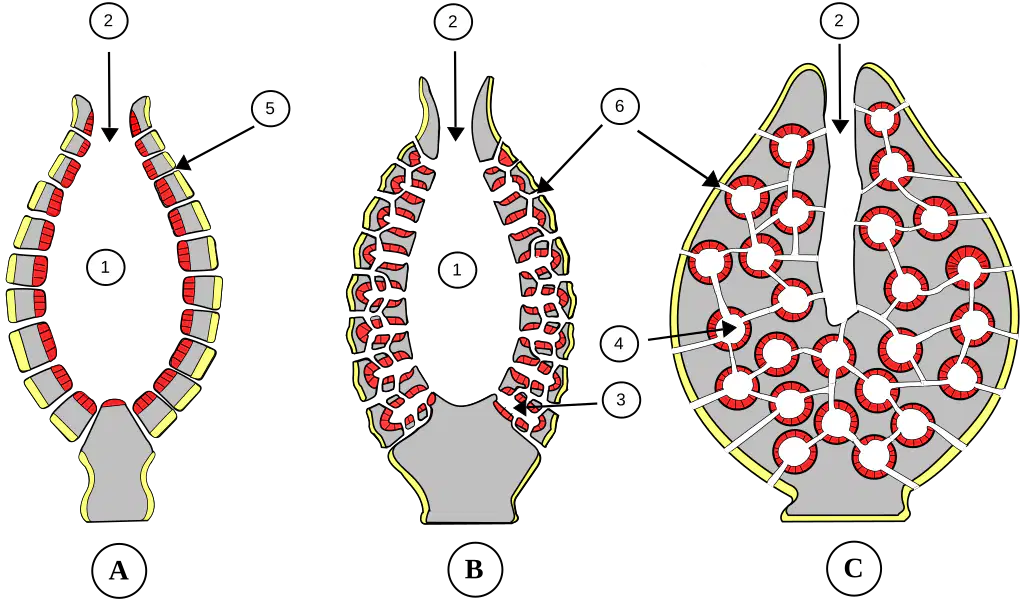
What is this body type of a sponge (Picture A)?
a)
Asconoid
b)
Syconoid
c)
Leuconoid
38.
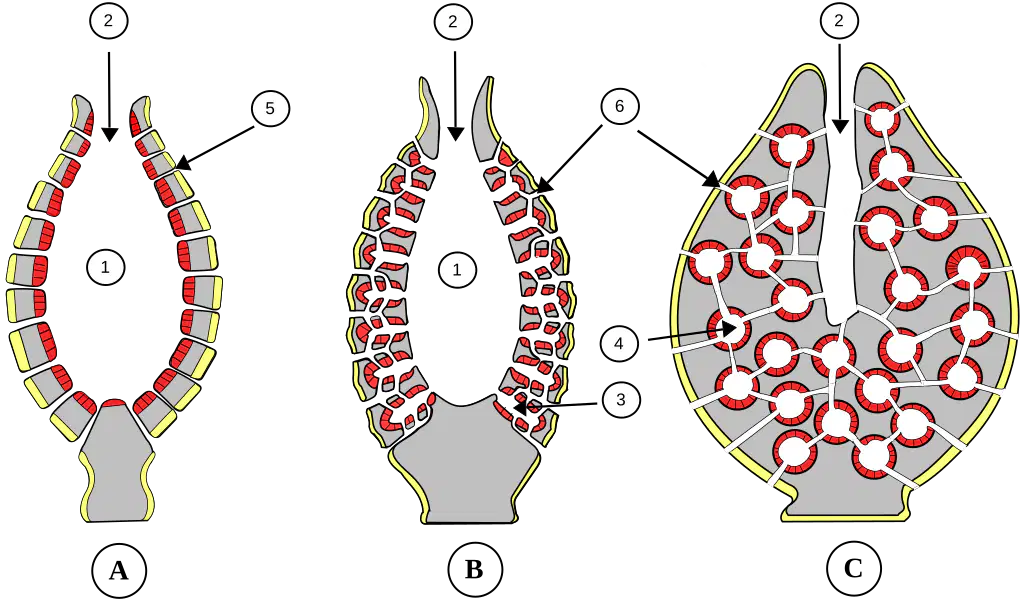
What is this body type of a sponge (Picture B)?
a)
Asconoid
b)
Syconoid
c)
Leuconoid
39.
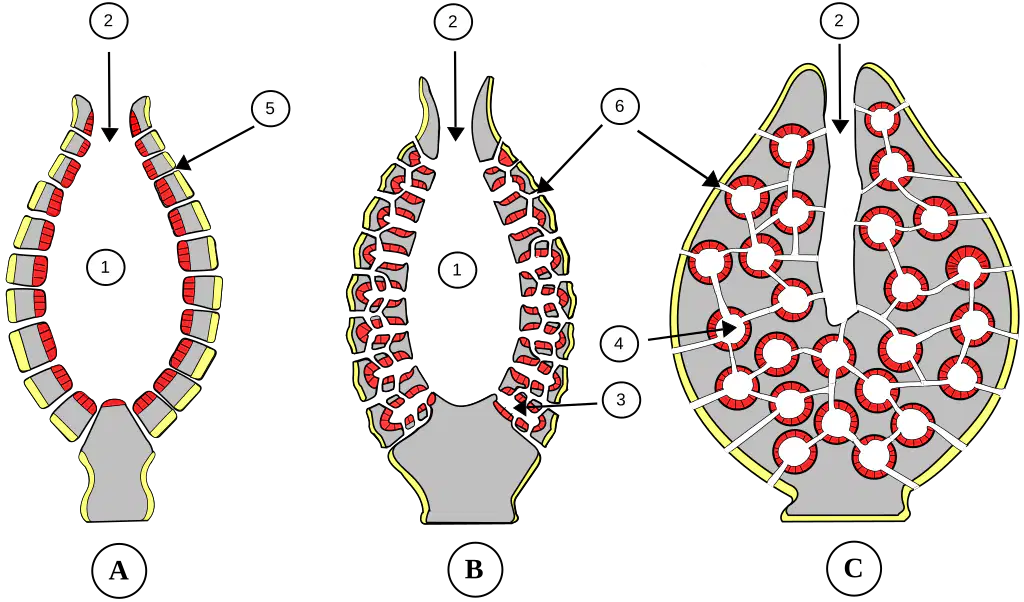
What is this body type of a sponge (Picture C)?
a)
Asconoid
b)
Syconoid
c)
Leuconoid
40.
What phylum do sponges belong?
a)
Poriferia
b)
Cnidarian
c)
Mammalia
41.
What does Phylum Porifera mean?
a)
Channels
b)
Pore Bearing
c)
Canals
d)
Regular
42.
Choanocytes are also known as _________________________ cells.
a)
Amoeba
b)
Flagellum
c)
Collar
d)
Upside down
43.
A giant barrel sponge is nicknamed the “____________________________ of the reef”
a)
Redwood
b)
Pine
c)
Oak
d)
Maple
44.
What are the two types of asexual reproduction for a sponge?
a)
Cloning and Gemmulation
b)
Cloning and Budding
c)
Budding and Gemmulation
45.
How do sponges clean the ocean?
a)
Talks to humans about what they're doing wrong in the ocean
b)
Rids of all bacteria and trash
c)
Clean the air
d)
Filter Feeders
46.
What is another way to say multicellular with a nucleus?
a)
Eukaryotic
b)
Prokaryotic
47.
The biological male gonad which produces sperm is the...
a)
Penis
b)
Testes
c)
Prostate gland
d)
Cowper's gland
48.
A sexual union to facilitate the reception of sperm by a female is...
a)
Fertilization
b)
Differentiation
c)
Copulation
d)
Cephalization
49.
Where does internal fertilization take place?
a)
Inside the body
b)
Outside the body
50.
What does the Greek root "coelom" mean?
a)
Anus
b)
Cavity / "colon"
c)
Mouth
d)
Teeth
51.
Which word does NOT describe animals?
a)
hetertropic
b)
multicellular
c)
prokaryotic
52.
In order to eat their food, what must an animal do?
a)
First ingest it, and then digest it
b)
First digest it, and then ingest it
c)
Only digest it
d)
Only ingest it
53.
The solid ball of cells that results from the dividing zygote is called
a)
Blastula
b)
Morula
c)
Gastrula
d)
Blastopere
54.
During cleavage, each cell in the embryo is called a
a)
Blastula
b)
Blastopore
c)
Blastomere
d)
Morula
55.
Early in cleavage, a cell breaks off and becomes isolated. It grows into an entire separate individual. this is an example of
a)
Mosaic development found in Deuterostomes
b)
Mosaic development found in Protostomes
c)
Regulative development found in Deuterostomes
d)
Regulative development found in Protostomes
56.
If you divided a radially symmetrical animal along any plane through its central axis, you would end up with :
a)
Roughly equal halves
b)
Front and back halves
c)
Top and bottom halves
d)
Tree pieces
57.
What type of symmetry is a Human?
a)
Radial
b)
Bilateral
c)
Asymmetrical
58.
Amphibian
a)
Vertebrate
b)
Invertebrate
59.
Bird
a)
Vertebrate
b)
Invertebrate
60.
Crustacean
a)
Vertebrate
b)
Invertebrate
61.
Echinoderm
a)
Vertebrate
b)
Invertebrate
62.
Fish
a)
Vertebrate
b)
Invertebrate
63.
Reptile
a)
Vertebrate
b)
Invertebrate
Reset

