wayground logo

Free Printable Worksheets

NEW

Font size

S
M
L
XL
Worksheets

Chemical Changes - GCSE

Total questions: 61

Worksheet time: 43mins

Name
Class
Date
1.

Which of the following is MOST reactive?

a)

Magnesium

b)

Lead

c)

Tin

d)

Copper

e)

Zinc

2.

What does displacement mean?

a)

A chemical reaction where a less reactive metal takes the place of a more reactive metal in a compound.

b)

A chemical reaction where a more reactive metal takes the place of a less reactive metal in a compound.

c)

A more reactive metal is removed from a compound.

3.

Lithium chloride + Iron → ?

a)

Lithium chloride + Iron (No change)

b)

Iron chloride + Lithium

c)

Lithium oxide + hydrogen

4.

Zinc sulphate + Magnesium → ?

a)

Magnesium + Sulphur + Hydrogen

b)

Zinc sulphate + Magnesium

c)

Magnesium sulphate + Zinc

5.
Acid + Metal --> ?
a)
Salt + Water
b)
Salt + Hydrogen
c)
Salt
d)
Hydrogen
6.

Iron + Hydrochloric acid --> ?

a)

iron(II) sulfate + water

b)

iron + hydrogen

c)

iron(II) chloride + hydrogen

d)

iron(II) chloride + water

7.

Which gas gives out a 'squeaky pop' when a lighted splint is placed in it?

a)

hydrogen

b)

oxygen

c)

carbon dioxide

d)

nitrogen

8.
Which of the following does not react with water?
a)
lithium
b)
magnesium
c)
lead
d)
calcium
9.

Metals react with acids to produce a gas

a)

Carbon dioxide

b)

Nitrogen

c)

Hydrogen

d)

Oxygen

10.

Metals are good conductor of

a)

Only heat

b)

Only electricity

c)

Heat and electricity both

d)

None of the above

11.

Metal oxides are

a)

Basic

b)

Acidic

c)

Neutral

d)

None of the above

12.
What are the reactants for the reaction of metal with water?
Metal + water ---> metal hydroxide + hydrogen
a)
Metal
b)
Water
c)
Metal and water
d)
Metal hydroxide and hydrogen
13.
What are the products for the reaction of metal with water?
Metal + water ---> metal hydroxide + hydrogen
a)
Metal
b)
Water
c)
Metal and water
d)
Metal hydroxide and water
14.
What metal hydroxide is produced when magnesium reacts with water?
a)
Copper hydroxide
b)
Magnesium oxide
c)
Magnesium
d)
Magnesium hydroxide
15.
What gas is always produced when a metal reacts with water?
a)
Oxygen
b)
Carbon dioxide
c)
Hydrogen
d)
Carbon monoxide
16.
Which metal is most likely to react with water or acid?
a)
Copper
b)
Potassium
c)
Magnesium
d)
Iron
17.
An acid reacts with metal to produce 
a)
Carbon dioxide 
b)
Hydrogen gas
c)
Hydrogen gas and water 
d)
Salt and hydrogen gas 
18.

Zinc + sulfuric acid -->

a)

Zinc sulfide + hydrogen

b)

Zinc sulfate + hydrogen

c)

Zinc sulfate + Water +Carbon dioxide

d)

Zinc sulfide + water

19.

Iron + hydrochloric acid -->

a)

Iron chloride + hydrogen

b)

Iron chloride + carbondioxide

c)

Iron hydroxide + acid

d)

Iron chloric + hydrogen

20.

During the process of reduction, _________________

a)

protons are lost.

b)

protons are gained.

c)

electrons are lost.

d)

electrons are gained

e)

neutrons are lost.

21.

Oxidation is the _________ of electrons.

a)

loss

b)

gain

c)

sharing

d)

transfer

22.

Reduction is the ___________ of electrons.

a)

loss

b)

gain

c)

sharing

d)

transfer

23.

Gaining oxygen is an example of...

a)

oxidation

b)

reduction

24.
What is an ore?
a)
a solid metal
b)
a rock cantaining a metal combined with other elements
c)
an element
d)
an object used to row a boat
25.
Which of these elements is unlikely to be found native?
a)
gold
b)
platinum
c)
aluminium
d)
silver
26.
What is the removal of oxygen from a substance called?
a)
reduction
b)
extraction
c)
electrolysis
d)
oxidation
27.
What is the addition of oxygen to a substance called?
a)
decomposition
b)
reduction
c)
oxidation
d)
extraction
28.
The pH scale is a range from:
a)
1-7
b)
0-14
c)
1-14
d)
1-20
29.
A(n) ______ is a substance with a pH less than 7
a)
Acid
b)
Alkaline
c)
Base
d)
Buffer
30.
A(n) _______ is a substance with a pH greater than 7.
a)
Base
b)
Acid
c)
Buffer
d)
Water
31.
Which solution releases H+ in solution?
a)
Base
b)
Acid
c)
Buffer
d)
Water
32.
This substance releases OH- into solution
a)
Acid
b)
Base
c)
Neutral
33.

A chemical dye that can be added to a substance that changes colour depending on whether the substance is acidic, neutral or alkaline.

a)

A poison

b)

An alkali

c)

An acid

d)

An indictor

34.

An acid that fully dissociates in solution to produce a high concentration of hydrogen ions.

a)

a weak acid

b)

a strong acid

c)

a weak alkali

d)

a strong alkali

35.

An acid that only partially dissociates in solution forming only a low concentration of hydrogen ions.

a)

a strong acid

b)

a strong alkali

c)

a weak acid

d)

a weak alkali

36.
What is the name of the reaction when an acid react with alkali?
a)
Displacement
b)
Neutralization
c)
Precipitation
37.
An alkali that ionises completely in water to produce a higher concentration of hydroxide ion. 
This statement is referring to.. 
a)
Alkali
b)
Strong alkali
c)
Weak alkali
38.
An acid reacts with a metal carbonate to produce 
a)
Salt, water and hydrogen gas
b)
Salt, water and carbon dioxide
c)
Limewater
d)
Salt and water 
39.
Complete the following reaction:
Sulphuric acid + sodium carbonate
--> 
a)
Carbon dioxide + water 
b)
calcium carbonate + water + carbon dioxide 
c)
Sodium sulphate + water + carbon dioxide 
d)
Sodium chloride + water + carbon dioxide 
40.
Complete the following reaction:
Hydrochloric acid + magnesium hydroxide --> 
a)
Magnesium chloride + water 
b)
Magnesium + water
c)
Magnesium chloride + hydrogen gas 
d)
Magnesium chloride + water + carbon dioxide 
41.
What elements make up Copper sulphate? CuSO4
a)
copper, sulphate
b)
copper, sulphur
c)
copper, sulphur and oxygen
d)
copper and oxygen
42.
Magnesium and hydrochloric acid are mixed together in a beaker, hydrogen is produced as well as magnesium chloride.
Choose correct word equation
a)
magnesium chloride + hydrogen --> magnesium + hydrochloric acid
b)
magnesium + hydrochloric acid --> magnesium chloride + hydrogen
43.

Evaporation separates a mixture by

a)

Moving a mixture over another as it stays still

b)

Using heat to change a liquid to a gas

c)

Using both evaporation and condensation

d)

Separating chemicals from water and air

44.
Which statement correctly describes the 2 electrodes?
a)
The anode is negative and the cathode is positive
b)
The anode and cathode are both positive
c)
The anode is positive and the cathode is negative
d)
The anode and cathode are both negative.
45.

___________ electrode is an inert electrode.

a)

Copper

b)

Iron

c)

Carbon

d)

Zinc

46.
Positive ions (cations) will move towards the cathode (-) where they will discharge by....
a)
Breaking apart
b)
Losing electrons
c)
Clumping together.
d)
Gaining electrons
47.

Ionic compounds do not conduct electricity when they are solid because,

a)

their electrons are not free to move

b)

their ions are free to move

c)

their ions are not free to move

d)

their electrons are free to move

48.
In an aqueous solution of copper chloride, which ions are attracted to the negative electrode?
a)
Cu2+ and Cland Hand OH-
b)
Cu2+ and H
c)
 Cland OH-
d)
Cu2+ 
49.

What are the ions present in molten Al2O3?

a)

Al2+ and O3-

b)

Al2- and O3+

c)

Al3+ and O2-

d)

Al3- and O2+

50.

Oxidation is loss of electron. Where does oxidation take place during electrolysis.

a)

At anode

b)

In the electrolyte

c)

At the circuit

d)

At cathode

51.
What is the name of the positive electrode?
a)
cathode
b)
anode
52.
What is the name of the negative electrode?
a)
cathode
b)
anode
53.

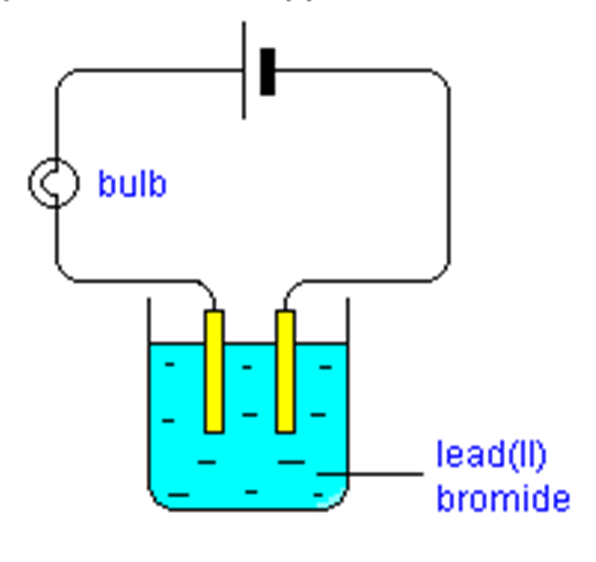
The diagram shows the electrolysis of lead(II) bromide using inert electrodes. Why does the bulb only light up when the lead(II) bromide is melted?

a)

Bromine atoms in lead(II) bromide are converted to ions when it is melted

b)

Electrons flow through the lead(II) bromide when it is melted

c)

The ions in lead(II) bromide are mobile charge carriers in the molten state.

d)

There are no ions in solid lead(II) bromide

54.

In electrolytic cell that uses aqueous copper(II) sulfate as electrolyte and copper plates as electrodes, what is the product at the anode?

a)

Oxygen gas and water

b)

Copper metal

c)

Copper(II) ions

d)

Hydrogen gas

55.

Anions get discharged by ________ electrons at the ___________

a)

gaining, cathode

b)

losing, anode

c)

gaining, anode

d)

losing, cathode

56.
What is electrolysis?
a)
breaking down of a compound using a current
b)
making a compound using a current
57.
Explain why the electrolyte has to be a liquid.
a)
So the ions can move
b)
So the electrons can move
c)
So that it doesn't get too hot
d)
So the fish are ok
58.
What does the Cathode (-) do to ions?
a)
Give electrons to the Positive ions to turn them back into atoms
b)
Take electrons from the positive ions?
c)
Turn ions back into atoms by removing electrons
d)
Turn atoms into ions by adding electrons
59.
Describe oxidation in terms of electrons
a)
oxidation is gain of electrons
b)
oxidation is loss of electrons
60.
Describe reduction in terms of electrons
a)
reduction is gain of electrons
b)
reduction is loss of electrons
61.
What type of charge does a metal ion have?
a)
+
b)
-