wayground logo

Free Printable Worksheets

NEW

Font size

S
M
L
XL
Worksheets

MuScLeS!

Total questions: 57

Worksheet time: 39mins

Name
Class
Date
1.
Which one is NOT a type of muscle tissue?
a)
Skeletal 
b)
Smooth 
c)
Rough 
d)
Cardiac 
2.
Select a type of muscle that is "striated".
a)
Skeletal 
b)
Smooth 
c)
Cardiac 
d)
They're all striated 
3.
Which of the following types of muscle is voluntary?
a)
Smooth 
b)
Cardiac 
c)
Skeletal 
4.
The heart is a type of _______ muscle.
a)
Smooth 
b)
Cardiac
c)
Skeletal 
5.

Which statement best describes the location of the Perimysium?

a)

It surrounds the entire muscle.

b)

It surrounds the sarcomere.

c)

It surrounds each fascicle.

d)

It surrounds the myofiber.

6.
Number 3 represents which of the following events
a)
action potential reaches the axon terminal
b)
sodium rushes into the muscle fiber
c)
potassium leaving the muscle fiber
d)
ACh crossing the synaptic cleft
7.
Z represents
a)
Dendrite
b)
Axon Terminal
c)
Neurotransmitters
d)
Synapse
8.
Skeletal Muscle contraction is initiated when the ________ sends a message to the muscle cell.  
a)
Muscle cell
b)
Neuron
c)
Gland
d)
None of the above
9.
What is the structure that stores the Calcium in the muscle cell.  
a)
Sarcoplasm
b)
Sarcolemma
c)
Sarcoplasmic Reticulum
d)
Myoglobin
10.
What two chemicals are necessary for muscle contraction to occur?
a)
Niacin and Potassium
b)
Calcium and ATP
c)
Sodium and Potassium
d)
Ach and Potassium
11.
Identify one factor that can cause the first sodium channel to open in a muscle cell.  
a)
Calcium ions being released from the sarcoplasmic reticulum.
b)
Acetylcholine being released from the motor neuron
c)
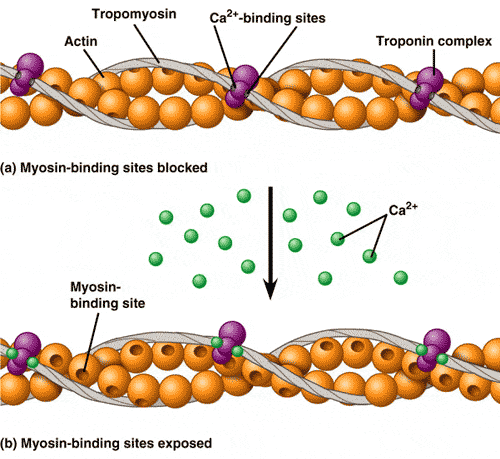
Calcium ions binding to troponin
d)
ATP causing the myosin heads to pop up.  
12.
The mechanism of muscle contraction.
a)
sarcoplasmic reticulum
b)
fasciitis
c)
sliding filament mechanism
d)
muscle cramps
13.
Region where a motor neuron comes in close contact with a muscle cell.
a)
neurotransmitter
b)
muscular dystrophy
c)
muscle tension
d)
neuromuscular junction
14.
Calcium:
a)
causes ATP binding to actin
b)
increases the action potential along the sarcolemma
c)
binds to proteins on myosin
d)
triggers the binding of myosin to actin
15.
The mitochondria is represented by
a)
9
b)
10
c)
11
d)
12
16.
The gap between the neuron and muscle cell is called a __________.
a)
Synapse
b)
motor end plate
c)
Tight Junction
d)
Acetylcholine Junction
17.
The connective tissue that is found just above the muscle is called?
a)
Fascia
b)
Epimysium
c)
Perimysium
d)
Endomysium
18.
The connective tissue that surrounds each fascicle is called?
a)
Fascia
b)
Epimysium
c)
Perimysium
d)
Endomysium
19.
The connective tissue that surrounds each muscle fiber is called?
a)
Fascia
b)
Epimysium
c)
Perimysium
d)
Endomysium
20.
Myofibrils are made up of two types of proteins known as?
a)
Actin and Myosin
b)
Troponin and Tropomyosin
c)
Myoglobin and hemoglobin
d)
none of these
21.

Muscles are responsible for producing most of our:

a)

body heat

b)

white blood cells

c)

protein synthesis

d)

erythrocytes

22.

If you do not exercise your muscles, they will become weak, flaccid, and will begin to:

a)

hypertrophy

b)

atrophy

c)

fill with fluid

d)

become myosclerotic

23.
When a muscle contracts, it _______
a)
gets longer
b)
gets shorter
c)
gets thinner
d)
grows hair
24.

ATP is required for muscles to contract. Which of the following statements is FALSE?

a)

ATP is used to get the cross‐bridges to bind to actin.

b)

ATP is used to get the cross‐bridges to disconnect from actin.

c)

ATP is used to get the troponin‐tropomyosin complex to move in such a manner to expose the binding sites.

25.

Which source of ATP lasts the longest and is the most efficient?

a)

creatine phosphate

b)

anaerobic glycolysis

c)

aerobic respiration

26.

What source of fuel is mainly used during a sprint?

a)

creatine phosphate

b)

anaerobic glycolysis

c)

aerobic respiration

27.
Skeletal muscle fatigue occurs because of
a)
inadequate numbers of mitochondria
b)
the feedback loop is not working
c)
a total lack of ATP
d)
insufficient intracellular quantities of ATP due to excessive consumption
28.
situation in which muscle loses its ability to contract, due to being used strenuously for a long period of time
a)
muscle pain
b)
muscle cramp
c)
muscle fatigue
d)
oxygen debt
29.
If you try your best Hulk impression and try to flip a truck, you will (along with pulling something) experience an _____ contraction because your muscle will not be able to shorten. 
a)
Isotonic
b)
Isometric
30.

What type of contraction is happening here??

a)

isostabilize

b)

isokinetic

c)

isotonic

d)

isometric

31.
Identify the muscle
a)
deltoid
b)
sternocleidomastoid
c)
pectoralis
d)
trapezius
32.
Identify the muscle
a)
pectoralis
b)
deltoid
c)
rectus abdominus
d)
triceps brachii
33.
Identify the muscle
a)
gastrocnemius
b)
Achilles tendon
c)
biceps femoris
d)
frontalis
34.
Standing on tip toe
a)
Dorsiflexion
b)
Inversion
c)
Plantarflexion
d)
Eversion
35.
Flexion...
a)
Decreases angle of the joint
b)
Increases angle of the joint
c)
Moves limb away from midline
d)
Moves limb towards midline
36.
Extension...
a)
Increases angle of the joint
b)
Decreases angle of the joint
c)
Standing on tiptoe
d)
Rotates limb at proximal joint
37.
Movement of a limb toward the body midline is called...
a)
Flexion
b)
Adduction
c)
Supination
d)
Abduction
38.
Moving limb away from midline is called....
a)
Pronation
b)
Abduction
c)
Adduction
d)
Flexion
39.
Proximal end of a limb is stationary and distal end moves in a circle
a)
Rotation
b)
Adduction
c)
Circumduction
d)
Abduction
40.
Turn sole of foot so it faces medially
a)
Eversion
b)
Inversion
c)
Plantarflexion
d)
Dorsiflexion
41.

During the first few minutes of exercise, the exercising muscle uses different energy sources to produce the ATP molecules necessary for contraction. Given the following sources of ATP production:

  1. anaerobic respiration
  2. aerobic respiration
  3. breakdown of creatine phosphate


Choose the arrangements that lists the energy sources in the order they are used.

a)

1,2,3

b)

1,3,2

c)

2,1,3

d)

2,3,1

e)

3,1,2

42.
A sphincter muscle is an example of which type of muscle fiber arrangement?
a)
Fusiform
b)
Triangular
c)
Circular
d)
Unipennate
43.
_________________________muscles have a tendon attached at both ends, but at one end they are attached by fascicles
a)
skeletal 
b)
pennate 
c)
cardiac 
44.
Which muscle do you sit on while watching Christmas movies?
a)
tricep 
b)
bicep 
c)
Gluteus Maximus 
45.
Which term best describes a muscle that tapers to a tendon on both ends?
a)
strap
b)
fusiform
c)
pennate
d)
bipennate
46.

This muscle helps to elevate the mandible (2)

a)

frontalis

b)

occipitalis

c)

temporalis

d)

platysma

47.

This muscle puckers the lips (15)

a)

orbicularis oris

b)

orbicularis oculi

c)

zygomaticus

d)

masseter

48.

This muscle elevates the mandible (5)

a)

frontalis

b)

zygomaticus

c)

platysma

d)

masseter

49.

Who is mostly affected by Duchenne Muscular Dystrophy?

a)

Males

b)

Females

50.
torn or overstretching of a muscle
a)
Back pain
b)
Muscle Sprain
c)
Muscle Strain
d)
Muscular dystrophy
51.
•Inherited
•Progressive muscle atrophy
Severe X-linked form occurs in 1 of every 3000 – 5000 boys; can be detected with 95% accuracy in pregnancy
a)
Muscular dystrophy
b)
Fibromyalgia
c)
Myasthenia gravis
d)
Gangrene
52.
a)
Latissimius Dorsi
b)
Trapezius
c)
Triceps
d)
Erectors
53.
Name this muscle.
a)
Tricep
b)
Trapezius
c)
Biceps Brachii
d)
Tres Major
54.
What is the name of this muscle?
a)
Vastus medialis
b)
Bicep Femoris
c)
Rectus Abdominus
d)
External Obliques
55.
#6?
a)
external oblique
b)
internal oblique
c)
transverse abdominis
d)
rectus abdominis
56.
The _______ is where the muscle meets the bone that DOESN'T move
a)
Origin
b)
Insertion
c)
Flexor
d)
Exensor
57.
The _______ is where the muscle meets the bone that DOES move
a)
Origin
b)
Insertion
c)
Flexor
d)
Exensor