
 Worksheets
exam 3 review
Total questions: 55
Worksheet time: 45mins
Name
Class
Date
1.

Which stage of the cell cycle is shown in the diagram?
a)
Prophase
b)
Interphase
c)
Anaphase
d)
Telophase
2.

The structure shown in the diagram is a _____________?
a)
chromatid
b)
chromosome
c)
centromere
d)
DNA
3.

Which stage of mitosis is shown in the diagram?
a)
Anaphase
b)
Cytonkinesis
c)
Interphase
d)
Prophase
4.

What is the name of the structure labeled X?
a)
Centriole
b)
Centrosome
c)
Chromatid
d)
Chromosome
5.

What structure is the red arrow pointing to?
a)
chromosome
b)
centromere
c)
chromatid
d)
centriole
6.

Which stage of mitosis is shown in the diagram?
a)
Cytokinesis
b)
Interphase
c)
Anaphase
d)
Metaphase
7.

Which is Metaphase?
a)
A
b)
E
c)
C
d)
F
8.

How many chromosomes do humans have?
a)
46
b)
21
c)
10
9.

Which stage of mitosis is shown in the diagram?
a)
Cytokinesis
b)
Anaphase
c)
Telophase
d)
Prophase
10.

Which structures are indicated by the green arrows?
a)
sister chromatids
b)
chromosomes
c)
spindle fibers
d)
centrioles
11.

Which stage of mitosis is shown in the diagram?
a)
Anaphase
b)
Cytokinesis
c)
Telophase
d)
Metaphase
12.
How many cells are made in the process of MITOSIS?
a)
one
b)
two
c)
four
d)
eight
13.

Cytokinesis happens at the end of mitosis. That is when
a)
the cell membrane splits
b)
the nucleus splits again
c)
the chromosomes merge
14.

Which stage of cell division is shown in the diagram?
a)
Anaphase
b)
Metaphase
c)
Cytokinesis
d)
Telophase
15.

Why would it be important to replicate DNA before a cell divides in mitosis or meiosis?
a)
In order for genetic information to be transferred into daughter cells.
b)
In order for the cell to be able to increase in size.
c)
In order for the DNA to be contained in the nucleus.
d)
In order for the cell to re-order the DNA sequencing in the new cells.
16.

In mitosis, the two resulting cells are
a)
different from the starting cell and identical to each other.
b)
different from the starting cell and different from each other.
c)
identical to the starting cell and different from each other.
d)
identical to the starting cell and identical to each other.
17.

Highly coiled strand of DNA
a)
Chromatin
b)
Chromosome
c)
Sister Chromatid
d)
Centeromere
18.
Attaches the two identical sister chromatids to form a chromosome.
a)
Chromatin
b)
Chromosomes
c)
Sister Chromatid
d)
Centromere
19.

What structure is the blue arrow pointing to?
a)
chromatid
b)
chromosome
c)
centromere
d)
centriole
20.
Chromosomes are copied during which phase of the cell cycle?
a)
M phase
b)
G1 phase
c)
G2 phase
d)
S phase
21.
The correct order of the phases of mitosis and meiosis could be abbreviated as:
a)
MAPT
b)
PAMT
c)
TPAM
d)
PMAT
22.
The nuclear membrane dissolves during
a)
Prophase
b)
Metaphase
c)
Anaphase
d)
Telophase
23.
The process of crossing over occurs in what phase of meiosis?
a)
anaphase 1
b)
prophase 1
c)
prophase 2
d)
telophase 1
24.

What phase is shown here?
a)
Prophase II
b)
Metaphase I
c)
Metaphase II
d)
Anaphase I
25.

What phase is shown here?
a)
Anaphase II
b)
Metaphase I
c)
Anaphase I
d)
Telophase II
26.

What phase is shown here?
a)
Metaphase II
b)
Telophase I
c)
Telophase II
d)
Metaphase I
27.

What phases is shown here?
a)
Prophase II
b)
Prophase I
c)
Anaphase II
d)
Interphase I
28.

What phase is shown here?
a)
Anaphase I
b)
Prophase I
c)
Metaphase II
d)
Metaphase I
29.

What phase is shown here?
a)
Telophase II
b)
Anaphase II
c)
Metaphase I
d)
Interphase I
30.

What phase is shown here?
a)
Telophase I
b)
Metaphase II
c)
Telophase II
d)
Anaphase I
31.

What phase is this?
a)
Interphase II
b)
Prophase I
c)
Metaphase I
d)
Anaphase II
32.
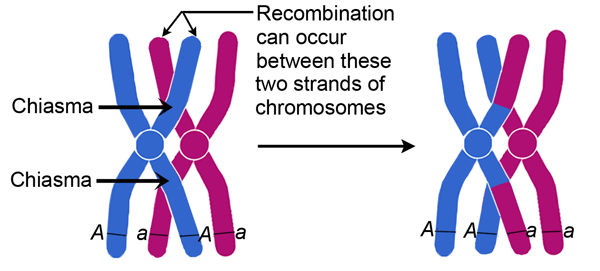
This image shows chromosomes during Prophase 1. Which of the following correctly describes the process shown?
a)
segregation of sister chromatids
b)
condensation and segregation of alleles
c)
mutationin which the DNA content of the gene is altered
d)
crossing - over in which alleles are exchanged
33.
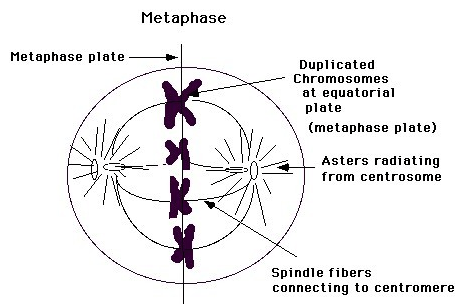
Which of the following phases of mitosis is represented by the diagram below?
a)
prophase
b)
metaphase
c)
anaphase
d)
telophase
34.

What phase is shown in the picture?
a)
anaphase 1
b)
anaphase 2
c)
metaphase 1
d)
telophase 1
35.
What phase is shown in the picture?
a)
anaphase 1
b)
anaphase 2
c)
metaphase 1
d)
telophase 1
36.

If green is dominant over purple, then what is the genotype for this individual?
a)
Purple
b)
Green
c)
GG
d)
gg
37.

Which is the correct phenotype for this organism?
a)
BB
b)
blue
c)
green
d)
bb
38.
Incomplete dominance means that the traits are
a)
expressed equally
b)
dominant
c)
recessive
d)
blended
39.

If you cross a black guinea pig with a white guinea pig and the offspring are gray, what type of dominant trait would that be.
a)
incomplete dominance
b)
codominance
c)
codependant
d)
cooperative
40.
One form of a gene is called_______________
a)
a DNA
b)
a Phenotype
c)
a trait
d)
an allele
41.

An offspring will receive how many alleles from each parent to determine a specific trait?
a)
one
b)
two
c)
three
d)
five
42.
Which of the following is a phenotype?
a)
BB
b)
Bb
c)
bb
d)
Blue eyes
43.
having two of the same genes for the trait (sometimes called purebred).
a)
homozygous
b)
hetrozygous
c)
protein
d)
chromosome
44.

A heterozygous long-tusked elephant is crossed with a homozygous recessive short-tusked elephant. What is the probability of the offspring having short tusks?
a)
0%
b)
25%
c)
50%
d)
75%
45.

Why are there no white rabbit babies?
a)
The white gene is not present in any of the babies.
b)
It takes two recessive genes to show the trait.
c)
Grey is a better color.
d)
Baby five will be white.
46.

In pea plants, the tall allele is dominant to the short allele. What key would demonstrate this?
a)
Tall = T
Short = S
Short = S
b)
Tall = T
Short = t
Short = t
c)
Tall = t
Short = T
Short = T
d)
Tall = TT
Short = tt
Short = tt
47.

In rabbits, black fur (B) is dominant over brown fur (b). If a rabbit has brown fur, what can you conclude about its genotype?
a)
It is BB.
b)
It is Bb
c)
It is brown
d)
It is bb.
48.
One dog carries homozygous, long-haired traits (SS), and its mate carries homozygous short-haired traits (ss). Use a Punnett square to determine the probability of one of their offspring having long hair.
a)
100%
b)
75%
c)
50%
d)
25%
49.

What are the possible genotypes for this cross?
(Click the picture to see it without the text)
(Click the picture to see it without the text)
a)
TT = 25% Tt= 50% tt=25%
b)
all tall
c)
TT= 75% tt = 25%
d)
Tt = 100%
50.

This is an example of
a)
Complete dominance
b)
Mendelian Genetics
c)
Codominance
d)
Incomplete Dominance
51.

This punnett square shows a cross between
a)
A hybrid Parent and a Homozygous parent
b)
A heterozygous parent and a heterozygous parent
c)
Two homozygous parents
d)
Two Hybrid Parents
52.
Which of the following genotypes is homozygous dominant?
a)
Yy
b)
yY
c)
yy
d)
YY
53.
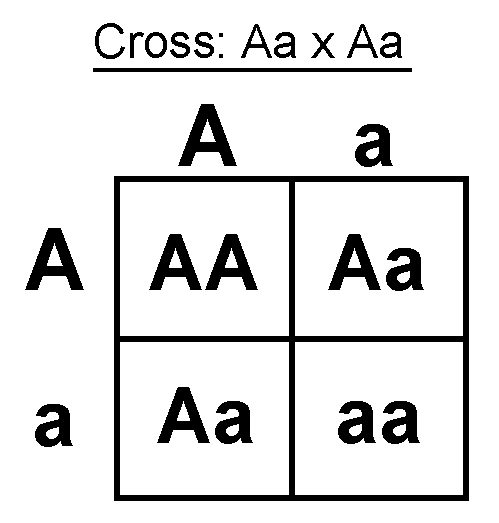
What are the phenotype percentages of the offspring?
(A-Brown fur color; a-white fur color)
a)
50 % Brown fur and 50% White fur
b)
25 % Brown fur and 75% White fur
c)
75 % Brown fur and 25% White fur
d)
0% Brown fur and 100% White fur
54.
B=Brown fur
b=tan fur
What percent of the offspring would be tan when you cross BbxBb?
a)
75%
b)
25%
c)
50%
d)
100%
55.
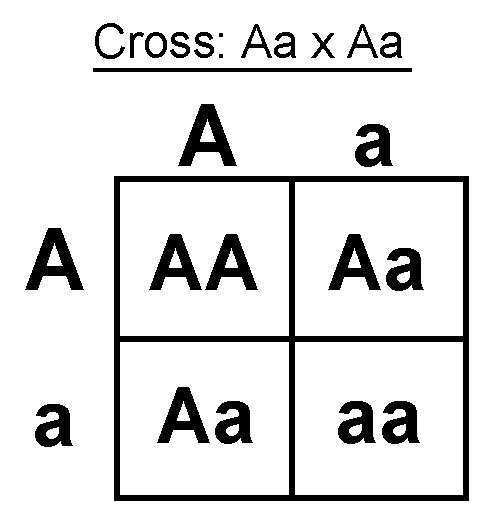
What is the genotypic ratio of the offspring?
a)
3:1
b)
1:3
c)
1:2:1
d)
2:2
100 %

