wayground logo

Free Printable Worksheets

NEW

Font size

S
M
L
XL
Worksheets

Kuhl - Unit 3 Review

Total questions: 50

Worksheet time: 1hrs 21mins

Name
Class
Date
1.
Has membrane bound organelles
a)
Prokaryote
b)
Eukaryote
c)
both
2.

Which has ribosomes?

a)

Prokaryote

b)

Eukaryote

c)

both

3.
How are prokaryotes and eukaryotes different?
a)
prokaryotes are larger
b)
eukaryotes have a nucleus
c)
eukaryotes are simpler
d)
prokaryotes are more complex
4.
Identify the part of the membrane identified as A.
a)
carbohydrate
b)
cholesterol
c)
protein
d)
phospholipid
5.
In what organelle is the genetic material found inside?
 
a)
Endoplasmic Reticulum
b)
Golgi Complex
c)
Nucleolus
d)
Nucleus
6.

What is the function of the organelle labeled number 6?

a)

To store food

b)

To store sunlight

c)

To produce energy

d)

To direct cell activities and store information transferred from parent to child.
7.
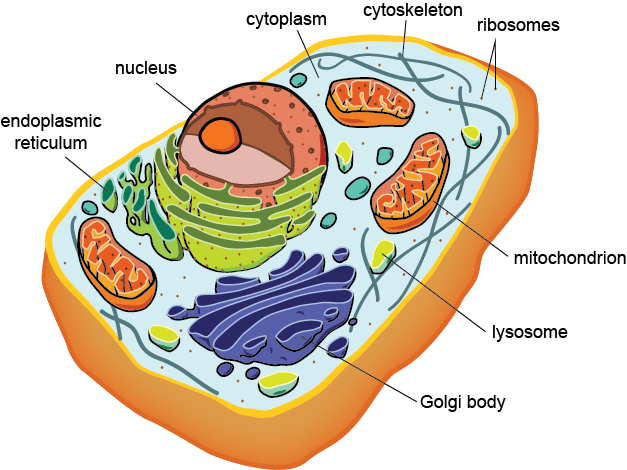
Which of the following statements is not part of the cell theory?
a)
Cells are the basic unit of structure and function in all living things.
b)
All cells are produced from other cells.
c)
Only animal cells are composed of cells.
d)
All living things are composed of cells.
8.
Which statement is a part of the cell theory?
a)
all cells come from preexisting cells
b)
bacteria are prokaryotic cells
c)
eukaryotic cells are complex
d)
humans are multicellular
9.
All protists are __________________________.
a)
Prokaryotic
b)
Eukaryotic
c)
Unicellular
d)
Multicellular
10.

How do you know this organism is a eukaryote?

a)

It has a nucleus and membrane bound organelles.

b)

It has a cell membrane.

c)

It is unicellular.

d)

It has cytoplasm.

11.

Is this organism a prokaryote or eukaryote? How do you know?

a)

Prokaryote - it has no membrane bound organelles.

b)

Eukaryote - it has membrane bound organelles.

c)

Prokaryote - it is unicellular

d)

Eukaryote - it is unicellular

e)

It is impossible to tell.

12.
This is a picture of the......
a)
cell membrane
b)
phospholipid bilayer
c)
plasma membrane
d)
all of these
13.
Which component of the cell membrane functions to isolate the cell from its environment?
a)
carbohydrates
b)
cholesterol
c)
phospholipids
d)
proteins
14.
What is the main function of chloroplast?
a)
Mitosis
b)
Meiosis
c)
Translation
d)
Photosynthesis
15.
In which organelle (part of the cell) does photosynthesis take place?
a)
mitochondria
b)
chloroplast
c)
nucleus
d)
cell membrane
16.
What are tiny organelles that convert glucose into ATP?
a)
Ribosomes
b)
Vesicles
c)
Cytoskeleton
d)
Mitochondria
17.

This organelle breaks down glucose and converts the energy from carbohydrates into ATP

a)

Chloroplast

b)

Mitochondria

c)

Lysosome

d)

Ribosome

18.

What is the primary function of the cell wall in plants?

a)

Passage of materials into and out of the cell

b)

Protection and rigidity

c)

Storage and shipment of proteins

d)

Production of proteins

e)

Production of ATP

19.
A rigid layer that lies outside the cell's  membrane is...
a)
Cytoskeleton
b)
Cilia
c)
Cell Wall
d)
Flagella
20.
Which organelle belongs in plant cells only?
a)
Cytoplasm
b)
Mitochondrion
c)
Large Central Vacuole
d)
Cell Membrane
21.
Which organelle belongs in both plant and animal cells?
a)
Cytoplasm
b)
Chloroplast
c)
Large Central Vacuole
d)
Cell Wall
22.
Which organelle belongs in plant cells only?
a)
Cell Membrane
b)
Mitochondrion
c)
Chloroplast
d)
Nucleus
23.
One example of a prokaryote is a...
a)
fungus
b)
bacteria
c)
animal
d)
plant
24.
Which is true of prokaryotic and eukaryotic cells?
a)
Prokaryotic cells are larger than eukaryotic cells.
b)
Eukaryotic cells do not have nuclei, and prokaryotic cells do have nuclei.
c)
Prokaryotic cells lack membrane-bound organelles, and eukaryotic cells contain membrane-bound organelles.
d)
Eukaryotic cells are simpler than prokaryotic cells.
25.
What is the location in the cell for translation?
a)
nucleus
b)
mitochondria
c)
ribosome
d)
chloroplast
26.
The process to go from DNA to mRNA is _______
a)
translation
b)
transcription
c)
replication
27.
The process to go from mRNA to a protein is called ____
a)
transcription
b)
rRNA
c)
replication
d)
translation
28.
You might think of me as the trash collector or recycler is maybe more accurate. What am I?
a)
cytoplasm
b)
lysosme
c)
vacuole
d)
ribosome
29.

This small structures break down materials in the cell, including removing entire cells such as when fingers are being made during animal development.

a)

Cholorplasts

b)

Ribosomes

c)

Lysosomes

d)

Golgi Body

30.
The maintenance of an organism’s internal environment is called:
a)
compensating
b)
homeostasis
c)
balancing
d)
routine
31.
Failure to maintain homeostasis could result in:
a)
lack of internal balance
b)
eventual death
c)
difficulty carrying on metabolism 
d)
all three
32.
Storage of food, water, wastes, and enzymes.
a)
Vacuole
b)
Mitochondria
c)
Cell Membrane
d)
Cytoplasm
33.

Plant cell vacuoles are ...

a)

Small and dispersed throughout the cell

b)

Large and centered in the cell

c)

Plants do not have vacuoles

d)

The central location of photosynthesis

34.

The golgi body packages, stores and modifies protiens

a)

No

b)

Maybe

c)

Yes

d)

I have no idea

35.
Packages proteins into vesicles and ships them out.
a)
Endoplasmic Reticulum
b)
Ribosomes
c)
Golgi Apparatus
d)
Nucleus
36.

Which organelle is the site of almost all cellular respiration?

a)

Endoplasmic Reticulum

b)

Nucleus

c)

Mitochondria

d)

Nucleolus

37.
What is one of the reactants of cellular respiration?
a)
energy
b)
glucose
c)
carbon dioxide
d)
water
38.

In which large molecule does a plant store the energy harvested from the sun?

a)

CO2

b)

H2O

c)

Glucose

d)

Adenosine Triphosphate

39.
surrounds the cell; controls what enters/leaves cell; maintains homeostasis
a)
vacuole
b)
cell wall
c)
cell membrane
d)
lysosome
40.
breaks down food to release energy
a)
nucleus
b)
lysosomes
c)
mitochondria
d)
vacuole
41.
moves substances within a cell (pipe like structures)
a)
endoplasmic reticulum
b)
nucleus
c)
cytoplasm
d)
vacuole
42.
control the cell's activities; contains the cell's DNA
a)
mitochondria
b)
cell membrane
c)
nucleus
d)
golgi body
43.

Eukaryotic cells are:

a)

only unicellular

b)

only multicellular

c)

unicellular or multicellular

d)

colonial

44.

What kind of cell is Euglena an example of?

a)

Virus

b)

Bacteria

c)

Prokaryotic cell

d)

Eukaryotic cell

45.

The function of the Golgi apparatus is to

a)

Sort, package and modify macromolecules produced by the cell.

b)

Produce proteins

c)

Produce lipids

d)

Produce RNA

46.

The function of the smooth ER is to:

a)

Make proteins

b)

Make lipids

c)

Make carbohydrates

d)

Make nucleic acids

47.
The organelle that looks like small dots.  It makes proteins.  
a)
nucleus
b)
cell membrane
c)
ER
d)
ribosomes
48.
Which organelle is found in both plant and animal cells but is larger in plant cells?
a)
Chloroplast
b)
Cell Wall
c)
Cell Membrane
d)
Vacuole
49.
Which organelle is found in both plant and animal cells and converts sugars into energy?  (the powerhouse of the cell)
a)
Mitochondria
b)
Cell Wall
c)
Cell Membrane
d)
Vacuole
50.
What organelle is labeled C?
a)
cytoplasm
b)
cell membrane
c)
cell wall
d)
nucleus