
 Worksheets
Weather, Space, and Sun-Moon-Earth Review
Total questions: 94
Worksheet time: 1hrs 25mins
Name
Class
Date
1.

Which star is the coldest?
a)
Yellow Star
b)
Red Star
c)
Orange Star
d)
Blue Star
2.

As a whole, Giants are considered hotter than White Dwarfs.
a)
True
b)
False
3.
Our galaxy is a ________ galaxy.
a)
Irregular
b)
Elliptical
c)
Spiral
d)
Twirl
4.

White Dwarf?
a)
A
b)
B
c)
C
d)
D
5.

Where are stars the most stable?
a)
Supergiant
b)
Main sequence
c)
White dwarf
d)
black dwarf
6.
What is usually the most damaging part of a hurricane?
a)
Eye
b)
Lightning
c)
Storm surge
d)
Hail
7.
In what areas of the world do hurricanes form?
a)
Warm ocean waters
b)
Polar ocean waters
c)
On lakes and rivers
d)
Over the central plains of the U.S
8.
Coriolis Effect is a force caused by... ?
a)
Earth's seasons
b)
Earth's spinning core
c)
Earth's tides
d)
Earth's rotation
9.
What is the difference between a hurricane, a typhoon, and a tropical cyclone?
a)
Begin on different dates
b)
Begin in warm waters
c)
Begin in different locations
d)
Begin/end on time
10.
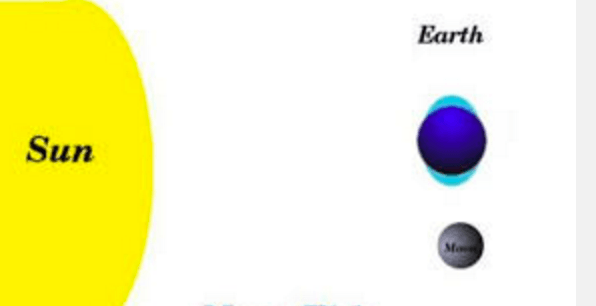
Which moon phase is shown in this diagram?
a)
new moon
b)
waxing quarter
c)
full moon
d)
waning quarter
11.

What moon phase is this?
a)
Waning Gibbous Moon
b)
Waxing Gibbous Moon
c)
Waning Crescent Moon
d)
Waxing Crescent Moon
12.

Name the phase of the moon for letter F?
a)
Waning Gibbous
b)
Waxing Gibbous
c)
Waning Crescent
d)
Waxing Crescent
13.

Why do we experience the changing of seasons on Earth?
a)
Earth's tilt & rotation
b)
Earth's tilt & revolution
c)
Earth's rotation on it's axis
d)
Earth's tilt on it's axis
14.

What is the name of the imaginary line running through the North Pole to the South Pole?
a)
orbit
b)
axis
c)
equator
d)
latitude
15.

What happens when the area in which you live tilts AWAY from the sun?
a)
It is summer.
b)
It is spring.
c)
It is winter.
d)
It is fall.
16.
Which season has the least amount of daylight hours?
a)
Winter
b)
Spring
c)
Summer
d)
Fall
17.

Which letter on the diagram shows spring?
a)
Letter A
b)
Letter B
c)
Letter C
d)
Letter D
18.

The Earth takes 365 days to travel around the Sun. What is the scientific word for this motion?
a)
revolution
b)
rotation
c)
spinning
d)
bouncing
19.

Shadows growing longer and shorter are evidence of ____________
a)
Earth's rotation
b)
Earth's tilt
c)
Earth's revolution
d)
Earth's weather
20.

What is indicated by the red line circle around the Sun?
a)
Earth’s rotation
b)
Earth’s revolution
c)
Earth’s orbit
d)
Earth’s seasons
21.

Why do globes lean sideways?
a)
To allow them to spin easier.
b)
To demonstrate the tilt of Earth's axis.
c)
To demonstrate the effects of gravity.
d)
To demonstrate day and night.
22.

How long does it take the Earth to make one REVOLUTION around the Sun?
a)
12 hours
b)
24 hours
c)
365 1/4 days
d)
29.5 days
23.

Which season is taking place in the NORTHERN Hemisphere in Position 2? Hint: What season is it in the NORTHERN hemisphere in location 1? What season will come next?
a)
Winter
b)
Spring
c)
Summer
d)
Fall
24.
The category that contains the most stars is...
a)
Main Sequence
b)
Supergiants
c)
Giants
25.
Which category is our Sun located in?
a)
White Dwarfs
b)
Supergiants
c)
Main Sequence
d)
Giants
26.

In which region of the H-R Diagram would you be likely to find Blue Giants?
a)
W
b)
X
c)
Y
d)
Z
27.

What color is the hottest color of star?
a)
Blue
b)
red
c)
purple
d)
Black
28.

What type of star is the Sun?
a)
Red giant
b)
White dwarf
c)
Red supergiant
d)
Main sequence
29.

The Milky Way Galaxy is most likely
a)
an irregular galaxy
b)
a spiral galaxy
c)
an elliptical galaxy
d)
a nebula
30.
The majority of stars are in their longest phase, which is called...
a)
white dwarf
b)
H-R Diagram
c)
Red giant
d)
Main-sequence
31.
One the main sequence, as stars get __________ they also get ___________.
a)
hotter, brighter
b)
hotter, dimmer
c)
cooler, brighter
d)
cooler, stays same brightness
32.
The highest frequency light is which of the following?
a)
Violet visible light
b)
Radio Waves
c)
Gamma Rays
d)
X-rays
33.
Which of the following is the lowest frequency visible light?
a)
Yellow
b)
Blue
c)
Violet
d)
Red
34.
Who is credited with discovering proof that we live in an expanding universe?
a)
Newton
b)
Hubble
c)
Einstein
d)
Hertzsprung and Russell
35.

Which star is considered a Main Sequence Star?
a)
A
b)
B
c)
C
d)
D
36.
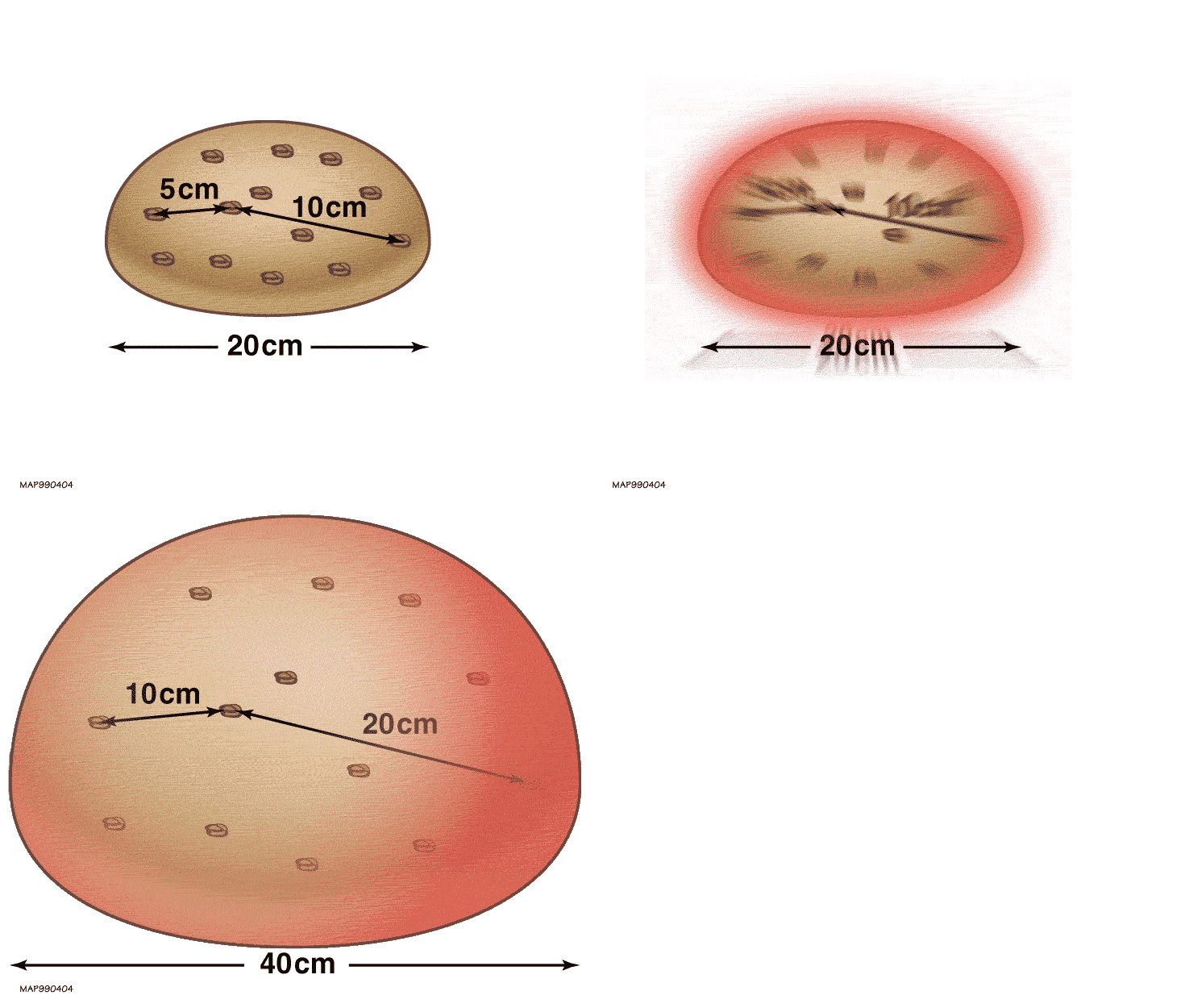
Who discovered that the galaxies were moving away from one another?
a)
Edwin Hubble
b)
Issac Newton
c)
Albert Einstein
d)
Galileo Galile
37.

It takes 8.9 years for light produced on Carinae V602 to reach the sun. If Star X is 30 times as far from the sun as Carinae V602 is, how far is Star X from the sun, to the nearest light year?
a)
267
b)
5358
c)
632
d)
68
38.

Which star has the lowest luminosity?
a)
A
b)
B
c)
C
d)
D
39.

What type of telescope would a scientist be using if she was collecting data on waves with a frequency of 1018.
a)
gamma rays
b)
x-rays
c)
visible light
d)
radio
40.

Are any of the galaxies moving towards Earth? Explain.
a)
A. It is redshifted
b)
B. It is redshifted.
c)
C. It is blue shifted.
d)
A. It is blueshifted.
41.
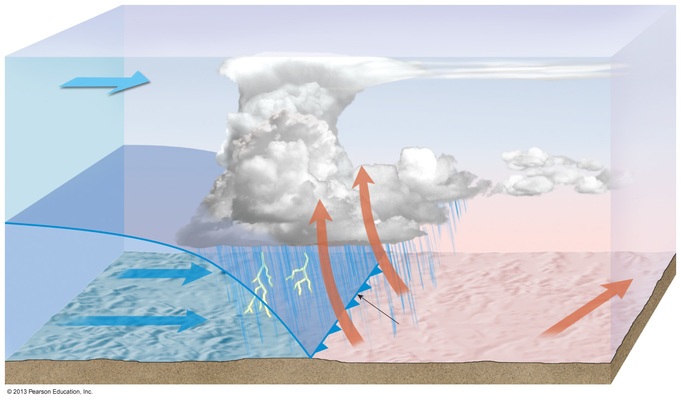
What type of storm front is this?
a)
warm front
b)
cold front
c)
stationary front
d)
occluded front
42.
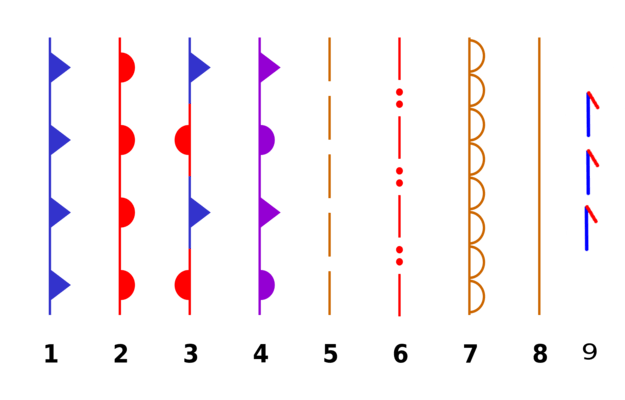
What does symbol # 3 mean?
a)
stationary front
b)
occluded front
c)
warm front
d)
cold front
43.

What type of air mass is the highlighted arrow?
a)
cold/dry
b)
cold/humid
c)
warm/dry
d)
warm/humid
44.

This is the symbol for a(n) _______________
a)
warm front
b)
cold front
c)
stationary front
d)
occluded front
45.

This is the symbol for which type of front?
a)
cold front
b)
warm front
c)
occluded front
d)
stationary front
46.
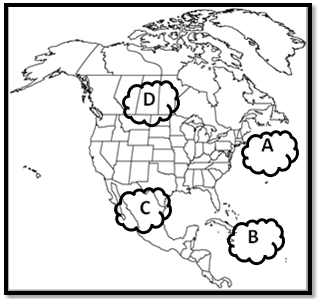
Which type of air would you find at air mass A?
a)
cold, dry
b)
warm, humid
c)
warm, dry
d)
cold, humid
47.
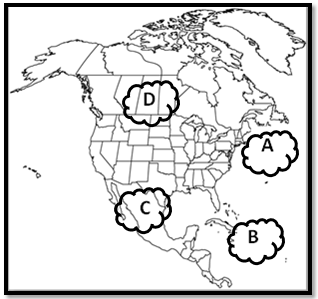
Which type of air would you find at air mass B?
a)
cold, dry
b)
warm, humid
c)
warm, dry
d)
cold, humid
48.
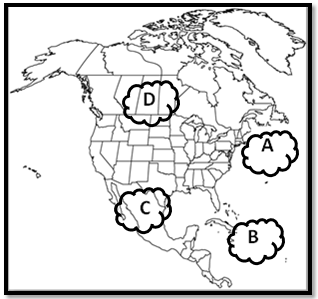
Which type of air would you find at air mass C?
a)
cold, dry
b)
warm, humid
c)
warm, dry
d)
cold, humid
49.
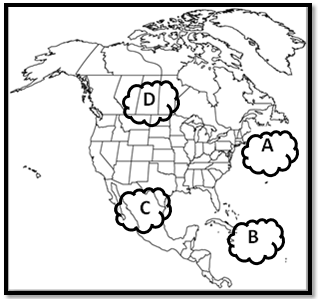
Which type of air would you find at air mass D?
a)
cold, dry
b)
warm, humid
c)
warm, dry
d)
cold, humid
50.

What type of storm front is this?
a)
warm front
b)
cold front
c)
stationary front
d)
occluded front
51.
What characteristics are used to classify air masses?
a)
temperature and humidity
b)
pressure and temperature
c)
latitude and longitude
d)
wind speed and location
52.
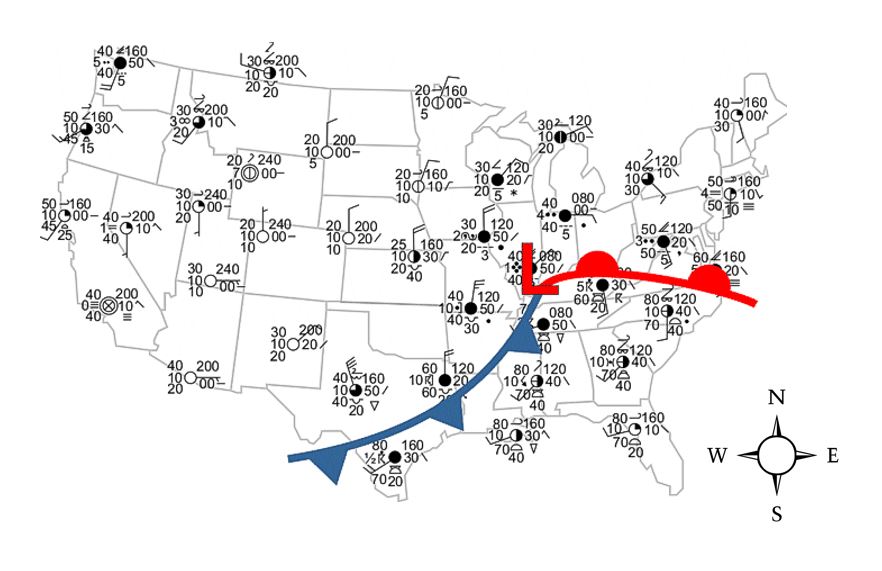
What direction is the warm front moving on the map?
a)
North
b)
South
c)
East
d)
West
53.
What direction is the cold front moving on the map?
a)
Southwest
b)
Northwest
c)
Southeast
d)
Northeast
54.
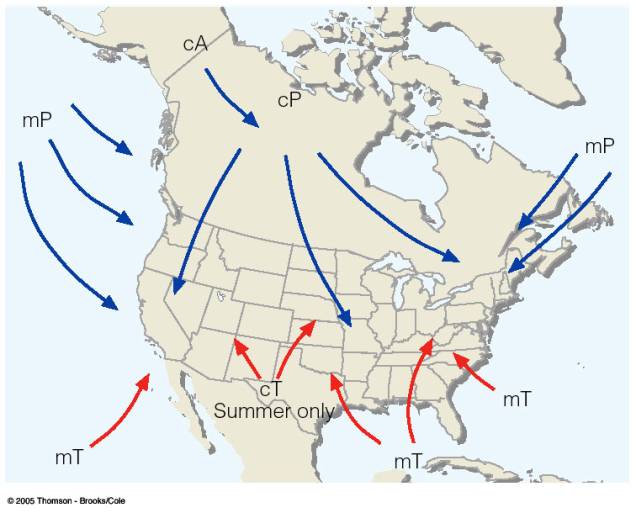
Which abbreviation of an air mass can be identified as dry and hot?
a)
cP
b)
mP
c)
cT
d)
mT
55.
Which abbreviation of an air mass can be identified as cold and moist?
a)
cP
b)
mP
c)
cT
d)
mT
56.
Which abbreviation of an air mass can be identified as warm and moist?
a)
cP
b)
mP
c)
cT
d)
mT
57.

Which abbreviation of an air mass can be identified as dry and cold?
a)
cP
b)
mP
c)
cT
d)
mT
58.

Why is the Equator warmest?
a)
Because it is closest to the sun.
b)
Because it receives the most direct sunlight
c)
Because no clouds form here.
d)
Because it is far from the sun
59.
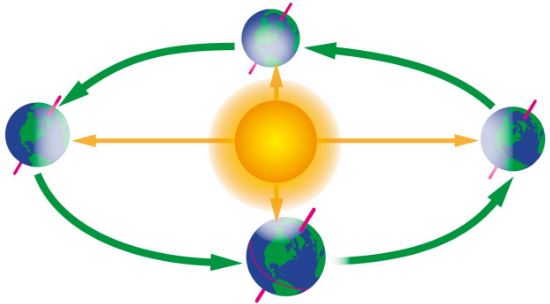
In spring and fall, the axis of the earth is pointed away or toward the sun?
a)
towards
b)
Neither away or toward
c)
away
d)
it changes every year
60.

Why does the area around the equator stay the same temperature all year?
a)
The equator rotates slower than the poles.
b)
The equator remains the same distance from the sun.
c)
The equator always receives direct sunlight.
d)
The equator has 18 hour days.
61.

What season is depicted in the picture?
a)
summer
b)
winter
c)
fall
d)
spring
62.

What season is depicted in the picture?
a)
summer
b)
winter
c)
fall
d)
spring
63.
Australia is in the ____ hemisphere.
a)
northern
b)
southern
64.
Object spinning on its axis.
a)
revolution
b)
rotation
65.
Object orbiting another object.
a)
revolution
b)
rotation
66.
If its ____ in the Northern hemisphere, then its fall in the Southern hemisphere.
a)
spring
b)
summer
c)
fall
d)
winter
67.
Path an object revolves around another object.
a)
axis
b)
orbit
c)
tilt
68.
When are the equinoxes?
a)
June & December
b)
July & January
c)
April & October
d)
March & September
69.
The term equinox means....
a)
equal amount of day light and equal amount of night
b)
Equal amount of winter and summer
c)
Equal amounts of hot dogs for everyone
d)
The longest day of the year
70.
What do June 21 and December 21 have in common?
a)
equinox dates
b)
the moon is full
c)
solstice dates
d)
the cold fronts blow in
71.

What season is shown in the Northern Hemisphere for this picture?
a)
Spring
b)
Winter
c)
Summer
72.

Which hemisphere has longer days during the time of the year pictured in this illustration.
a)
Northern Hemisphere
b)
Southern Hemisphere
73.

What season is represented in the northern hemisphere?
a)
Winter
b)
Spring
c)
Summer
d)
Fall
74.

Each season lasts...
a)
...three months.
b)
...four months.
c)
...six months.
75.

Which movement of Earth causes day and night?
a)
rotation
b)
revolution
76.

When the visible (lit) portion of the moon is increasing, the moon is:
a)
waning
b)
full
c)
waxing
d)
new
77.

Approximately how much time passes between the new moon and full moon?
a)
one month
b)
two weeks
c)
3 days
d)
24 hours�
78.

The Moon orbits Earth in a ________________ direction
a)
clockwise
b)
counterclockwise
c)
upwards
d)
downwards
79.
T/F The moon can be seen from Earth because it reflects the sun's light
a)
TRUE
b)
FALSE
80.

When the Northern Hemisphere of Earth is Leaning away from the Sun, What season is the Southern Hemisphere experiencing?
a)
Summer
b)
Winter
c)
Spring
d)
Fall
81.

If the Northern Hemisphere is experiencing Summer, What season is the Southern Hemisphere experiencing?
a)
Summer
b)
Winter
c)
Spring
d)
Fall
82.

What moon phases will you see at #1?
a)
Full moon
b)
New moon
c)
Waxing crescent
d)
Waning Gibbous
83.
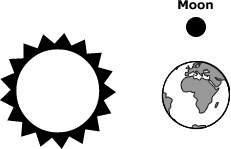
What type of tide is occurring on Earth?
a)
Reverse tide
b)
Quarter tide
c)
Neap tide
d)
Spring tide
84.
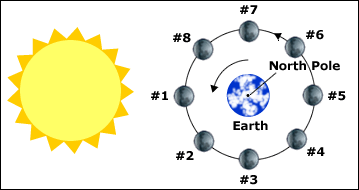
What phase is the moon when in position #5?
a)
New Moon
b)
First Quarter
c)
Full Moon
d)
Third Quarter
85.
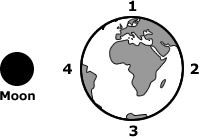
The diagram below shows Earth and the moon.In which position(s) will Earth's tidal bulge(s) occur?
a)
4 only
b)
1 and 4
c)
3 and 4
d)
2 and 4
86.
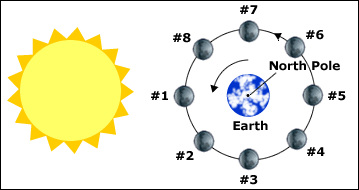
In what phase is the moon when in position #4?
a)
Waxing crescent
b)
Waning crescent
c)
Waxing Gibbous
d)
First Quarter
87.
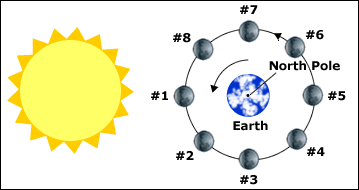
In what phase is the moon when in position #8?
a)
Waning crescent
b)
First Quarter
c)
Waxing crescent
d)
Third Quarter
88.
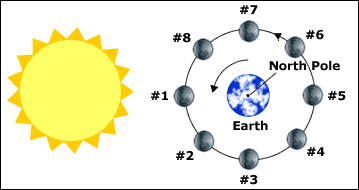
In what phase is the moon when in position #2?
a)
Waning Crescent
b)
Waning Gibbous
c)
Waxing Crescent
d)
Waxing Gibbous
89.
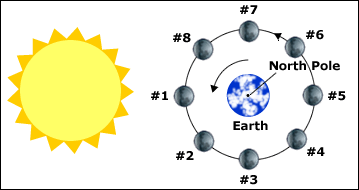
In what phase is the moon when in position #3?
a)
First Quarter
b)
New Moon
c)
Waxing Gibbous
d)
Waning Crescent
90.
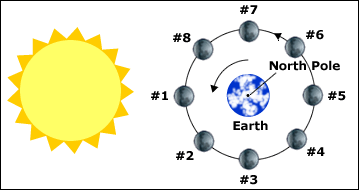
What phase is the moon when in position #6?
a)
Waning Gibbous
b)
Waxing Gibbous
c)
Waning Crescent
d)
Waxing Crescent
91.

What season is the Southern hemisphere in when the North Pole is leaning into the Sun?
a)
Summer
b)
Fall
c)
Winter
d)
Spring
92.

Which tide causes the biggest change in ocean levels?
a)
Spring Tide
b)
Neap Tide
c)
Summer Tide
d)
Leap year Tide
93.

What Moon phases are visible during a Neap Tide?
a)
Full and New Moon
b)
Waxing and Waning Crescent
c)
First and Last quarter
d)
Waxing an Waning Gibbous
94.

Which moon phase is visible at position 4?
a)
new moon
b)
1st quarter
c)
full moon
d)
3rd quarter
100 %

