
 Worksheets
States of Matter & Heat Transfer
Total questions: 25
Worksheet time: 19mins
Name
Class
Date
1.
A phase change from liquid to gas
a)
condensation
b)
evaporation
c)
sublimation
d)
deposition
2.
State of matter where atoms barely move, but rather vibrate in place
a)
solid
b)
liquid
c)
gas
d)
plasma
3.
The change from a gas to a liquid by cooling
a)
condensation
b)
evaporation
c)
sublimation
d)
deposition
4.
When you add heat to a liquid, turning it to gas, the process is called
a)
evaporation
b)
sublimation
c)
condensation
d)
deposition
5.
When we remove heat from a liquid
a)
it will freeze and turn into a solid
b)
it will freeze and turn into a gas
c)
it will freeze and turn into a liquid
d)
it will freeze and turn into plasma
6.
Adding more heat energy to molecules will
a)
make them move slower
b)
make them move faster
c)
make them stop moving
d)
destroy them
7.
What happens when my glass of water is sitting in the sun and disappears into a gas?
a)
evaporation
b)
burning
c)
melting
d)
freezing
8.
My glass of ice water is sitting in the sun and has droplets of water on the outside of the glass. What is happening?
a)
condensation
b)
evaporation
c)
melting
d)
freezing
9.
What kind of heat transfer happens when the sun is heating your body?
a)
Conduction
b)
Radiation
c)
Convection
d)
Density
10.
What heat transfer happens when you burn your hand by touching a fire?
a)
Radiation
b)
Conduction
c)
Convectio
d)
I don't know!!!!!!!!!!!
11.

Warm air rises and the cool air sinks demonstrates this type of heat transfer.
a)
conduction
b)
convection
c)
radiation
d)
Insolation
12.

The baby chickens are kept warm from the heat lamps demonstrates this type of heat transfer.
a)
conduction
b)
convection
c)
radiation
13.

Walking on the warm sand sand with your bare feet demonstrates this type of heat transfer.
a)
conduction
b)
convection
c)
radiation
14.
Warm air is __________ dense than cold air and rises creating convection currents.
a)
more
b)
less
15.
If two objects have different temperatures, heat will flow from the cooler object to the warmer one.
a)
true
b)
false
16.
Energy will always flow or move from...
a)
An area of low temperature to an area of high temperature
b)
An area of high temperature to an area of low temperature
c)
atoms to molecules
17.
Heat is what type of energy?
a)
Thermal
b)
Chemical
c)
Potential
d)
Kinetic
18.
Heat always travels from _____ to ______ objects.
a)
hot to cold
b)
cold to hot
c)
cold to cold
d)
hot to hot
19.

What happens when ice cubes melt in a glass?
a)
Heat travels from the ice to the warmer water.
b)
No energy is transferred.
c)
Heat is transferred from the warmer water to the ice cubes.
d)
The water warms up due to the humidity
20.
A huge rock at the state park gets hot during the day. The rock was warmed from the Sun by
a)
conduction
b)
convection
c)
radiation
21.
You lay on the same hot rock at night and keep warm from the rock by
a)
conduction
b)
convection
c)
radiation
22.

The speed of the molecules determines the _____.
a)
Temperature
b)
density
c)
pressure
23.
Which statement about the boiling point and melting point of water is true?
a)
the melting point is warmer
b)
the boiling point is warmer
c)
the melting and boiling points are the same
d)
the melting point is colder
24.
Which statement is a correct comparison between water as a solid, liquid and gas?
a)
Gases are more dense than liquids
b)
Liquids are more dense than gas
c)
Gases are more dense than solids
d)
Solids are less dense than gases
25.
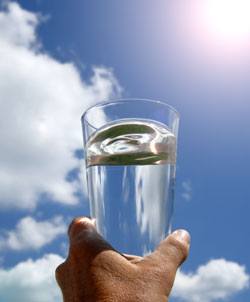
The temperature of a glass of cold water will eventually...
a)
Match the temperature of the surrounding environment.
b)
Always be colder than the surrounding environment.
c)
Become warmer than the surrounding environment.
d)
Never change temperature.
100 %

