
 Worksheets
Cambridge Primary Checkpoint Science Review 2
Total questions: 130
Worksheet time: 2hrs 36mins
Name
Class
Date
1.
To release energy from food is called:
a)
Movement
b)
Respiration
c)
Sensitivity
d)
Excretion
2.
A physical change is
a)
burning wood
b)
rusting metal
c)
cutting fruit
d)
cooking eggs
3.
Lemonade is a solution because
a)
it is a combination of two or more substances and a new kind of matter is made.
b)
it is one substance whose kind of matter is not changed.
c)
it is a combination of two or more substances and the kind of matter of each is not changed.
d)
it is one substance whose kind of matter is changed.
4.
When water changes from a liquid to a solid, it ______________ which is a ___________ change.
a)
melts, chemical
b)
melts, physical
c)
freezes, physical
d)
freezes, chemical
5.
Why is baking cookie batter a chemical change?
a)
The substances that make up the batter become a different kind of matter.
b)
The substances that make up the batter change the way they look.
c)
The substances that make up the bater can be separated easily?
d)
The substances that make up the batter are heated.
6.
You can separate saltwater by
a)
Pouring it through a strainer.
b)
Add food coloring.
c)
Boiling it.
d)
Freezing it.
7.
A tossed salad is an example of a
a)
mixture
b)
solution
c)
melted substance
d)
chemical change
8.
A sculptor
a)
causes a both a physical and chemical change.
b)
doesn't cause a physical or a chemical change.
c)
causes a chemical change.
d)
causes a physical change.
9.
Which is a chemical change?
a)
frying eggs
b)
ripping paper
c)
freezing water
d)
making lemonade
10.
Matter can be heated or cooled, it can be cut into pieces, it can be stretched or folded.
a)
True
b)
False
11.
Mixtures are
a)
are made of 2 or more substances
b)
1 substance
12.
Solutions are made of two or more substances
a)
True
b)
False
13.
Swimming and cooking are examples of uses of which state of water?
a)
Gas
b)
Ice
c)
Solid
d)
Liquid
14.
Which of the following sports uses water it its solid state?
a)
Water skiiing
b)
Conoeing
c)
Ice Hockey
d)
Swimming
15.
Which of these show how liquid water changes as the temperature of the air decreases?
a)
Water -> Gas
b)
Gas -> Water
c)
Water -> Ice
d)
Ice -> Water
16.
Temperature when a solid becomes a liquid
a)
melting point
b)
condensation
c)
freezing point
d)
boiling point
17.
State of matter with particles vibrating in a fixed position
a)
liquid
b)
solid
c)
gas
d)
plasma
18.
Which of the following is not a state of matter?
a)
solid
b)
liquid
c)
gas
d)
mass
19.
Mass per unit volume is
a)
density
b)
volume
c)
matter
d)
centimeters
20.
Anything that has mass and takes up space is
a)
mass
b)
volume
c)
liquid
d)
matter
21.
The amount of matter in an object is its
a)
volume
b)
matter
c)
mass
d)
density
22.
Change that creates a new substance is a
a)
chemical
b)
physical
23.
State of matter with no definite volume or shape is a
a)
solid
b)
liquid
c)
gas
d)
matter
24.
Unit used to measure mass is
a)
weight
b)
grams
c)
meters
d)
milliliters
25.
Temperature at which a liquid becomes a gas is
a)
condensation
b)
boiling point
c)
melting point
d)
freezing point
26.
In a ______________, the particles move freely at high speeds.
a)
solid
b)
liquid
c)
gas
27.
When a solid is heated up and it turns to a liquid, it is called...
a)
freezing
b)
condensing
c)
evaporating
d)
melting
28.
What happens when my glass of water is sitting in the sun and disappears into a gas?
a)
evaporation
b)
burning
c)
melting
d)
freezing
29.

This is...
a)
condensation
b)
evaporation
c)
freezing
d)
melting
30.
What is the definition of sublimation?
a)
a chemical process where a solid turns into a gas without going through a liquid stage
b)
the process of a liquid changing into a gas
31.
The change from a liquid to a gas is _______________
a)
melting
b)
freezing
c)
vaporization
d)
deposition
32.
The change from a liquid to a solid is ___________
a)
melting
b)
boiling
c)
freezing
d)
vaporization
33.
If you want to change the pitch of a sound, you have to change the ___
a)
frequency
b)
amplitude
c)
speed
d)
volume
34.
What happens when you increase the amplitude of a sound?
a)
it makes the sound louder
b)
it makes the sound travel faster
c)
it increases the wavelength of the sound
d)
it increases the frequency of the sound
35.
This is the unit used to measure the volume of a sound.
a)
Decibel
b)
Medium
c)
Vibration
d)
Oscilloscope
36.
True or False: Can sound travel through a vacuum (space).
a)
True
b)
False
37.
True or False: Sound travels better through solids than through liquids
a)
True
b)
False
38.
What is a pitch?
a)
highness or lowness of a sound
b)
the intensity of a vibration
c)
the amplitude of the sound wave
d)
volume of sound
39.
Bats use ________ TO LOCATE MOSQUITOES IN THE AIR.
a)
solar
b)
ecology
c)
echolocation
d)
evolution
40.
How does a sound wave interact with a human ear?
a)
vibrates the ear drum
b)
bounces off the ear canal
c)
rotates the ear drum
d)
vibrates the ear canal
41.
The Sun is a source of light. It is important because __________________ and ___________________.
a)
cools the earth, helps plants make food
b)
warms Earth, helps animals make their own food
c)
warms the Earth, allows plants to make their own food
d)
warms Earth, and helps Earth spin on its axix
42.
How can yellow light, ultraviolet waves, and X rays be described?
a)
They are harmful light waves.
b)
They are forms of visible light.
c)
They are forms of invisible light.
d)
They are part of the electromagnetic spectrum.
43.
What happen to light that passes through a concave lens?
a)
The light rays spread apart.
b)
The light rays are absorbed.
c)
The light rays come together.
d)
The light rays move in a straight path.
44.
Which muscular part of the eye controls how much light enters the eye?
a)
lens
b)
iris
c)
pupil
d)
cornea
45.
What type material is used to make a stained glass window?
a)
opaque
b)
relective
c)
transparent
d)
translucent
46.
When does light refract?
a)
When light travels in a vacuum.
b)
When light moves through cold air.
c)
When light travels in only one medium.
d)
When light moves from one medium to another.
47.
How are light waves and sound waves similar?
a)
The both are invisible.
b)
They both carry energy.
c)
They both travel in vacuums.
d)
They both are harmful to cells.
48.
Shorter wind instruments have ____________ pitches to their sound.
a)
lower
b)
like
c)
higher
d)
vibrating
49.
The colors that you don't see are _________.
a)
absorbed
b)
diffraction
c)
scattering
d)
reflected
50.
The colors of the rainbow in order.
a)
ROYGBIV
b)
BIVROYG
c)
ROYROGERS
d)
ROYGVIB
51.
The color with the shortest wavelength.
a)
Violet
b)
Blue
c)
Green
d)
White
52.
You will see a flash of lightening before you hear the thunder that goes with it because-
a)
the eye is quicker than the ear
b)
thunder occurs much later than lightening
c)
sound travels faster through the atmosphere than light
d)
light travels faster through the atmosphere than sound
53.

As you tighten the string, the sound you make when you pluck it..
a)
gets quieter
b)
gets lower in pitch
c)
gets louder
d)
gets higher in pitch
54.

As you shorten the string, the sound you make when you pluck it..
a)
gets lower in pitch
b)
gets louder
c)
gets higher in pitch
d)
gets quieter
55.
The frequency of a sound wave determines it _________.
a)
amplitude
b)
energy
c)
pitch
d)
volume
56.

What is this?
a)
Concave lens
b)
Convex lens
c)
Prism
d)
Sound Wave
57.

What is this?
a)
Concave Lens
b)
Convex Lens
c)
Prism
d)
Sound Wave
58.

a)
reflection
b)
refraction
59.

a)
reflection
b)
refraction
60.

When a rainbow is formed outside naturally, what causes the light to refract?
a)
A. Small raindrops
b)
B. Sunlight rays
c)
C. Tiny mirrors
d)
D. Glass prisms
61.

Which window is opaque?
a)
Window 1
b)
Window 2
c)
Window 3
d)
None
62.

The Law of Reflection:
The angle of incidence is _________ the angle of reflection
The angle of incidence is _________ the angle of reflection
a)
bigger than
b)
the same as
c)
smaller than
63.
Luminous means...
a)
Gives out its own light
b)
Reflects light from other things
64.
Opaque means...
a)
No light passes through it
b)
All light passes through it
c)
Some light passes through it
65.
What Does a Concave Lens Do?
a)
Make things bigger
b)
Make things smaller
c)
Make things closer
d)
Make things happy
66.
What Does a Convex Lens Do?
a)
Make things bigger
b)
Make things smaller
c)
Make things closer
d)
Make things sader
67.
___________ is a from of energy that we can see with our eyes.
a)
shadow
b)
light
c)
energy
d)
reflection
68.
The _______ of the Earth on its axis causes the position and length of the shadow to change.
a)
rotation
b)
revolution
c)
spin
d)
tilt
69.
At ____ the length of a shadow is the shortest.
a)
8am
b)
5pm
c)
midday
70.
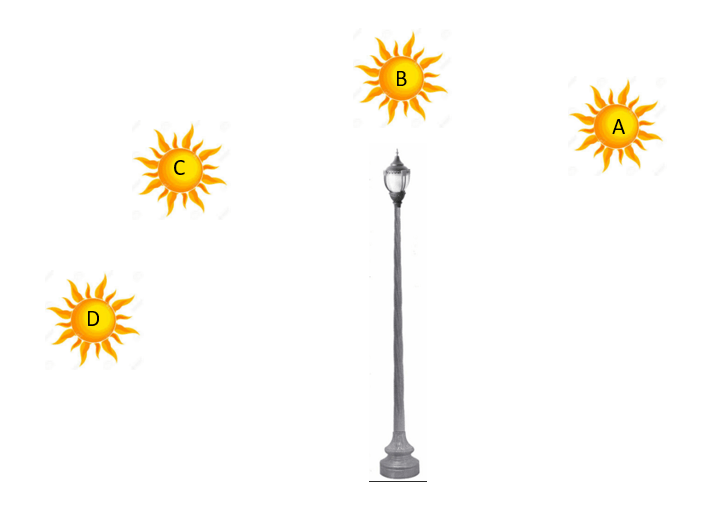
At which location of the sun would the shadow of the light pole be the longest?
a)
A at 11 a.m
b)
B at noon
c)
C at 2 p.m.
d)
D at 6 p.m.
71.
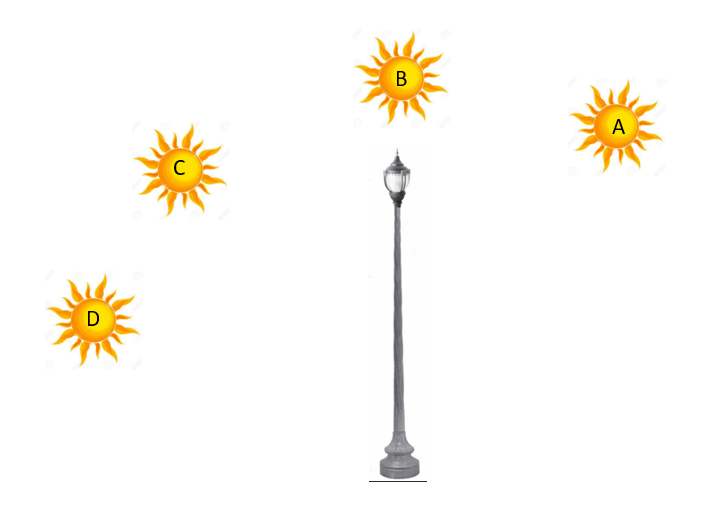
At which location of the sun would the shadow of the lamp post be the shortest?
a)
A
b)
B
c)
C
d)
D
72.

What part of the moon do we see from Earth?
a)
all of it
b)
only one quarter
c)
none of it
d)
the same side
73.

As the lighted part of the moon appears to get smaller, we say that the moon is ____________.
a)
waning
b)
disappearing
c)
swelling
d)
waxing
74.

When do we see a full moon?
a)
when half of the sun's light is shining on the half of the moon facing away from us
b)
when the sun goes down and there are no clouds in the night sky
c)
when none of the sun's light is shining on the half of the moon facing toward us
d)
when all the sun's light is shining on the half of the moon facing toward us
75.
How long does it take the moon to change from a new moon to a full moon?
a)
about 1 month
b)
about 1 year
c)
about 1 week
d)
about 1 day
76.
The Sun seems to travel across the sky from ___________ to __________.
a)
south to north
b)
west to east
c)
north to south
d)
east to west
77.

What is causes a shadow?
a)
turning the lights off in a room
b)
standing still with your back to the sun
c)
the sun being blocked out by an object
d)
standing in a dark room
78.
Phases of the moon in which the moon appears to be getting larger are referred to as _.
a)
waxing
b)
waning
c)
new
d)
eclipse
79.

Which phase of the moon is represented by the letter E?
a)
New Moon
b)
Full Moon
c)
First Quarter
d)
Waning Crescent
80.
A material that allows light to pass through it so that objects can be seen clearly on the other side.
a)
Prism
b)
Opaque
c)
Translucent
d)
Transparent
81.
A material that lets some light pass through it but scatters the light causing the image to not be clear.
a)
Translucent
b)
Transparent
c)
Opaque
d)
Reflect
82.
Bending of a light ray as it passes from one medium to another.
a)
Reflect
b)
Magnify
c)
Emit
d)
Refraction
83.
To bounce off a surface, as in light bouncing off a mirror.
a)
Reflect
b)
Emit
c)
Refract
d)
Visible
84.
To give off something as in the sun giving off light.
a)
Emit
b)
Prism
c)
Magnify
d)
Reflect
85.

What are tides?
a)
circulation of water
b)
wind pushing ocean water
c)
glaciers melting causing rising water
d)
rise and fall of the water level on the shore
86.

What causes the tides on Earth?
a)
energy coming out from the core of the Earth
b)
movement of tectonic plates
c)
gravitational pull of the sun and moon
d)
volcanic eruptions near the oceans
87.
High tide happens about _________ before a low tide.
a)
1 week
b)
1 month
c)
12 1/2 hours
d)
24 hours
88.

Which planet has the biggest rings?
a)
Jupiter
b)
Saturn
c)
Uranus
d)
Neptune
89.

What force keeps the planets orbiting the sun?
a)
Gravity
b)
Magnetism
c)
Electricity
d)
Friction
90.
The order of the planets is:
a)
Mars,Venus,Earth,
Mercury,Saturn
Jupiter, Uranus, Neptune
Mercury,Saturn
Jupiter, Uranus, Neptune
b)
Earth,Venus,Mars
Jupiter, Neptune,
Mercury,Saturn,
Uranus
Jupiter, Neptune,
Mercury,Saturn,
Uranus
c)
Mercury,Venus,Earth
Mars,Jupiter,
Saturn,Uranus
Neptune
Mars,Jupiter,
Saturn,Uranus
Neptune
91.

Which planet is the largest?
a)
Jupiter
b)
Saturn
c)
Uranus
d)
Neptune
92.
Which planet is fifth from the sun?
a)
Saturn
b)
Jupiter
c)
Mars
d)
Earth
93.
Which planet is seventh from the sun?
a)
Saturn
b)
Earth
c)
Venus
d)
Uranus
94.
which planet is the third from the sun?
a)
Mercury
b)
Neptune
c)
Pluto
d)
Earth
95.
Which is the second closest planet to the sun?
a)
Earth
b)
Saturn
c)
Venus
d)
Mercury
96.
The earth orbits around...
a)
the sun.
b)
the moon
c)
other planets
d)
the Milky Way
97.
Some scientists believe that this dwarf planet is actually a very large comet caught in a permanent orbit.
a)
Eris
b)
Pluto
c)
Mars
d)
Neptune
98.
This gas giant has a large storm in its atmosphere known as The Red Spot
a)
Jupiter
b)
Saturn
c)
Uranus
d)
Neptune
99.
This is the only planet in the solar system with oceans of liquid water.
a)
Mercury
b)
Mars
c)
Venus
d)
Earth
100.

When the Northern Hemisphere of Earth is Leaning away from the Sun, What season is the Southern Hemisphere experiencing?
a)
Summer
b)
Winter
c)
Spring
d)
Fall
101.
How long does it take the Earth to make one REVOLUTION around the Sun?
a)
12 hours
b)
24 hours
c)
365 days
d)
29.5 days
102.
Day and night is caused by the _____________ of earth on its axis.
a)
revolution
b)
orbit
c)
rotation
103.
What are the reasons for the seasons?
a)
Earth's tilt and rotation.
b)
Earth's rotation and revolution.
c)
Earth's tilt and revolution.
d)
Earth's tilt and resolution
104.
How long does it take for Earth to complete on full rotation?
a)
365 days
b)
23 hours
c)
24 hours
d)
1 month
105.
Planets that are closer to the sun
a)
take more time to orbit
b)
take less time to orbit
106.
What keeps objects moving in space?
a)
gravity and inertia
b)
mass and distance
c)
mass and weight
d)
inertia and mass
107.

What are the outer planets made up of?
a)
Gas
b)
Rings
c)
Rocks
d)
Moons
108.
What two factors affect gravity?
a)
Inertia and gravity
b)
Mass and inertia
c)
Distance and mass
d)
Distance and weight
109.

Which planet is Earth's sister planet?
a)
Mercury
b)
Venus
c)
Earth
d)
Mars
110.
An asteroid is...
a)
A dirty/icy snowball
b)
Circumstellar disc in the Solar System
c)
Rocky objects that are too small/numerous
d)
A light phenomena
111.

Asteroids and Comets orbit around...
a)
Their axis
b)
The Earth
c)
The Sun
d)
Each other
112.

What causes meteors to burn up in our atmosphere?
a)
Heat from the Sun
b)
Heat from Earth's atmosphere
c)
They are already so hot that our atmosphere can't handle it
d)
Friction
113.
Which space object is larger?
a)
Asteroid
b)
Meteor
c)
Meteorite
114.
The orbit of the Earth around the sun is
a)
A perfect circle
b)
Extremely slow
c)
Elliptical
d)
Chaotic
115.
What causes the temperatures at the North and South Poles to remain so cold throughout the year?
a)
The tilt of the Earth's axis
b)
Lines of Latitude
c)
The rotation of the earth
d)
The distance of the sun from Earth
116.
What is a shooting star really called?
a)
Asteroid
b)
Planet
c)
Dwarf Sun
d)
Meteor
117.
During which phase of the Moon is it passing between the Earth and the Sun?
a)
Full Moon
b)
Quarter Moon
c)
Blue Moon
d)
New Moon
118.
What causes Mars and Saturn to have years of different lengths?
a)
Their revolutions around the moon
b)
Their revolutions around the sun
c)
Their rotations around the moon
d)
Their rotations around the sun
119.
A word used to describe the curved shape of the visible part of the Moon before and after a new Moon.
a)
Toenail
b)
Waxing Gibbous
c)
Full Moon
d)
Crescent
120.
A group of billions of stars.
a)
Sun
b)
Solar System
c)
Hollywood
d)
Galaxy
121.
A word used to describe the Moon when it appears to be more than half but less than full.
a)
Crescent
b)
Gibbous
c)
Third Quarter
d)
First Quarter
122.
Earth’s natural satellite.
a)
Sun
b)
Mars
c)
Moon
d)
Milky Way
123.
To move or travel around an object in a curved path.
a)
Rotate
b)
Orbit
c)
Gravitate
d)
Phase
124.
A group of stars humans observe in a pattern and give a name.
a)
Waxing Crescent
b)
Galaxy
c)
Constellation
d)
Horizon
125.
A huge sphere of hydrogen and helium that radiates heat and light.
a)
Star
b)
Moon
c)
Earth
d)
Satellite
126.
The star around which Earth and other planets orbit.
a)
Moon
b)
Sun
c)
Mars
d)
Mercury
127.

Why don't you see any stars during the daytime?
a)
They disappear in the day.
b)
Sun is closer and too bright
c)
The moon orbits the earth.
d)
Constellations are groups of stars.
128.

What is a star?
a)
small dot in the sky
b)
a big hot ball in the sky
c)
really hot object you can see at night
d)
hot ball of gas that gives off light and heat
129.

Galileo Galilei was the first scientist to use a telescope to see...
a)
Earth
b)
a black hole
c)
craters and moons
d)
sun
130.

Why do you see different stars in winter and summer?
a)
Earth rotates on its axis.
b)
The Moon revolves around Earth.
c)
Earth revolves around the Sun.
100 %

