wayground logo

Free Printable Worksheets

Font size

S
M
L
XL
Worksheets

7th Grade CBA #3 Review

Total questions: 189

Worksheet time: 2hrs 25mins

Name
Class
Date
1.
Which would result in the most diverse offspring?
a)
an orchid with a flower structure that forces self pollination
b)
planting a cutting from a potato to grow a new potato plant
c)
bees bringing pollen from the flower of one plant to the flower of another
d)
an amoeba in a fresh water pond reproducing through binary fission
2.
Some moths have a brown body and brown wings while other moths have a white body and white wings. The brown moths often rest on the bark of pine trees and the white moths rest on the white bark of aspen trees. If all aspen trees in an area were cut down, what would be the likely result?
a)
more brown moths will survive than white moths because predators will be able to spot the white moths more easily. Over time, there will be no white moths in the area
b)
The white moths will grow brown wings in order to blend in with the environment. Over time, there will be no white moths in the area.
c)
The white moths will migrate to a new area where aspen trees are found. The brown moths will remain in the original area. The number of brown moths will increase.
d)
The white moths will rest on the remaining trees. Over time, they will become brown moths, so the number of moths will increase.
3.
Which internal structure is an adaptation that provided organisms with the function to perform gas exchange on land?
a)
gills
b)
lungs
c)
hollow bones
d)
chambered heart
4.
Mudskippers are a species of fish which, over thousands of generations, have developed adaptations that allow them not only to survive outside of the water, but to actually travel from one water source to another. What environmental condition likely led to these adaptations?
a)
lower temperatures
b)
frequent droughts
c)
larger predators
d)
increased precipitation
5.
Galapagos finches are birds that live on islands off the coast of South America. The finches on the various islands are very different from each other. As a result of the different food resources on the islands, which of the following structures of the Galapagos finches experienced the greatest change through natural selection?
a)
head size
b)
eye shape
c)
feather color
d)
beak shape
6.
Antibiotics are used to kill bacteria or prevent them from infecting cells. Over time, many bacteria have become resistant to antibiotics. That means that the antibiotics no longer kill the bacteria. Through which process do bacteria become resistant to antibiotics?
a)
cloning
b)
natural selection
c)
selective breeding
d)
genetic engineering
7.
Which of these is an example of natural selection?
a)
farmers crossbreed two types of cows
b)
dogs of the same breed that have a desirable coat color are bred with one another to produce offspring with that same coat color
c)
giraffes with longer necks survive a dry season by eating leaves from the tops of trees. Those giraffes breed more successfully that year
d)
people capture yellow fish from a pond and breed only the most attractive ones
8.
What is variation?
a)
an explanation for why some organisms survive and other to not
b)
a range of physical traits among members of a species
c)
the process by which populations change over time
d)
a group of organisms that live longer in the same ecosystem
9.
Energy flows from:
a)
wildflowers to the grasshopper to the field mouse
b)
wildflowers to the rattlesnake to the grasshopper
c)
wildflowers to the field mouse to the grasshopper
d)
the grasshopper to the rattlesnake to the field mouse
10.
In a food chain, what organism provides the initial energy for the chain?
a)
producer
b)
consumer
c)
herbivore
d)
decomposer
11.
All organisms must obtain energy from their environment. Every organism needs this energy in order to grow and reproduce. How do producers obtain energy?
a)
by eating plants, bacteria, and algae
b)
extract chemical energy from decaying organic matter
c)
extract energy from the chemicals in soil, air, and water
d)
capture energy from sunlight and manufacture their own food
12.

What conclusion can students draw regarding the cycling of matter within living systems?

a)

As matter is broken down, it is recycled back into the environment to be used again by other organisms.

b)

Matter is not broken down, and it is just used by other organisms.

c)

The grass decomposed the banana peels.

d)

The banana peels decomposed on their own.

13.

Composting is the decomposition of organic matter. All compostable materials are either...

a)

oxygen or nitrogen-based

b)

carbon or nitrogen-based

c)

hydrogen or nitrogen-based

d)

air or nitrogen-based

14.
21% represents which gas?
a)
nitrogen
b)
carbon monoxide
c)
oxygen
d)
other gases
15.
Which is the most common gas in the atmosphere?
a)
nitrogen
b)
helium
c)
air
d)
oxygen
16.
What gas is 78%?
a)
air
b)
other gases
c)
nitrogen
d)
oxygen
17.
The force of air pushing down us is called...
a)
atmosphere
b)
gravity
c)
air pressure
d)
altitude
18.
What is the layer that holds the ozone?
a)
stratosphere
b)
exosphere
c)
troposphere
d)
thermosphere
19.
What is the layer where weather occurs?
a)
troposphere
b)
exosphere
c)
mesosphere
d)
stratosphere
20.
Two factors that determine work are
a)
amount of the force, and effort used
b)
amount of the force, and type of force
c)
mass, and distance
d)
amount of force and distance moved
21.
If you and your friend EACH apply 55N of force pushing against a wall for 10 minutes. How much work did you do?
a)
10 J
b)
110 J
c)
55 J
d)
0J
22.
It takes 20 N of force to move a box a distance of 10 m. How much work is done on the box ?
a)
200 J
b)
20.0J
c)
2 J
d)
200 N
23.
You apply a force of 18 N to a dresser and move it 3.0 m. How much work did you do on the dresser?
a)
54 N
b)
6.0 J
c)
54 J
d)
27 J
24.
In which of the following situations do your arms do work on books?
a)
holding a heavy stack of books while standing
b)
carrying a heavy stack of books
c)
dropping a stack of books onto a table
d)
picking up a pile of books from the floor
25.
The unit or label for work is
a)
netwons
b)
joules
c)
meters
d)
seconds
26.
Ms. McDonald holds a desk perfectly still above her head. If she holds the desk at a height of 0.5 meters above her head, and applis 68 Newtons of force to do so, how much work has she done?
a)
34 Joules
b)
0 Joules
c)
68 Joules
d)
340 Joules
27.
 Work done = Force x blank?
a)
a. distance
b)
b. acceleration
c)
c. velocity
d)
d. speed
28.
Astronaut spacesuits include an oxygen delivery system because 
a)
there is less gravity in space. 
b)
space has nitrogen-rich air. 
c)
asteroids dissolve in oxygen. 
d)
space is an airless vacuum. 
29.
Which of the following parts of a spacesuit is essential for the survival of astronauts taking short space walks of less than thirty minutes? 
a)
Tool belt 
b)
Oxygen supply
c)
Freeze-dried food
d)
Magnetic boots 
30.
A spacesuit includes a helmet, gloves, shoes, and a total body covering. What vital part of the spacesuit that keeps the astronaut alive is missing from this list? 
a)
A handheld computer 
b)
A robotic arm 
c)
An oxygen system 
d)
A jet pack
31.
What accommodations have been designed to protect astronauts from micrometeoroids hitting their spacesuits? 
a)
Jet packs 
b)
Land rovers 
c)
Removable straps 
d)
Multilayered spacesuits 
32.
Astronauts need to exercise while in space because, without gravity, the environment in space - 
a)
lacks breathable air, including the oxygen humans need. 
b)
makes astronauts consume more calories during their missions. 
c)
provides less resistance and weakens muscles and bones. 
d)
does not allow the human body to retain heat as well as on Earth. 
33.
Which of the following helps astronauts move from one area to another inside of a spaceship? 
a)
Special handles 
b)
Jet packs 
c)
Swimming strokes 
d)
Conveyor belts 
34.
An astronaut returns from six months on the space station. The astronaut’s muscles are weak, requiring the astronaut to be helped from the spacecraft once back on Earth. Which of the following accommodations on the space station would help prevent this problem? 
a)
Provide food that provides astronauts with more energy. 
b)
Outfit the space station with exercise equipment. 
c)
Increase the oxygen levels inside the space station. 
d)
Design spacesuits that are lighter and easier to wear. 
35.
There is no air in space. Which of the following accommodations is required for an astronaut to directly communicate with another astronaut in space? 
a)
Computer 
b)
Radio 
c)
Satellite 
d)
Jet pack 
36.
Which of the following results in the need for a strong outer layer, similar to a bullet-proof vest, on a spacesuit? 
a)
Passing comets 
b)
Lack of air 
c)
Cold temperature 
d)
Small micrometeoroids 
37.
Velcro® allows objects to be easily attached and also easily separated. What condition of space made the invention of Velcro® necessary? 
a)
Lack of oxygen 
b)
Vacuum of space
c)
Microgravity environment 
d)
Extreme temperatures 
38.
Which of the following accommodations is designed to overcome the unique difficulties associated with showering in space? 
a)
A skid-proof floor mat 
b)
A drain in the floor of the shower 
c)
A vacuum system to control water movement 
d)
A bench inside the shower 
39.
Astronaut beds have straps attached to provide a safe sleeping environment. What condition of space do the straps accommodate? 
a)
Lack of oxygen 
b)
Vacuum of space 
c)
Microgravity environment 
d)
Extreme temperatures 
40.
To offset the effects of the low-gravity space environment on the body, astronauts must - 
a)
exercise regularly. 
b)
eat high-fat meals. 
c)
shower twice a day. 
d)
take naps every day. 
41.
An astronaut should not remove his or her helmet while working outside the space station because the helmet provides - 
a)
nitrogen. 
b)
oxygen. 
c)
water. 
d)
food. 
42.

Which layer of the space suit allows for drive life supporting need?

a)

urine collecting device

b)

in suit drinking bag

c)

primary life support subsystem

d)

helmet

43.

Planet R is a small, terrestrial planet that has one moon, liquid water, and a thin atmosphere. What is Planet R?

a)

Jupiter

b)

Mars

c)

Earth

d)

Saturn

44.

Astronauts may encounter various events while on a spacewalk. A spacesuit must ensure the astronaut is safe while venturing outside of the ship. Which of the following would result in the need for a strong outer layer on a spacesuit, similar to a bulletproof vest?

a)

space walk

b)

lack of nitrogen

c)

passing comets

d)

cold temperatures

45.

The Habitable Zone

“One of the main ingredients for life as we know it is liquid water. Water exists as a liquid between 273K and 373K (unless the pressure is too low, in which case the water sublimates into gaseous water vapor). The region of the solar system (or any planetary system) where the temperature is in this range, is called the habitable zone."


Which is a reason why this area one might find the tiniest identification of life?

a)

The temperature is consistent within a range.

b)

There is usable liquid water.

c)

An identifiable atmosphere is evident.

d)

There is hydrogen gas available.

46.

Life on Earth depends on the _____ as their heat source.

a)

heat vents in on the ocean floor

b)

volcanoes in the Pacific Ocean

c)

the medium sized star

d)

the heaters found in your home

47.

When deciding if a place beyond Earth holds any possibility for life, the two things that are most looked for by astrobiologists are –

a)

nitrogen and sodium

b)

oxygen and nitrogen

c)

carbon and water

d)

carbon and hydrogen

48.

A scientist is analyzing images of an object in the solar system. The features in the images that would cause the scientist to hypothesize that the object might be able to support life are –

a)

Craters that indicate collisions with meteoroids

b)

Poles that indicate a magnetic field

c)

Ridges that indicate tectonic activity

d)

Channels that indicate flowing water

49.

Identify the following items need to be taken into consideration when planning human space travel except –

a)

Access to oxygen, food, and water

b)

Atmospheric thickness of neighboring planets

c)

Extreme temperatures and pressure

d)

Protection from solar radiation

50.

All of the following are characteristics of the Earth’s atmosphere that allow for life to thrive except –

a)

The atmosphere helps maintain stable temperatures.

b)

The atmosphere rises 600 kilometers above Earth.

c)

The atmosphere burns up meteoroids.

d)

The atmosphere absorbs harmful radiation.

51.

An astronaut returns from six months on the space station. The astronaut’s muscles are weak, requiring the astronaut to be helped from the spacecraft once back on Earth. Of the following accommodations on the space station, the one that might help alleviate this problem is –

a)

Increased oxygen levels inside the space station.

b)

Spacesuits that are lighter and easier to wear.

c)

Exercise equipment that can be used to help maintain muscle mass

d)

Food that helps astronauts with more energy.

52.

The composition of the atmosphere protects life on Earth. Which of the following is NOT a way that the atmosphere protects the Earth?

a)

causes the seasons

b)

maintains temperature

c)

absorbs radiation

d)

burns up meteoroids

53.

An astronaut should not remove his or her helmet while working outside the space station because the helmet provides -

a)

hydrogen

b)

nitrogen

c)

argon

d)

oxygen

54.

Earth does support life primarily because it has liquid water, a heat source, the right distance away from the Sun, and a protective ozone layer from the Sun’s radiant energy. The gas that is found in the greatest quantity in our atmosphere is:

a)

nitrogen

b)

hydrogen

c)

argon

d)

oxygen

55.

The accommodation that is designed to help overcome the unique difficulties associated with using the restroom in space is –

a)

a vacuum system to control the flow of waste

b)

a drain in the floor of the bathroom

c)

a skid-proof floor mat

d)

a bench in the bathroom

56.

All of the following are characteristics of Jupiter’s moon, Europa.

Of these, the condition that does NOT allow Europa to support life as we know it is –

a)

water on the surface

b)

gravity on the surface

c)

surface temperature of -260°F

d)

oxygen in the atmosphere

57.

Which item would prevent the body from overheating?

a)

hard upper torso

b)

liquid cooling and ventilation garment

c)

gloves

d)

lower torso

58.

A space suit includes a helmet, gloves, boots, and a suit that completely covers the body. What vital part of the spacesuit, critical for keeping the astronaut alive, is missing from this list?

a)

a handheld computer

b)

a robotic arm

c)

a jet pack

d)

an oxygen system

59.

NASA is always searching for life beyond Earth and has found there to be three essentials for this to happen. All of the following would be a necessary requirement for life beyond Earth except –

a)

Proper distance between the planet and the source of heat.

b)

Chemicals to ensure that vegetation is supported.

c)

Liquid water is available.

d)

Atmosphere with necessary gaseous elements for gas exchange.

60.

Can you explain the "Goldie Locks" idea as concerns to life in outer space?

a)

No I can't

b)

Not sure, so

c)

Might be

d)

Yes

61.

When given a chart or graph, what do you need to pay close attention to and read very close?

a)

data in the boxes

b)

titles of the columns

c)

general title

d)

titles of the rows

62.
Runoff from agricultural land carries chemicals from fertilizers and can eventually cause what? 
a)
aquatic life to die
b)
result in subsidence
c)
change the flow of natural waterways
d)
a drought to occur
63.
A town in Texas had to be evacuated because houses were sinking. What is the likely cause of this problem?
a)
heavy rains over saturated the land
b)
over building polluted the ground water
c)
excessive removal of groundwater weakened the ground
d)
runoff from fertilized land created a dead zone
64.
Overflow during a heavy rainstorm from a wastewater treatment plan would result in what?
a)
polluted runoff into nearby ponds
b)
flooding in the local aquifer
c)
weakened housing foundations
d)
over-treated drinking water
65.
What can runoff contaminates cause in a lake, river, or stream?
a)
the earth to sink
b)
the water in an aquifer to drop
c)
harmful rapid growth of algae
d)
cleaner water for bathing
66.
A paper company wants to build a paper mill in the watershed where a village exists. In order to minimize pollution, where would be the best place to build it?
a)
at the highest point in the watershed
b)
downstream from the village
c)
closest to freshwater
d)
near a main street in the village
67.
Pollutants from a factory that enters the water in a watershed will have negative effect on which?
a)
local pond life
b)
rainfall rates
c)
direction of river flow
d)
available space for crops
68.
Which is an explanation for of why a well drilled into an aquifer would fail to produce water?
a)
pollutants have seeped into groundwater
b)
over pumping has exceeded rain water replenishment 
c)
algae has killed local pond life
d)
runoff containing chemicals has caused a dead zone
69.
The movement of colored water through gravel in a clear cup best models what?
a)
condensation
b)
surface runoff
c)
conservation of water
d)
pollution of groundwater
70.
Droughts forces towns to pump out almost all of the water held in aquifers. Which is a result?
a)
stability of the underground rock will be weakenend
b)
excessive growth of plants
c)
rainfall levels increase
d)
a dead zone will be created
71.
Rapid growth of algae in a pond is a result of what?
a)
loss of habitat
b)
flooding
c)
excess nutrients from fertilizer runoff
d)
clogged river tributaries
72.
Which human activity leads to subsidence?
a)
using toxic chemicals
b)
filtering out pollutants
c)
storing drinking water above ground
d)
excess removal of water from underground reservoirs
73.
Which is a layer of permeable rock that allows water to flow?
a)
aquifer
b)
porosity
c)
groundwater
d)
watershed
74.
Water from precipitation that flows into a stream, which then flows into a lake, river or ocean is what?
a)
groundwater
b)
surface water
c)
aquifer
d)
subsidence
75.
An area of land where surface water and groundwater drains into a particular body of water, separated from each other by drainage divides-
a)
water table
b)
porosity
c)
watershed
d)
aquifer
76.
The top of the saturation zone-
a)
water table
b)
permeability
c)
watershed
d)
saturation zone
77.
Which is the amount of empty space in a material?
a)
water table
b)
permeable rock
c)
permeability
d)
porosity
78.
Pollutants introduced into surface or groundwater that are without a specific location source is what?
a)
non-point source water pollution
b)
zone of aeration
c)
point source water pollution
d)
surface water
79.
Which is a single identifiable and localized source of water pollution? 
a)
point source water pollution
b)
non-point source water pollution
c)
zone of aeration
d)
surface water
80.
What collects in cracks and pores in underground soil and rock layers?
a)
porosity
b)
runoff
c)
surface water
d)
groundwater 
81.
Which is how well water flows through a material?
a)
groundwater
b)
permeability
c)
porosity
d)
water table
82.
Which catastrophic event will most likely have the effect of returning an ecosystem to primary succession?
a)
A tornado
b)
A volcanic eruption
c)
A flood
d)
A drought
83.
Which of the following describes large areas of ground that fall or flow on slopes due to gravity?
a)
floods
b)
hurricanes
c)
landslides
d)
wildfires
84.
Where are hurricanes most likely to do the most damage?
a)
Near the coast
b)
In the forest
c)
In a desert
d)
On the North Pole
85.
What catastrophic event would be of greatest risk to a grassland?
a)
hurricane
b)
flood
c)
tsunami
d)
wildfire
86.
What catastrophic event results in destruction along a narrow path?
a)
a volcanic eruption
b)
a tsunami
c)
a hurricane
d)
a tornado
87.
What catastrophic event can be caused by thunderstorms?
a)
a wildfire
b)
a tsunami
c)
a volcanic eruption
d)
a drought
88.
How are tsunamis generated?
a)
generated from earthquakes
b)
generated from tornadoes
c)
generated from crazy people
89.
Another name for a hurricane in the Indian Ocean
a)
Tornado
b)
Tsunami
c)
Typhoon
d)
Blizzard
90.
What is the major cause of weathering and erosion to form canyons?
a)
wind
b)
ice
c)
glaciers
d)
moving water
91.
The process of breaking up rocks on Earth's surface is called...
a)
sediment
b)
erosion
c)
weathering
d)
deposition 
92.
How does freezing water cause the weathering of rocks?  The freezing water—
a)
keeps the rocks in place
b)
makes the rocks last longer
c)
expands in the cracks and breaks rocks
d)
causes rocks to fall in landslides
93.
Which natural disaster uses the Richter scale to measure strength? 
a)
Earthquake
b)
Tornado
c)
Tsunami
d)
Hurricane
94.
A prolonged period lacking rainfall that leads to a shortage of water.
It hadn't rained for three months straight and the _________ began to kill our crops. 
a)
Forest Fire
b)
Epidemic
c)
Heatwave
d)
Drought
95.
Which storms have the strongest winds?
a)
hailstorms
b)
tornadoes
c)
earthquakes
d)
hurricanes
96.
Which of the following natural disasters have had the LEAST impact on TEXAS
a)
hurricanes
b)
floods
c)
tornadoes
d)
earthquakes
97.
Which of the following natural disasters have the MOST impact on TEXAS?
a)
hurricanes
b)
floods
c)
tornadoes
d)
earthquakes
98.
What catastrophic event would be of greatest risk to a coastal area?
a)
hurricane
b)
drought
c)
none of the above
d)
all of the above
99.
Rain washing away soil from a hillside
a)
Weathering
b)
Erosion
c)
Deposition
100.
Where do hurricanes form?
a)
In a river or stream
b)
Over the ocean
c)
At plate boundaries
d)
Under the Earth
101.
A long high sea wave caused by an underwater Earthquake, landslide or underwater volcanic
a)
Typhoon
b)
Flood
c)
Tornado
d)
Tsunami
102.
What is the order of succession shown in this figure?
a)
A, B, C, D
b)
B, A, D, C
c)
C, D, A, B
d)
D, A, B, C
103.
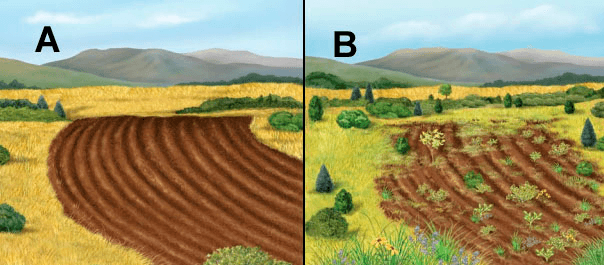
What type of succession is shown going from figure A to figure B?
a)
primary succession
b)
ecological succession
c)
secondary succession
d)
intermediate
104.
What is the goal of the pioneer species in Primary Succession?
a)
To kill the dead materials after a disaster
b)
To rebuild soil
c)
To feed Johnny
d)
To put fresh oxygen into the air
105.
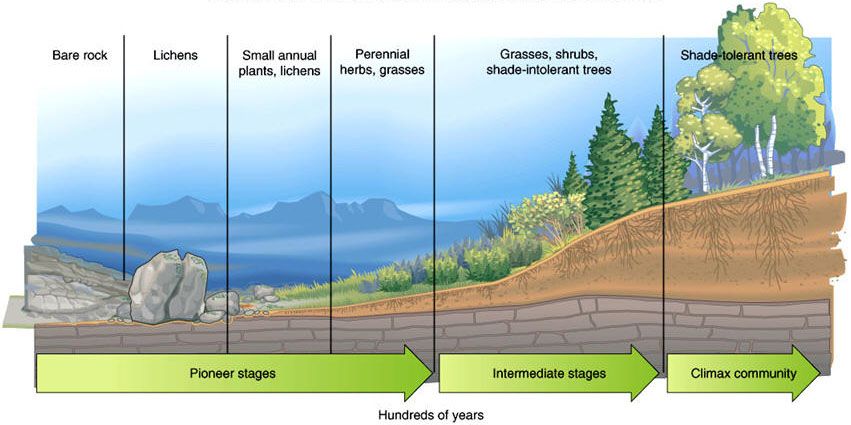
The picture shows what type of succession?
a)
primary
b)
secondary
c)
tertiary
d)
quadanary
106.
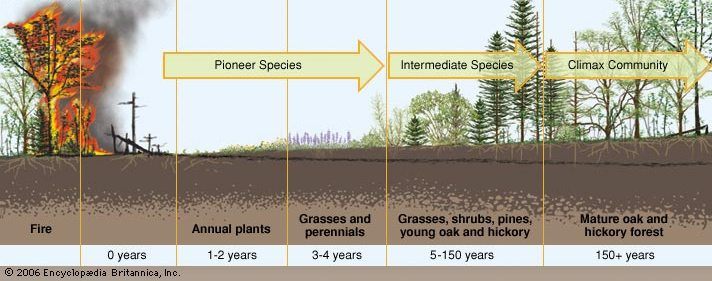
The picture shows what type of succession?
a)
primary
b)
secondary
c)
tertiary
d)
quadanary
107.
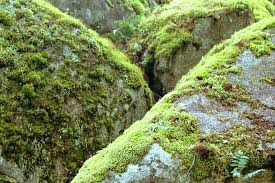
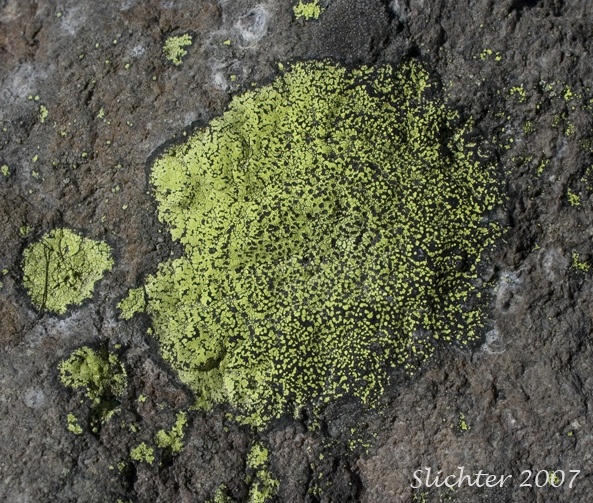
What is the name given to lichen or algae after a primary succession?
a)
pioneer species
b)
volunteer species
c)
founder species
d)
conqueror species
108.
What are examples of pioneer species in a primary succession?
a)
Bushes and Shrubs
b)
Oak trees
c)
Mossess and Lichens 
d)
A rose Bush
109.
After a volcanic eruption, lava covers the land. What is the order that plants grow to repopulate the area?
a)
Lichens → Shrubs → Grasses → Trees
b)
Lichens → tree → shrubs→Grasses
c)
Grasses → Lichens → Shrubs → Trees
d)
Lichens → Grasses → Shrubs → Trees
110.
the process by which a new community forms where no community lived before 
a)
resource
b)
invasive (non- native) species
c)
primary succession
d)
competition
111.
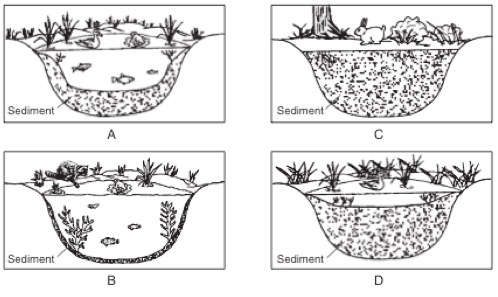
What is the correct order from oldest (happened first) to youngest (happened last) in this pond succession?
a)
A, B, C, D
b)
D, C, B, A
c)
B, A, D, C
d)
C, D, A, B
112.
Reaches a climax community quicker because soil is already present
a)
primary succession 
b)
secondary succession
c)
both types of succession
113.
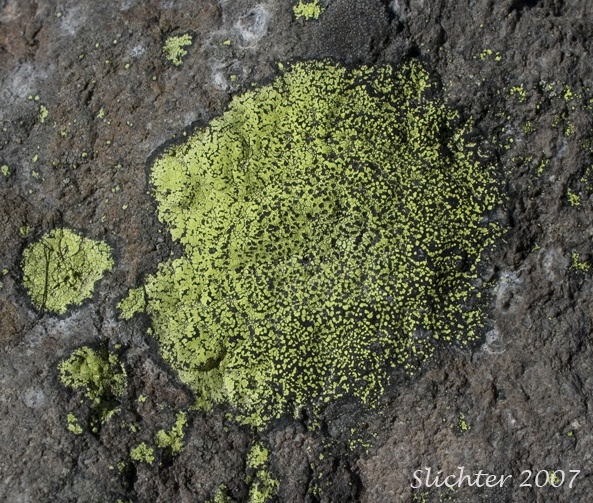
What is the first species you will see after a primary succession? (in picture)
a)
lichens
b)
grasses
c)
small plants
114.
Final illustration (#8) shows
a)
pioneer species
b)
climax community
c)
only biotic factors
d)
only abiotic factors
115.
Succession type?
a)
primary succession
b)
secondary succession
c)
tertiary succession
d)
variable succession
116.
Succession type?
a)
primary succession
b)
secondary succession
c)
tertiary succession
d)
variable succession
117.
This is an example of...
a)
Climax communities
b)
Secondary succession
c)
Lichen
d)
Pioneer species
118.
This is an example of...
a)
Secondary Succession
b)
Primary succession
c)
Utter and complete destruction! RAWR!
d)
Climax Communities
119.
A pioneer species is...
a)
a large organism
b)
the first organisms to adapt to a new environment 
c)
The best organism 
d)
Abiotic organisms 
120.
What is the most important function of pioneer species?
a)
To create rocks
b)
To create soil and add nutrients to the environment 
c)
To look nice
d)
Food for animals 
121.
Succession that occurs in an area with NO SOIL
a)
ecological succession 
b)
primary succession 
c)
secondary succession
d)
pioneer speciles
122.
Does this picture show biodiversity?
a)
Yes
b)
No
123.
What does biodiversity mean?
a)
Only one species in an area.
b)
The different amount of species in an area
c)
All abiotic life
d)
Nitrogen fixation
124.
 Which biome is more likely to survive a change in the environment?
a)
High (rich) biodiversity
b)
Low (poor) biodiversity
125.
When an ecosystem is more diverse it has more sustainability.
a)
False
b)
True
126.
What is sustainability?
a)
the ability to be maintained at a certain rate or level.
b)
a bunch of animals
c)
a loss
d)
a win
127.
Does this picture have sustainability?
a)
Yes
b)
No
128.
Does this have biodiversity?
a)
Yes
b)
No
129.
Does this have sustainability?
a)
Yes
b)
No
130.
If biodiversity is high then sustainability is ____?
a)
High
b)
Low
131.
If biodiversity is low then sustainability is ____?
a)
High
b)
Low
132.
The polar bear's white fur allows it to hide in the cold arctic. This adaptation is called________________.
a)
White on white
b)
Camouflage
c)
Color matching
d)
behavioral adaptation 
133.
What adaptation does this squirrel have that allows it to glide through the air?
a)
Extra skin under the arms and legs to capture air as it falls.
b)
Big ears to capture are as it falls
c)
Small eyes to see where it will land
d)
A short thin tail
134.
Polar bears have an adaptation that allows them to swim. What is most likely this adaptation?
a)
White coat
b)
Fat belly
c)
Small eyes
d)
Webbed Feet
135.
Most desert plants have spines. How does this adaptation help them survive in a harsh environment?
a)
The spines capture water
b)
The spines make it colder
c)
The spines will make it rain
d)
The spines will protect the plant from animals that want to eat it
136.
Cactus have a thick, hard surface (cuticle) that prevent ______________ from evaporating.
a)
Water
b)
Air
c)
Sugar
d)
light
137.
What is the function (job) of fish gills?
a)
To absorb water from the water
b)
To make the fish faster
c)
To make the fish lighter
d)
To absorb oxygen from the water
138.
The feet of this bird tell us that this animal can...
a)
Run fast
b)
Swim 
c)
Fly fast
d)
Climb rocks 
139.
What adaptation most likely helps this bird fly?
a)
A strong beak
b)
Small feet
c)
Hollow bones 
d)
The color of the bird
140.
Why do hollow bones help birds during flight?
a)
Hollow bones make the birds weigh less
b)
Hollow bones are full of heavy blood
c)
Hollow bones store water
d)
Hollow bones are made of feathers 
141.
Xylem is a plant adaptation that allows plants to transport ______________ up the stem.
a)
Salt 
b)
Sugar
c)
Water
d)
Coffee
142.
Birds migrate during the winter to less cold areas. What type of adaptation is this?
a)
Behavioral 
b)
Physiological 
143.
Some plants such as beets, onions and tulips have physical adaptations that allows them to store energy for the next season. What are these types of roots called?
a)
Dubs
b)
Bulbs
c)
Xylem
d)
Phloem 
144.
Anteaters have a long thin snout and even longer tongue. What is this adaptation most likely for?
a)
To reach through small tunnels in the ground where it can find insects.
b)
To reach for fruits in trees
c)
To fight off predators 
d)
'to lick himself after eating 
145.
If a fishes gills are small, what might this say about the oxygen in the water?
a)
The water has no oxygen
b)
The water must have a high concentration of oxygen. 
c)
The water must have a low concentration of oxygen
d)
The water is clear and cold
146.
The Great Horned Owl has his eyes in the front of his head. What can you conclude about this fact?
a)
The Horned Owl is a prey
b)
The Horned Owl is a predator
147.
Goats have eyes on the side of the head. What does this adaptation say about the animal?
a)
He is a prey, and it allows goats to have a wide viewing range
b)
He is a prey, and it allows goats to have a smaller viewing range.
c)
Goats are predators 
d)
Goats are predators, and this allows them to see more
148.
Define Adaptation.
a)
How an organism has NOT changed and continues to live in an environment 
b)
All animals can live in any environment 
c)
How an organism grows over time
d)
Special features or behaviors that allow an animal to survive in an environment.
149.
Hibernation is a ____________________ adaptation that allows animals to survive at times where food is not available.
a)
physical 
b)
behavioral 
150.
This stick insect is using ________________ to blend in to it's environment. 
a)
air 
b)
terra
c)
camouflage 
d)
synthesis 
151.
Define Heredity
a)
The passing of genetic material from child to parent
b)
DNA and RNA
c)
The passing of genetic material from brother to sister 
d)
The passing of genetic material from parent to offspring
152.
The tool used to measure the mass of a substance or object is a ______________.
a)
balance
b)
graduated cylinder
c)
ruler
d)
thermometer
153.
Jack has a rock. The rock has a mass of 14g and a volume of 2cm3. What is the density of the rock?
a)
7 mL
b)
7 g/cm3
c)
28 g/cm3
d)
1/7 g/cm3
154.
What is the volume of Object X?
a)
10.0 cm3
b)
15.0 cm3
c)
20.0 cm3
d)
25.0 cm3
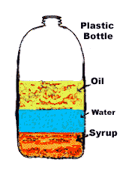
155.
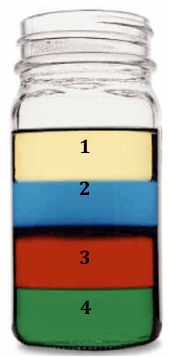
Put the liquids in order from most dense to least dense?
a)
4, 3, 2, 1
b)
1, 2, 3, 4
c)
3, 4, 2, 1, 
d)
4, 3, 1, 2
156.
Which liquid is the least dense?
a)
oil
b)
water
c)
syrup 
d)
plastic bottle
157.
Which box has a higher density?  
a)
Box A
b)
Box B
c)
cannot be determined
d)
they are the same
158.
In general what is the most dense form of matter?
a)
solid
b)
liquid
c)
gas
d)
plasmas
159.
What is the formula for density?
a)
density = mass x volume
b)
density = mass / volume
c)
density = mass + volume
d)
density = mass - volume
160.
Frank has an eraser. It has a mass of 4g, and a volume of 2cm3. What is its density?
a)
8 g/cm3
b)
2 g/cm3
c)
1/2 g/cm3
d)
24 g/cm3
161.
Frank has a paper clip. It has a mass of 9g and a volume of 3cm3. What is its density?
a)
3 g/cm3
b)
1/3 g/cm3
c)
27 g/cm3
d)
39 g/cm3
162.
If the mass of an unknown substance is 5.3 grams and the volume is 2 cm3. What would be its density? (round)
a)
2.7
b)
2.5
c)
2.4
d)
2.2
163.
Calculate the density of the cube.
a)
2 g/cm3
b)
4 g/cm3
c)
6 g/cm3
d)
8 g/cm3
164.
Calculate the density of the cube.
a)
2 g/cm3
b)
4 g/cm3
c)
6 g/cm3
d)
8 g/cm3
165.
Which biome is characterized by low temperatures and low amounts of rainfall?
a)
tundra
b)
desert
c)
temperate deciduous forest
d)
tropical rain forest
166.
Which biome covers most of the land mass near the Earth's equator?
a)
tundra
b)
desert
c)
grassland
d)
tropical rainforest
167.
Which biome is found on the mountain above the tree line?
a)
grassland
b)
deciduous forest
c)
tundra
d)
tropical forest
168.
Which biome, because of its climate, has the largest number of species of plants and animals?
a)
tundra
b)
desert
c)
tropical rainforest
d)
pine forest
169.
Which type of trees is found in a temperate forest?
a)
deciduous
b)
evergreen
c)
ginko
d)
palm
170.
Which major biome is home to cacti, mesquite, white thorn, pack rats, small reptiles, and coyotes?
a)
desert
b)
taiga
c)
tundra
d)
grassland
171.
What is the main factor that separates the biomes?
a)
Land
b)
Water
c)
Climate
d)
Longitude
172.
You observe earthworms in a microhabitat in your schoolyard. Why are earthworms and other decomposers an essential part of a healthy ecosystem?
a)
Decomposers make resources available to producers by breaking down waste materials.
b)
Decomposers extract energy from sunlight as they break down plant materials, adding returning energy to the system.
173.
A/n ___ consists of all the communities that live in an area and the abiotic features of their environment.
a)
community
b)
population
c)
biome
d)
ecosystem
174.
All the organisms of one species that live in an area are called the ___.
a)
population
b)
ecosystem
c)
biome
d)
community
175.
What factor contributes the most to the sustainability of a habitat?
a)
competition among large predators
b)
large variety of organisms
c)
presence of volcanic rock
d)
absence of bacterial species
176.
Where  does  the energy of most of the ecosystems come from?
a)
Batteries 
b)
Air
c)
Sun
d)
Electricity
177.
Temperature, light, air, water, and soil are all  _____  parts of the environment
a)
alive
b)
biotic 
c)
abiotic
d)
living
178.
A ____________ breaks down waste or dead organisms and recycles nutrients.
a)
consumer
b)
producer
c)
decomposer
d)
omnivore
179.

Functions of animals that help them survive in their environment are —

a)

structural adaptations

b)

modifications

c)

physical characteristics

d)

behavioral adaptations

180.
What is happening at D?
a)
Stationary
b)
Accelerating
c)
Fast steady speed; moving away from the starting position
d)
Slower steady speed; moving away from the starting position
181.
What is happening at A?
a)
Stationary
b)
Accelerating
c)
Slower steady speed; moving away from the starting position
d)
Steady speed; returning to start position
182.
What is happening at B?
a)
Stationary
b)
Accelerating
c)
Slower steady speed; moving away from the starting position
d)
Steady speed; returning to start position
183.
Which runner won the race?
a)
A
b)
B
c)
C
184.
Which runner had a head start?
a)
A
b)
B
c)
C
185.
How long did it take this object to travel 10 m?
a)
0 s
b)
10 s
c)
15 s
d)
20 s
186.
How long did it take this object to travel back to its reference/starting point?
a)
20 s
b)
30 s
c)
60 s
d)
100 s
187.
At 60 seconds, how far had this object traveled? 
a)
0 m
b)
10 m
c)
20 m
d)
40 m
188.
What is this graph showing?
a)
Constant Speed
b)
Acceleration (speeding up)
c)
Deceleration (slowing down)
d)
No motion
189.
What is the speed of this object at 3 seconds?
a)
5 m/s
b)
45 m/s
c)
5 s/m
d)
45 s/m