
 Worksheets
SC Science PASS Review 2018
Total questions: 189
Worksheet time: 3hrs 5mins
Name
Class
Date
1.
An experiment is performed on plants to see how different liquids affect plant growth. Each plant in the experiment is given a different liquid; water, apple juice, or milk. Each plant has the same amount of soil, sunlight, and listens to the same music. In this investigation, the independent variable is ...
a)
The type of plant
b)
The amount of sunlight
c)
The type of music
d)
The type of liquid
2.
An experiment is performed on plants to see how different liquids affect plant growth. Each plant in the experiment is given a different liquid; water, apple juice, or milk. Each plant has the same amount of soil, sunlight, and listens to the same music. In this investigation, what are the controlled variables?
a)
Type of plant, amount of music, and sunlight
b)
Water, apple juice, milk
c)
Plant growth
3.
An experiment is performed on plants to see how different liquids affect plant growth. Each plant in the experiment is given a different liquid; water, apple juice, or milk. Each plant has the same amount of soil, sunlight, and listens to the same music. In this investigation, what is the dependent variable?
a)
Type of plant
b)
Water, apple juice, milk
c)
Plant growth
4.
The independent variable is the ONE thing you _____.
a)
change on purpose
b)
control or keep constant
c)
measure
5.
The variable that is being measured or observed is called the _______________. Hint: this is the variable that is the result or effect
a)
independent variable
b)
dependent variable
c)
control variable
6.
Tectonic plates are made up of continental crust and ________ crust.
a)
continental
b)
oceanic
c)
plates
d)
mantle
7.
What is the thickest layer of the Earth?
a)
the crust
b)
the mantle
c)
the outer core
d)
the inner core
8.
What is the core made of?
a)
steel
b)
iron
c)
aluminum
d)
iron and nickel
9.
What describes the outer core?
a)
solid
b)
liquid
c)
viscous
d)
gas
10.
Why is the inner core solid?
a)
its unknown
b)
what it's made of
c)
the pressure
d)
it is colder than the outer core
11.
Which layer(s) of the Earth make up the asthenosphere?
a)
Part of the mantle
b)
Crust, mantle, Core
c)
Crust and upper mantle
d)
Only the crust
12.
What layer is a semisolid and acts like a plastic?
a)
Lithosphere
b)
Mantle
c)
Asthenosphere
d)
crust
13.
The oceanic floor is made of?
a)
Granite
b)
Basalt
c)
Cookies
d)
Water
14.
The continental floor is made up of?
a)
Flowers and grass
b)
Basalt
c)
Granite
d)
Crust
15.
What happens to temperature as we move from the crust to the inner core?
a)
Decreases
b)
Increases
c)
Nothing
16.
Which layer of Earth is made up of tectonic plates?
a)
outer core
b)
inner core
c)
asthenosphere
d)
lithosphere
17.
What type of rock would you most likely find a fossil inside of?
a)
sedimentary
b)
igneous
c)
metamorphic
d)
diamond
18.

a)
Gold
b)
Hematite
c)
Pyrite
d)
Galena
19.

a)
luster
b)
streak
c)
scratch
d)
hardness
20.

a)
Yellow
b)
Gray
c)
Brassy Yellow
d)
Brassy Gray
21.

a)
Gold
b)
Hematite
c)
Pyrite
d)
Galena
22.

a)
Fluorite
b)
Talk and Calcite
c)
Talc
d)
none of the above
23.

a)
Talc
b)
Gypsum
c)
Fluorite
d)
Talc and Gypsum
24.
True or False:
A mineral is a solid, nonliving material with a definite chemical makeup.
A mineral is a solid, nonliving material with a definite chemical makeup.
a)
True
b)
False
25.
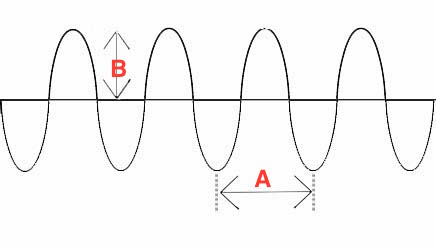
What property of the wave is represented by the letter "B"?
a)
amplitude
b)
crest
c)
trough
d)
wavelength
26.

Which vocabulary term is used to identify the distance between points C & G?
a)
Amplitude
b)
Crest
c)
Frequency
d)
Wavelength
27.
When the frequency of a wave increases, what happens to the wavelength?
a)
The wavelength is not directly affected by the frequency of a wave.
b)
The wavelength increases.
c)
The wavelength decreases.
d)
More specific information is needed to form a conclusion about the wavelength.
28.
A mechanical wave cannot travel through...
a)
a vacuum(empty space).
b)
water.
c)
air.
d)
glass.
29.
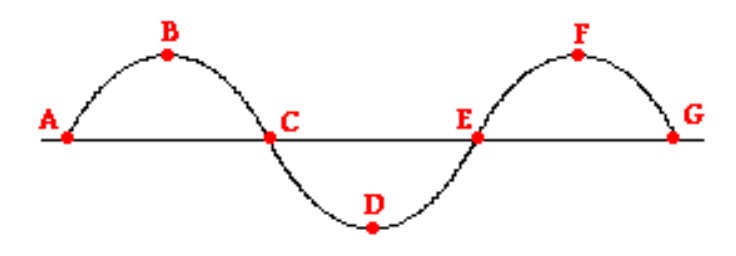
Which letter(s) represent the trough of the wave?
a)
A
b)
B & D
c)
D
d)
C & G
30.
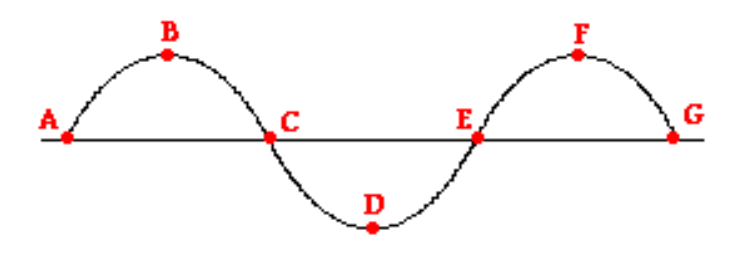
Which letter(s) represent the crest of the wave?
a)
A
b)
B & D
c)
B & F
d)
F
31.
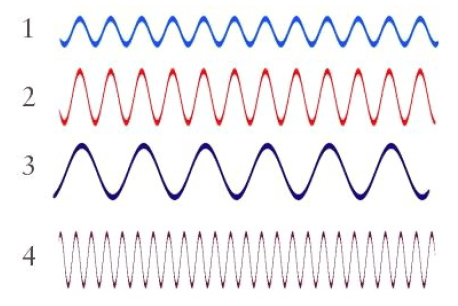
Which wave in the diagram has the greatest frequency?
a)
1
b)
2
c)
3
d)
4
32.
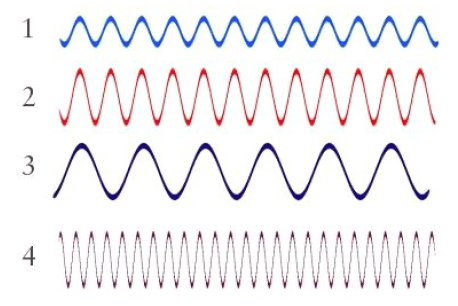
Which wave in the diagram has the greatest wavelength?
a)
1
b)
2
c)
3
d)
4
33.
Which of the following can sound travel through?
a)
solid
b)
liquid
c)
gas
d)
all of the above
34.
When a wave strikes and object and bounces off. (example echo)
a)
medium
b)
refraction
c)
reflection
d)
interference
35.
The units for frequency are measured in _____________.
a)
hertz
b)
seconds
c)
m/s
d)
m
36.
Which factor(s) affect how quickly sound travels?
a)
The amplitude of the sound wave.
b)
The temperature.
c)
The amplitude of the sound wave and the medium the wave travels through.
d)
The temperature and the medium the wave travels through.
37.
Amplitude reflects the amount of ____________________ in a wave.
a)
energy
b)
compression
c)
rarefaction
d)
speed
38.
The ___________________ of waves can change when the waves move from one medium to another.
a)
altitude
b)
amplitude
c)
speed
d)
compression
39.
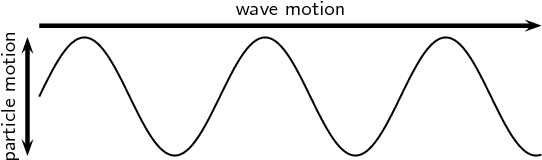
What kind of wave is pictured below?
a)
compressional wave
b)
transverse wave
c)
sound wave
d)
mechanical wave
40.

What are the spaced out sections of this wave called?
a)
Reflections
b)
Rarefactions
c)
Compressions
d)
Wavelengths
41.
electromagnetic waves with the longest wavelengths are
a)
gamma rays
b)
x-rays
c)
infrared waves
d)
radio waves
42.
Which waves are used to show heat loss with heat sensitive cameras?
a)
Infrared radiation
b)
ultraviolet radiation
c)
microwaves
d)
gamma rays
43.
Which waves are the type that can give us suntans and sunburns?
a)
Infrared radiation
b)
Ultraviolet radiation
c)
Radio waves
d)
X-rays
44.
In visible light, which color has the longest wavelength?
a)
Red
b)
Violet
c)
Yellow
d)
Green
45.

________________ are waves used by cops to test the speed of your car with RADAR.
a)
Ultraviolet
b)
Infrared
c)
Radio
d)
Microwaves
46.
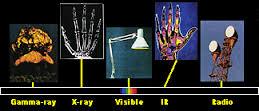
Cancer can be treated with_______________waves.
a)
Penicillin
b)
Radio
c)
Infrared
d)
Gamma
47.

Electromagnetic waves________________travel through space.
a)
Never
b)
Cannot
c)
Can
d)
Wish they could
48.

The acronym (letters) used to remember visible light is____________
a)
KTPERRY
b)
ROYGBIV
c)
DOGPOUND
d)
ROMERO
49.

_____________________light is the only type of EM wave detected by the human eye.
a)
Red
b)
Gamma
c)
Microwave
d)
Visible
50.

Wavelengths on the right side of the Electromagnetic spectrum are ______________.
a)
short
b)
long
c)
average
51.

The higher the frequency the ______ the energy.
a)
higher
b)
lower
c)
neither, stays the same
52.
Select the correct order of waves on the Electromagnetic Spectrum
a)
Radio, Micro, Infra, Visible, Ultra, X-ray, Gamma
b)
Gamma, X-ray, Ultra, Vis, Infra, Micro, Radio
c)
Vis, Micro, Infra, Ultra, X-ray, Gamma, Radio
d)
Micro, Radio, Vis, Infra, Ultra, X-ray, Gamma
53.
If you're moving from gamma rays to microwave, describe how the energy level changes
a)
Increases
b)
Decreases
c)
Energy level doesn't change
d)
We never talked about it
54.
Produced when sediments fill in a cavity made when an object decayed
a)
cast
b)
mold
c)
original remains
55.
Cavity in a rock made when an organism decayed
a)
cast
b)
mold
c)
original remains
56.
Process that uses the properties of atoms in rocks and other objects to determine their ages
a)
relative dating
b)
radioactive decay
c)
absolute dating
57.
Principle that states in a sequence of undisturbed rocks, the oldest rocks are on the bottom and the rocks become progressively younger toward the top
a)
superposition
b)
uniformitarianism
c)
half-life
58.
Gaps in rock records made when agents of erosion remove existing rock layers
a)
fossils
b)
unconformities
c)
permineralized remains
59.
Method by which a geologist can calculate the absolute age of the rock by knowing the half-life of an isotope
a)
radiometric dating
b)
relative dating
c)
absolute dating
60.
Fossil of thin layer of carbon atoms and molecules
a)
original remains
b)
carbon film
c)
trace fossil
61.
Formed when original material in skeletal remains are replaced by minerals
a)
original remains
b)
fossil
c)
permineralized remains
62.
Method by which order of events or age of rocks is determined by examining the position of rocks in a layer
a)
relative dating
b)
absolute dating
c)
radiometric dating
63.

Correctly sequence the layers of rocks oldest to youngest
a)
A,B,C,D
b)
D,C,B,A
64.

Correctly sequence the layers of rocks oldest to youngest
a)
C,E,D,A,B
b)
C,E,D,A,B
c)
C,E, D,B,A
65.

Correctly sequence the layers of rocks oldest to youngest
a)
A,D, C, B, E
b)
E, B,C D, A
c)
B,E,C, D, A
66.

The diagram shows layers of sedimentary rock and examples of the fossils each layer contains, Which layer contains the oldest fossils?
a)
A. Layer 2
b)
B. Layer 4
c)
C. Layer 1
d)
D. Layer 3
67.

This fossil was found at an excavation site in West Texas. What can a scientist determine about this animal from evidence of the fossil?
a)
A. This animal was a carnivore.
b)
B. This animal was a good swimmer.
c)
C. This animal lived in a cold climate.
d)
D. This animal lived underground.
68.
How are fossils created?
a)
A. Traces of organisms harden like rock.
b)
B. Dead organisms are quickly buried for millions of years.
c)
C. Animals get trapped.
d)
D. All of the above
69.
What had to be applied in order to make buried organic matter into fossil fuels?
a)
A. Industrial Pollution
b)
B. Ocean Currents
c)
C. Volcanic Activity
d)
D. Heat and pressure
70.
All of these are related to the formation of oil or natural gas EXCEPT:
a)
A. Decomposed Animals
b)
B. Decayed Plants
c)
C. Sedimentary Rocks
d)
D. Active Volcanoes
71.
Granite, an igneous rock, is broken down by weathering and deposited. What rock type will this deposit most likely become?
a)
igneous
b)
sedimentary
c)
metamorphic
d)
foliated
72.
Minerals that are mined because they contain useful metals or nonmetals are classified as__________
a)
Rocks
b)
Ores
c)
Minerals
d)
Fossil Fuels
73.
What must be present for Fossil Fuels to form?
a)
Bones and Sediment
b)
Dead Organisms and Layers of Sediment
c)
Dead Organisms, Layers of Sediment, and Heat & Pressure over time
d)
Bones, Layers of Sediment, and Heat & Pressure over time
74.
Fossil fuels are classified as nonrenewable because they.......
a)
require expensive equipment
b)
take millions of years to replace
c)
can be found all over
d)
provide all the energy we use
75.
Iron, Gold, and lead are examples of______
a)
Minerals
b)
Ores
c)
Fossil Fuels
d)
Rocks
76.
An object seen through translucent material appears less clear than one seen through transparent material because the translucent material....
a)
transmits none of the light coming from the object.
b)
reflects all the light coming from the object.
c)
transmits all of the light coming from the object.
d)
diffuses (spreads out) some of the light coming from the object.
77.
An object appears red because it....
a)
reflects light waves of all colors.
b)
reflects light waves of red.
c)
absorbs light waves of red.
d)
transmits light waves of all colors.
78.
How do colors differ from one another?
a)
Different colors have different wavelengths.
b)
Different colors have different amplitudes.
c)
Different colors are made from different energy sources.
d)
Different colors are found in different sections of the electromagnetic spectrum.
79.
Which structure refracts the bulk of the light that enters our eyes?
a)
The iris.
b)
The pupil.
c)
The cornea.
d)
The retina.
80.
Which eye structure is covered by rods and cones -- cells specially designed to respond to light and colors?
a)
The iris.
b)
The pupil.
c)
The cornea.
d)
The retina.
81.
When visible light is absorbed by an object, it is converted into....
a)
invisible light.
b)
heat energy.
c)
scattered energy.
d)
nothing -- light energy that is absorbed is simply destroyed.
82.
How do rainbows form?
a)
White light refracts as it passes through drops of water in the atmosphere.
b)
White light scatters as it passes through drops of water in the atmosphere.
c)
Water in the atmosphere reflects all colors of white light.
d)
Our atmosphere is translucent, influencing the way that light passes through it.
83.
Transparent materials....
a)
allow almost all of the visible light to pass through them.
b)
reflect almost all of the visible light that attempts to pass through them.
c)
absorb most of the visible light that attempts to pass through them.
d)
scatters most of the visible light that attempts to pass through them.
84.

Upside down images are formed on the ____________ at the back of the eyeball.
a)
cornea
b)
iris
c)
retina
d)
pupil
85.

Signals from the retina travel to the brain through the __________.
a)
spinal cord
b)
eye cord
c)
optic nerve
d)
last nerve
86.

Which fossil is a replica of the original shape of the organism?
a)
cast
b)
mold
c)
trace
d)
preserved remains
87.

Which fossil is an impression left by the original organism?
a)
cast
b)
mold
c)
trace
d)
preserved remains
88.
Relative dating of rock layers tells us that the deeper we dig, _______.
a)
the younger the rocks get
b)
the smellier the rocks get
c)
the harder the rocks get
d)
the older the rocks get
89.
The Geologic Time Scale is a record of what?
a)
old geologists
b)
sweet geology music
c)
the known history of rocks and fossils
d)
a list of every living thing ever
90.
How old do Paleontologists believe the Earth is?
a)
2015 years old
b)
3.6 billion years old
c)
4.6 billion years old
d)
4.6 million years old
91.
Which is the most recent era of time- the one that we are currently in?
a)
Mesozoic
b)
Paleozoic
c)
Cenozoic
d)
Precambrian
92.
Footprints, nests, burrows and fossilized poop are examples of what kind of fossils?
a)
Trace Fossils
b)
preserved remains
c)
Erosion
d)
sedimentary rock
93.
Fossils in which minerals replace all, or a part, of an organism is what kind of fossil?
a)
Petrified Fossil
b)
Preserved
c)
Fault
d)
Intrusion
94.
Identify the Era in which each of the events occurred:
Jurassic period
Jurassic period
a)
Mesozoic
b)
Paleozoic
c)
Cenozoic
d)
Precambrian
95.
Identify the Era:
called the "Age of Mammals"
called the "Age of Mammals"
a)
Precambrian
b)
Paleozoic
c)
Mesozoic
d)
Cenozoic
96.
Identify the Era:
that was the longest of all eras
that was the longest of all eras
a)
Precambrian
b)
Paleozoic
c)
Mesozoic
d)
Cenozoic
97.
Identify the Era:
where dinosaurs thrived
where dinosaurs thrived
a)
Precambrian
b)
Paleozoic
c)
Mesozoic
d)
Cenozoic
98.
Identify the Era:
First forms of life appeared in this era.
First forms of life appeared in this era.
a)
Precambrian
b)
Paleozoic
c)
Mesozoic
d)
Cenozoic
99.
Identify the Era:
This era contains the Triassic, Jurassic, and Cretaceous Periods
This era contains the Triassic, Jurassic, and Cretaceous Periods
a)
Precambrian
b)
Paleozoic
c)
Mesozoic
d)
Cenozoic
100.
What is absolute dating
a)
The age when the rock was formed
b)
dinner and movie with a rock
c)
A range of rock compared to other rocks
d)
Relative dating
101.

What principle proves Layer 1 is younger than 2.
a)
superposition
b)
crosscutting
c)
inclusions
d)
horizonality
102.
Put this in order of smallest to largest time frame.
a)
Eon, Era, Periods, Epoch
b)
Periods, Epoch, Eon, Era,
c)
Epochs, Periods, Eras, Eons
d)
Eras, Periods, Epochs, Eons
103.
Scientists
studied a population of tree ants in a forest.
The forest is near a large factory.
At first there were many more brown ants than gray ants. The factory was slowly polluting the water,
and the tree bark in the forest changed from brown to grey. At the end of the study, there were more gray
ants than brown ants. What might explain
this?
a)
a. The gray ants killed the brown ants
b)
b. The brown ants were killed by pollution
c)
c. The gray ants were better adapted to the polluted tree bark
d)
d. The scientists did not count the number of gray ants correctly
104.
A
Cuttlefish can change its color to match the area around it. Look at the picture below and tell which
statement BEST explains how changing
its color could help the cuttlefish to survive?
a)
a.
It
helps the Cuttlefish avoid predators
b)
b. It helps the Cuttlefish find a place to live
c)
c. It helps the Cuttlefish see its prey more clearly in cloudy ocean waters
d)
d. It helps the Cuttlefish keep its body warm in the cold ocean waters
105.
The Tasmanian tiger was declared
extinct in 1936. What does this tell you about the Tasmanian tiger?
a)
a. There are only a few Tasmanian tigers left in the world.
b)
b. The Tasmanian tiger is well adapted to its environment.
c)
c. The Tasmanian tiger is not well adapted to its environment.
d)
d. All Tasmanian tigers are dead and gone forever.
106.
The Aspen tree has a large root
system below the ground. Scientists have discovered that forest fires help the
Aspen’s roots grow better. Forest fires also burn away competing plants and
leave behind soil that is rich in minerals. This soil is good for growing
Aspens. Which statement BEST describes Aspen trees?
a)
a. They are adapted to forest fires.
b)
b. They can move away from forest fires.
c)
c. They are endangered by forest fires.
d)
d. They are not affected by forest fires.
107.
Thorns
on a rose bush
a)
Physical Adaptation
b)
Behavioral Adaptation
108.
Wolves hunting in packs
a)
Physical Adaptation
b)
Behavioral Adaptation
109.
The term that best describes "the better adapted organisms survive to pass traits along to offspring".
a)
Evolution
b)
Natural Selection
c)
Extinction
d)
Artifical Selection
110.
According to the theory of natural selection, why are some individuals more likely than others to survive and reproduce?
a)
Some individuals pass on to their offspring new characteristics they have acquired during their lifetimes.
b)
Some individuals are better adapted to exist in their environment than others are.
c)
Some individuals do not pass on to their offspring new characteristics they have acquired during their lifetimes.
d)
Some individuals tend to produce fewer offspring than others in the same environment.
111.
The differences among a species, like different bird beaks, are called
a)
genes.
b)
variations.
c)
traits.
d)
theories.
112.
Humans are causing extiction in which ways?
a)
By over hunting animals for food or products.
b)
By destroying the natural habitat of species.
c)
By polluting the environments of the world.
d)
All of the above.
113.
How can you help prevent extinctions?
a)
By not polluting our environment.
b)
By protecting sensitive habitats and species.
c)
By not eating or buying products from endangered animals.
d)
All of the above.
114.
Which of the following was a natural factor that caused extinctions?
a)
Over harvesting
b)
Changes in the oxygen levels
c)
Pollution
d)
Habitat destruction
115.
Occurs when an unusually large number of organisms become extinct over a relatively short period of geologic time.
a)
index fossil
b)
radiometric dating
c)
Pleistocene Ice age
d)
mass extinction
116.
What era has seen the rise of mosses, ferns, and conifers?
a)
Precambrian
b)
paleozoic
c)
Mesozoic
d)
Cenzoic
117.
By the end of this era, reptiles became dominant.
a)
cenzoic
b)
mesozoic
c)
paleozoic
d)
precambrian
118.
Popular theory suggests this ended the age of dinosaurs.
a)
asteroid impact
b)
ice age
c)
human predation
119.
One huge continent-Pangaea-forms.
a)
mesozoic
b)
cenozoic
c)
paleozoic
120.
Index fossils are useful b/c they tell the _______________ age of rock layers
a)
absolute
b)
relative
121.
What can happen if a volcano erupts explosively?
a)
Ash and dust clouds circle the planet via wind blocking light from the sun
b)
plants get nutrients from the lava and that is why Hawaii has such pretty flowers
c)
nothing because people evacuate before the lava gets to their house
d)
rain
122.
Which statement is correct?
a)
organisms become more complex over time
b)
The most complex organisms lived during the precambrian time
c)
organisms have not changed in complexity
d)
The complexity of organisms has nothing to do with science
123.

What are the remains of organism noticed by Wegener that are found the same in two continents?
a)
Leaves and flowers
b)
Ice and mountains
c)
Plants and animals
d)
Dinosaurs and reptiles
124.

Cynognathus fossils are found between where?
a)
India
b)
Africa and South America
c)
Antartica
d)
South America only
125.
Which piece of evidence did Wegener use to prove continental drift?
a)
The shape of the continents
b)
Similar fossils found on separate continents
c)
Tree fossils found in odd places
d)
All of the above
126.

As you travel from the inner core to the crust, how would temperature, pressure and density of the material change?
a)
The would all increase
b)
The would all decrease.
c)
Nothing, the layers are made of the same material throughout
d)
Temperature would decrease, but pressure and density would increase
127.
The movement of Earth's crust along plate boundaries produces
a)
earthquakes
b)
volcanoes
c)
mountains
d)
All of these options.
128.
Which type of event often occurs along transform fault boundaries?
a)
volcanoes
b)
earthquakes
c)
sea-floor spreading
d)
mountain building
129.
A collision between two pieces of continental crust at a converging boundary produces a
a)
mid ocean ridge
b)
deep ocean trench
c)
rift valley
d)
mountain range
130.

The circular arrows inside the Earth's Mantle represent what type of motion, that drives ALL plate movement?
a)
Convergent Boundary
b)
Ocean Currents
c)
Convection Currents
d)
Transform Boundary
131.
Andrew found warm-weather plant fossils while on an expedition to Antarctica. Which conclusion best supports his find?
a)
The seeds of plants were carried by flying dinosaurs that escaped Jurrassic Park
b)
The island was once closer to the equator, but has since drifted to its current location
c)
Ancient Mariners transported the plants to the island.
d)
The plants drifted on the ocean currents to the island.
132.
What geologic feature/event would you most likely to find at a divergent boundary between two pieces of oceanic crust?
a)
Rift Valley
b)
Mid-Ocean Ridge
c)
Island Arc
d)
Flat land
133.
A subduction zone is formed...
a)
when one tectonic plate sinks below another
b)
at every type of convergent plate boundary
c)
at every type of divergent plate boundary
d)
at transform boundaries
134.
The area where two or more plates meet is called a __________________.
a)
fault
b)
plate boundary
c)
plate edge
d)
ring of fire
135.
A deep crack in the Earth's crust is called a _______________.
a)
canyon
b)
trench
c)
fault
d)
plate
136.

What kind of plate boundary is shown here?
a)
divergent
b)
convergent
c)
transform
d)
strike slip
137.
If a star is being observed from Earth and it's light has shifted towards the blue side of the electromagnetic spectrum it would be...
a)
Moving towards the Earth
b)
Moving away from the Earth
c)
This is a trick question that cannot be answered
d)
It isn't a star, it is a very large blueberry.
138.
If a star is being observed from Earth and it's light has shifted towards the red side of the electromagnetic spectrum it would be...
a)
Moving towards the Earth
b)
Moving away from the Earth
c)
This is a trick question that cannot be answered
d)
It isn't a star, it is a very large blueberry.
139.
The vast majority of galaxies in our universe are moving away from us. We know this because we observe __________ in the galaxies absorption spectra.
a)
Redshift
b)
Blueshift
c)
Turbulance
d)
Superposition
140.
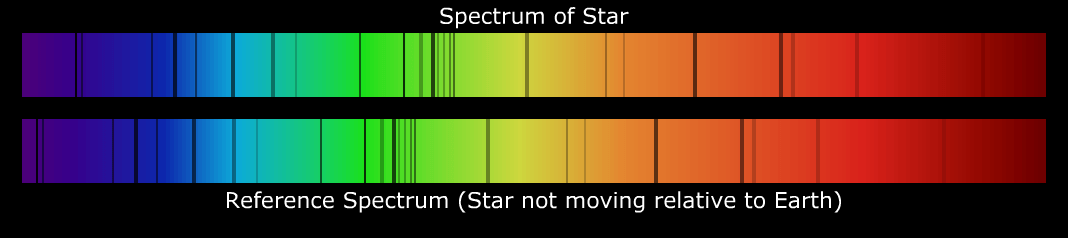
Use the image to identify the motion of the object relative to Earth. Compare the absorption spectra of the star to what the star would look like if it were not moving at all relative to Earth.
a)
It is not moving
b)
It is moving away from Earth (Redshift)
c)
It is moving towards Earth (Blueshift)
d)
It is moving towards Earth (Redshift)
141.
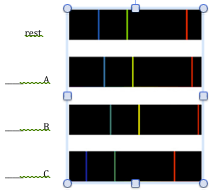
Are any of the galaxies moving towards
Earth? Explain.
a)
A. It is redshifted
b)
B. It is redshifted.
c)
C. It is blue shifted.
d)
A. It is blueshifted.
142.
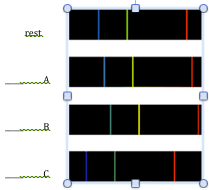
Based on Doppler effect, which of the galaxies is moving away from Earth?
a)
A
b)
B
c)
C
d)
A and B
143.

In this rock layer diagram there are two unconformities, a fault at E and an intrusion at D. Which unconformity occurred first? How do you know?
a)
Intrusion D occurred first because the instrusion has been moved by the fault.
b)
The fault occurred first because it has moved the intrusion D.
c)
Intrusion D occurred first because it can be seen in all of the rock layers.
d)
Fault E occurred first because it is a normal fault.
144.

Which Rock layer or intrusion is the youngest?
a)
A
b)
B
c)
C
d)
D
145.

An archaeologist made the following diagram of a dig site. What can be said about the pottery as compared to the skull found in the site?
a)
The rock layer with the pottery is more recent than the rock layer with the skull.
b)
The rock layer with the skull is more recent than the rock layer with the pottery.
c)
The rock layer with the skull is approximately the same age as the rock layer with the pottery.
d)
The rock layer with the skull has an absolute date of 17,000 years.
146.
What is the study of past life as rocks or fossils?
a)
Paleontology
b)
Archeology
c)
Fossilology
147.
Which best describes the fossil record?
a)
The fossil record cannot provide evidence of evolution.
b)
The fossil record provides evidence of a common ancestor to many species.
c)
The fossil record provides evidence that disputes the theory of evolution.
d)
The fossil record is inaccurate because scientists are not able to date fossils.
148.
In rock layers, jellyfish fossils are found lower than trilobite fossils, and trilobite fossils are found lower than ammonite fossils. What can be determined from this information?
a)
Trilobites existed before jellyfish and ammonites.
b)
Jellyfish existed before trilobites and ammonites.
c)
Ammonites existed before trilobites and jellyfish.
d)
Jellyfish, trilobites, and ammonites lived together.
149.
What is the difference between instantaneous speed and average speed?
a)
Average speed happens in a particular instant, Instantaneous speed is the speed of an object over a longer period of time.
b)
Instantaneous speed is never right, average speed is always right
c)
Instantaneous speed happens in a particular instant, Average speed is the speed of an object over a longer period of time.
d)
Do not pick this answer
150.

Calculate the speed:
A Car traveled 240 Km in 5 Hours
A Car traveled 240 Km in 5 Hours
a)
48 Km/Hr
b)
1200 Km/Hr
c)
4.8 Km/Hr
d)
0.02 Km/Hr
151.

Calculate the speed:
A truck traveled 208 Km in 4 Hours
A truck traveled 208 Km in 4 Hours
a)
52 Km/hr
b)
25 Km/hr
c)
0.019 Km/hr
d)
832 Km/hr
152.
8 N to the left , and 4 N to the right. Find the net force. Is this balanced
a)
12 N Right No
b)
4 N Left No
c)
12 N Right Yes
d)
4 N Left Yes
153.
Find the net force: 15 N to the right, and another 15 newtons to the right.
a)
0 N Right
b)
0 N Left
c)
30 N Left
d)
30 N Right
154.
With unbalanced forces, the object will move in the direction of the _______ force.
a)
larger
b)
smaller
c)
equal
155.

The force that pulls things toward earth.
a)
Speed
b)
Gravity
156.

What is the net force?
a)
5000 N right
b)
4000 N right
c)
40 N left
d)
4000 N left
157.
A distance vs. time graph shows an object's
a)
frame of reference
b)
speed
c)
acceleration
d)
favorite food
158.
Velocity is both ____ and _____.
a)
speed , direction
b)
direction, mass
c)
volume, density
d)
direction, magnitude
159.
65mi/hr South is an example of...
a)
Speed
b)
Velocity
c)
Acceleration
d)
Direction
160.
What is the Sun mostly made of?
a)
Stars
b)
Hydrogen and Helium
c)
Oxygen
d)
Carbon Dioxide
161.
Moving areas of magnetic activity with temperatures that are cooler than the area of the photosphere
a)
Photosphere
b)
Corona
c)
Sunspots
d)
Prominence
162.
The part of the Sun that we see
a)
Solar Flare
b)
Prominence
c)
Sunspot
d)
Photosphere
163.
Bright arch-like loops that may erupt from the photosphere into the corona
a)
Sunspots
b)
Solar Flares
c)
Prominences
d)
Photosphere
164.
Sudden, intense explosions that result in changes in brightness when magnetic energy is released.
a)
Prominences
b)
Solar Flare
c)
Sunspot
d)
Photosphere
165.
Energy released from _________ can cause damage to the International Space Station, disrupt radio and electrical transmissions on Earth, and cause Auroras in the skies near the North and South Poles
a)
Sunspots
b)
Solar Flares
c)
Prominences
d)
Corona
166.

A dark spot on the photosphere of the sun
a)
corona
b)
solar flare
c)
sunspot
d)
magnitude
167.

The visible surface of the sun
a)
galaxy
b)
universe
c)
corona
d)
photosphere
168.

The distance light travels in one Earth year; about 6 trillion miles
a)
galaxy
b)
universe
c)
light-year
d)
corona
169.

At position A, which hemisphere would have summer?
a)
Northern hemisphere
b)
Southern hemisphere
170.

What happens when the area in which you live tilts away from the sun?
a)
It is summer.
b)
It is spring.
c)
It is winter.
d)
It is fall.
171.
The term equinox means....
a)
equal amount of day light and equal amount of night
b)
Equal amount of winter and summer
c)
Equal amounts of hot dogs for everyone
d)
The longest day of the year
172.
What do June 21 and December 21 have in common?
a)
equinox dates
b)
the moon is full
c)
solstice dates
d)
the cold fronts blow in
173.
What is the longest day of the year?
a)
winter solstice
b)
summer solstice
c)
fall equinox
d)
spring equinox
174.
Why do we experience the changing of the season on the earth?
a)
distance from the sun
b)
rotation of the earth
c)
change in solar output
d)
tilt of the earth's axix
175.

Why is the Equator warmest?
a)
Because it is closest to the sun.
b)
Because it receives the most direct sunlight
c)
Because no clouds form here.
d)
Because it is far from the sun
176.

Which season is taking place in the Southern Hemisphere in Position 1?
a)
Winter
b)
Spring
c)
Summer
d)
Fall
177.

Which season is taking place in the Northern Hemisphere in Position 1?
a)
Winter
b)
Spring
c)
Summer
d)
Fall
178.

Which season is taking place in the Northern Hemisphere in Position 2?
a)
Winter
b)
Spring
c)
Summer
d)
Fall
179.

Which season is taking place in the Northern Hemisphere in Position 4?
a)
Winter
b)
Spring
c)
Summer
d)
Fall
180.

Which season is taking place in the Northern Hemisphere in Position 3?
a)
Winter
b)
Spring
c)
Summer
d)
Fall
181.
A solar eclipse only happens during a ________ moon.
a)
New
b)
Cresent
c)
Gibbous
d)
Full
182.

What do we call the sun's outer atmosphere that you see during a solar eclipse?
a)
an umbra
b)
a corona
c)
an orbit
d)
a shadow
183.
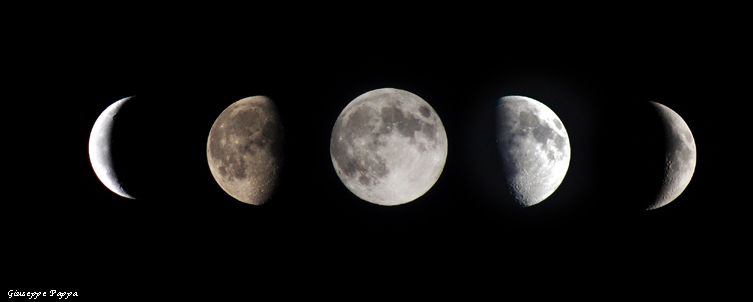
A solar eclipse only occurs during which moon phase?
a)
1st Quarter
b)
New Moon
c)
Full Moon
d)
3rd Quarter
184.

a)
solar eclipse
b)
lunar eclipse
185.

a)
solar eclipse
b)
lunar eclipse
186.
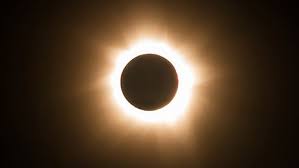
During a solar eclipse...
a)
The sun is blocked by the moon
b)
The Earth is blocked moon
c)
The moon is blocked by the sun
d)
You are blocked
187.
Why do the Sun and Moon appear to be the same size in the sky?
a)
The Sun is 400 times bigger, but the Moon is 100 times closer.
b)
The Sun is 100 times bigger, but the Moon is 400 times closer.
c)
The Sun is 400 times bigger, but the Moon is 400 times closer.
d)
The Moon is 400 times bigger, but the Sun is 400 times closer.
188.
An eclipse in space is when....
a)
one object passes through the shadow of another object.
b)
two shadows collide.
c)
the moon is in the waxing crescent phase.
d)
the Sun and Moon are side by side.
189.
What is the order during a lunar eclipse
a)
sun, moon, earth
b)
sun, earth, moon
100 %

