wayground logo

Free Printable Worksheets

Font size

S
M
L
XL
Worksheets

Summer Term Science Revision Practice 2026

Total questions: 191

Worksheet time: 4hrs 0mins

Name
Class
Date
1.
The color of a mineral in powder form is called the mineral's 
a)
hardness
b)
specific gravity
c)
luster
d)
streak
2.
How light reflects off of a mineral is called the mineral's 
a)
luster
b)
streak
c)
cleavage
d)
fracture
3.
The following image shows what mineral property?
a)
Hardness
b)
Streak
c)
Cleavage
d)
Density
4.
A mineral's resistance to being scratched is called?
a)
streak
b)
luster
c)
hardness
d)
heft
5.
Which of the following is NOT true of minerals?
a)
They are liquids
b)
They are formed in nature
c)
They are inorganic
d)
They have crystalline structure
6.
The definition of a mineral does NOT include:
a)
crystalline structure
b)
solid
c)
organic
d)
natural
7.
Which test is not reliable in identifying minerals
a)
streak
b)
luster
c)
specific gravity
d)
color
8.
Breakage along smooth, flat planes
a)
fracture
b)
cleavage
c)
streak
d)
ore
9.
Breakage along rough or jagged edges
a)
cleavage
b)
fracture
c)
streak
d)
luster
10.
Metallic and nonmetallic are two examples of the physical property _______________.
a)
streak
b)
color
c)
luster
d)
cleavage
11.
A mineral breaks into pieces like are shown in the picture. How would you describe its breakage?
a)
Fracture
b)
Cleavage
c)
Glassy
d)
Waxy
12.
A mineral breaks into pieces like are shown in the picture. How would you describe its breakage?
a)
Fracture
b)
Cleavage
c)
Glassy
d)
Waxy
13.
Which mineral property is being shown here?
a)
luster
b)
hardness
c)
cleavage
d)
streak
14.

Minerals come in many different ________ which can sometimes be helpful in identification.

a)

rocks

b)

streaks

c)

Nalence

d)

colors

15.

A mineral is a __________ formed, inorganic solid that has a definite ___________structure.

a)

solid, rock

b)

naturally, crystalline

c)

man-made, nice

d)

Nalence, salt

16.

A minerals ________________ is its resistance to being scratched.

a)

hardness

b)

luster

c)

colors

d)

streak

17.

The _________________ of a mineral is how it interacts with light.

a)

color

b)

luster

c)

streak

d)

hardness

18.

The ___________________ of a mineral is the color of its powder when rubbed on a white tile.

a)

color

b)

luster

c)

streak

d)

hardness

19.

The _________________ of a mineral can be found by using its mass and volume.

a)

luster

b)

color

c)

weight

d)

density

20.

Silver would have a _________luster

a)

glassy

b)

metallic

c)

non-metallic

d)

resinous

21.

A metallic mineral is ____

a)

shiny, looks like it is made of metal

b)

dull, does not look like it was made of metal

22.

A nonmetallic mineral is ____

a)

shiny, looks like it is made of metal

b)

dull, does not look like it was made of metal

23.

What does naturally occurring mean?

a)

found in nature

b)

man-made

c)

made from living things

24.

What does organic mean?

a)

came from living things

b)

it does not come from living things

25.

What does inorganic mean?

a)

came from living things

b)

it does not come from living things

26.

Minerals are ____

a)

inorganic

b)

organic

27.

Adaptation in relation to animals is...

a)

How an animal adapts to survive in its environment

b)

What an animal eats

c)

How an animal breeds

d)

How animals manage to eat more than one type of food

28.

Evolution in relation to animals is...

a)

The different things animals eat

b)

How animals have evolved over time into different species

c)

How to classify different animals

d)

How animals have learnt to eat other animals

29.

Inheritance in relation to animals is...

a)

How animals behave in an environment.

b)

What animals do to survive in an environment.

c)

What animals like to eat.

d)

Certain things that animals get from their parents.

30.

How has a polar bear adapted to live in the Arctic? Tick one or more that you think are correct.

a)

It has thick white fur to keep it warm.

b)

It can swim

c)

It is a mammal

d)

it is warm blooded

31.

Why is adaptation important for animals?

a)

So they can live in a range of different habitats

b)

So they can have more young

c)

So they don't get scared by humans

d)

so they can live in groups

32.

The most obvious adaptation of a giraffe is what?

a)

Big feet to walk steadily

b)

They can be tamed to live in zoos.

c)

Long neck to reach leaves that other animals cannot.

d)

A long tail to flick flies away.

33.

If evolution didn't exist we wouldn't have as many different species of animals and plants?

a)

True

b)

False

34.

Which famous person discovered the theory of evolution?

a)

Carl Linnaeus

b)

Charles Darwin

c)

David Attenborough

d)

Chris Packham

35.

Evolution is linked to how new species have evolved whereas adaptation is how species adapt to live in different environments.

a)

True

b)

False

36.

Which of these did you not inherit from your parents?

a)

Hair colour

b)

Height

c)

Weight

d)

Eye Colour

37.

Which of these enables the calf in the picture to look different to its Mum?

a)

Adaptation

b)

Inheritance

c)

Evolution

38.

Can you inherit a sense of humour from your parents?

a)

Yes

b)

No

39.

Which of these could a tiger cub inherit from its parents?

a)

Where it lives when it is older.

b)

How it hunts.

c)

What the best food is to eat.

d)

Colour of its fur.

40.

Here is Mr Preston's dog Poppy. Which of these did Poppy inherit - tick as many as you think are correct.

a)

Fur colour

b)

How to sit

c)

Eye Colour

d)

Height

e)

To go to for a wee in the garden

41.

Scientists say humans evolved from apes.

a)

True

b)

False

42.
What is another name for natural selection?
a)
survival of the smartest
b)
survival of the fastest
c)
survival of the biggest
d)
survival of the fittest
43.
The cause of artificial selection is…
a)
The environment
b)
Humans
c)
Mutation
d)
Gene Flow
44.
Why are advantageous traits more likely to be passed onto offspring?
a)
Because they are more likely to survive and reproduce.
b)
Because they come from dominant alleles.
c)
Because they come from recessive alleles.
d)
Because the trait is an acquired phenotype.
45.
In natural selection, the selective agent is the
a)
humans
b)
mutations
c)
breeders
d)
environment
46.

A process of change over many generations, where animals or plants slowly change some of their physical characteristics is called...

a)

breeding

b)

adaptation

c)

evolution

d)

inheritance

47.

Sophie is a tall, 11 year old drummer. She has a scar on her right cheek. She is good at swimming. Which of her traits did Magda most likely inherit?

a)

Scar

b)

Height

c)

Ability to swim

d)

Ability to play the drums

48.

When an organism completely dies out, it is called...

a)

Fossilisation

b)

Adaptation

c)

Mutation

d)

Extinction

49.

The white feathers of a snowy owl allow it to blend in with its environment during the winter months (snow). This is an example of _______

a)

Adaptation

b)

Environmental change

c)

Variation

d)

Species

50.

A change or difference between animals of the same species is called...

a)

Behaviour

b)

Environment

c)

Offspring

d)

Variation

51.

Mary Anning was a very famous palaeontologist. This means she...

a)

Studied evolution

b)

Selectively bred animals

c)

Studied living plants and animals

d)

Studied and collected fossils

52.

Tick the statements you believe to be true. Fossils...

a)

are the remains or traces of plants and animals that lived long ago.

b)

are shells.

c)

are always found on a beach.

d)

give scientists clues about the past.

53.

Adaptation in relation to animals is...

a)

How an animal adapts to survive in its environment

b)

What an animal eats

c)

How an animal breeds

d)

How animals manage to eat more than one type of food

54.

Evolution in relation to animals is...

a)

The different things animals eat

b)

How animals have evolved over time into different species

c)

How to classify different animals

d)

How animals have learnt to eat other animals

55.

Inheritance in relation to animals is...

a)

How animals behave in an environment.

b)

What animals do to survive in an environment.

c)

What animals like to eat.

d)

Certain things that animals get from their parents.

56.

Why is adaptation important for animals?

a)

So they can live in a range of different habitats

b)

So they can have more young

c)

So they don't get scared by humans

d)

so they can live in groups

57.
A ____________ is a special metal that attracts other metals.
a)
coil
b)
magnet
c)
bunker
d)
repellant
58.
Magnets attract to __________________.
a)
iron
b)
nickel
c)
cobalt
d)
all of the above
59.
True of False:  Magnets attract to aluminum foil.
a)
True
b)
False
60.
_______________________ is the invisible force that flows through a magnet.  
a)
repel
b)
copper
c)
attraction
d)
magnetism
61.
What happens when the North pole of a magnet interacts with another magnet's north pole?
a)
attract
b)
repel
62.
A magnet can lose its magnetic properties if you ___________________
a)
drop or hit the magnet
b)
put the magnet in a strong magnetic field that is opposite of its own
c)
heat up the magnet
d)
all of the above
63.
True or False:  An electromagnet can function without electricity.
a)
True
b)
False
64.
There are several modern uses of magnets.  A ________________________ can have million of magnets.  Each magnet points in its own direction, making a code.  This allows an individual to make purchases.
a)
Driver's License
b)
Check Book
c)
Credit Card
d)
TV
65.
True or False:  A permanent magnet stays magnetized for a long time
a)
True
b)
False
66.
There are several modern uses of magnets.  ________________________ make electricity by spinning magnets around coils of wire.  The magnetism makes an electric current in the wire.
a)
ceiling fans
b)
smoke detectors
c)
flashlights
d)
generators
67.
There are several modern uses of magnets.  Magnets allow high speed trains to ______________________ above the track.  They go faster because without touching the tracks there is no friction to slow them down.
a)
collide
b)
levitate
c)
attract
d)
repair
68.
True or False:  A temporary magnet remains magnetized for a long period of time
a)
True
b)
False
69.
True or False:  The Earth is a giant magnet
a)
True
b)
False
70.
In this image, matching north poles from two magnets are introduced.  What do you predict will be the outcome?
a)
There will be no interaction.  The poles of magnets do not have an effect on one another.
b)
The two north poles will attract each other
c)
The two north poles will repel each other
d)
The two magnets will combine and become one magnet
71.
What subject is attracted to a magnet?
a)
Silver
b)
Water
c)
Metal
d)
Iron
72.
True or False: All metals stick to magnets.
a)
True
b)
False
73.
True or False:
Most rocks are magnetic.
a)
True
b)
False
74.
True or False:
A magnet wrapped in cloth will attract paper clips.
a)
True
b)
False
75.
What do magnets stick to?
a)
copper
b)
wood
c)
iron
d)
plastic
76.
Magnetism is a type of ____________
a)
force
b)
book
c)
plant
d)
animal
77.
When two magnets attract, they ______________
a)
push apart
b)
change color
c)
get colder
d)
pull together
78.
When two magnets repel, they ________________
a)
change color
b)
pull together
c)
push apart
d)
get colder
79.
The force of magnetism is stronger when magnets are ________________
a)
cold
b)
round
c)
closer together
d)
farther apart
80.

Objects that are attracted to each other are called

a)

Nonmagnetic objects

b)

Metal

c)

Magnetic Objects

d)

Electric Objects

81.

What is this magnet called?

a)

bar magnet

b)

horseshoe magnet

c)

donut magnet

82.

When iron touches a magnet, it becomes a magnet too.

a)

True

b)

False

83.

Once a paperclip touches a magnet and becomes a magnet itself, does a paperclip STAY that way? Or does it stop being a magnet?

a)

stay that way forever

b)

stop being a magnet

c)

stay that way for a short time

84.
Magnetism is generated by moving
a)
protons.
b)
electrons.
c)
neutrons.
d)
elements.
85.
What do the lines around this magnet represent?
a)
North Pole
b)
South Pole
c)
Magnetic Declination
d)
Magnetic Field
86.
What kind of magnet can be turned on and off?
a)
refridgerator magnet
b)
electromagnet
c)
magnetite
d)
iron
87.
What three things may happen to light that strikes an object? 
a)
The light may be reflected, transmitted or absorbed.
b)
The light may be reflected and refracted.
c)
The light may be absorbed and transmitted.
88.

Which of the following is the best example of an object absorbing light?

a)

A black sweater in the sun.

b)

A clean window in the sun.

c)

A curved mirror in the sun.

d)

A long shadow in the sun.

89.
The bouncing of light off an object is ....
a)
a mirror
b)
absorption
c)
reflection
d)
refraction
90.
Light is a kind of.....
a)
reflection
b)
energy
c)
heat
d)
matter
91.
Which of these describes how light travels through an empty space?
a)
It travels straight but may change direction to avoid objects.
b)
It changes direction often even if there are no objects. 
c)
It comes to a stop after it travels a certain distance. 
d)
It travels in a straight line without stopping. 
92.
What surface best reflects light?
a)
dull
b)
shiny
c)
clear
d)
black
93.
If a black and white car were in the parking lot all day. Compare the temperatures of the two cars.
a)
The black car would be cooler.
b)
The white car would be hotter.
c)
The black car would be hotter.
d)
They would be the same
94.

Which reflect light

a)

Cat

b)

Potato

c)

Mirror

d)

Moon

e)

empty space

95.

This leaf will

a)

Reflect green light

b)

Absorb green light

c)

Reflect red light

d)

Reflect no light

96.

Which has more energy than visible light?

a)

Microwaves

b)

Radio waves

c)

Infrared light

d)

Gamma rays

97.

Which has less energy than visible light?

a)

Radio waves

b)

Gamma rays

c)

X-Rays

d)

UV light

98.
An actorś red shirt and blue pants both appear black. What color is the stage light shining on the actor?
a)
Blue 
b)
Red
c)
Magenta
d)
Green
99.
Which pairs of colors of pigment combine to make black?
a)
green and magenta
b)
red and cyan
c)
yellow and blue
d)
All of the above
100.
The two kinds of reflection are 
a)
transparent and translucent
b)
opaque and translucent
c)
regular and diffuse
101.
______ is a copy of the object formed by reflected or refracted rays of light
a)
reflection
b)
refraction
c)
object
d)
image
102.
A plane mirror produces a/an 
a)
a small, real image
b)
a large, real image
c)
 a small, virtual image
d)
a same sized, virtual image
103.
_______ is an imaginary line that divides a mirror into half.
a)
focal point
b)
equator
c)
optical axis
d)
incident angle
104.
The point at which rays parallel to the optical axis is called the 
a)
reflection point
b)
focal point
c)
refraction point
105.

Which of the following is a source of light

a)

Eye

b)

Mirror

c)

Fire

d)

the moon

106.

When light bounces of a mirror,it is

a)

Reflected

b)

Corrected

c)

Absorbed

d)

Refracted

107.

The picture shows an area of Yosemite National Park.Which statement about light is supported by this picture?

a)

Light travels in a straight line until it enters a definite material like water in a lake

b)

Light can refract in air and in clean water

c)

The water in a lake is blue because light forms an image

d)

Light is reflected off the smooth surface of the lake

108.

This is an example of

a)

Reflection

b)

Refraction

c)

Absorption

d)

None of the above

109.

What happen to the light as it passess from air to the transparent window

a)

Light changes speed but not direction

b)

All light is reflected

c)

Light changes speed and direction

d)

All light pass through

110.

Latif wakes up one morning and sees that it is foggy outside.Whcih term best describe the fog he sees

a)

Opaque

b)

Reflective

c)

Transparent

d)

Translucent

111.

During a thunderstorm, Sanjay saw lightning and then heard thunder 5s later.Why did he see the lightning before he heard the thunder

a)

Sound travel faster than light

b)

Light travel faster than sound

c)

He would have seen the thunder and lightning at the same time

d)

There is no reason

112.

Which of the following allow light to pass through it easily

a)

A metal plate

b)

Glass tumbler

c)

Book

d)

A wooden block

113.

The property of light by which it travels in a straight line is known as

a)

Rectilinear propagation of light

b)

lateral inversion

c)

Circular motion

d)

random motion

114.

Example of a luminous object

a)

Sun

b)

Moon

c)

Pencil

d)

Wall

115.

Which of these provides the best explanation for why the pencil appears broken?

a)

The pencil absorbs the light rays that hit it.

b)

Water reflects light rays away from the pencil.

c)

Light rays are bent by the water in the glass.

d)

The surface of the water reflects the light rays.

116.

Caleb is sitting near the window on a sunny day. When he closes the curtain, the room becomes darker. What property of the curtain allows it to make the room darker?

a)

The curtain absorbs light.

b)

The curtain is brightly colored.

c)

The curtain folds easily.

d)

The curtain is rectangular shape.

117.

Light travels in straight lines until reflected by another object. Which illustration best shows the light being reflected?

a)
b)
c)
d)
118.

Which of the following is the best example of an object transmitting light?

a)

A black sweater in the sun.

b)

A clean window in the sun.

c)

A curved mirror in the sun.

d)

A long shadow in the sun.

119.

Which of the following is demonstrated when light bounces off of mirrors or shiny surfaces?

a)

Scattering

b)

Refraction

c)

Absorption

d)

Reflection

120.

A concave lens has an inward curved shape. It refracts light outward from the lens. They light rays spread apart as they exit the lens. Which represents a concave lens and what type of image appear through a concave lens?

a)

Image A / small, upright image

b)

Image B / small, upright image

c)

Image A / small, inverted image

d)

Image B / small, inverted image

121.
Law of reflection state that - The angle of incidence is .................. to the angle of reflection.
a)
equal
b)
double
c)
half
122.

Energy from visible light travels in...

a)

Transverse waves

b)

Longitudinal waves

123.
The three primary colors of light are
a)
Red, Blue, Yellow
b)
Pink, Green, Blue
c)
Violet, Green, Red
d)
Blue, Green, Red
124.
Why does an apple appear red?
a)
All colors are absorbed & none are reflected
b)
All colors are absorbed except for blue, which is reflected
c)
All colors are reflected and none are absorbed
d)
All colors are absorbed except for red, which is reflected
125.
Sunlight is
a)
not light at all
b)
red light
c)
yellow light
d)
white light
126.
Which of the following is the best reflector of light?
a)
Lens
b)
Microscope
c)
Mirror
d)
Prism
127.
Light enters this part of the eye first.
a)
Retina
b)
Cornea
c)
Lens
d)
Cones
128.
Humans can see colors because of these photo receptor cells in the Retina called 
a)
rods
b)
optic cells
c)
cones
d)
sclera
129.
Objects that reflect ALL colors will appear _____?
a)
Black
b)
White
c)
Gray
d)
Multi-colored
130.
Objects that ABSORB all colors of light will appear _______.
a)
white
b)
black
c)
multi-colored
d)
gray
131.
If you are using a red color filter, blue objects will appear what color?
a)
purple
b)
blue
c)
red
d)
black
132.
Why can we sometimes see only parts of the moon?  
a)
The path of light can only reach half of the moon at a time.
b)
The path of light from Earth to the Sun is blocked.
c)
The moon is partially eaten by giant zombie rodents, but it can regrow.
d)
Our brain just wants to make things up to confuse us.
133.
Which of the following would not reflect light?
a)
Mirror
b)
Water
c)
Glasses
d)
Brick Wall
134.
What percentage of colors makes white light?
a)
100% of red, green, and blue
b)
100% of red, blue, and yellow
c)
0% of red, green, and blue
d)
50% of all colors
135.
A girl in her bedroom saw her sister break her mother's lamp in the living room.  Explain how this could be possible.
a)
The girl can see through the wall.
b)
The girl can see her sister, because light can bend.
c)
The girl can see her sister because of a reflective surface in the kitchen.
d)
Since there is light in the living room and bedroom, she is able to see.
136.
What two colors make purple?
a)
Red and White
b)
Red and Blue
c)
Red and Green
d)
Red and Black
137.

How do shadows change throughout the day?

a)

Shadows grow longer and shorter based on where the Sun is in the sky.

b)

Shadows change because of the clouds

c)

Shadows do not change throughout the day.

138.

Explain the difference between rotation and revolution.

a)

Rotation is a complete turn on its axis. Revolution affects the length of the day.

b)

Rotation is moving around another object. Revolution is a complete turn on its axis.

c)

Rotation is a complete turn on its axis. Revolution is when object makes a complete circle around another object.

139.

What is the path of the Sun throughout the day?

a)

North to South

b)

East to West

c)

West to East

d)

South to North

140.

When is the Sun highest in the sky?

a)

Morning

b)

Midday

c)

Evening

141.

One rotation of the Earth occurs in 12 hours.

a)

True

b)

False

142.

Why do the Northern and Southern Hemisphere have opposite seasons?

a)

Because the Earth is tilted on its axis, one hemisphere is tilted toward the sun and one is tilted away from the sun.

b)

Because Earth takes 365 1/4 days to revolve around the Sun, one hemisphere will get more sun while the other hemisphere gets less sun.

c)

All the seasons are the same

143.

Earth's rotation causes the apparent motion of many objects in space.

a)

True

b)

False

144.

A shadow forms when light is__________.

a)

bright

b)

blocked

c)

coming from the sun

145.

The path a revolving object follows is its_______________.

a)

revolution

b)

rotation

c)

orbit

146.

The Sun appears ________during the summer and _________during the winter.

a)

higher, lowest

b)

lowest, higher

c)

bighter, darker

147.

What characteristic causes Earth's day and night?

a)

Earth's rotation

b)

Earth's orbit

c)

Earth's gravity

148.

Which statement is not true about the planets in our solar system?

a)

All the planets in our solar system are held in their orbits around the Sun by gravity and inertia.

b)

All the planets in our solar system have at least one moon.

c)

The inner planets in our solar system are terrestrial(rocky) with cores of iron.

d)

The outer planets in our solar system do not have solid surfaces and are made of gases.

149.

In the winter at the poles of the Earth, daytime is longer than nighttime.

a)

True

b)

False

150.

How does the tilt of the Earth on its axis affect the seasons?

a)

When a hemisphere is tilted away from the Sun, it receives less heat energy causing winter. When a hemisphere is tilted towards the Sun, it receives more heat energy causing summer.

b)

Seasons change when the sun moves from the East to the West

c)

The Earth can not tilt on its axis because the axis is imaginary

151.

Earth's rotation causes the apparent motion of many objects in space.

a)

True

b)

False

152.

Which of the following is the correct hierarchical organization of the celestial bodies in the universe, from largest to smallest?

a)

moon, planet, star, galaxy, universe

b)

universe, galaxy, planet, star, moon

c)

universe, galaxy, sun, planet, moon

d)

galaxy, star, planet, moon, universe

153.

All statements below are true EXCEPT

a)

Each galaxy in the universe is made of billions of stars.

b)

Each galaxy has solar system where sun is the star.

c)

The whole universe is made of billions of galaxies.

d)

The Milky Way is one of the billions of galaxies.

154.

Which is one that is a NOT CORRECTLY MATCH?

a)

galaxy-cluster of stars orbiting around a central point

b)

star-ball of burning gas, mostly hydrogen and helium

c)

moon-the object that revolves around a planet

d)

Earth- the smallest planet of the solar system

155.

What is the main cause of the periodic rise and fall of ocean tides?

a)

sun's gravity

b)

moon's gravity

c)

Coriolis effect

d)

Earth's tilted rotation

156.

The periodic rise and fall of ocean waters is called

a)

tides

b)

Coriolis effect

c)

global conveyor belt

157.

Which statement is TRUE about Earth's motion in our solar system?

a)

The Earth revolves around the sun; the sun revolves around the moon.

b)

The Earth revolves around the moon; the moon revolves around the sun

c)

The moon revolves around the Earth; the Earth revolves around the sun.

158.

What is the common effect of Earth's rotation on its axis?

a)

ocean currents

b)

plate tectonics

c)

day and night

d)

season changes

159.

If it is summer in the Northern hemisphere,

a)

Earth has reached its closest point to the sun.

b)

it is summer in the southern hemisphere due to Earth's tilt.

c)

it is winter in the southern hemisphere due to Earth's tilt

160.

Earth's rotation on its tilted axis results in

a)

day and night

b)

four seasons

c)

ocean tides

d)

moon phases

161.

According to Kepler's law of planetary motion, the planet's orbit is

a)

irregular

b)

circular

c)

elliptical

d)

parabolic

162.
In this diagram, the motion of the EARTH can best be described as -
a)
Rotation
b)
Revolution
163.
In this diagram, the motion of the Earth can best be described as -
a)
Rotation
b)
Revolution
164.

The Earth spins on a tilted, imaginary line called a (an)

a)

Axis

b)

Equator

c)

Solstice

d)

Hemisphere

165.
When shooting a basketball in gym class, the basketball travels through the air spinning representing Earth's
a)
Rotation
b)
Revolution
166.
What looks to be the motion of the Sun in the sky is really caused by the motion of _____
a)
the Earth
b)
the stars
c)
the planets
d)
the Earth's axis
167.
For a solar eclipse to occur, what has to happen?
a)
The sun must be directly between Earth and the moon.
b)
The moon must be directly between Earth and the Sun.
168.
During a solar eclipse...
a)
The sun is blocked
b)
The Earth is blocked
169.
True or False: You must wear your eclipse goggles at all times except during totality due to safety reasons.
a)
True
b)
False
170.
Solar eclipses occur during which Moon phase?
a)
New Moon
b)
Waning Crescent
c)
Waxing Crescent
d)
Waning Gibbous
171.
The date of the solar eclipse is __________________.
a)
August 21, 2018
b)
August 21, 2017
c)
August 22, 2018
d)
August 22, 2017
172.
Staring at the Sun will not cause permanent damage to your eyes.
a)
True
b)
False
173.
The closest star to the Earth. A huge ball of gas.
a)
planet
b)
solar system
c)
sun
d)
moon
174.
You would see a partial solar eclipse if you were within the Moon’s penumbra.
a)
True
b)
False
175.
What is the darkest inner part of the shadow cone called, where a total eclipse can be viewed.
a)
Total
b)
Umbra
176.
What does this line on the map of the United States show about the solar eclipse?
a)
the path of no eclipse
b)
the path of totality
c)
the path of the lunar eclipse
177.
When does a lunar eclipse occur?
a)
At night
b)
When the moon's shadow is on the earth
c)
when the moon comes between the sun and earth
d)
During the day
178.
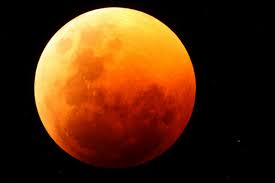
During a lunar eclipse, what color does the moon appear?
a)
Black
b)
Red-orange
c)
Yellow-green
d)
White
179.
A solar eclipse only happens during a ________ moon.
a)
New
b)
Cresent
c)
Gibbous
d)
Full
180.
A lunar eclipse only happens during a ________ moon.
a)
New
b)
Cresent
c)
Gibbous
d)
Full
181.
Where must you be to see a total solar eclipse?
a)
a corona
b)
an orbit
c)
the moon's shadow
d)
the earth's shadow
182.
Where must you be to see a total solar eclipse?
a)
a corona
b)
an orbit
c)
the moon's shadow
d)
the earth's shadow
183.
What do we call the sun's outer atmosphere that you see during a solar eclipse?
a)
an umbra
b)
a corona
c)
an orbit
d)
a shadow
184.
What do we call the sun's outer atmosphere that you see during a solar eclipse?
a)
an umbra
b)
a corona
c)
an orbit
d)
a shadow
185.
What is the darkest inner part of the shadow cone called, where a total eclipse can be viewed.
a)
Total
b)
Umbra
c)
Penumbra
186.
What is the larger outer lighter part of the shadow cone called, where a partial eclipse can be viewed?
a)
Partial
b)
Umbra
c)
Penumbra
187.
In order to have an eclipse, the Moon, Sun and Earth have to be?
a)
Below each other
b)
Above each other
c)
In alignment
188.
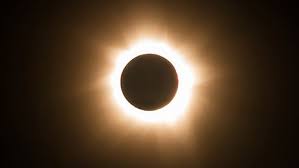
This image is an example of 
a)
Lunar Eclipse
b)
New Moon
c)
Solar Eclipse
d)
Full Moon
189.
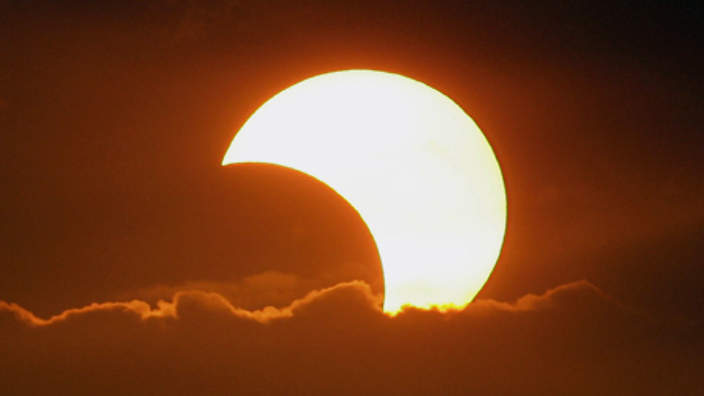
This image is an example of
a)
Lunar Eclipse
b)
Full Moon
c)
New Moon
d)
Solar Eclipse
190.
Which of the following is NOT true about a total solar eclipse?
a)
It can be viewed from every spot on earth
b)
It is dangerous to look at without the proper device
c)
When it happens, the moon blocks all of the sun except the corona
d)
You must be within the moon's umbra to see it
191.
We do NOT have a solar or lunar eclipse each month because...
a)
The tilt of the moon's orbit is at 5 degrees
b)
The moon is too small
c)
The moon's orbital distance changes
d)
All choices