
 Worksheets
Geology review form B
Total questions: 75
Worksheet time: 1hrs 8mins
Name
Class
Date
1.
A mineral's resistance to being scratched is called?
a)
streak
b)
luster
c)
hardness
d)
igneous rocksheft
2.

By definition, a mineral has which of the following characteristic(s)?
a)
chemical composition
b)
crystalline structure
c)
naturally made
d)
all of the above
3.

Which mineral property is being shown here?
a)
luster
b)
hardness
c)
cleavage
d)
streak
4.
Dull, silky, waxy, pearly, and earthy are terms that best describe which property of minerals?
a)
luster
b)
color
c)
streak
d)
cleavage
5.
Fluorescence is
a)
an uneven, jagged, or irregular break of a mineral
b)
a special property of minerals that causes some of them to glow
c)
color of the powder of a mineral
d)
a mineral that contains oxygen
6.
Which of the following is NOT true of minerals?
a)
They are liquids
b)
They are formed in nature
c)
They are inorganic
d)
They have crystalline structure
7.

A mineral breaks into pieces like are shown in the picture. How would you describe its breakage?
a)
Fracture
b)
Cleavage
c)
Glassy
d)
Waxy
8.

A mineral breaks into pieces like are shown in the picture. How would you describe its breakage?
a)
Fracture
b)
Cleavage
c)
Glassy
d)
Waxy
9.
A type of rock that forms from the cooling of molten rock at or below the surface of the earth
a)
Igneous Rock
b)
Metamorphic Rock
c)
Sedimentary Rock
d)
chemical Rock
10.
Igneous rock that forms when magma hardens beneath Earth's surface
a)
intrusive Rock
b)
compaction
c)
Chemical Rock
d)
Clastic Rock
11.
What does Ignis mean?
a)
hot
b)
fire
c)
steam
d)
flame
12.
A slow cooling igneous rock will have _____ crystals
a)
large
b)
small
c)
average
d)
black
13.
Rapid cooling of lava in which tiny crystals form results in _____ texture
a)
coarse-grained
b)
fine-grained
c)
glassy
14.
Igneous rock that forms from lava on Earth's surface
a)
Organic Rock
b)
Intrusive Rock
c)
Clastic Rock
d)
Extrusive Rock
15.

Fossils are only found in sedimentary rocks.
a)
True
b)
False
16.
What is the process in which sediment settles out of the water or wind carrying it?
a)
Erosion
b)
Deposition
c)
Compaction
d)
Cementation
17.
What is the process that presses sediments together?
a)
Erosion
b)
Deposition
c)
Compaction
d)
Cementation
18.
What is the process in which dissolved minerals crystallize and glue particles of sediment together?
a)
Erosion
b)
Deposition
c)
Compaction
d)
Cementation
19.
What type of sedimentary rock forms when rock fragments are squeezed together?
a)
Clastic
b)
Organic
c)
Chemical
20.
Geologists classify sedimentary rocks into three major groups: _________ rock, chemical rock, and organic rock.
a)
Clastic
b)
Limestone
c)
Extrusive
d)
Foliated
21.
Metamorphic rock can form out of other metamorphic rock.
a)
true
b)
false
22.
The process during which rocks are formed, change, wear down, and are formed over long periods is called the ___.
a)
mineral
b)
pressure
c)
rock cycle
d)
sedimentary rocks
23.

Identify the texture of this metamorphic rock.
a)
Foliated
b)
Nonfoliated
24.

The process when rocks break into smaller pieces due to exposure to natural elements is called
a)
erosion
b)
weathering
c)
sediments
25.
The movement of weathered material (sediment) is called?
a)
weathering
b)
erosion
c)
deposition
26.

Each rock type can follow only one pathway of the rock cycle.
a)
True
b)
False
27.

This rock was formed by smaller pieces of rock that settled at the bottom of a lake millions of years ago. What type of rock is this?
a)
Sedimentary
b)
Igneous
c)
Metamorphic
28.
What is a constructive force?
a)
A natural process that builds up land
b)
A natural process that destroys land
c)
A natural process that breaks up rocks and sediment
d)
This ain't the answer!
29.

The Grand Canyon is a result of which of these destructive processes?
a)
earthquake
b)
erosion
c)
tornadoes
d)
volcanoes
30.
Landslides may cause homes to slide into valleys. What type of event is a landslide?
a)
weathering
b)
sorting
c)
mass wasting
d)
deposition
31.
This type of weathering is an example of chemical weathering
a)
Land Slide
b)
Root Prying (wedging)
c)
Ice Wedging
d)
Acid Rain
32.
This type of weathering is caused by oxidation
a)
Ice Wedging
b)
Abrasion
c)
Rusting
d)
Acid Rain
33.

The picture is showing an example of ______________ weathering
a)
Chemical
b)
Heavy
c)
Tree
d)
Mechanical
34.
An accumulation of sediment on the sides of a glacier is called a _______.
a)
cirque
b)
moraine
c)
till
d)kettle lake
35.
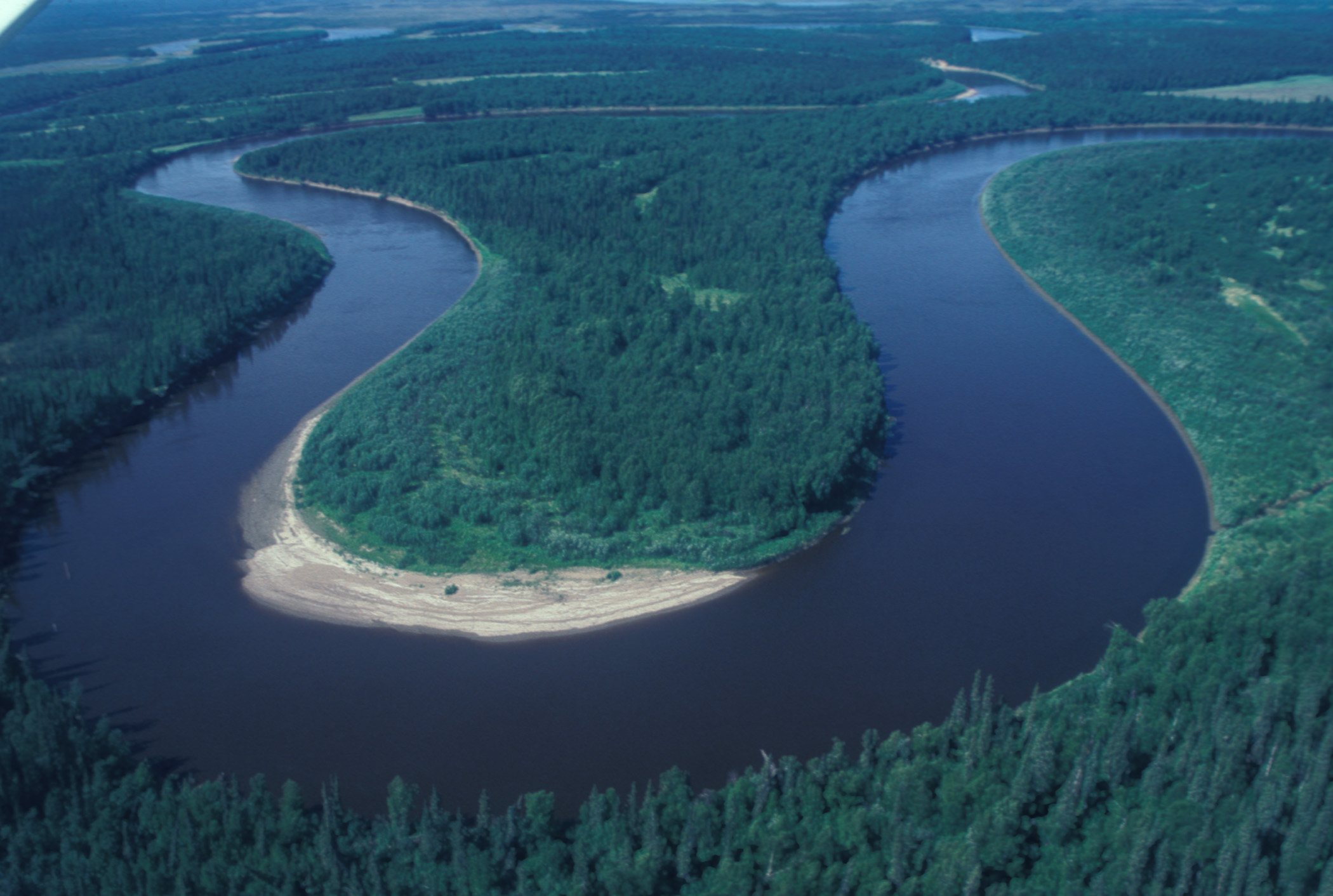
What river feature does this picture show?
a)
Oxbow Lake
b)
Meander
c)
Estuary
d)
Tributary
36.

What river feature does this image show?
a)
Meander
b)
Oxbow Lake
c)
Tributary
d)
Headwaters
37.
Freezing and thawing cycles which break up rock are known as what form of weathering?
a)
Chemical Weathering
b)
Biological Weathering
c)
Physical Weathering
d)
In situ weathering
38.
A large plain on either side of a river
a)
Plain
b)
Flood Plain
c)
Island
d)
Glacier
39.
The thinnest layer of the Earth is?
a)
Mantle
b)
Lithosphere
c)
Athenosphere
d)
Crust
40.
The lithosphere combines what two layers?
a)
Athenosphere & Crust
b)
Crust & Upper Mantel
c)
Mantel & Athenosphere
d)
Inner and Outer Cores
41.
This layer of Earth is the thickest part
a)
crust
b)
outer core
c)
mantle
d)
inner core
42.
Which layer of the earth is under the highest pressure?
a)
Crust
b)
Mantle
c)
Outer Core
d)
Inner Core
43.
Oceanic crust is thicker than continental crust.
a)
True
b)
False
44.
Using data from seismic waves, geologists have learned that Earth's interior is made up of several
a)
continents
b)
layers
c)
ridges
d)
trenches
45.
Which layer of Earth is LIQUID?
a)
upper mantle
b)
lower mantle
c)
outer core
d)
inner core
46.
This layer of Earth is solid Iron and Nickel
a)
Outer Core
b)
Mantle
c)
Inner Core
d)
Crust
47.
_____________ came up with the theory of continental drift.
a)
Alfred Einstein
b)
Alfred Wegener
c)
Harry Hess
d)
Barack Obama
48.
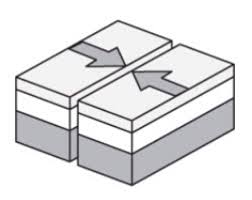
Name the boundary
a)
convergent boundary
b)
divergent boundary
c)
transform boundary
d)
sergent boundary
49.
In which type of boundary do the plates go away from each other?
a)
convergent
b)
normal
c)
divergent
d)
transform
50.

What kind of plate boundary is shown here?
a)
divergent
b)
convergent
c)
transform
d)
strike slip
51.
An ocean trench occurs when...
a)
plates divide and magma rises up
b)
oceanic crust subducts below continental crust
c)
we dig a hole in the ocean
d)
when plates slide past each other
52.
What 2 things could be created by a divergent plate boundary?
a)
Trench/mid-ocean ridge
b)
Mountain/mid-ocean ridge
c)
Mid-ocean ridge/Continental rift valley
d)
Mid-ocean ridge/tsunami
53.
Oceanic plates separate from each other at a divergent plate boundary at the bottom of the ocean. Magma comes up and cools between the plates, forming...
a)
a fault
b)
a mid-ocean ridge
c)
a rift valley
d)
a trench
54.
Continental crust and continental crust come toward each other at a convergent plate boundary. This will likely form... (think of India)
a)
a trench
b)
mountains
c)
volcano
d)
mid-ocean ridge
55.
What type of boundary occurs when two tectonic plates separate?
a)
divergent
b)
convergent
c)
transform
56.
Where are most volcanoes found?
a)
Southern Hemisphere
b)
Ring of Fire
c)
Mid-Atlantic Ridge
d)
Hot Spots
57.
Where do volcanoes come from?
a)
Places where plates move apart
b)
Places where plates are moving together
c)
Hot Spots
d)
All of these options
58.
Which type of wave is the first to arrive after an earthquake occurs?
a)
P Wave
b)
Rayleigh Wave
c)
S Wave
d)
Shear Wave
59.
S Waves can move through which of the following?
a)
Gas
b)
Liquid
c)
Solid
d)
All of these
60.
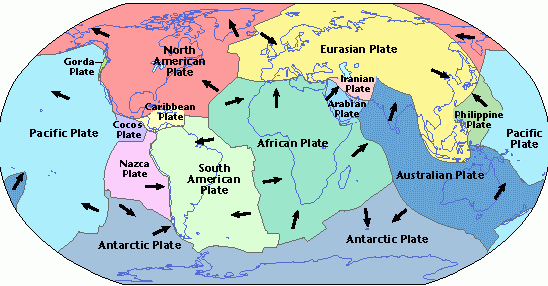
Many earthquakes happen along the borders of...
a)
Countries
b)
Tectonic Plates
c)
Climate Zones
d)
None of the above.
61.
What role do faults play in the Law of Superposition?
a)
Faults create new types of rock.
b)
Faults are younger than the layers they cut through.
c)
Faults are the same age as the layers they cut through.
62.
Which statement best describes the Law of Superposition?
a)
Each layer of rock represents 1,000 years of Earth's age, much like the rings of a tree.
b)
In undisturbed layers of rocks, the upper rock layers are older than the lower rock layers.
c)
In undisturbed layers of rock, the lowest layers contain the older rocks.
d)
Rocks that form near volcanoes are older than surrounding rock.
63.
Which best describes a fossil that helps determine the relative age of a rock layer?
a)
trace fossil
b)
index fossil
c)
radioactive fossil
d)
unconformity fossil
64.

Which rock layer is the oldest
a)
A
b)
E
c)
D
d)
C
65.
Definition: Division of Earth's History into time units based on the types of life-forms that lived only during certain periods
a)
Fossil
b)
Geologic Time Scale
c)
Extincton
d)
Law of superposition
66.

a)
B, C, A, D, E
b)
D, C, B, A, E
c)
C, B, A, D, E
d)
E, D, C, B, A
67.
when rock layer tilts or bends this law is broken.
a)
original horizontality
b)
superposition
c)
lateral continuity
d)
cross-cutting relationships
68.

The vein running through the rock is
a)
the oldest layer
b)
youngest layer
c)
the same age
d)
smooth
69.
Most geologists rejected Alfred Wegener's idea of continental drift because...
a)
they were afraid of a new idea.
b)
Wegener was interested in what Earth was like millions of year ago.
c)
Wegener used several different types of evidence to support his hypothesis.
d)
Wegener could not identify the force that could move the continents.
70.

According to the law of superposition, which layer is the youngest?
a)
A
b)
B
c)
C
71.
Underwater landforms found on the ocean floor are
a)
the same size as the ones on dry land.
b)
taller and wider than the ones found on dry land.
c)
taller, deeper, longer, and wider than the ones found on dry land.
72.
Steve's school was having an addition put on. Once the ground was dug up, his teacher brought his class out to examine the rock layers exposed in the ground. They were able to see fossils such as coral, clams, fish. What did this tell them about the environment many years ago?
a)
Desert sand covered this area.
b)
The environment was cold and icy
c)
An ocean once covered this area
d)
There was a forest in this area
73.
7. Which fossil fuel is the remains of ancient plants?
a)
Coal
b)
Petroleum
c)
Natural Gas
74.
Which of the following is an example of a fossil fuel?
a)
Uranium
b)
Sea Water
c)
Sand and Gravel
d)
Dead plants and animals
75.
Fossil fuels include coal, oil and natural gas. Fossil fuels are classified as nonrenewable because they —
a)
Take many, many years to be replaced
b)
require expensive equipment
c)
Can be found all over Earth's surface
d)
Provide much of the energy we use
100 %

