
 Worksheets
Local/Global Wind
Total questions: 23
Worksheet time: 3600secs
Name
Class
Date
1.
What causes wind?
a)
differences in pressure
b)
differences in oxygen
c)
differences in thermosphere
d)
differences in gravity
2.
Why does warm air rise and cold air sink?
a)
warm air is warmer
b)
cold air is colder
c)
warm air is less dense than cold air
d)
cold air is less dense than warm air
3.

What kind of breeze is this & what time of day/night would it form?
a)
Land breeze - daytime
b)
Land breeze - nighttime
c)
Sea breeze - daytime
d)
Sea breeze - nighttime
4.
Which statement correctly defines wind?
a)
Wind is the movement of air from areas of low pressure to areas of high pressure
b)
Wind is the movement of air to a colder area in the atmosphere.
c)
Wind is the movement of air from areas of high pressure to areas of low pressure.
d)
Wind is the movement of air pushed around and bouncing off Earth's surface.
5.
Where does the initial source of energy come from that creates winds?
a)
the moon
b)
the sun
c)
the Earth's surface
d)
the rotation of the Earth
6.
Land and water absorb and release the sun’s heat in different ways. One result of this is a sea breeze. Which statement is true of sea breezes?
a)
They originate in the day and blow toward the land.
b)
They originate in the day and blow toward the water.
c)
They originate in the evening and blow toward the land.
d)
They originate in the evening and blow toward the water.
7.
Which statement correctly describes the properties of cold air?
a)
less dense and less pressure than warm air
b)
more dense and more pressure than warm air
c)
more dense and less pressure than warm air
d)
less dense and more pressure than warm air
8.

Which diagram shows the formation of a land breeze?
a)
diagram Y
b)
diagram X
c)
neither
d)
both
9.
How do differences in air pressure affect the movement of air?
a)
Air always moves from areas of high pressure to areas of low pressure.
b)
Air always moves from areas of low altitudes to high altitudes.
c)
Air always moves from areas of low pressure to areas of high pressure.
d)
Air always moves from east to west.
10.
Cool air moving across land and warm air rising up from the ocean will result in:
a)
land breeze
b)
sea breeze
c)
warm breeze
d)
no breeze
11.
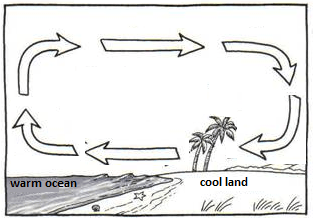
What kind of breeze is this and when would it form?
a)
Land breeze - daytime
b)
Land breeze - nighttime
c)
Sea breeze - daytime
d)
Sea breeze - nighttime
12.
Why do land breezes occur at night?
a)
Land cools off slower than water, so the air above water is cooler.
b)
Water cools off faster than land, so the air above land is warmer.
c)
Land heats up slower than water, so the air stays cooler during the day.
d)
Water cools off slower than land, so the air above water is warmer.
13.
Land heats up and cools down faster than water.
a)
True
b)
False
14.
Which best describes why winds at the beach change direction between day and night?
a)
because the temperatures over land and over water change
b)
because warm air over land sinks and stays in place over land
c)
because cool air rises and is replaced by warm air from the ocean
d)
because cool air sinks and stays in place over land
15.
Which is true about sea breezes?
a)
They form when both the land and the ocean have cooler temperatures.
b)
They form when both the land and the ocean have warmer temperatures.
c)
They form because the land warms up more quickly than the cooler ocean waters.
d)
They form because the ocean warms up more quickly than the cooler land masses.
16.
What type of global wind flows toward the poles from west to east carrying moist air over the United States?
a)
Prevailing Westerlies
b)
Prevailing Easterlies
c)
Polar Easterlies
d)
Doldrums
17.

The curving of air to the right in the Northern hemisphere is caused by ___________ and is called the _________ effect.
a)
Earth's rotation...Coriolis
b)
Earth's revolution...Coriolis
c)
Earth's rotation...Doppler
d)
Earth's revolution...Doppler
18.
What type of winds blow constantly, predictably, and over long distances?
a)
land breezes
b)
mountain breezes
c)
global winds
d)
land breezes
19.
What causes wind?
a)
differences in pressure
b)
conduction currents
c)
density
d)
tropical currents
20.

What type of pressure is associated with cold air masses?
a)
Low
b)
Middle
c)
High
21.

How do differences in air pressure affect the movement of air?
a)
Air always moves from areas of high pressure to areas of low pressure.
b)
Air always moves from areas of low altitudes to high altitudes.
c)
Air always moves from areas of low pressure to areas of high pressure.
d)
Air always moves from east to west.
22.

Why does warm air rise?
a)
Warm air is more dense than cooler air.
b)
Warm air has more pressure than cooler air.
c)
Warm air is less dense than cooler air.
d)
Warm air has a higher dew point than cooler air.
23.

More direct light would mean the temperature in that area would be...
a)
cooler and letter B
b)
cooler and letter A
c)
hotter at letter A
d)
hotter at letter B
100 %

