
 Worksheets
Events to the American Revolution
Total questions: 69
Worksheet time: 1hrs 4mins
Name
Class
Date
1.
What was the Tea Act?
a)
A higher tax on tea
b)
A way to increase money for the colonies
c)
A way to cut the colonies out of the tea trade
d)
a law to make it easier to get tea
2.

Which of the following demonstrated the colonists’ last attempt to make peace with Great Britain?
a)
The Boston massacre
b)
The Boston Tea Party
c)
The Navigation Acts
d)
The Olive Branch Petition
3.

Why was the phrase “taxation without representation” so important to the revolutionary cause?
a)
Colonists did not wish to support a government in which they had no voice
b)
Great Britain would have ended taxation if colonists had kept the peace
c)
Colonists believed that Great Britain should only tax certain items
d)
Great Britain only taxed the colonists to force them to rebel
4.
What was the committee of correspondence?
a)
A group of ladies who worked for the British.
b)
a letter writing campaign to inform the colonies of the happenings in Boston
c)
A plan for a new government
d)
A group of angry colonists who wanted to fight the British.
5.

What ended the French and Indian War?
a)
Treaty of Paris 1763
b)
Proclamation of 1763
c)
Treaty of Versialle
d)
Proclamation of France defeat 1763
6.

Name one effect of the French and Indian War.
a)
France received tons of land.
b)
The Native Americans gave their land to the government.
c)
Great Britain had a lot of debt.
d)
The French beat the Indians.
7.

The Proclamation of 1763 made the colonists angry because
a)
The British taxed their tea.
b)
The Spanish started exploring the south.
c)
The British controlled the colonies and told the colonists what to do.
d)
They wanted more money from the British.
8.

Which act was passed as a result of the Boston Tea Party?
a)
Stamp Act
b)
Quartering Act
c)
Intolerable Acts
d)
Tonwnshend Acts
9.

The Second Continental Congress had 3 tasks. Which of these is NOT one of their tasks?
a)
sign the Constitution
b)
organize the colonies for war
c)
appoint a leader for the army
d)
decide whether to declare independence
10.

What sparked the Boston Massacre?
a)
British soldiers shooting colonists
b)
Colonists throwing snowballs at British soldiers
c)
The Boston Tea Party
d)
The Stamp Act
11.

The Intolerable Acts
a)
closed the Boston Harbor
b)
banned town meetings in the colonies
c)
allowed British officials to be tried in Great Britain
d)
all of the above
12.

The Townshend Acts
a)
banned town meetings.
b)
closed the Boston Harbor.
c)
placed a tax on tea, lead, glass, and paint.
d)
taxed sugar.
13.

Who wrote Common Sense?
a)
Thomas Jefferson
b)
Thomas Paine
c)
Samuel Adams
d)
Benjamin Franklin
14.

The Boston Massacre took place in 1770 in the British colony of Massachusetts. Which description of this event is written from the point of view of the Sons of Liberty?
a)
Conflict between British soldiers and Boston residents resulted in 5 deaths
b)
Unprovoked British soldiers fired into a defenseless crowd, taking 5 innocent lives
c)
British soldiers were surrounded by unruly colonists and fired their muskets in self defense
d)
A mob of angry Bostonians unlawfully confronted British soldiers, resulting in several deaths.
15.

Why was the First Continental Congress formed?
a)
To enforce the Coercive Acts
b)
To practice using muskets and cannons
c)
To set up a political body that would challenge British control
d)
To unite the colonists and the British.
16.

“If life so dear, or peace so sweet, as to be purchased at the price of chains and slavery?. . . I know not what course others may take; but as for me, give me liberty or give me death.” -Patrick Henry 1775
Based on the excerpt above, a reader can conclude that Patrick Henry believed?
Based on the excerpt above, a reader can conclude that Patrick Henry believed?
a)
The colonists would be labeled as traitors
b)
Negotiating with Great Britain was necessary
c)
Loyalists would join the patriot cause
d)
Freedom was worth dying for
17.

The pamphlet “Common Sense,” aided the American cause in the Revolutionary War because it ________.
a)
convinced France to join in the fight against England
b)
led to the repeal of the Stamp Act
c)
created a new system of government for the United States
d)
persuaded individuals who were undecided to support independence
18.
What was the punishment for the Boston Tea Party?
a)
Townshend Acts
b)
Intolerable Acts
c)
Stamp Act
d)
Lexington and Concord
19.
What caused Britain to tax the colonists?
a)
Debt from the F & I War
b)
They were poor
c)
The Boston Tea Party
d)
Proclomation of 1763
20.
Delegates from all colonies except Georgia met to discuss problems with Great Britain and to promote independence.
a)
First Constitutional Congress
b)
Proclamation of 1763
c)
First Continental Congress
d)
Lexington & Concord
21.
The colonies declared independence from Great Britain (July 4, 1776).
a)
Declaration of Independence
b)
Treaty of Paris
c)
Constitutional Convention
d)
Lexington & Concord
22.

Who won the French & Indian War?
a)
The French who wanted to increase its holding in North America.
b)
The Indians who wanted their land returned to them.
c)
The British who wanted to remain a world power.
d)
The Spanish who wanted revenge on the British.
23.

The Proclamation of 1763 restricted--
a)
colonists from moving back to Great Britain.
b)
the western movement of settlers.
c)
the control of colonial legislatures.
d)
the amount of tea imported from Europe.
24.
Colonists opposed taxes from Great Britain because the--
a)
colonies had no representation in Parliament.
b)
taxes were too high.
c)
British people had no representation in Parliament.
d)
colonists wanted American Indians and French to pay all the taxes.
25.

Paul Revere became famous as a patriot who--
a)
gained Spain's support for American independence.
b)
was a member of the Continental Congress.
c)
saved the lives of many patriots as a battlefield doctor.
d)
made a daring ride to warn colonists of the British arrival in Lexington.
26.

What significant event happened at the Battles of Lexington and Concord?
a)
End of the Revolutionary War.
b)
Colonists were shot after taunting British soldiers.
c)
Site of the first armed conflict of the Revolutionary War.
d)
The French joined the American colonists in fighting the British.
27.
The colonial militia is also known as ______________, because they had to be ready in a minute's notice.
a)
minutemen
b)
minute rice
c)
minute militia
d)
colonial minutes
28.
What were the British searching for at Concord?
a)
grain
b)
livestock
c)
missing British soldiers
d)
weapons and ammunition
29.
Who fired the "shot heard around the world?"
a)
Captain Prescott
b)
Captain Revere
c)
no one knows
d)
the British of course
30.
What was the writs of assistance?
a)
A new tax on tea
b)
A law that allowed British officials to search cargo without a warrant
c)
A law that prevents colonists from moving from one colony another.
d)
A law that required colonists to house British soldiers.
31.
After the French and Indian War, Britain __________ the colonists to pay of the war debt.
a)
taxed
b)
attacked
c)
enslaved
d)
jailed
32.
The Proclamation of 1763 did NOT allow the colonists to do what?
a)
to vote in Britain's Parliament
b)
to trade with anyone except Britain
c)
to create their own army
d)
To move west over the mountains
33.
Which of the following events happened first?
a)
French and Indian War
b)
Boston Massacre
c)
Battle of Lexington and Concord
d)
Signing of the Declaration of Independence
34.
During the French and Indian War, France and Britain were fighting for what area of land?
a)
Dominican Republic
b)
Florida
c)
Ohio River Valley
d)
Western Canada
35.
What types of items did the Stamp Act tax?
a)
Sugar and Molasses
b)
Paper Materials like newspapers and legal documents
c)
Gold, salt, and spices
d)
Lead, paint, and tea
36.
Why did the colonists put on disguises and throw tea into the Boston Harbor?
a)
They did it because England sent soldiers to Boston
b)
They did it because of the stamp act
c)
They did it because of the Proclamation of 1763
d)
They were angry because they felt that Britain was trying to control them and make more money.
37.
At what event were colonists shot after taunting British Soldiers? HINT = 5 colonists will die
a)
Boston Massacre
b)
Boston Tea Party
c)
1st Continental Congress
d)
My Birthday Party
38.
The Townshend Acts
a)
banned town meetings.
b)
closed the Boston Harbor.
c)
placed a tax on tea, lead, glass, and paint.
d)
taxed sugar.
39.
The Intolerable Act
a)
closed the Boston Harbor
b)
banned town meetings in the colonies
c)
allowed British officials to be tried in Great Britain
d)
all of the above
40.
The Stamp Act required
a)
a British stamp to be placed on all legal documents
b)
an American stamp be placed on all legal documents
c)
a raise in price of stamps
d)
a tax on tea
41.
Why was Common Sense such an important document?
a)
It helped inspire Americans to support the fight for freedom.
b)
It convinced Americans to remain loyal to Great Britain.
c)
It was a good story.
d)
Thomas Paine was a good writer.
42.
What sparked the Boston Massacre?
a)
British soldiers shooting colonists
b)
Colonists throwing snow balls at British soldiers
c)
The Boston Tea Party
d)
The Stamp Act
43.
The event in which the Sons of Liberty dumped British Tea into the Boston Harbor in protest of British rule was the
a)
Boston Massacre
b)
Revolutionary War
c)
Boston Tea Party
d)
Tea Act
44.
A loyalist during the Revolution was loyal to
a)
Great Britain
b)
France
c)
Spain
d)
The colonies
45.
What act required the colonists to pay a tax on imported good?
a)
Sugar Act
b)
Quartering Act
c)
Stamp Act
d)
Proclamation of 1763
46.
During the Revolutionary War period, Thomas Paine’s Common Sense was important because it
a)
described a military plan for the defeat of England
b)
convinced many Americans to support Independence from England
c)
contained a detailed outline for a new form of government
d)
argued for the addition of a bill of rights to the Constitution
47.
To refuse to buy goods from someone as a form of protest . . .
a)
occupy
b)
boycott
c)
`damage
48.
What are the main ideas of the Declaration of Independence?
a)
Life, liberty, and the pursuit of happiness
b)
Life, freedom, and justice
c)
Life. Liberty, and freedom
d)
Justice, peace, and freedom
49.
Who did the Patriots support during the Revolution?
a)
France
b)
Spain
c)
Great Britain
d)
The colonies
50.
The man responsible for writing most of the Declaration of Independence was,
a)
John Adams
b)
Thomas Jefferson
c)
Benjamin Franklin
d)
George Washington
51.
Why did poet Ralph Waldo Emerson describe the battles fought at Lexington and Concord as the “shot heard round the world?”
a)
the use of exaggeration was consistent with the Enlightenment literary style.
b)
those conflicts began the fight that led to the creation of the US & inspired revolutions elsewhere.
c)
he sought to commemorate the history of those areas in which conflicts occurred
d)
literature was commonly used to encourage people in other countries to revolt against tyranny
52.
The battle of Lexington was the result of…
a)
Boston Tea Party
b)
Stamp Act
c)
Tea Act
d)
General Gage ordering troops to seize colonial weapons
53.
What was the purpose of the Olive Branch Petition sent by the 2nd Continental Congress to King George III?
a)
To declare to the King that the colonies should be free and independent from England
b)
To declare their undying support to the King
c)
To ridicule the King and Parliament to try and provoke a war with England
d)
To try and make peace with England after the events at Lexington and Concord.
54.
After the Boston Tea Party, the British Parliament passed this set of laws in order to punish Massachusetts.
a)
Proclamation of 1863
b)
Sugar and Stamp Acts
c)
Writs of Assistance
d)
Intolerable/Coercive Acts
55.
What group was created as a response to the Stamp Act?
a)
Son of liberty
b)
The patriots
c)
The red coats
d)
The loyalists
56.
The Olive Branch Petition was written as a last attempt at …
a)
Freedom
b)
Peace
c)
Loyalty
d)
Rebellion
57.
The Quartering Act stated that…
a)
British soldiers could stay in private colonial homes
b)
Colonists could stay in British forts
c)
King George could stay in any colonial home
d)
Colonist had to pay a quarter tax for a pound of tea
58.

This revolutionary cartoon by Benjamin Franklin was meant to -
a)
persuade colonists to support the loyalists
b)
recruit colonists for the Royal Navy
c)
encourage colonists to unite together and overcome their differences
d)
convince colonists to maintains state sovereignty
59.

After colonist threw rocks, sticks and snowballs at British forces, this event happened leading to tense relations between the British military and colonists.
a)
firing on Lexington and Concord
b)
Boston Tea Party
c)
Boston Massacre
d)
Battle at Bunker Hill
60.
A group of volunteers who fight in times of emergency.
a)
blockade
b)
boycott
c)
rivalry
d)
militia
61.

This patriot made a daring ride to warn colonists that British soldiers were approaching.
a)
Patrick Henry
b)
Paul Revere
c)
John Adams
d)
Samuel Adams
62.
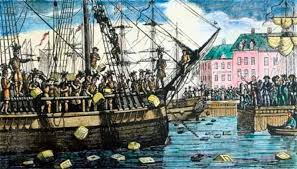
Samuel Adams and Paul Revere led members of the Sons of Liberty in this protest against taxes.
a)
First Continental Congress
b)
Boston Massacre
c)
Boston Tea Party
d)
Stamp Act Congress
63.
Thomas Paine wrote the pamphlet Common Sense. Who responded favorably to his ideas?
a)
Tories
b)
Loyalists
c)
the King of England
d)
Patriots
64.
What was the name of the meeting of colonial leaders where all the colonies agreed to boycott British goods and wrote a letter to the King voicing their complaints?
a)
Committees of Correspondence
b)
The Declaration of Independence
c)
The Revolutionary War
d)
First Continental Congress
65.
Due to the widespread anger against the Stamp Act and Townshend Acts, Parliament eventually ____________the laws.
a)
Returned
b)
Rewrote
c)
Repealed
d)
Returned
66.
Sons of Liberty were a group of American colonists who worked to repeal the Stamp Act by doing what?
a)
Taking military action against the British
b)
Forming alliances with the enemies of Britain
c)
Meeting with Parliament in England
d)
Publicly protesting and organizing boycotts
67.
Colonists protested the Stamp Act because they believed in what phrase?
a)
Join or Die
b)
All men are created equal
c)
Life, liberty, and pursuit of happiness
d)
No taxation with representation
68.
An angry crowd of workers surrounded a small group of British soldiers and were fired upon
a)
Boston Massacre
b)
Boston Rebellion
c)
Boston Treaty
d)
Boston Tea Party
69.
Which concern of the colonists led to the American Revolution?
a)
opposition to British tax policies
b)
Desire for greater religious freedom
c)
Fear of attacks by American Indians
d)
Increasing immigration from countries other than Britain
100 %

