
 Worksheets
9 Weeks Study Guide
Total questions: 60
Worksheet time: 53mins
Name
Class
Date
1.
A severe storm which involves a funnel cloud forming over land is:
a)
hurricane
b)
tornado
c)
thunderstorm
d)
blizzard
2.
A severe storm that involves winds over 119mph and forms over water is:
a)
tornado
b)
thunderstorm
c)
hurricane
d)
blizzard
3.
This severe weather involves low temperatures and snow either falling or drifting
a)
hurricane
b)
thunderstorm
c)
tornado
d)
blizzard
4.
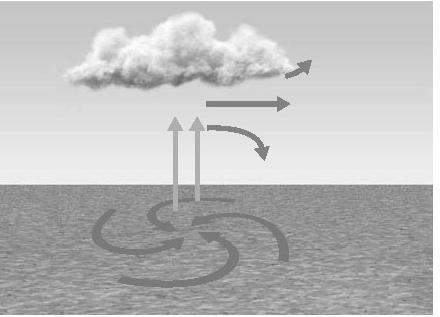
Which type of pressure system is pictured?
a)
high
b)
low
c)
medium
d)
none
5.
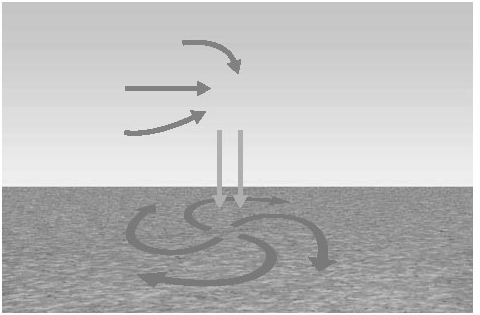
Which type of pressure system is pictured?
a)
high
b)
low
c)
medium
d)
none
6.

What type of weather would you expect from the pressure system pictured?
a)
clear
b)
cloudy
c)
hot
d)
stormy
7.

What type of weather would you expect with the pressure system pictured?
a)
clear
b)
cloudy
c)
severe storms
d)
hot
8.
The temperature at which air is saturated and condensation forms is the:
a)
dew point
b)
rain point
c)
wind point
d)
relative humidity
9.
Cold air traveling south from Canada is:
a)
continental tropical
b)
continental polar
c)
maritime tropical
d)
maritime polar
10.
Warm air moving upwards from the Gulf of Mexico is:
a)
continental tropical
b)
continental polar
c)
maritime tropical
d)
maritime polar
11.
Warm air mass that does not carry water:
a)
continental tropical
b)
continental polar
c)
maritime tropical
d)
maritime polar
12.
Cold air mass that is carrying water is:
a)
continental tropical
b)
continental polar
c)
maritime tropical
d)
maritime polar
13.
In _________ pressure systems, air sinks:
a)
high
b)
low
c)
medium
d)
none
14.
In _______ pressure systems, air rises
a)
high
b)
low
c)
medium
d)
none
15.
This type of front can bring strong storms
a)
cold
b)
warm
c)
stationary
d)
occluded
16.
This type of front results in the same weather for several days
a)
warm
b)
cold
c)
stationary
d)
occluded
17.
This means that the conditions are right for severe weather
a)
watch
b)
warning
18.

Identify the type of front that is shown in the image.
a)
Occluded Front
b)
Cold Front
c)
Stationary Front
d)
Warm Front
19.

Identify the type of front that is shown in the image.
a)
Occluded Front
b)
Cold Front
c)
Stationary Front
d)
Warm Front
20.
Weather in a region over an extended period of time.
a)
Climate
b)
Weather
21.
Atmospheric conditions on a daily basis.
a)
Climate
b)
Weather
22.
Soft white pieces of frozen water that fall from the sky.
a)
Rain
b)
Sleet
c)
Snow
d)
Thunderstorm
23.
Ice crystals that fall toward the ground, partly melt and then refreeze.
a)
Rain
b)
Snow
c)
Sleet
d)
Thunderstorm
24.
Clouds are made up of tiny drops of ______ or ice. The moisture in the cloud affects the weather.
a)
dust
b)
water
c)
cloud particles
d)
precipitation
25.
They are highest clouds in the sky. They look curly, white and feathery. Usually mean good weather.
a)
Cumulus
b)
Cumulonimbus
c)
Cirrus
d)
Stratus
26.
They are low in the sky and look soft and fluffy.
a)
Cirrus
b)
Cumulonimbus
c)
Cumulus
d)
Stratus
27.
Where do hurricanes originate?
a)
Over dry warm land
b)
Over dry cold land
c)
Over cold ocean water
d)
Over
warm ocean water
warm ocean water
28.
Water changing from water vapor to a liquid by loss of eat.
a)
Evaporation
b)
Weather
c)
Precipitation
d)
Condensation
29.
Water that falls to the Earth's surface as rain, snow, sleet.
a)
Evaporation
b)
Weather
c)
Precipitation
d)
Condensation
30.
The boundary between two air masses is known as:
a)
front
b)
storm
c)
climate
d)
flood
31.

Which number illustrates Condensation?
a)
1
b)
2
c)
3
d)
4
32.
An example of a conductor is :
a)
a glass paperweight
b)
a plastic cap
c)
a metal screw
d)
a wooden handle
33.
An example of an insulator is:
a)
iron
b)
silver
c)
copper wire
d)
rubber
34.
What is the difference between a conductor and an insulator?
a)
An insulator allows electricity to flow through it easily and a conductor does not
b)
A conductor allows electricity to flow through it easily and an insulator does not.
c)
An insulator is magnetic and a conductor is not
d)
A conductor is magnetic and an insulator is not
35.
What happens to the brightness of the light bulbs in a series circuit when you add more lights.
a)
Each bulb gets dimmer
b)
Each bulb remains the same
c)
Half of the bulbs get dimmer
d)
Each bulb gets brighter
36.

Does this diagram represent a series or parallel circuit?
a)
series circuit
b)
parallel circuit
37.
Which best describes a parallel circuit?
a)
Electricity flows along one pathway.
b)
The flow of electricity comes from more than one source.
c)
Electricity flows along more than one pathway.
d)
The flow of electricity comes from more than 1 load.
38.
Insulator or Conductor?
STEEL
STEEL
a)
Insulator
b)
Conductor
39.
What are the components of a simple circuit?
a)
wires, switch, outlet
b)
battery, switch, motor
c)
wires, light bulb, motor
d)
wires, battery, light bulb
40.
If two batteries are in a circuit and the positive side is touching the positive side will the circuit work?
a)
Yes
b)
No
41.

Is this circuit open or closed?
a)
Closed
b)
Open
42.
When the switch is closed, the light
a)
comes on
b)
stays off
c)
burns out
43.
The plastic around the wire is
a)
conductor
b)
insulator
c)
decoration
44.
Glass is a
a)
conductor
b)
insulator
45.
Like charges ...
a)
attract
b)
repel
46.
Which of the charges below will attract each other
a)
[Positive] [Positive]
b)
[Negative] [Negative]
c)
[Positive] [Negative]
d)
All of the Above
47.
Current is the ...
a)
pressure of electricity
b)
flow of electricity
c)
tendency of a material to resist the flow of electricity.
d)
total power
48.

A closed pathway through which electricity can flow is called
a)
Simple circuit
b)
switch
c)
load
d)
insulator
49.
What charge does a proton have?
a)
negative (-)
b)
positive (+)
c)
neutral or no charge (0)
50.
What charge does an electron have?
a)
negative (-)
b)
positive (+)
c)
neutral or no charge (0)
51.
Static electricity is
a)
The balance of electrical charge on an object
b)
The imbalance of electrical charge on an object
c)
The discharge of electrical charge
d)
The build up of protons in the nucleus of an atom
52.

A series circuit has only one path for electricity to go through. Therefore, a break in a series circuit with light bulbs means...
a)
the other lights will still work.
b)
the one light will not work.
c)
all the bulbs will not work.
d)
all of the bulbs will work.
53.

A ___ circuit has more than one path for electricity to go through.
a)
open
b)
series
c)
parallel
d)
closed
54.

A circuit with one battery powered one bulb. BUT another bulb was added to the circuit. Now the bulbs will ___.
a)
glow normally
b)
glow dimly
c)
glow brightly
d)
turn off
55.
Two types of circuits are
a)
parallel and magnetic
b)
electromagnetic and series
c)
series and parallel
56.
How many paths does a series circuit have?
a)
One
b)
Ten
c)
Seventeen
d)
A million
57.
What is one benefits of using a parallel circuit?
a)
It gets confusing.
b)
There are no problems.
c)
If one goes down, it does not affect the others.
d)
Porque es para llelio.
58.
According to this law, the current in a circuit equals the voltage difference divided by the resistance.
a)
Law of Conservation of Energy
b)
Ohm's Law
c)
Law of Conservation of Charges
d)
Newton's First Law
59.
Electricity is the flow of _________.
a)
Protons
b)
Neutrons
c)
Electrons
60.
Copper is a
a)
conductor
b)
insulator
100 %

