
 Worksheets
Evolution Review
Total questions: 105
Worksheet time: 2hrs 53mins
Name
Class
Date
1.

Which of the following is a term for a group of similar organisms that can reproduce fertile offspring?
a)
individual
b)
population
c)
species
d)
fossil
2.

If an organism has a vestigial structure, that structure likely once had a function in a(n)
a)
close relative
b)
early ancestor
c)
unrelated organism
d)
embryological stage
3.
Mutations are important because they bring about
a)
death of the organism in which they develop
b)
genetic variation needed for a population to evolve
c)
benefits for the individual, not for the population
d)
Hardey-Weinberg equilibrium within a population
4.
Group of organisms capable of interbreeding and producing fertile offspring.
a)
species
b)
gene pool
c)
population
d)
homologous structure
5.

Which two species are most related?
a)
B&C
b)
A&B
c)
A&C
d)
C&B
6.

The gradual change in species over time is...
a)
Evolution
b)
Nucleotide
c)
Adaptation
d)
Natural Selection
7.
Extinction can occur because of which of the following?
a)
All can be causes of extinction.
b)
Increased competition with other species
c)
New predators within the environment
d)
Loss of habitat and/or catastrophes
8.
Finches on the Galapagos Islands had different beaks in order to help them do what?
a)
Build nests
b)
Fight off predators
c)
Collect food sources
9.
This scientist came up with the idea of natural selection.
a)
Robert Hooke
b)
Gregor Mendel
c)
Charles Darwin
d)
Thomas Mach
10.
A remnant or trace of an organism from the past is called a _______.
a)
Ancestor
b)
Skeleton
c)
Fossil
d)
Imprints
11.
Inherited trait that helps an organism survive is a(n) __________.
a)
Fossil
b)
Adaptation
c)
Ancestor
d)
Natural selection
12.
Survival of the fittest or when favorable adaptations reproduce faster is called what?
a)
Evolution
b)
Adaptation
c)
Natural selection
d)
Fossilization
13.
This occurs when no more of a species is living.
a)
Fossilization
b)
Adaptation
c)
Extinction
d)
Natural selection
14.
What animal is Darwin known for studying?
a)
dinosaurs
b)
tunicates
c)
finches
d)
horses
15.
Magda is a tall, 11 year old drummer. She has a scar on her right cheek. She is good at swimming. Which of her traits did Magda most likely inherit?
a)
height
b)
the scar
c)
ability to swim
d)
ability to play drums
16.

According to the cladogram, which organism is most distantly related to the human?
a)
crayfish
b)
rat
c)
perch
d)
frog
17.

According to the diagram, which organism is older: the ammonite or the coral?
a)
ammonite
b)
coral
18.

According to the diagram, which bird has the most similar DNA to a large tree finch?
a)
small tree finch
b)
medium tree finch
c)
large ground finch
d)
green warbler finch
19.

On this map there are many different geographical barriers, which could be mountains, rivers, or oceans. Animals that do not have a barrier between them have more similarities, which set shows that common ancestry existed?
a)
1 and 2
b)
3 and 4
c)
7 and 8
20.
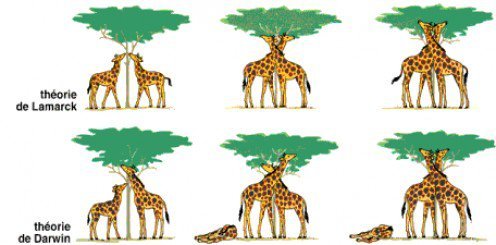
What would happen if the Giraffes never evolve?
a)
they would survive
b)
They would thrive
c)
They would become extinct
d)
They will find another source of food
21.
Group of organisms all of the same species, living in the same place at the same time.
a)
gene pool
b)
population
c)
species
d)
evolution
22.
Where the better adapted organisms survive to pass traits along to offspring.
a)
Evolution
b)
Natural Selection
c)
Extinction
d)
Artifical Selection
23.

Farmers breed cows to produce high amounts of milk. This is an example of...
a)
Natural Selection
b)
Variations in a species
c)
Selective Breeding
24.

The chimp is showing what adaptation?
a)
physiological
b)
behavioral
c)
structural
d)
mutation
25.

The diagram shows fossils in different rock layers. Which of these statements about the age of these fossils is most likely correct?
a)
Fossil A and C are the same age
b)
Fossil B is older than fossil C
c)
Fossils A is older than fossil B
d)
Fossil D is older than fossil C
26.

Two organisms that are closely related would have
a)
very similar DNA sequence
b)
exactly the same DNA sequences
c)
no proteins in common
d)
completely different DNA sequence
27.

An organism has thick white fur, a bushy tail,
and short ears. It often burrows holes and curls into a ball for warmth. For
which environment is this organism most likely adapted?
a)
Grassland
b)
Arctic Tundra
c)
Coniferous Forest
d)
Desert
28.
Charles Darwin’s observation that finches of different species on the Galápagos Islands have many similar physical characteristics supports the hypothesis that these finches
a)
have the ability to interbreed.
have the ability to interbreed.
have the ability to interbreed.
b)
acquired traits through use and disuse.
c)
all eat the same type of food.
d)
descended from a common ancestor.
29.
Brown mice survive and reproduce in their desert environment better than white mice because owls can see and eat the white mice more easily. In this situation, what is doing the selecting?
a)
Owl
b)
Desert Background
c)
Brown Mice
d)
White Mice
30.

If 10 people live in an island and no one can enter or exit, what is the only way new traits can be introduced into the population?
a)
Natural Selection
b)
Artificial Selection
c)
Selective Breeding
d)
Mutations
31.

Some animals are able to see in ultraviolet (UV) light. Bees for instance can see Green and Blue and UV, but no Red, but butterflies and birds can see Red, Green, Blue and UV. Why would a plant need these special ultra violet markings?
a)
to show insects they are poisonous
b)
Attract insects to help it pollinate
c)
avoid sunlight
d)
visibility at night
32.
Why are advantageous traits more likely to be passed onto offspring?
a)
Because they are more likely to survive and reproduce.
b)
Because they come from dominant alleles.
c)
Because they come from recessive alleles.
d)
Because the trait is an acquired phenotype.
33.

characteristic or trait that helps an organism survive in its environment
a)
skills
b)
speciation
c)
natural instinct
d)
adaptation
34.
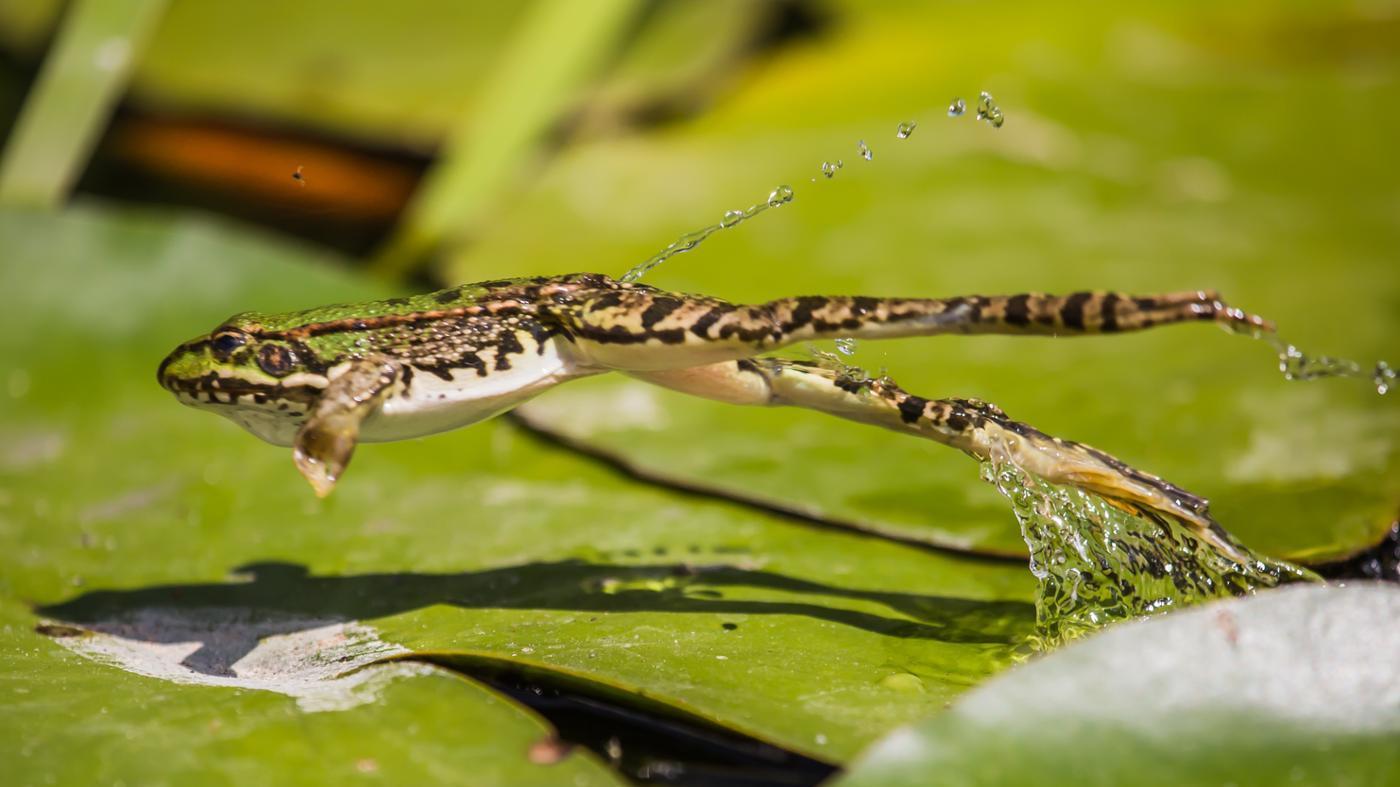
Frogs have webbed feet that help them to swim in water. Webbed feet in frogs are an example of a
a)
niche
b)
variation
c)
adaptation
d)
learned behavior
35.
Suppose an ecosystem changes. One
kind of organism CANNOT adapt to this change and they begin to die off faster
than they can reproduce. This organism is most likely to ___________.
a)
a. recover
b)
b. become angry hiding
c)
c. become extinct
d)
d. go into hiding
36.
Who was the first naturalist to study evolution?
a)
Charles Darwin
b)
Gregor Mendal
c)
Carolus Linneaus
d)
Thomas Edison
37.
This is a process in which organisms gradually change over time.
a)
Environment
b)
Competition
c)
Evolution
d)
Fossils
38.
These are natural differences within a species.
a)
Evolution
b)
Genetic variation
c)
Biological diversity
d)
Populations
39.
This is the variation of living organisms.
a)
Biological diversity
b)
Evolution
c)
Environment
d)
Natural selection
40.

What do these three organisms have in common?
a)
They have stomachs of the same size
b)
They have DNA made up of the same components
c)
They have eyes that see the same ways
d)
They have brains that are the same size
41.
The white feathers of a snowy owl allow it to blend in with its environment during the winter months (snow). This is an example of ________________
a)
Species
b)
Environmental Change
c)
Adaptation
d)
Variation
42.
What is the definition of species?
a)
a group of organisms with similar characteristics that allow them to reproduce
b)
the act of making something new
c)
the role an organism plays in its environment
d)
stay alive
43.
What does it mean to "reproduce"?
a)
stay alive
b)
to buy something
c)
to make something new
d)
to hunt
44.
What does the word "adapt" mean?
a)
stay alive
b)
an animal that is hunted as food
c)
structure one is born with that helps it survive in its environment
d)
the place or environment in which an organism naturally lives
45.
What does it mean to survive?
a)
stay alive
b)
let a predator eat you
c)
to revolve around the earth
d)
dissolves in water
46.
What is the definition of mimicry?
a)
to survive
b)
when an organism looks similar to another organism or to its surroundings that gives it a better chance to survive
c)
an animal that hunts
d)
something that cries
47.
What is the definition of camouflage?
a)
characteristics that blend in with the surrounding environment and increase chances of survival
b)
the seasonal movement of animals from one place to another
c)
an animal that is hunted as food
d)
the place or environment in which an organism naturally lives
48.
What does migrate mean?
a)
to go to sleep for a long period of time
b)
to run away from a predator
c)
the seasonal movement of animals from one place to another
d)
to drink water because you're thirsty
49.
Which is an example of migration?
a)
Birds flying south because it is getting cold in the north
b)
A baby sleeping all day
c)
A dog chasing a cat
d)
A chicken eating seeds off of the ground
50.
What is the definition of prey?
a)
an animal that hunts other animals for food
b)
an animal that is hunted as food
c)
something that gets its energy from the Sun
d)
a producer
51.
What is a habitat?
a)
the place or environment in which an organism naturally lives
b)
Something your do over and over again
c)
An inherited trait
d)
When you revolve around the Sun
52.
A giraffe has a long neck. Why would the giraffe need this adaptation?
a)
to keep warm
b)
to reach food high above the ground
c)
to have room to eat more
d)
to catch birds
53.
A Porcupine has sharp quills. Why would a porcupine need this adaptation?
a)
to protect itself
b)
to keep warm
c)
to kill its prey
d)
to cover its skin
54.
The raccoon has hands and feet. Why would the raccoon need this adaptation?
a)
to fight
b)
to help them find and pick up food
c)
to hang from trees
d)
to dig a tunnel
55.

The ears of this fox are an example of...
a)
A behavioral adaptation
b)
Poor breeding
c)
A physical adaptation
d)
Plastic surgery gone horribly wrong
56.
_________ is when animals move from one place to another due to seasonal change, following a food or water source, or to find a mate and give birth.
a)
body covering
b)
omnivore
c)
migration
d)
herbivore
57.
How do adaptations help animals?
a)
To hide from predators
b)
to hunt for food
c)
to survive in their habitats
d)
All of these are correct
58.
Which adaptation would NOT help a hawk catch a mouse?
a)
Hollow Bones
b)
Good eye sight
c)
Talons
d)
Camouflage
59.
Lions often hide in the tall grass while stalking their prey. This is an example of...
a)
camouflage
b)
warning coloration
c)
mimicry
d)
hibernation
60.
A camel has long eyelashes to keep out the sand.
a)
Structural
b)
Behavioural
61.

Cactus has spines instead of leaves. The spines reduces water loss through the stomata.
a)
Structural
b)
Behavioural
62.
Crocodile has strong powerful tail to swim easily in the water.
a)
Structural
b)
Behavioural
63.

Seeds has hooks to hook onto the animals’ fur.
a)
Structural
b)
Behavioural
64.
Fruit has fibrous husk to help it float on water.
a)
Structural
b)
Behavioural
65.
Flowers have bright petals to attract birds to pollinate them.
a)
Structural
b)
Behavioural
66.

Venus fly trap closes the leaves to trap insects.
a)
Structural
b)
Behavioural
67.
Birds migrate (move to) a warmer place during winter.
a)
Structural
b)
Behavioural
68.
A camel can go without water for a long time.
a)
Structural
b)
Behavioural
69.

What is the most primitive organism shown on the diagram?
a)
chimp
b)
perch
c)
hagfish
d)
salamander
70.

Penguins huddle close together to keep warm.
a)
Structural
b)
Behavioural
71.

Which organisms pictured on the diagram have hair?
a)
prosimians only
b)
prosimians and humans
c)
humans only
d)
prosimians and birds
72.

Which group(s) of organisms do not have vertebrae?
a)
lampreys and lancelets
b)
lampreys and tuna
c)
lancelets only
d)
salamanders, tuna, and lampreys
73.

According to this cladogram, sharks are MOST closely related to which organism?
a)
Amphibians
b)
Ray finned fish
c)
Crocodiles
d)
Birds
74.

Which two orgainsms have hair?
a)
Sharks & Ray Finned Fish
b)
Primates & Rodents
c)
Birds & Crocodiles
d)
Rabbits & Birds
75.
Branching Tree diagrams are constructed by grouping organisms together based on their____________ characteristics.
a)
shared
b)
different
c)
similar
d)
opposite
76.

On the diagram, which feature do all organisms inherit?
a)
A
b)
B
c)
C
d)
D
77.

On the diagram, which organism is the closest relative of the human?
a)
Frog
b)
Hare
c)
Caiman
d)
Parrot
78.

Which trait do only humans have, according to the diagram?
a)
jaws
b)
mammary glands & hair
c)
terrestrial during all life stages
d)
bipedal & opposable thumbs
79.
Branching Tree diagrams reconstruct the evolutionary history of a set of organisms.
a)
True
b)
False
80.
What word describes the process of having the advantageous traits that helps an organism survive and reproduce?
a)
natural selection
b)
adaptation
c)
mutation
d)
genetic engineering
81.
All mutations and adaptations usually lead to what process?
a)
selective breeding
b)
behavioral
c)
natural selection
d)
genetic engineering
82.
Why do frogs and other organism reproduce so many eggs or offspring?
a)
so that their babies can have friends to play with
b)
the more offspring the more likely the offspring will survive
c)
the more offspring the less likely offspring will survive
d)
the more offspring the less competition
83.
Which organisms are most likely to survive?
a)
the best adapted
b)
the fastest
c)
the strongest
d)
the most domesticated (tamed)
84.
Almost all adaptations started off as?
a)
selective breeding
b)
physiological
c)
structural
d)
mutation
85.
Which of the following means "genetic change over time"
a)
natural selection
b)
speciation
c)
evolution
d)
fitness
86.
Do organisms "decide" to evolve and change?
a)
Yes, they know they need to change to survive
b)
No, they change because of natural selection
87.
The differences among a species, like different bird beaks, are called
a)
genes.
b)
variations.
c)
traits.
d)
theories.
88.
Why are advantageous traits more likely to be passed onto offspring?
a)
Because they are more likely to survive and reproduce.
b)
Because they come from dominant alleles.
c)
Because they come from recessive alleles.
d)
Because the trait is an acquired phenotype.
89.

The great barrier reef of Australia is the largest coral reef in the world and known to have brutal hot summers. Some species of turtles stay well below the surface during the summer months. This behavior is most likely to help the turtle by
a)
avoiding sharks
b)
getting better oxygenated water
c)
keeping their body temp low
d)
be close to the plants they eat
90.

A male bumble bee uses pheromones to lure a female where he can mate with her. The male flies along, marking plants with his perfume. Once he sets his "traps," he patrols his territory waiting for a female to land on one of his perches. Bees that cannot mark plants this way eventually die off. This is known as
a)
Genetic behavior
b)
Natural Selection
c)
Learned behavior
d)
Selective breeding
91.

Chameleons eyelids are fused, and cover almost the entire eyeball, except for a small hole to let the pupil see through; each eye can be moved independently from the other. As a prey species, chameleons have eyes have adapted like this to
a)
give better focus to catch moving prey
b)
see a long distance
c)
allow them to see over a wider area allow them to detect predators
d)
spot humans
92.

Most foxes of the desert have a reddish brown coat but the artic fox has a white coat. How has this adaptation allowed the arctic fox to survive over many years?
a)
it gives it warmth during the summer
b)
it makes the fox look meaner
c)
it keeps it warm
d)
its protects it from prey using camoflauge
93.

Mother cows gave birth to fours calves in the same litter but have different hair color than the mother. Which of the following processes is responsible for the variety of hair color in this litter
a)
sexual reproduction
b)
asexual reproduction
c)
mutation
d)
generations
94.

Flashy tails on many animals is an example of coloration. Why might flashy tailed animals display their colors to another of the same species?
a)
make friends
b)
help build a nest
c)
attract a mate
d)
scare predators
95.

The passage of genetic instructions from one generation to the next is known as
a)
mitosis
b)
generationality
c)
behaviors
d)
herecdity
96.

a unit of heredity that is transferred from a parent to offspring and is held to determine some characteristic of the offspring which is found in the DNA.
a)
enzyme
b)
mutation
c)
gene
d)
nucleus
97.
What happened to the color of moths over time?
a)
More black moths than white moths appeared
b)
More white moths than black moths appeared
c)
Grey moths developed
d)
The smoke stained the moths changing their color
98.
The term that best describes why the moth population changed color over time
a)
adaptation
b)
natural selection
c)
mutation
d)
predator-prey
99.
The key factor that impacted natural selection of the moths is...
a)
predator prey
b)
environmental factors
c)
time
d)
Ms. Lubold
100.
Why did the population of moths change
a)
Predators were able to easily see their prey.
b)
People hunted lighter colored moths
c)
White moths were killed by the smoke from the factories
d)
Moths mood changed to sad, causing them to become dark
101.
The source of all genetic material is...
a)
Protein
b)
cells
c)
DNA
d)
The brain
102.

Which types of peppered moths survived and reproduced the most during the Industrial Revolution?
a)
White Peppered Moths
b)
Black Peppered Moths
103.

Some organisms that share a common ancestor have features that have different functions, but similar structures. These are known as
a)
vestigial structures
b)
analogous structures
c)
homologous structures
d)
fossil structures
104.

An earthquake causes an ocean channel top open and separate an island into two. the species on each section are now in
a)
geographic isolation
b)
behavioral isolation
c)
disruptive isolation
d)
temporal isolation
105.
organisms within a species ______________ for food, water, space and mates.
a)
look
b)
compete
c)
locate
d)
leave an area
100 %

