
 Worksheets
8th Grade Physical Science GMAS Review Force and Motion
Total questions: 35
Worksheet time: 22mins
Name
Class
Date
1.
Inertia is best described as
a)
the tendency for objects to resist force.
b)
the tendency for objects to move.
c)
the tendency for objects to resist changes in motion.
d)
the tendency for objects to decelerate.
2.
Pressing on the brake pedal of a car causes a brake pad to be applied to a rotor. This application of pressure slows the rotation of he wheel, resulting in a decrease in speed of the car. What force slows the rotation of the wheel?
a)
friction
b)
nuclear
c)
gravitational
d)
electromagnetic
3.
Velocity includes both speed and
a)
distance
b)
rate of change
c)
time
d)
direction
4.
An unbalanced force acts on a body. Identify the change or changes in motion the unbalanced force can produce.
a)
increased speed only
b)
increased or decreased speed only
c)
increased speed and direction only
d)
increased speed, decreased speed or direction change
5.
The force that keeps a communications satellite in orbit around Earth is
a)
gravity
b)
friction
c)
magnetism
d)
electricity
6.
A school bus is moving 55 miles per hour. Before it can go 60 miles per hour,
a)
there must be less air resistance.
b)
an additional force must act on the bus.
c)
a physical change must happen.
d)
there must be less air resistance.
7.
While riding in the backseat of a car, a child holds a cup of juice. When the car suddenly stops, the liquid in the cup will
a)
flow off to one side of the cup.
b)
flow toward the back of the cup.
c)
flow in the direction the car was moving.
d)
stop as suddenly as the car stops.
8.
A crumpled sheet of paper will fall to the ground faster than an uncrumpled sheet because crumpling the paper
a)
causes it to have less mass.
b)
changes the chemical state of the paper.
c)
adds potential energy.
d)
causes it to have less air resistance.
9.
A roller coaster car raced down a track going faster as it neared the bottom of a hill. What term describes this increase in speed?
a)
inertia
b)
velocity
c)
potential energy
d)
acceleration
10.
On Earth, an astronaut has a mass of 140 kg. When the astronaut goes into space, she
a)
will have a mas of 140 kg, but will have less weight.
b)
will have less mass and weight.
c)
will have a mass of 140 kg, and have a weight of 140 kg.
d)
will have less mass and a weight of 140 kg.
11.
Which term refers to the rate of change of motion?
a)
speed
b)
momentum
c)
velocity
d)
acceleration
12.
Which is true about the relationship between an object's mass and its weight?
a)
The object's mass is caused by the weight of the object pushing downward.
b)
Weight is gravity's force on an object, which is determined by its mass.
c)
An object's
weight and mass are the same, but they are measured differently.
weight and mass are the same, but they are measured differently.
d)
An object's weight and mass are independent of each other.
13.
Which of the following is certain to change as a ball accelerates?
a)
mass of the ball
b)
inertia of the ball
c)
velocity of the ball
d)
force acting on the ball
14.
The gravitational force between any two objects depends on which of these factors?
a)
The weight and density of the two objects.
b)
The inertia and the weight of the objects.
c)
The mass of the objects and the distance between them.
d)
The weight of the objects and the distance between them.
15.
You bravely hop on the Scream Machine at Six Flags. What energy changes have taken place once your roller coaster car when it arrives at the top of the track?
a)
Kinetic energy has been gained.
b)
Potential energy has been lost.
c)
Potential energy has been changed to kinetic energy.
d)
Kinetic energy has been changed to potential energy.
16.
A wagon is pulled down a hill with a constant velocity. All the forces on the wagon are
a)
balanced
b)
unbalanced
c)
increasing
d)
decreasing
17.
A more massive marble collides with a less massive one that is not moving. The total momentum after the collision is equal to
a)
zero.
b)
the original momentum of the more massive marble.
c)
the original momentum of the less massive marble.
d)
twice the original momentum of the more massive marble.
18.
The following examples represent forces measured in Newtons pushing on a block. If no other forces are pushing on the block, in which case is the acceleration of the block the greatest?
a)
4 Newtons pushing on a 4 kilogram block.
b)
1 Newton pushing on a 4 kilogram block
c)
4 Newtons pushing on a 1 kilogram block.
d)
1 Newton pushing on a 1 kilogram block.
19.
Scenario:
There are two opposing forces.
A = 70 Newtons
B = 20 Newtons
Which statement is true?
There are two opposing forces.
A = 70 Newtons
B = 20 Newtons
Which statement is true?
a)
The force of gravity is equal on both.
b)
The forces vary but have the same inertia.
c)
The forces are equal and opposite.
d)
A has greater inertia than B.
20.
How does Newton’s third law explain how a rocket takes off?
a)
The rocket’s acceleration is positive, while the gasses acceleration is negative but the direction is the same.
b)
The rocket is at rest until ignition.
c)
The hot gasses move in one direction, while the rocket moves in the opposite direction but with equal force.
21.

What is this graph showing?
a)
Constant Speed
b)
Acceleration (speeding up)
c)
Deceleration (slowing down)
d)
No motion
22.

How many times does this object STOP moving?
a)
None
b)
Once
c)
Twice
d)
Three times
23.
According to Newton’s first law of motion, a moving object that is not acted on by an unbalanced force will
a)
remain in motion.
b)
eventually come to a stop.
c)
change its momentum.
d)
accelerate.
24.
Which object has the greatest inertia?
a)
Tennis Ball
b)
Golf Ball
c)
Bowling Ball
d)
Baseball
25.
What is the definition of "weight"?
a)
the force in which gravity pulls on an object
b)
the time it takes to get on a ride
c)
the amount of matter in an object
d)
the size of an object
26.

What is the net force of the object?
a)
10 N
b)
25 N
c)
5 N
d)
0 N
27.

The bottom picture is an example of
a)
balanced forces
b)
unbalanced forces
28.
If a baseball and a cannonball are dropped from the same height at the same time, which ball will hit the ground first?
a)
the cannonball
b)
the baseball
c)
The balls land at the same time.
d)
the ball with the larger volume
29.

If there is a big mass, it would need a stronger force to accelerate it. Which law does this describe?
a)
Newton's 1st Law
b)
Newton's 2nd Law
c)
Newton's 3rd Law
d)
Newton's Law of Universal Gravitation
30.

Which graph shows an object slowing down?
a)
A
b)
B
c)
C
d)
D
31.

What is the force applied to all objects on Earth?
a)
Inertia
b)
Gravity
c)
Space-time
d)
Mass
32.

What is the net force in the picture?
a)
5 N to the left
b)
45 N to the left
c)
5 N to the right
d)
45 N to the right
33.

The greater the mass, the greater the amount of force needed for a given acceleration, which law is represented here?
a)
Newton's 1st Law
b)
Newton's 2nd Law
c)
Newton's 3rd Law
34.
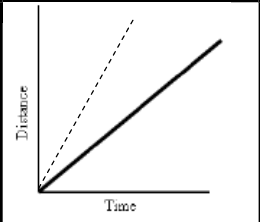
What does this graph represent?
a)
Constant Speed
b)
Acceleration
c)
Not moving
35.
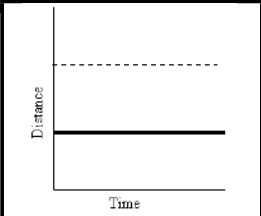
What does this graph represent?
a)
Constant speed
b)
Acceleration
c)
Not moving
100 %

