
 Worksheets
Reflection and refraction
Total questions: 40
Worksheet time: 50mins
__________________________ occurs when light hits an irregular surface.
diffuse reflection
regular reflection
no reflection
___________________________ occurs when light hits a smooth surface.
diffuse reflection
regular reflection
no reflection
What type of image is formed when light rays meet?
virtual image
real image
no image
Which type of mirror has a surface that curves outward?
concave mirror
convex mirror
plane mirror
The point at which rays parallel to the optical axis meet is called the
focal point
virtual point
optic point
real point
What do you call a flat mirror?
plane mirror
convex mirror
concave mirror

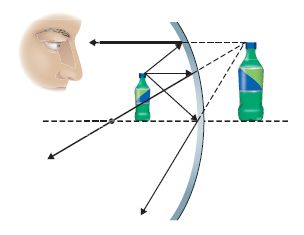
Which type of mirror is shown by picture A?
concave mirror
convex mirror
plane mirror

Where is the focal point of mirror A?
in front of the mirror
on the side of the mirror
behind the mirror
there isn't a focal point

Where is the focal point of Mirror B?
behind the mirror
in front of the mirror
on the side of the mirror
there isn't a focal point

The above lens is a type of ___.
diverging lens
converging lens
divergent lens
convergent lens
Which lens represents the path light takes through a diverging lens?


Which figure represents the path light takes through a converging lens?
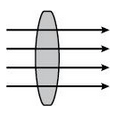
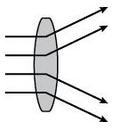
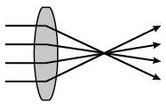
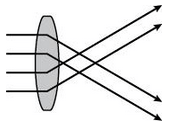
The image of an object, which is placed one foot in front of a plane mirror, will be ___.
behind the mirror and reversed, left to right.
behind the mirror.
in front of the mirror and reversed, left to right.
in front of the mirror.
A shopkeeper wants to keep an eye on his store in order to prevent shoplifting. What could the shopkeeper hang on the wall in order to see a wider image of his store and his customers?
a convex mirror
a concave mirror
a convex lens
a concave lens

What type of lens is used in the shown instrument?
concave lens
convex lens
reflection lens
reduction lens

What type of lens creates the image seen in the eyeglasses?
convex
concave
reflection
plane
A dentist uses a small dental mirror to help magnify teeth in your mouth. What type of mirror is this?
a convex mirror
a concave mirror
a convex lens
a concave lens
The side view mirrors on your car help shrink the image on both sides of the car, allowing you to see a larger field of view. What type of mirror is this?
a convex mirror
a concave mirror
a convex lens
a concave lens
forms only virtual images that are right-side up and smaller than the actual object.
plane mirror
convex mirror
concave mirror
How do virtual and real images differ?
Why can you see your reflection on a mirror but not on a piece of paper?
A plane mirror (or a flat mirror) produces a (a) image.
An imaginary line that divides a mirror in half.
Real image.
Virtual image.
Optical axis.
Focal point.
Straight lines that represent light waves.
Regular refelction.
Diffuse reflection.
Convex mirror.
Rays
An image is a copy of the object formed by reflected or refracted rays of light.
True
False

Type of mirror found in a bathroom...
Plane
Convex
Concave

According to the law of reflection the angle of incidence is ____________ the angle of reflection.
less than
greater than
equal to
Type of mirror that can produce a virtual image...
Plane
Convex
Concave
All of the above
Image behind the mirror is
virtual
real
upside down
upright
The image which can be formed on a screen is called?
Real
Virtual
Inverted
Which of the following is not a plane mirror?
Spoon surface
Smartphone display
Laptop display

The image that forms when light rays actually meet is called
virtual image
real image
diffuse reflection
regular reflection

Which ray diagram shows a real image?


None of the above
Four ray diagrams show the images formed in mirrors and lenses. Which shows a virtual image?


All of the above.

Light bends as it passes through a lens. This is called what?
Reflection
Diffraction
Refraction
Dilation
When light waves move from passing through air to passing through a glass lens when happens to them?
They slow down and change direction
They speed up and change direction
They maintain the same speed and change direction
They maintain their same speed and direction
What type of lens do you have in your eye?
Concave
Prismatic
Objective
Convex

