
 Worksheets
Organisms Change over Time-Evidence of Evolution
Total questions: 35
Worksheet time: 6hrs 50mins

Who was the naturalist/scientist that traveled the world to study plants and animals?
Albert Einstein
Charles Darwin
Heather White
Charles Barkley

The gradual change in species over time is called...
Evolution
Nucleotide
Adaptation
Natural Selection


What characteristic did Darwin observe about the finches on the Galapagos Islands?
Their feathers
Genotypes
Their beaks
Their body sizes

Another word for adapt is ____________.
change
create

Genetic differences between organisms of the same species
Variation
Population
Behavior
Environment

What is the advantage of having different shaped beaks?
To look different from other species.
To be able to eat the food readily available in the environment.
To protect itself against predators.
To protect itself against prey.

What do you call similar structures that related species have inherited from a common ancestor?
Natural Selection
Analogous Structure
Vestigial Structure
Homologous Structure

What do we call structures that no longer perform their original function?
Natural Selection
Analogous Structure
Vestigial Structure
Homologous Structure

What do you call a characteristic that allows an organism to survive in an environment?
variation
adaptation
selection
overproduction

Hibernation is an example of which type of adaptation?
Behavioral Adaptation
Physical Adaptation

Beak shape, camouflage, and webbed feet are all examples of which type of adaptation?
Behavioral Adaptation
Physical Adaptation

Brown mice survive and reproduce in their desert environment better than white mice because birds can see and eat the white mice more easily. In this situation, what part of the environment is doing the selecting?
predator
soil composition
mouse fur color
mating preferences

What is speciation?
combining of two species to form one with different traits
Intentional breeding designed to maintain a desired trait
timing of mating that prevents normal selection
A population splits and accumulates different genes in the new groups

Which of the following is an example of artificial selection? (not exactly "natural selection")
People breeding cows for size and milk production.
Insect populations developing resistance to certain pesticides.
Bacteria becoming resistant to antibiotics.
Male birds of certain species inheriting colorful feathers that are more attractive to females.

The pelvic bone of whales is not needed for movement within the water. This is an example of a(n) ______________ structure.
vestigial
analogous
homologous

Many different groups of organisms have wings, even though they do not share a recent common ancestor. This is because they evolved in environments with similar selective pressures. Wings are an example of a(n) ______________ structure.
vestigial
analogous
homologous

Below are the % similarities of DNA between whales and other species. Based on this, which are whales most closely related to?
Pig, 68.4%
Hippo, 83.4%
Mouse, 38.4%

The fossil record help scientists
better understand the kinds of organisms that lived in the past
better understand how the environment has changed over time
better understand how organisms have evolved over time
all of the answers help scientists

What is common ancestry?
When a species no longer exists
When organisms are descended from a single ancestor

50 million years ago, the Pakicetus had nostrils toward the front of it's skull Gray whales, modern-day descendants of the Pakicetus have nostrils toward the back of the skull. The Aetiocetus lived 25 million years ago, and it's nostril was in the middle of the skull. In this case, the Aetiocetus serves as a ______________.
index fossil or key fossil unlocking a time
transitional fossil showing the connection from one kind of fossil to another
carbonization fossil showing the carbon pressed into the rock
Which of the following are homologous (same) structures?
whale flipper and bat wing
legs on a beetle and legs on a cat

The cave fish and minnow are related to each other but the cave fish is blind and only has the remnants of an eye. What type of structure is this?
vestigial
analogous
What are examples of vestigial structures in a human?
liver, kidney and bladder
appendix, tail bone and wisdom teeth
heart, lungs and brain

_______________, or selective breeding, is one way that humans impact evolution. One example is how we have created so many dog breeds
Artificial selection
Homologous structures
Analogus structures

How does embryology support the Theory of Evolution?
It shows that they have a common ancestor because of their similarities.
I'm not sure.
Animals change over time.


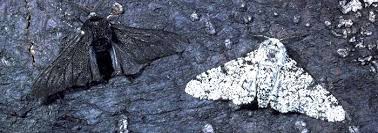
Predict which moth would increase in population with dark trees.
light
dark

The image suggests that whales and hippopotamuses shared a common ancestor. When did these ancestors live?
25-35 million years ago
50-60 million years ago
75 million years ago or more

If this land creature was a common ancestor to the whales and dolphins millions of years ago what evidence do we have?
fossils that show "nose" holes from the front of the snout to the top of the head like whales and dolphins
similar skeleton variation over time
a vestigial structure of what is a non functioning hip and leg bone
all of the answers are evidence

Do you think sea wolves in British Columbia, Canada could evolve (change, adapt) to spend more time in the water if food continues to be easier to find in water?
yes, they will need to adapt and offspring that are born with traits that help hunt in water will continue to mate and survive
no, they will go extinct
no, they will go back inland to hunt deer and small mammals

Darwin's term "survival of the fittest" actually means _____.
you fit in or match your environment so you can have a better chance of surviving to pass on your traits to offspring
you are fit like you workout and are big and muscular

