wayground logo

Free Printable Worksheets

NEW

Font size

S
M
L
XL
Worksheets

Characteristics and Behavior of Waves

Total questions: 42

Worksheet time: 37mins

Name
Class
Date
1.
What is the lowest point on a wave?
a)
amplitude
b)
peak
c)
trough
d)
wavelength
2.
The maximum distance from the center line to the top of the crest or the bottom of the trough is called the __________ of the wave.
a)
amplitude of the wave
b)
wavelength of the wave
c)
frequency of the wave
d)
speed of the wave
3.
High frequency waves have _________ wavelengths.
a)
varying
b)
long
c)
the same
d)
short
4.
Which wave has a greater frequency?
a)
A
b)
B
5.
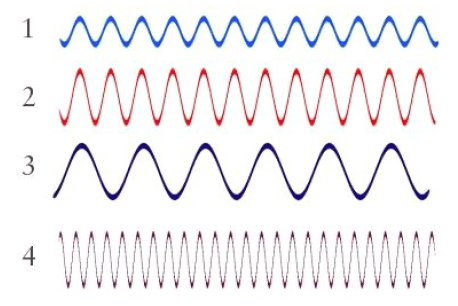
Which wave in the diagram has the greatest wavelength?
a)
1
b)
2
c)
3
d)
4
6.
Which wave has a longer wavelength?
a)
wave C
b)
wave D
7.
The unit of frequency is ___.
a)
meters
b)
nanometers (nm)
c)
m/s
d)
Hertz
8.
All waves carry
a)
energy
b)
light 
c)
matter
d)
particles
9.
Which material does sound travel the fastest?
a)
solid 
b)
liquid 
c)
gases
10.
When a wave strikes and object and bounces off. (example echo)
a)
medium
b)
refraction
c)
reflection
d)
interference
11.
When a wave bends as it passes through at an angle from one medium to another.(example: pencil in a glass of water-)
a)
medium
b)
refraction
c)
reflection
d)
interference
12.
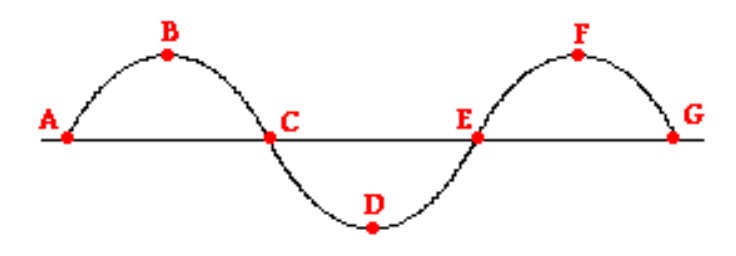
Which vocabulary term is used to identify the distance between points C & G?
a)
Amplitude
b)
Crest
c)
Frequency
d)
Wavelength
13.
Which letter(s) represent the trough of the wave?
a)
A
b)
B & D
c)
D
d)
C & G
14.
Which letter(s) represent the crest of the wave?
a)
A
b)
B & D
c)
B & F
d)
F
15.
If the wavelength increased, what would happen to the sound made by this wave?
a)
it would get softer
b)
it would get louder
c)
it would have a lower pitch
d)
It would have a higher pitch
16.
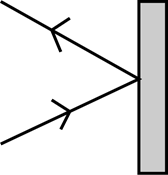
The illustration shows a light ray striking an object.
In the illustration, the light ray striking the object is-
a)
absorbed
b)
stopped
c)
reflected
d)
refracted
17.
A student placed a pencil in a cup of water.  The pencil appears broken because light-
a)
always travels in a straight line
b)
bends when it passes through water
c)
makes the water in the glass evaporate
d)
reflects the pencil on the water's surface
18.
The bouncing off of light rays from the surface of an object such as a mirror or other shiny surface is called:
a)
mirror
b)
laser
c)
reflection
d)
refraction
19.
What do we call this tool that separates white light into the colors of the Visible Spectrum?
a)
tuning fork
b)
prism
c)
microscope
d)
graduated cylinder
20.
a)
Reflection
b)
Refraction
21.
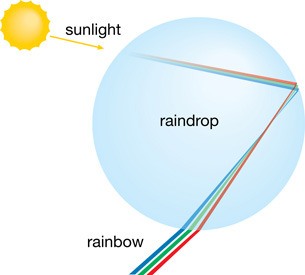
Light bending as it passes through a rain drop is an example of...
a)
Refraction
b)
Reflection
22.
The bending of a wave as it passes at an angle from one medium to another is called?
a)
Convex Lens
b)
Refraction
c)
Concave Lens
23.
Refraction is the bending of a wave disturbance as it passes from one _________ into another.
a)
glass
b)
medium
c)
area
d)
boundary
24.
According to the Law of reflection, a light ray striking a mirror
a)
continues moving through the mirror in the same direction
b)
moves into the mirror at a slightly different angle
c)
bounces off the mirror toward the direction it came from
d)
bounces off the mirror at the same angle it hits.
25.
When light/waves move from one medium to another, change in ____ can be observed.
a)
speed, direction, frequency
b)
speed, direction
c)
frequency
d)
amplitude
26.

How does light energy move?

a)

Longitudinal Waves

b)

Wavelengths

c)

Transverse Waves

d)

Ocean Waves

27.

A Transverse Wave is a wave that goes up and down

a)

True

b)

False

28.

What color has the shortest wavelength and highest frequency?

a)

Violet

b)

Orange

c)

Red

d)

Blue

29.

What color has the longest wavelength?

a)

Black

b)

Green

c)

Purple

d)

Red

30.

What is a wavelength?

(Hint: there is one correct answer)

a)

a. The distance between a crest & a trough

b)

b.The highest part of a transverse wave

c)

c.The distance between two crests

d)

d. Light doesn't have a wavelength

31.

Why do we see grass as green?

a)

Green light is absorbed

b)

Green light is reflected

32.
A disturbance that travels through a medium as a longitudinal wave
a)
sound
b)
wavelength
c)
pitch
d)
frequency
33.
The number of wavelengths that pass a point each second
a)
frequency
b)
wavelength
c)
pitch
d)
amplitude
34.
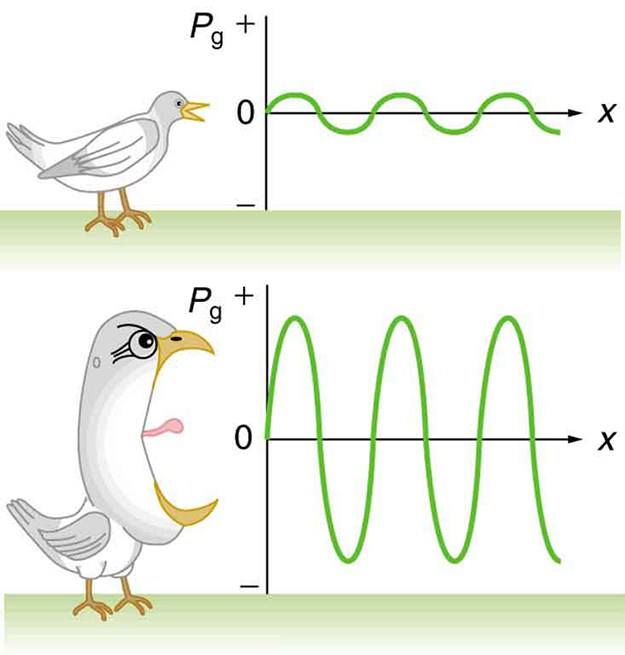
When a sound is louder what measurement gets bigger?
a)
Frequency 
b)
Amplitude 
c)
Wavelength 
d)
Crest
35.
What does pitch depend on?
a)
amplitude 
b)
frequency
c)
intensity 
d)
volume of sound
36.
What is B?
a)
crest
b)
trough
c)
compression
d)
rarefaction
37.
A part in a longitudinal wave where the particles are spread apart
a)
compression
b)
rarefaction
c)
crest
d)
trough
38.
The part of a longitudinal wave where the particles of the medium are close together.
a)
rarefaction
b)
compression
c)
crest
d)
trough
39.
A wave that requires a medium through which to travel
a)
mechanical wave
b)
chemical wave
c)
electromagnetic wave
d)
pitch
40.
A medium can be a .....
a)
solid
b)
liquid
c)
gas
d)
all of the above
41.

A longitudinal wave is also known as a __________

a)

Constitutional

b)

Conditional

c)

Confessional

d)

Compressional

42.

Which type of interference does a pair of noise-cancelling headphones utilize?

a)

Destructive

b)

Constructive

c)

Compressional

d)

Transverse