
 Worksheets
Waves
Total questions: 45
Worksheet time: 34mins


What does the arrow in the picture represent?
amplitude
wavelength
frequency
trough

What does the arrow in the picture represent?
wavelength
echolocation
amplitude
peak
If the amplitude increases, the energy of the wave:
increases
decreases
stays the same
Waves that require a medium to travel are:
mechanical waves
transverse waves
electromagnetic waves
light waves
What happens when you increase the amplitude of a sound?
it makes the sound louder
it makes the sound travel faster
it makes the sound softer
it changes the pitch or note of the sound
What can electromagnetic waves travel through (select all that apply)?
solids
empty space
liquids
gases

What kind of wave is pictured below?
compressional wave
transverse wave
longitudinal wave
mechanical wave

Which wave is pictured?
Transverse
Longitudinal
Electromagnetic
Light
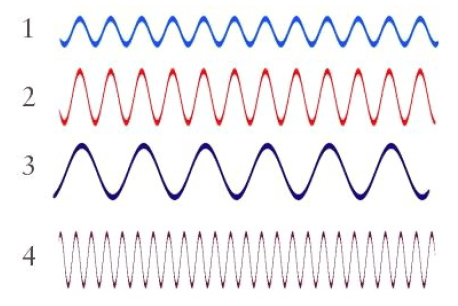
Which wave in the diagram has the greatest frequency?
1
2
3
4
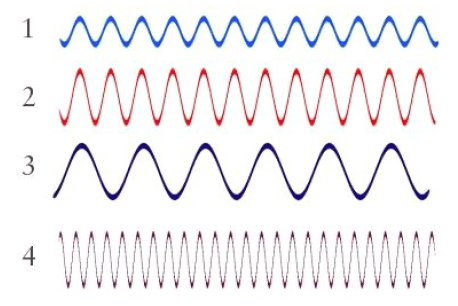
Which wave in the diagram has the longest wavelength?
1
2
3
4
If a wave has a greater frequency, what happens to the wavelength?
increases
decreases
stays the same
This sound has high pitch, which means it has a(n):
Higher frequency
Lower frequency
Higher amplitude
Lower amplitude
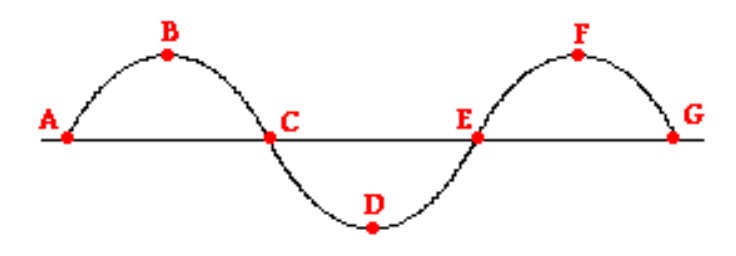
Which letter(s) represent the rest position of the wave (select all that apply)?
A & C
B & F
E & G
D
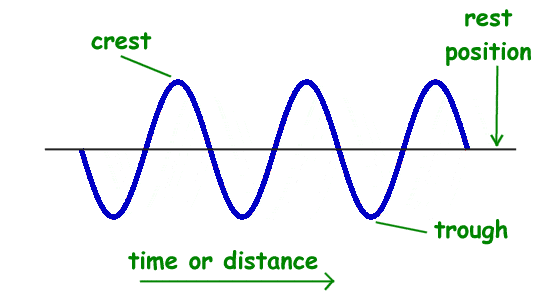
What is measured from crest to crest or trough to trough?
mediums
resting position
wavelength
origin
A disturbance that transfers energy from place to place through matter or space
wave
position
time
protein
How are Electromagnetic waves different from Mechanical waves?
EM waves have very short wavelengths
EM waves transmit energy instead of matter
EM waves can travel through the vacuum of space (without particles)
EM waves can change direction by reflection
What is the amplitude of a wave?
how often a wave passes a certain point
the distance from the middle of the wave to a crest or a trough
the highest point of a wave
chick-fil-a
Which of the following properties makes a light wave different from all mechanical waves?
A light wave slows down in a vacuum.
A light wave is able to transmit energy.
A light wave exists as a transverse wave.
A light wave can travel without a medium.
Waves that need a medium are called?
Electromagnetic Waves
P-Waves
Mechanical Waves
Taco Bell
Waves that can travel through a vacuum and do no require a medium are called?
Transverse Waves
S-Waves
Mechanical Waves
Electromagnetic Waves
What is the visible light spectrum in order?
red, orange, yellow, green, blue, indigo, violet
orange, blue, green, yellow, red, violet, indigo
red, green blue, orange, violet, yellow, indigo
McDonald's is gross
What causes the refraction of a wave?
the density of the medium changes the speed
the amount of the medium changes the direction
the color of the medium changes the speed
the type of wave changes the direction
When a wave bounces back, it is called?
diffraction
refraction
transmission
reflection
When a wave spreads out, it is called____________________?
reflection
refraction
diffraction
absorption
When a wave bounces back, it is called?
diffraction
refraction
transmission
reflection
Objects appear different in size and shape in a container of water due to ____________________________.
transmission
reflection
absorption
refraction
The electromagnetic waves with the highest frequencies are called?
radio waves
gamma rays
x-rays
visible light
The electromagnetic waves with the longest wavelengths are called?
radio waves
microwaves
gamma rays
x-rays



