
 Worksheets
6th Grade SOL Challenge
Total questions: 40
Worksheet time: 44mins
Name
Class
Date
1.
Which is the largest object in our solar system?
a)
Sun
b)
Jupiter
c)
Earth
d)
Pluto
2.
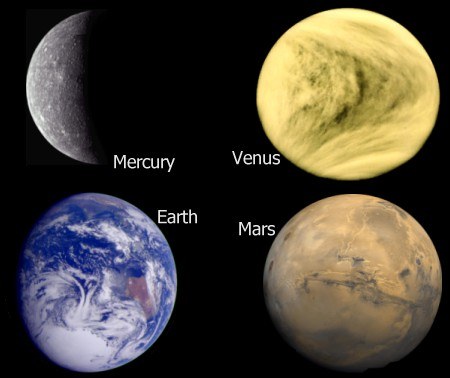
Earth and the other planets closest to the Sun are made mostly of _______
a)
gas
b)
metal
c)
water
d)
rock
3.
One of the main differences between the outer and inner planets is __________.
a)
The inner planets all have water
b)
the inner planets are much bigger than the outer planets
c)
the outer planets are gas planets
d)
the outer planets have rings, and the inner planets don't
4.
Why does Earth have different seasons?
a)
because of the distance between Earth and the sun
b)
because of the speed of Earth as it rotates on its axis
c)
because of the amount of light blocked by the moon on its axis
d)
because of the tilt of Earth on its axis as it moves around the sun
5.
Which of the following is an accurate model of how the Sun, Earth, and Moon move?
a)
Sun and moon orbit Earth
b)
Earth and moon orbit Sun
c)
Earth orbit's the Sun and the moon orbits Earth
d)
Earth and sun orbit moon
6.

The moon is a natural ______ of Earth.
a)
comet
b)
axis
c)
satellite
d)
space probe
7.
A student made a model of how the Earth, Moon, and Sun orbit. She used ping-pong balls
to represent each one. She painted each one a different color. Then, she placed the Moon
and Earth close together and the Sun much further away.What is one limitation of the student's model?
to represent each one. She painted each one a different color. Then, she placed the Moon
and Earth close together and the Sun much further away.What is one limitation of the student's model?
a)
She used the same size balls.
b)
She made earth orbit the sun.
c)
She moved the Sun away from the Earth and Moon.
8.
The land area that drains a particular set of streams and rivers is called
a)
an acre
b)
a drainage hectare
c)
a woodland
d)
watershed
9.
A student was listing all the abiotic elements she saw in the environment. She listed rocks, soil, trees, water, and air. Which item on her list was NOT abiotic?
a)
rocks
b)
trees
c)
water
d)
air
10.

Of the following choices, which watershed in Virginia is the largest?
a)
New
b)
Rappahannock
c)
Shenandoah-Potomac
d)
James
11.

A person poured oil into a creek at the starred location on the Virginia map. What major body of water would most likely be harmed?
a)
Gulf of Mexico
b)
Indian Ocean
c)
Pacific Ocean
d)
Atlantic Ocean
12.
The Chesapeake Bay is the largest ________ in the contiguous United States.
a)
Watershed
b)
River System
c)
Estuary
d)
Water Park
13.
What is a water molecule composed of?
a)
1 Hydrogen atom and 2 Oxygen atoms
b)
2 Hydrogen atoms and 1 Oxygen atom
c)
3 Oxygen atoms
d)
2 Helium atoms and 1 Oxygen atom
14.

Our watershed is part of a larger watershed called -
a)
Gulf of Mexico
b)
Mississippi Valley Watershed
c)
Chesapeake Bay Watershed
d)
Abemarle Sound
15.

Which states other than Virginia make up the Chesapeake Bay Watershed?
a)
Tennessee, Mississippi and Alabama, Deleware
b)
New York, New Jersey, Pennsylvania, Delaware, Maryland
c)
North Carolina, Georgia, Florida
d)
Louisian, Texas, Ohio
16.
What is the base unit of mass in the metric system?
a)
oz
b)
gram
c)
lbs
d)
cm
17.
What method could you use to find the volume of a small rock?
a)
water displacement
b)
triple beam
c)
ruler method
d)
scale
18.
What is the density... volume of 10 mL and a mass of 20 g? Would it sink or float?
a)
2g/ml..sink
b)
20g/ml..float!
c)
2g/ml...float
d)
sink
19.
If you are unsure about your data results you should...
a)
do more trials
b)
quit and be done
c)
guess what would happen
d)
A and B
20.
The variable that is purposely changed and tested is the...
a)
manipulated/independent variable
b)
responding variable
c)
conclusion
d)
control
21.

Which object's speed is increasing A or B
a)
A
b)
B
22.

How much weight is on this triple beam balance?
a)
272 g
b)
272.5 g
c)
270 g
d)
372 g
23.
The parts of the experiment that are kept the same
a)
variable
b)
conclusion
c)
hypothesis
d)
controls
24.
An attempt by a different group to conduct the same experiment
a)
bias
b)
repeated trial
c)
replication
d)
scientific explanation
25.
A possible answer to a scientific question
a)
Independent variable
b)
Hypothesis
c)
Observation
d)
Scientific inquiry
26.
An experiment in which all factors except one are kept constant.
a)
responding variable
b)
controlled experiment
c)
manipulated variable
d)
hypothesis
27.
The process of sharing ideas and information with other people. Writing, reading, speaking, listening and making models. Scientists communicate and share results, information and opinions.
a)
communicating
b)
share
c)
scientific inquiry
d)
controlled experiment
28.
Long periods of low precipitation are called
a)
deserts
b)
droughts
c)
low rain
d)
no rain
29.
The way the earth's rotation makes winds curve is called
a)
Coriolis effect
b)
humidity
c)
land breeze
d)
sea breexe
30.
High, wispy, feathery clouds made mostly of ice crystals that form at high levels are called
a)
cirrus
b)
stratus
c)
cumulus
d)
nimbostratus
31.
The flow of air from land to a body of water is called
a)
local breeze
b)
land breeze
c)
sea breeze
d)
global winds
32.
The process by which heat is trapped in the atmosphere by water vapor and carbon dioxide is called
a)
convection.
b)
the greenhouse effect.
c)
conduction.
d)
radiation.
33.

According to the graph, natural gas represents what percent of the energy resources produced in Virginia?
a)
1.34%
b)
9.72%
c)
76.42%
d)
98.66%
34.
Radioactive waste is one of the main disadvantages of which type of energy resource?
a)
nuclear power
b)
solar power
c)
fossil fuels
d)
biomass
35.
Which of these energy resources produces the least amount of air pollution?
a)
Natural gas
b)
coal
c)
solar power
d)
biomass
36.
Power from burning plants, plant products or animal dung.
a)
geothermal power
b)
nuclear power
c)
biomass power
d)
solar power
37.
Power from the heat stored in the Earth. The heat from hotspots can be used in powerplants.
a)
geothermal power
b)
hydroelectric power
c)
wind power
d)
solar power
38.
______ is a solid fossil fuel.
a)
coal
b)
charcoal
c)
natural gas
d)
petroleum
39.
Precipitation that contains chemicals that hurt plants and wildlife due to its low pH is called _______ .
a)
smog
b)
global warming
c)
acid rain
d)
fossil fuel
40.
According to the Law of Conservation of Energy, energy cannot be _________ or ____________.
a)
destroyed, destroyed
b)
created, saved
c)
created, destroyed
d)
lost, found
100 %

