wayground logo

Free Printable Worksheets

NEW

Font size

S
M
L
XL
Worksheets

Unit- 8 Mock Test

Total questions: 37

Worksheet time: 30mins

Name
Class
Date
1.
Which parts of the environment can humans affect?
a)
air
b)
food
c)
soil and water
d)
all of the above
2.

A factory creates pesticides that help farmers kill bugs. If the machines in the factory are washed and the remaining dirty water is not disposed of properly, how could the nearby town be affected?

a)

The texture of the soil could change.

b)

The river in town could become polluted.

c)

The air could be polluted.

d)

The house plants could become taller.

3.

Which of the following is an example of conservation?

a)

People take as many fish as the can catch.

b)

People never fishing at all.

c)

People raise fish on farms.

d)

People fish only as much as the natural population allows.

4.

Which of these is NOT a way that humans change ecosystems?

a)

cutting down forests

b)

causing drought because of little rain

c)

introducing new species

d)

turning land into farms

5.

Which environmental problem was directly caused by the invention of the automobile?

a)

storage of nuclear waste

b)

increased air pollution

c)

increased use of pesticides

d)

flooding the Midwest

6.

Burning oil ____________.

a)

may prevent acid rain.

b)

is a possible cause of global warming.

c)

may increase tree growth.

d)

does not cause pollution.

7.

A shopping mall was recently built near Mary's neighborhood. Soon Mary began to notice fewer birds at her bird feeder. What can Mary infer?

a)

Birds prefer to eat different birdfeed.

b)

Only cardinals are visting her feeder.

c)

Birds habitats were destroyed by the new shopping mall.

d)

Marry will see birds later in the afternoon.

8.

Why does the government enforce environmental controls for factories?

a)

to help ecosystems make a profit

b)

to protect the environment

c)

to keep employment rates high

d)

to slow down industrialization

9.
What is the most dramatic result of deforestation?
a)
land is no longer green and full of life
b)
pictures from space show deforestation
c)
loss of habitat for approximately 70% of the worlds species
d)
people can't explore rainforests
10.
largest number of individuals of a population that the environment can support  
a)
carrying capacity
b)
primary succession 
c)
denitrification
d)
mutualism
11.

In the 1800s rabbits were introduced for the first time into Australia. Here they had no natural predators and a plentiful food supply. What happened several years after the rabbit was introduced into Australia?

a)

The rabbits began to overpopulate greatly.

b)

Populations of animals competing with rabbits grew.

c)

The rabbit population declined sharply.

d)

New rabbit predators evolved.

12.
A supply of materials in a habitat
a)
Resources
b)
Biomes
c)
Organisms
d)
Groceries
13.
During "oh, deer", what caused the population of deer to increase?
a)
Not enough resources were available
b)
Plenty of resources were available
c)
Predation
d)
Mutualism
14.
Which of the following is an EXAMPLE of a limiting factor?
a)
Water
b)
the color of the sky
c)
Migration
d)
Thick fur
15.
Which of the following is an example of competition?
a)
Two vultures fight over a dead rabbit
b)
A bear eats a fish
c)
Birds migrate south
d)
Pet dog keeps a man company
16.
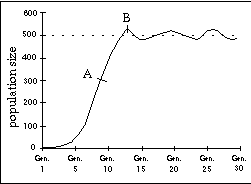
What is the carrying capacity of the following graph?
a)
1000
b)
8000
c)
800
d)
600
17.

What is the carrying capacity of the graph?

a)

around 400

b)

more than 500

c)

less than 500

d)

around 600

18.
If a disease destroying barley plants in a field swept through an ecosystem, what would happen to the barley eating bird population in the the field ?
a)
The bird population would stay the same
b)
The bird population would infinitely increase
c)
The bird population would decrease
19.
If the amount of food or resources available increases, the carrying capacity for an animal:
a)
Stays the same
b)
Increases
c)
Decreases
d)
Fluctuates
20.
In a forest ecosystem, which of the following is the best example of a limiting factor for a rabbit population?
a)
Squirrel Population
b)
Sunlight
c)
Grass available
21.
If the carrying capacity of a predator decreases, what will happen to the carrying capacity of the prey?
a)
Will Increase
b)
Will Decrease
c)
Will stay the same
d)
Will fluctuate
22.
The parasitic wasp injects its larvae into caterpillars . Acid rain has destroyed the caterpillar population. What will happen to the wasp population?
a)
Stay the same
b)
Increase
c)
Decrease
23.
Any thing or organism that regulates the size of a population is known as __________.
a)
a limiting measure
b)
a limiting factor
c)
carrying capacity
d)
biodiversity
24.
Limiting factors are sometimes helpful because they can keep the population from getting to large.
a)
True
b)
False
25.
What will happen to the population when the death rate is larger than the birth rate?
a)
grow
b)
shrink
c)
stay the same
26.
Will competition increase/decrease the carrying capacity of an ecosystem for the animal in competition?
a)
Decrease
b)
Increase
27.
Temperature, light, air, water, and soil are all  _____  parts of the environment
a)
alive
b)
biotic 
c)
abiotic
d)
living
28.
A __________ includes all living and non-living things in an environment. 
a)
population
b)
niche
c)
abitotic
d)
ecosystem
29.
What will happen if all of the frogs in a population die?
a)
The frogs' predators will decrease and the frogs' prey will increase
b)
The frogs' predators will increase and the frogs' prey will decrease
c)
The frogs' predators will increase and they frogs' prey in increase.
d)
We better all pray because there isn't anymore frogs.
30.
Environmental factors that keep a population from increasing. 
a)
Carrying Capacity
b)
Limiting Factors
31.
Which is NOT an example of a limiting factor.
a)
Climate
b)
Available Food & Water
c)
Available Space & Shelter
d)
Species color
32.
Which of the following is NOT a method of energy conservation?
a)
taking public transportation to work (bus, subway)
b)
riding your bike to work
c)
walking to work 
d)
driving alone in your car to work
33.
Fishermen have harvested certain fish to the point where the population of that fish is decreasing. This level of direct harvesting could cause
a)
ecosystems to be improved for future generations
b)
ecosystems to be severely damaged
c)
the restoration of environmental stability
d)
all other fish species to increase in number
34.
What happens when humans cut down forests to build shopping malls?
a)
Plants and animals thrive in the new environment and pollution decreases.
b)
New animals species form and plants produce more oxygen.
c)
The shopping mall reduces the amount of pollution in the area.
d)
Habitat is altered, plants and animals destroyed, and pollution increases.
35.
What will most likely decrease the size of a habitat?
a)
Clearing land to build a house.
b)
Using public transportation.
c)
Recycling once a week.
d)
Conserving water on a daily basis.
36.
The acidity of a local stream would most likely be affected by
a)
a change in the percentage of decomposers living in the stream
b)
a new source of air pollution 
c)
a new predator species being introduced to the ecosystem
d)
a decrease in the amount of sunlight that reaches the stream
37.

Which of the following has had the most negative impact on the ecosystems of the world?

a)

recycling

b)

human population growth

c)

the invention of plastic

d)

cows