
 Worksheets
Waves Unit Review
Total questions: 37
Worksheet time: 36mins

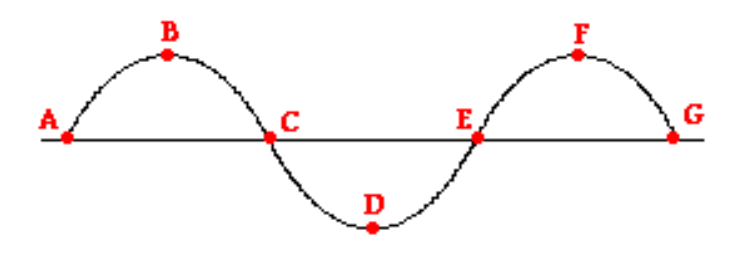
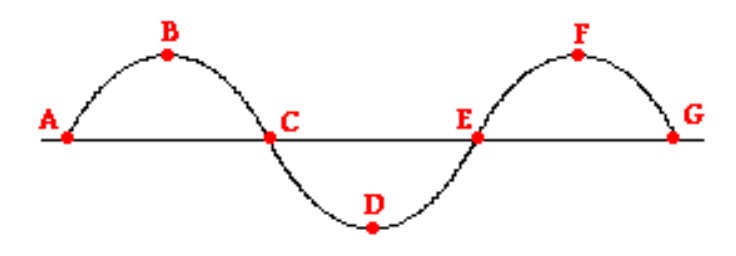
What kind of wave is pictured below?
compressional wave
transverse wave
sound wave
mechanical wave
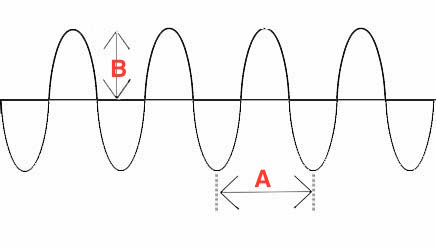

Areas of increased pressure on a sound wave are known as a ----
Rarefaction
Compression
Frequency
Amplitude

The distance from the beginning of one compression to the beginning of the next compression is called a -----
Rarefaction
Frequency
Wavelength
Compression
Sound waves are also known as ----- waves.
Compression
Longitudinal
Neither
Both longitudinal and compression
Spread out areas or areas of decreased pressure on a sound wave are known as a ---
Rarefaction
Amplitude
Compression
Hertz
Sound waves travel the fastest through ---
Liquids
Gases
Solids
The speed of sound depends on these two things:
The density of the medium and the temperature of the medium
Speed of the medium and temperature of the medium
Temperature of the medium and sound of the medium
None of the above

What is the behavior of a wave called when it strikes a barrier and bounces back?
Reflection
Refraction
Diffraction
Absorption

What is the behavior of a wave called when it enters a new medium and bends changing its direction?
Reflection
Refraction
Diffraction
Absorption

The behavior of a wave when it bends to go through and opening or around a barrier is called?
Reflection
Refraction
Diffraction
Absorption
The frequency of a sound wave is also called what?
Amplitude
Energy
Pitch
Volume
Which part of the Electromagnetic Spectrum has the longest wavelengths and lowest frequencies?
Visible Light
Microwaves
X-Rays
Radio Waves
Which part of the electromagnetic spectrum has the shortest wavelength and highest frequency?
X-rays
Infrared
Visible Lights
Gamma Rays
Energy in the electromagnetic spectrum moves in the form of what?
X-Rays
Radio Waves
Radiation
Microwaves
List the electromagnetic spectrum in order from lowest energy to highest energy
Radio waves, infrared waves, microwaves, visible light, ultraviolet, x-rays, gamma rays
gamma rays, x-rays, ultraviolet, visible light, infrared waves, microwaves, radio waves
Gamma rays, -x-rays, visible light, ultraviolet, infrared waves, microwaves, radio waves
Radio waves, microwaves, infrared waves, visible light, ultraviolet, x-rays, gamma rays
Light colors ___________________ EM waves
reflect
absorb
refract
diffract
Dark Colors ______________________ EM waves
Reflect
absorb
refract
diffract
In the eye, light is refracted in the
cornea and retina
cornea and iris
pupil and iris
cornea and lens

Which type of lens has light converging to a focal point when passed through it?
Concave
Convex

Which type of lens has light spreading out when it passes through the lens?
Concave
Convex
Electromagnetic waves travel as ______________________ when they enter a medium
Longitudinal waves
Radiation
Transverse waves
none of the above
The color we see what is
reflected
refracted
absorbed
diffracted
The shorter the wavelength on the electromagnetic spectrum the ________________________ the energy
lower
higher

According the the Law of Reflection, the angle light is reflected at is always
larger than the angle it hits a surface with
smaller than the angle it hits a surface with
equal to the angle it hits a surface with
unrelated to the angle it hits a surface with
Which of the following allows a lens to focus light?
Reflection
Refraction
Diffraction
Absorption
The only part of the EM Spectrum we can see is
Infrared
Visible light
X-Rays
Radio Waves
How are sound waves different from EM waves?
EM waves need a medium to travel through and sound waves do not.
Sound waves need a medium to travel through and EM waves do not.
Sound waves travel at the same speed.
Sound waves can travel in any direction.

