wayground logo

Free Printable Worksheets

NEW

Font size

S
M
L
XL
Worksheets

Plate Tectonics Overview

Total questions: 38

Worksheet time: 43mins

Name
Class
Date
1.

The land mass where all of the continents were once together in one large continent is called ________________.

a)

Laurasia.

b)

Pangaea.

c)

Eurasia.

d)

Gondwana.

2.

Tectonic plates consist of

a)

continental crust.

b)

mesosphere.

c)

both continental and oceanic crust.

d)

oceanic crust.

3.

The fact that similar fossils are found on both sides of the ocean is evidence of

a)

magnetic reversal.

b)

global positioning.

c)

continental drift.

d)

oceanic drift.

4.

What is the outermost layer of the Earth called?

a)

lithosphere

b)

core

c)

asthenosphere

d)

mesosphere

5.

Tectonic plates “float” on

a)

the lithosphere.

b)

the mantle.

c)

the ocean.

d)

the asthenosphere.

6.

What was the name of scientist who proposed Continental Drift?

a)

Harry Hess

b)

Alfred Wegner

c)

Charles Rawls

d)

Steven Doring

7.

The order of the mechanical layers of the Earth from the surface to the center is:

a)

asthenosphere, lithosphere, mesosphere,

outer core, inner core

b)

lithosphere, asthenosphere, mesosphere,

inner core, outer core

c)

mesosphere, outer core, inner core,

lithosphere, asthenosphere

d)

lithosphere, asthenosphere, mesosphere,

outer core, inner core

8.

Which of these did NOT provide evidence for continental drift?

a)

Erosion evidence

b)

Jigsaw evidence

c)

Climate Evidence

d)

Fossil evidence

9.

Which layer of the Earth represents tectonic plates?

a)

asthenosphere

b)

mantle

c)

mesosphere

d)

lithosphere

10.

Why was the theory of Continental Drift not supported?

a)

lack of fossils

b)

limited number of extinctions

c)

absence of rock samples

d)

lacked a mechanism

11.
The ______ is the layer of the Earth under the crust.
a)
core
b)
mantle
c)
magma
d)
none of the above
12.
Which of these is NOT a type of plate boundary?
a)
Convergent
b)
Divergent
c)
Bivergent
d)
Transform
13.
This is the process of warm liquids rising while cooler liquids sink.
a)
Convection
b)
Subduction
c)
Boiling
d)
Uplift
14.
This type of plate boundary is when two plates slide past each other.
a)
Convergent
b)
Transform
c)
Divergent
d)
Subductive
15.
This type of plate boundary is when two plates crash into each other.
a)
Convergent
b)
Transform
c)
Divergent
d)
Subductive
16.
This type of plate boundary is when two plates move apart.
a)
Convergent
b)
Transform
c)
Divergent
d)
Subductive
17.
This is when two plates converge but one slides under the other due to density.
a)
Uplift
b)
Subduction
c)
Trench
d)
None of the above
18.
What are the puzzle pieces of the Earth's surface called?
a)
Tectonic plates
b)
Puzzles
c)
Earthquakes
19.

The movement of the tectonic plates is caused by

a)

the rotation of the Earth.

b)

convection currents in the Asthenosphere

c)

the gravity of the iron-nickel core.

d)

the Moho discontinuity.

20.

Below is a picture of sea-floor spreading. How are the ocean crusts moving?

a)

Converging

b)

Diverging

c)

Sliding

d)

No movement

21.

The San Andreas Fault in California is known as an active earthquake area. What type of

boundary is it?

a)

Converging

b)

Diverging

c)

Transform

d)

Sea Floor Spreading

22.
What are the two types of crust
a)
continental and oceanic
b)
ocean and upper
c)
lower and upper
d)
pizza and subway
23.
Wegener’s proposal of a supercontinent was supported by:
a)
earthquake data
b)
seafloor magnetism
c)
rock, fossil, and climate data.
d)
convection currents in the mantle.
24.
What does the theory of continental drift state?
a)
The continents were once joined in a super-continent and have moved over time
b)
Continents are stationary and do not move
c)
The Earth is broken into lithospheric plates that move due to convection currents
d)
none of the above
25.
Why did no one believe Wegener's thoery?
a)
He could not explain HOW the continents moved
b)
He didn't have evidence
c)
His data was wrong
d)
He didn't use the right technology to gather data
26.
Identify the Major Plate labeled B
a)
African Plate
b)
Antarctic Plate
c)
Pacific Plate
d)
Eurasian Plate 
27.
Identify the Major Plate labeled I
a)
African Plate
b)
Antarctic Plate
c)
Pacific Plate
d)
Eurasian Plate 
28.
Pangaea was an ancient supercontinent made up of...
a)
America, Greenland, and Europe.
b)
Antarctica, India, and America.
c)
all of Earth’s continents.
d)
South Africa, India, Australia, and South America.
29.
The type of plate boundary where two plates come together is a .....
a)
Convergent Boundary
b)
Divergent Boundary
c)
Transform Boundary
d)
Plate Boundary
30.
Which of the following causes Earth's tectonic plates to move?
a)
Energy from the Sun
b)
Magnetic Pole Reversal
c)
Convection currents in the mantle
d)
Faults in Mountain Ranges
31.
What type of event will occur at this boundary?
a)
Earthquake
b)
Volcano Eruption
c)
Tornado
d)
Mountain Building
32.
Oceanic Trenches are formed by _______ plate boundaries
a)
Convergent
b)
Transform
c)
Plate
d)
Divergent
33.
Islands can from from magma which is pushed up at a __________ plate boundary
a)
Divergent
b)
Convergent
c)
Transform
34.

When did Alfred Wegener proposed Continental drift?

a)

1880

b)

1900

c)

1912

d)

1930

35.

What are the two metals present in the inner and outer core?

a)

gold and silver

b)

iron and steel

c)

nickel and steel

d)

iron and nickel

36.

The portion of Earth underneath the crust containing the asthenosphere and the mesosphere is the ________

a)

mantle

b)

core

c)

tsunami

d)

magma

37.
The formation of the Hawaiian Islands is associated with ____.
a)
a transform boundary
b)
hot spots
c)
convergent boundaries
d)
divergent boundaries
38.

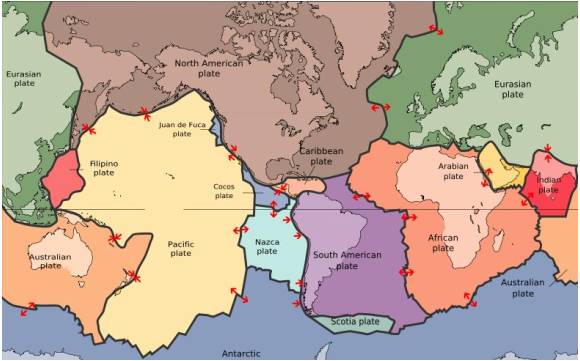
The map in the picture shows tectonic plate boundaries. The lighter colored crust is land (continental) and the darker color crust is oceanic. What type of crust is the Nazca plate?

a)

land crust

b)

sediment

c)

oceanic crust

d)

continental crust