
 Worksheets
Evolution Review
Total questions: 35
Worksheet time: 51mins
Name
Class
Date
1.
The white feathers of a snowy owl allow it to blend in with its environment during the winter months (snow). This is an example of ________________
a)
Species
b)
Environmental Change
c)
Adaptation
d)
Variation
2.

Which of the following is a term for a group of similar organisms that can reproduce fertile offspring?
a)
individual
b)
population
c)
species
d)
fossil
3.
Mutations are important because they bring about
a)
death of the organism in which they develop
b)
genetic variation needed for a population to evolve
c)
benefits for the individual, not for the population
d)
Hardey-Weinberg equilibrium within a population
4.
Structures that have common evolutionary origins, provide evidence for common ancestor.
a)
Species
b)
Vestigial Structures
c)
Population
d)
Homologous Structures
5.
Group of organisms all of the same species, living in the same place at the same time.
a)
gene pool
b)
population
c)
species
d)
evolution
6.
Where the better adapted organisms survive to pass traits along to offspring.
a)
Evolution
b)
Natural Selection
c)
Extinction
d)
Artifical Selection
7.

The diagram shows fossils in different rock layers. Which of these statements about the age of these fossils is most likely correct?
a)
Fossil A and C are the same age
b)
Fossil B is older than fossil C
c)
Fossils A is older than fossil B
d)
Fossil D is older than fossil C
8.

An organism has thick white fur, a bushy tail,
and short ears. It often burrows holes and curls into a ball for warmth. For
which environment is this organism most likely adapted?
a)
Grassland
b)
Arctic Tundra
c)
Coniferous Forest
d)
Desert
9.

When an animal tries to look, sound, or act like
another animal to fool predators into thinking it is poisonous or dangerous,
this is called?
a)
camouflage
b)
hibernation
c)
migration
d)
mimicry
10.
Charles Darwin’s observation that finches of different species on the Galápagos Islands have many similar physical characteristics supports the hypothesis that these finches
a)
have the ability to interbreed.
have the ability to interbreed.
have the ability to interbreed.
b)
acquired traits through use and disuse.
c)
all eat the same type of food.
d)
descended from a common ancestor.
11.

Farmers breed cows to produce high amounts of milk. This is an example of...
a)
Natural Selection
b)
Variations in a species
c)
Selective Breeding
12.

If 10 people live in an island and no one can enter or exit, what is the only way new traits can be introduced into the population?
a)
Natural Selection
b)
Artificial Selection
c)
Selective Breeding
d)
Mutations
13.

Some animals are able to see in ultraviolet (UV) light. Bees for instance can see Green and Blue and UV, but no Red, but butterflies and birds can see Red, Green, Blue and UV. Why would a plant need these special ultra violet markings?
a)
to show insects they are poisonous
b)
Attract insects to help it pollinate
c)
avoid sunlight
d)
visibility at night
14.

characteristic or trait that helps an organism survive in its environment
a)
skills
b)
speciation
c)
natural instinct
d)
adaptation
15.
Suppose an ecosystem changes. One
kind of organism CANNOT adapt to this change and they begin to die off faster
than they can reproduce. This organism is most likely to ___________.
a)
a. recover
b)
b. become angry hiding
c)
c. become extinct
d)
d. go into hiding
16.
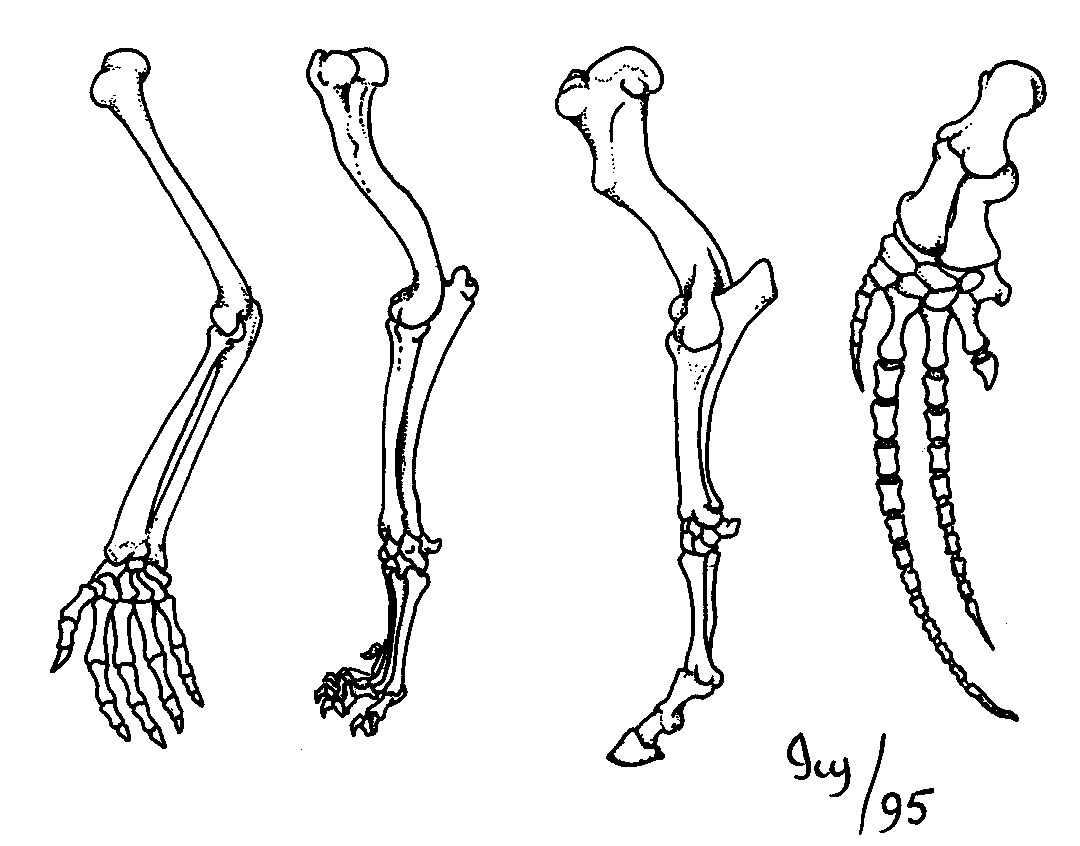
Structures with the same parts have different functions; suggests that organisms share a common ancestry
a)
vestigial structures
b)
homologous structures
c)
adaptive radiation
d)
fossil
17.
The process by which populations slowly change over time is called__________
a)
selective breeding
b)
adaptation
c)
sepeciation
d)
evolution
18.

Which layer is the oldest
a)
B
b)
A
c)
E
d)
C
19.

Which best describes these fossils?
a)
The oldest fossils can be found on the lower layers
b)
The oldest fossils can be found at the top layers
c)
The youngest fossils are always found on the bottom layers
d)
You can not tell the age of any of these fossils
20.
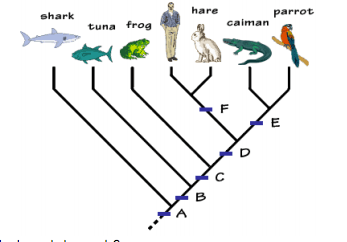
On the cladogram, which organism is the closest relative of the human?
a)
Frog
b)
Hare
c)
Caiman
d)
Parrot
21.

Which trait do only humans have, according to the cladogram?
a)
jaws
b)
mammary glands & hair
c)
terrestrial during all life stages
d)
opposable thumbs
22.
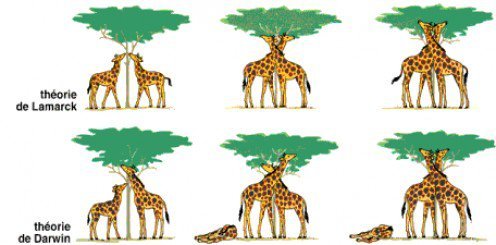
What would happen if the Giraffes never evolve?
a)
they would survive
b)
They would thrive
c)
They would become extinct
d)
They will find another source of food
23.
asexual reproduction produces offspring with
a)
half of a single parent's genes
b)
the same genes as the parent
c)
a mix of genes from two parents
d)
lots of genetic variation
24.
Which of the following is a fossil?
a)
a plant that has recently died
b)
a group of organisms that can reproduce
c)
a structure or organ that no longer functions
d)
a trace of an organisms that existed in the past
25.

what did Charles Darwin observe in finch populations of the Galapagos Islands off the coast of South America?
a)
different species on different islands
b)
all species on one of the islands
c)
identical species on all the islands
d)
the same species as North America
26.
The more genetic variation a population has,
the more likely it is for some individuals to
a)
evolve
b)
migrate
c)
survive
d)
mutate
27.
What is the process in which humans breed organisms for certain traits?
a)
natural selection
b)
inheritance
c)
artificial selection
d)
descent withOUT modification
28.
The opossum and kangaroo both incubate their young in a pouch. This provides evidence that they---
a)
are descended from a common ancestor
b)
Have very similar skeletal structures
c)
belong to the same species
d)
must range great distances to eat
29.

Which of the following statements best explains why some mosquitoes survived after the first spraying?
a)
Some mosquitoes had a genetic mutation that made them resistant to the insecticide
b)
A. All mosquitoes had a genetic mutation that made them resistant to the insecticide
c)
A. None of the mosquitoes had a genetic mutation that made them resistant to the pesticide
30.

A graph regarding the effect of agricultural bioengineering on insect pests is shown below How has natural selection affected species of insect pests?
a)
A. Natural selection has not affected the number of species that are resistant to pesticides
b)
A. Natural selection has rapidly increased the number of species that are resistant to pesticides
c)
A. Natural selection has only affected the number of species that are resistant to pesticides
31.

Over a period of several decades, ecologists conduct an investigation on the survival of a species of lizards. They summarize their results in a chart showing the effect of color mutations on lizard survival.
The ecologist conclude from their data that---
The ecologist conclude from their data that---
a)
A. Natural selection produced a change in the color of individual lizards
b)
A. Natural selection produced a change in the genes of the lizard population
c)
A. Natural selection produced a change in the color distribution of the lizard population
32.

The green frog (Lithobates clamitans clamitans) is found in many parts of the United States. The table contains some information about this frog.
Why does the ability to lay 1,000 to 5,000 eggs increase the fitness of the species L. clamitans clamitans?
Why does the ability to lay 1,000 to 5,000 eggs increase the fitness of the species L. clamitans clamitans?
a)
A. It increases the probability that some offspring will survive long enough to reproduce.
b)
It increases the chance of the recombination of alleles, leading to genetic drift in the population.
c)
A. It increases opportunities for offspring to compete for limited resources.
33.
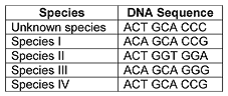
According to this data, the unknown bacterial species is most closely related to:
a)
Species I
b)
Species II
c)
Species III
d)
Species IV
34.
Certain insects resemble (look like) the bark of the trees on which they live. Which statement provides the best explanation for this resemblance? (Peppered Moths)
a)
The trees caused mutations in the insects
b)
Natural selection played a role in this protective coloration
c)
The insect camouflage so they developed this coloration
35.
Evolution is the theme that ties together all of biology. This is because the process of evolution
a)
explains how organisms become adapted to their environment.
b)
explains the diversity of organisms
c)
explains why distantly related organisms sometimes resemble one another.
d)
all of the above are appropriate answers.
100 %

