
 Worksheets
Great Depression
Total questions: 65
Worksheet time: 1hrs 1mins
Name
Class
Date
1.
The New Deal...
a)
gave free land to homesteaders
b)
helped women get the vote
c)
spread civil rights throughout the country
d)
helped people during the depression
2.
Which one is a cause of the Great Depression?
a)
End of the gold rush
b)
Crash of the stock market
c)
End of World War II
d)
High price of oil
3.
Which of the following BEST describes the Great Depression?
a)
The depression was severe, but only in the United States.
b)
Governments acted quickly and the depression only lasted two years.
c)
The depression caused revolutions all across the world.
d)
Many countries around the world experienced the economic depression
4.
Because of the New Deal, the government...
a)
was less involved in the economy
b)
became concerned with social welfare
c)
went into a budget surplus
d)
cut back on federal spending
5.
Which of the following is NOT a way people tried to escape their troubles during the Great Depression?
a)
Going to the movies
b)
Running track and field
c)
Reading popular books and comics n
d)
Listening to soap operas
6.
Which of the following is NOT a New Deal Program?
a)
Conservation Country Corporation (CCC)
b)
Works Progress Administration (WPA)
c)
Civilian Conservation Corps (CCC)
d)
Tennessee Valley Authority (TVA)
7.
Because of the Dust Bowl, many farmers moved to...
a)
California
b)
Virginia
c)
New York
d)
Kansas
8.
Homes that were in parks and built out of cardboard boxes were called...
a)
Hoovervilles
b)
Rooseveltowns
c)
Hoovertowns
d)
Roosevelburgs
9.
What is the nickname for the decade where the U.S. economy thrived before the Great Depression?
a)
Dirty 30s
b)
Boring 40s
c)
Roaring 20s
d)
Fantastic 50s
10.
Which area in the United States was known as the "Dust Bowl"?
a)
Southeast
b)
Midwest
c)
Northwest
d)
Northeast
11.
What weather condition in the United States lead to the great dust storms?
a)
flooding
b)
tornado
c)
drought
d)
earthquakes
12.
Why did people lose all of their money that were put into banks?
a)
banks were not insured by the government
b)
government ran out of money for the banks
c)
banks wasted all of their money on bad investments
d)
people stopped putting their money in banks
13.
What happened to a large number of the banks in the United States during this time period?
a)
banks stayed open
b)
banks were shut down
c)
banks had to pay a fine
d)
banks were destroyed by riots
14.
Overspeculation is...
a)
giving out loans they knew would not be paid back
b)
valuing stocks to be worth more than they actually were
c)
buying stocks on credit
d)
not insuring customers' money
15.
When did the stock market crash?
a)
October 29, 1929
b)
February 19, 1919
c)
October 10, 1919
d)
October 19, 1929
16.
Who was the President of the United States when the Great Depression started?
a)
Franklin D. Roosevelt
b)
Harry S. Truman
c)
Dwight D. Eisenhower
d)
Herbert Hoover
17.
What was the unemployment rate at the height of the Great Depression?
a)
25%
b)
50%
c)
75%
d)
100%
18.
Why were the people of the United States angry at President Hoover during the Great Depression?
a)
They thought the depression was all his fault
b)
They felt he did not help enough during the depression
c)
He went on expensive vacations during the depression
d)
He lied to congress about the depression
19.
Where did Hoover expect the aid to the poor would come from?
a)
Charities and churches
b)
State government
c)
Federal government
d)
Foreign countries
20.
Who was the Democratic candidate in the 1932 Presidential Election?
a)
Theodore Roosevelt
b)
Herbert Hoover
c)
Franklin D. Roosevelt
d)
William Howard Taft
21.
The New Deal had three goals: bring relief to unemployed, restore the economy, and _____________?
a)
bring relief to unemployed
b)
reform the system
c)
make sure citizens don't need to work
d)
redistribute wealth from the wealthy
22.
Which New Deal program insured checking and savings accounts?
a)
Civilian Conservation Corps
b)
Fair Labor Standards Act
c)
Federal Deposits Insurance Corporation
d)
Social Security Act
23.
Which New Deal program prevented the prices of crops from dropping to help farmers?
a)
Rural Electrification Act
b)
Agricultural Adjustment Act
c)
Fair Labor Standards Act
d)
Civilian Conservation Corps
24.
Which New Deal program employed young men under the age of 25 to work on various public works projects?
a)
Social Security Act
b)
Works Progress Administration
c)
Rural Electrification Act
d)
Civilian Conservation Corps
25.
Which New Deal program set aside savings through taxes for retired Americans?
a)
Federal Deposits Insurance Corporation
b)
Social Security Act
c)
Agricultural Adjustment Act
d)
Civilian Conservation Corps
26.
Which New Deal program brought electricity to poor, rural areas of the country?
a)
Tennessee Valley Authority
b)
Social Security Act
c)
Civilian Conservation Corps
d)
Federal Deposits Insurance Corporation
27.
A major result of the New Deal was that it...
a)
eliminated poverty in the US
b)
extended the merit system in the civil service
c)
destroyed the private enterprise system
d)
greatly increased the size and power of the Federal Government
28.
How did "bank runs" (failures) impact the American people during the Great Depression?
a)
Banks eventually ran out of money to loan, and people's life savings were gone.
b)
Banks made loans throughout the Great Depression, helping people pays bills until they could find work.
c)
Banks were able to people's deposits safe, but they could not loan out any more money.
d)
Banks were not at all involved in the Great Depression because people did not use them.
29.
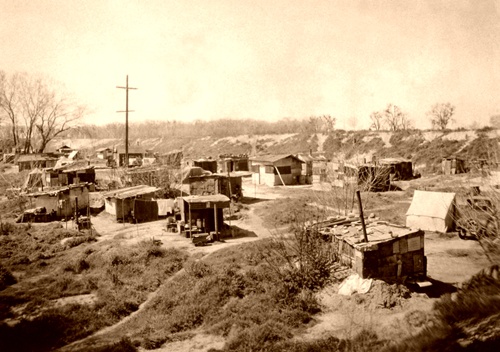
What was the main reason for the emergence of “Hoovervilles” like the one shown in the photograph?
a)
Many Americans had lost jobs during the Great Depression.
b)
Thousands of homes had been destroyed by the effects of the Dust Bowl.
c)
Housing projects could not keep up with the demand for homes needed by the poor.
d)
Preparations for World War I had created a shortage of building materials.
30.
In 1932, Bonus Army marched on Washington to...
a)
strengthen the nation’s defenses
b)
end the military draft
c)
bring American troops home from overseas
d)
pressure the government into paying them $1000
31.
During the 1930s, poor land management and severe drought conditions across the Midwest resulted in the...
a)
formation of the United States Department of Agriculture
b)
creation of wheat surpluses
c)
growth of the Populist movement
d)
development of Dust Bowl conditions on the Great Plains
32.
Which of these statements is true of the 1932 presidential election?
a)
Franklin Roosevelt won in a landslide.
b)
Hoover lost by a narrow margin.
c)
Hoover won a second term.
d)
Roosevelt won a third term.
33.
Unlike Hoover, Roosevelt...
a)
wanted to rely on private charities to provide assistance
b)
stressed the need for rugged individualism
c)
supported direct relief to people out of work
d)
thought the government should not be involved in economic reform
34.
FDR addressed the American public in weekly broadcasts known as:
a)
FDR Hour
b)
Hangin' With Franklin
c)
Fireside Chats
d)
Around the Fire
35.
What was a guiding principle of the New Deal economic policies?
a)
Pro-business tax breaks would solve poverty.
b)
Antitrust legislation would destroy the economy.
c)
Rugged individualism would solve social inequality.
d)
Government must help the poor.
36.
As part of the New Deal, the SEC and FDIC were created to...
a)
allow for a quick recovery of stock prices
b)
provide direct loans to businesses
c)
protect individual investors from stock fraud and bank failure
d)
allow banks and companies to invest in the stock market
37.
The CCC and WPA were both New Deal programs developed to address the problem of...
a)
excessive stock market speculation
b)
high unemployment
c)
increased use of credit
d)
limited income of senior citizens
38.
The TVA hired people to...
a)
deliver food to the poverty-stricken Dust Bowl residents
b)
build dams and generators that provided electricity
c)
work on farms to help stabilize agriculture
d)
publish important facts about businesses
39.
FDR declared a __________________ when he closed all the banks and did not allow them to reopen until they were stable.
a)
Bank closures
b)
Bank retreats
c)
Bank Holiday
d)
Margin Holiday
40.
Programs of the New Deal that ensured the causes of the Great Depression were addressed and corrected so that a depression would not happen again.
a)
Relief
b)
Recovery
c)
Reform
41.
Programs of the New Deal that put Americans back to work by completing government funded projects and rebuilding the economy.
a)
Relief
b)
Recovery
c)
Reform
42.
This natural disaster worsened the effects of the Great Depression on farmers in the Midwest.
a)
Tornados
b)
Dust Bowl
c)
Black Tuesday
d)
Hurricanes
43.

During the Great Depression, Roosevelt was...
a)
unwilling to allow government agencies to establish jobs programs
b)
unable to win congressional support for his economic program
c)
able to ignore economic issues for most of his first term in office
d)
more willing to use government intervention to solve economic problems
44.
What were the major goals of the New Deal?
a)
no gold standard and free coinage of silver
b)
abolition and suffrage
c)
relief, recovery, and reform
d)
expanding the size and economic influence of the United States
45.
What was the name of FDR's plans and programs designed to fix the problems of the Great Depression?
a)
New Deal
b)
Great Deal
c)
Social Security
d)
the New Liberalism
46.
Which was NOT an impact of the Great Depression on Americans?
a)
unemployment at an all time high
b)
homeless and hungry Americans
c)
income of farmers decreased
d)
Americans were spending more money
47.

What event ended the Great Depression?
a)
Bonus Army
b)
Hoover Dam
c)
New Deal
d)
World War II
48.
Which of the following was NOT a cause of the Great Depression?
a)
Stock market crash
b)
High international tariffs
c)
Unpaid WWI debt
d)
Bank failures
49.

An effect of the Great Depression was...
a)
A large number of people were admitted to the hospital.
b)
A large number of banks and businesses excelled.
c)
A large number of banks and businesses failed.
d)
A large number of banks and businesses moved to Canada.
50.
In the 1930’s, the passage of New Deal programs demonstrated a belief that...
a)
corporations were best left to operate without government interference
b)
state governments should give up control over commerce inside their states
c)
the government should be more concerned with the people's social welfare
d)
the stock market was best left unregulated
51.
When the Great Depression began in 1929, President Hoover believed...
a)
the government should assume control of industry
b)
the economy would recover on its own
c)
an increase in defense spending would stimulate the economy
d)
the government should regulate the economy
52.
FDR's New Deal was based on the three Rs. Which of the following is not one of the three Rs?
a)
Relief
b)
Recovery
c)
Reform
d)
Recession
53.

This law gave FDR the power to close all banks, and only reopen those that were stable.
a)
Federal Emergency Relief Act
b)
Emergency Banking Relief Act
c)
National Recovery Administration
d)
Civilian Conservation Corps
54.
After the Stock Market Crash of 1929, what happened to the banks?
a)
People were rushing to deposit their money
b)
People were rushing to take out their money
c)
Banks went on vacation
d)
People were taking out a bunch of credit cards
55.
Herbert Hoover's political philosophy was known as...
a)
The Good Samaritan
b)
Fourteen Points
c)
New Deal
d)
Rugged Individualism
56.
Franklin D. Roosevelt believed the government should be like...
a)
The Good Samaritan
b)
Rugged Individuals
c)
Laissez-faire capitalists
d)
Great Compromisers
57.
Programs of the New Deal that were created to help those who were hit hardest by the Great Depression.
a)
Relief
b)
Recovery
c)
Reform
58.
In the 1920s, people bought stocks with money borrowed from stock brokers. This is known as...
a)
Buying on credit
b)
Installment buying
c)
Buying on the margin
d)
Insurance payments
59.
Which groups were hit the hardest by the Great Depression?
a)
Women
b)
African Americans
c)
Native Americans
d)
All minority groups were hit the hardest
60.
The ________________ decreased international trade and worsened the economic depression.
a)
Smoot-Hawley Tariff
b)
Emergency Banking Relief Act
c)
Securities and Exchange Commission
d)
Federal Deposit Insurance Commission
61.
Which New Deal program employed artists to work for the government?
a)
Social Security Act (SSA)
b)
Works Project Administration (WPA)
c)
Civilian Conservation Corps (CCC)
d)
Agricultural Adjustment Act (AAA)
62.
Which New Deal agency regulated the stock market?
a)
Federal Deposit Insurance Commission (FDIC)
b)
Securities and Exchange Commission (SEC)
c)
Works Project Administration (WPA)
d)
Social Security Act (SSA)
63.
Which of the following is a criticism of the New Deal?
a)
It was too expensive and increased federal spending
b)
It decreased the unemployment rate
c)
It gave President Hoover too much power
d)
It allowed banks to operate without any regulations
64.
Which type of government did many foreign countries turn to during the Great Depression?
a)
Nationalism
b)
Communism
c)
Militarism
d)
Capitalism
65.
Which government agency had the power to prevent the banks from failing, but chose not to?
a)
Federal Reserve
b)
White House
c)
Congress
d)
NY Stock Exchange
100 %

