
 Worksheets
Seasons and Weather
Total questions: 27
Worksheet time: 22mins
Name
Class
Date
1.

Which season is taking place in the Northern Hemisphere in Position 3?
a)
Winter
b)
Spring
c)
Summer
d)
Fall
2.

Which season is taking place in the Northern Hemisphere in Position 4?
a)
Winter
b)
Spring
c)
Summer
d)
Fall
3.
The Earth's axis is tilted _____ degrees.
a)
23.5
b)
25.3
c)
30.2
d)
24
4.

At position A, which hemisphere would have summer?
a)
Northern hemisphere
b)
Southern hemisphere
5.

What happens when the area in which you live tilts away from the sun?
a)
It is summer.
b)
It is spring.
c)
It is winter.
d)
It is fall.
6.
The term equinox means....
a)
equal amount of day light and equal amount of night
b)
Equal amount of winter and summer
c)
Equal amounts of hot dogs for everyone
d)
The longest day of the year
7.
What is the longest day of the year?
a)
winter solstice
b)
summer solstice
c)
fall equinox
d)
spring equinox
8.
Why do we experience the changing of the season on the earth?
a)
distance from the sun
b)
rotation of the earth
c)
change in solar output
d)
tilt of the earth's axix
9.

Why is the Equator warmest?
a)
Because it is closest to the sun.
b)
Because it receives the most direct sunlight
c)
Because no clouds form here.
d)
Because it is far from the sun
10.

Why does the area around the equator stay the same temperature all year?
a)
The equator rotates slower than the poles.
b)
The equator remains the same distance from the sun.
c)
The equator always receives direct sunlight.
d)
The equator has 18 hour days.
11.
One rotation of Earth is equal to
a)
a day.
b)
a year.
12.
Objects appear to move from east to west because Earth turns from _______ to ________.
a)
East to West.
b)
West to East.
c)
North to South.
d)
South to North.
13.
If Earth rotated slower, we would have...
a)
shorter days.
b)
longer days.
c)
shorter years.
d)
longer years.
14.
A severe storm which involves a funnel cloud forming over land is:
a)
hurricane
b)
tornado
c)
thunderstorm
d)
blizzard
15.
The boundary between two air masses is known as:
a)
front
b)
storm
c)
climate
d)
flood
16.
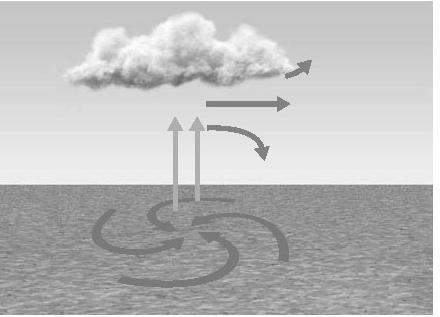
Which type of pressure system is pictured?
a)
high
b)
low
c)
medium
d)
none
17.

What type of weather would you expect with the pressure system pictured?
a)
clear
b)
cloudy
c)
severe storms
d)
hot
18.
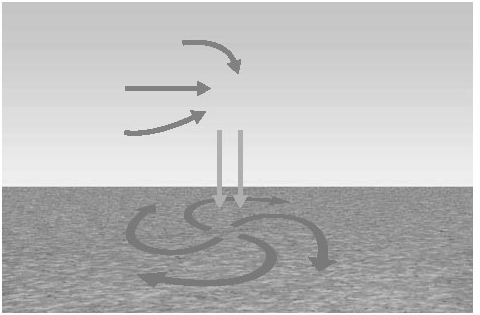
Which type of pressure system is pictured?
a)
high
b)
low
c)
medium
d)
none
19.

What type of weather would you expect from the pressure system pictured?
a)
clear
b)
cloudy
c)
hot
d)
stormy
20.
When air contains as much moisture as possible at a specific temperature, it is:
a)
at its dew point
b)
saturated
c)
at its dew point AND saturated
d)
none of the rest
21.
Cold air traveling south from Canada is:
a)
continental tropical
b)
continental polar
c)
maritime tropical
d)
maritime polar
22.
Warm air mass that does not carry water:
a)
continental tropical
b)
continental polar
c)
maritime tropical
d)
maritime polar
23.
Cold air mass that is carrying water is:
a)
continental tropical
b)
continental polar
c)
maritime tropical
d)
maritime polar
24.
In _________ pressure systems, air sinks:
a)
high
b)
low
c)
medium
d)
none
25.
In _______ pressure systems, air rises
a)
high
b)
low
c)
medium
d)
none
26.
This type of front can bring strong storms
a)
cold
b)
warm
c)
stationary
d)
occluded
27.
Which weather tool measures air pressure?
a)
thermometer
b)
barometer
c)
anemometer
d)
psychrometer
100 %

