
 Worksheets
Genetics Retest Work
Total questions: 30
Worksheet time: 33mins
Name
Class
Date
1.
Traits that cover over, or dominate another form of that trait. Always shows up in the phenotype, even when only one is present.
a)
Inherited Traits
b)
Acquired Traits
c)
Recessive trait
d)
Dominant trait
2.
If black (B) is dominant to white (b), which of the following are all possible genotypes if you cross a homozygous dominant chicken with a homozygous recessive chicken.
a)
BB
b)
white
c)
Bb
d)
Black
3.
The heterozygous genotype produces a phenotype that falls in between the dominant trait and the recessive trait.
a)
Incomplete dominance
b)
Complete dominance
c)
Codominance
d)
Half dominance
4.
Which of the following is an example of incomplete dominance?
a)
Red flower and White flowers making Pink flowers.
b)
Blue eyed parent and brown eyed parent making brown eyed children.
c)
Rabbit with black fur and a rabbit with white fur making white furred rabbits.
d)
Blue eyed parents having a blue eyed child.
5.
Condition in which both alleles of a gene are expressed in heterozygous offspring.
a)
Incomplete dominance
b)
Complete dominance
c)
Codominance
d)
Unclear dominance
6.
Which of the following is an example of codominance in humans?
a)
cow coat color
b)
eye color
c)
fur color
d)
blood types
7.
Snap dragon color is a incomplete dominant trait. A red flower (RR) is crossed with white flower (rr)? What color are flowers that are Rr?
a)
Red
b)
Red and White
c)
White
d)
Pink
8.
In chickens, feather color is codominant. If a black chicken BB is mated with one that is black and white (BW) what are the chances of having a chicken that is black and white?
a)
50%
b)
0%
c)
25%
d)
100%
9.
In certain birds, black birds (BB) and white birds (bb) are homozygous. Heterozygous individuals are grey (Bb).
What is the genotype ratio for a cross between a grey birds and a white birds?
What is the genotype ratio for a cross between a grey birds and a white birds?
a)
2 BB: 2 Bb: 0 bb
b)
0 BB: 4 Bb: 0 bb
c)
0 BB: 2 Bb: 2 bb
d)
1 BB: 2 Bb: 1 bb
10.
In some carnations, flower color exhibits codominance. Identify the correct genotypes for red, white, and speckled carnations.
a)
Red = RR, white = rr, speckled = Rr
b)
Red = RR, white = WW, speckled = rw
c)
Red = RR, white = ww, Speckled = Rw
d)
Red = RR, white = WW, speckled = RW
11.
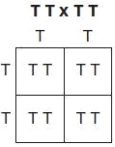
What ratio of the offspring from the cross shown will be homozygous recessive for the trait of tallness?
a)
0 in 4
b)
1 in 4
c)
2 in 4
d)
4 in 4
12.

What are the possible genotypes for this cross?
(Click the picture to see it without the text)
(Click the picture to see it without the text)
a)
TT = 25% Tt= 50% tt=25%
b)
all tall
c)
TT= 75% tt = 25%
d)
Tt = 100%
13.

What is the genotypic ratio here?
a)
25% blue eye 75 % brown eye
b)
BB = 25% Bb = 50% bb = 25%
c)
BB= 50 % bb = 50%
d)
All brown eye
14.

In the punnett square shown, what must the genotype of the missing parent be?
a)
BB
b)
Bb
c)
bb
d)
Tt
15.

What genotype would go in box 1?
a)
BB
b)
Bb
c)
bb
16.
Two brown eyed parents (Bb) have a baby. What is the chance the baby is blue eyed?
a)
0 %
b)
25%
c)
50%
d)
75%
17.
In plants, tall (T) is dominant to short (t). Perform the following cross: Tt x Tt. What is the probability of producing a short plant?
a)
0%
b)
25%
c)
50%
d)
75%
18.

B = brown fur b = white fur
In the punnett square, what is the probability for white fur?
In the punnett square, what is the probability for white fur?
a)
0%
b)
25%
c)
50%
d)
75%
19.
Genetic Engineering:
–Manipulates or alters the genetic makeup of organisms
–Results in organisms with new traits
–Manipulates or alters the genetic makeup of organisms
–Results in organisms with new traits
a)
True
b)
False
20.
The selection of certain seeds or animals for reproduction
in order to influence the traits inherited by the next generation.
a)
genetic engineering
b)
selective breeding
c)
cloning
d)
mutation
21.
The selective, deliberate change of genes (genetic material) by man.
The technique of removing, modifying or adding genes to a DNA molecule in order
to change the information it contains.
a)
genetic engineering
b)
selective breeding
c)
cloning
d)
mutation
22.
A change in genetic that can occur randomly (naturally).
a)
genetic engineering
b)
selective breeding
c)
cloning
d)
mutations
23.
Mutations are not always harmful.
a)
true
b)
false
24.
Creating a genetically identical copy of an organism.
a)
Cloning
b)
Selective Breeding
c)
Genetic Engineering
d)
Mutations
25.
These are all advantages of cloning:
- Organ replacement for humans, less chance of rejection.
- All offspring will have the desired characteristics of the original.
- Can help increase numbers of endangered species.
- Organ replacement for humans, less chance of rejection.
- All offspring will have the desired characteristics of the original.
- Can help increase numbers of endangered species.
a)
true
b)
false
26.
There are no ethical issues with cloning.
a)
True
b)
False
27.
Crossing a female donkey with a male zebra is an example of ......
a)
selective breeding
b)
cloning
c)
genetic engineering
d)
mutations
28.
Removing the feather gene from a chicken, in order to get featherless chickens, is an example of ....
a)
genetic engineering
b)
selective breeding
c)
cloning
d)
mutation
29.
When an animal naturally loses the ability to produce melanin, resulting in an albino. This is an example of ....
a)
cloning
b)
mutation
c)
genetic engineering
d)
selective breeding
30.
Taking cells from an organism in order to make an exact duplicate of that organism is an example of ......
a)
cloning
b)
mutation
c)
genetic engineering
d)
selective breeding
100 %

