
 Worksheets
8th Grade Science STAAR Review
Total questions: 35
Worksheet time: 18mins
Name
Class
Date
1.

a)
4N
b)
6N
c)
10 N
d)
14 N
2.

All living things require oxygen to survive. Where on the periodic table above would you find gases like oxygen?
a)
section A
b)
section B
c)
section C
d)
section D
3.
Henry is investigating the properties of elements in section A. What are the general characteristics of elements from section A?
a)
conducts heat and electricity, shiny, and solid
b)
mostly gases and are very reactive
c)
share properties of metals and nonmetals
d)
liquids that are stable in pure form
4.
CH4 +2O2 → CO2 +2H2O
How many different elements are involved in this reaction?
How many different elements are involved in this reaction?
a)
two
b)
three
c)
four
d)
five
5.
When comparing two elements on the periodic table, elements in the same ___________ are most likely to have similar chemical and physical properties.
a)
group
b)
period
c)
area
d)
section
6.
On a topographic map of a mountain, you walk a longer distance to get to the top when the contour lines are
a)
spread out
b)
close together
c)
going down
d)
going up
7.
The height above sea level is called
a)
topographic
b)
contour
c)
elevation
d)
depth
8.
An example of erosion is
a)
rock is broken into little bits
b)
pieces of rock carried by water settle in a new location
c)
a delta
d)
pieces of rock are blown away by the wind
9.

In which direction is Mill River flowing?
a)
Southeast
b)
Southwest
c)
Northeast
d)
Northwest
10.

What is the highest elevation on this map?
a)
Over 320 meters
b)
Over 450 meters
c)
Over 220 meters
d)
Over 380 meters
11.
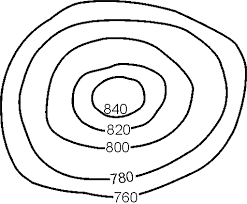
Determine the contour interval:
a)
5 m
b)
10 m
c)
15 m
d)
20 m
12.

Which phases happen immediately before and after the phase shown
a)
Full moon and New moon
b)
Waxing Crescent and Waxing Gibbous
c)
Waxing Crescent and Full Moon
d)
Waxing Gibbous and Full Moon
13.

If the new moon must always be between the sun and Earth where should a student put the "sun"
a)
Position 1
b)
Position 2
c)
Position 3
d)
Position 4
14.

What moon phase comes next?
a)
New Moon
b)
First Quarter
c)
Full Moon
d)
Third Quarter
15.

In the diagram given, what happens as we move to the left?
a)
Stars Get Larger
b)
Stars get Colder
c)
Stars get hotter
16.
Which of these stars is hottest?
a)
Red Star
b)
Yellow Star
c)
Orange Star
d)
Blue Star
17.
Which category is our Sun located in?
a)
White Dwarfs
b)
Supergiants
c)
Main Sequence
d)
Giants
18.

Look at the H-R diagram. Which star is
sort of cool, dim (not too much light), and red?
sort of cool, dim (not too much light), and red?
a)
Betelguse
b)
Sirius B
c)
Procyon B
d)
Barnard's star
19.

Insecticides are sprayed over a large area in an effort to reduce the number of grasshoppers that are eating the corn plants. How will this change affect this food chain?
a)
The number of grasshoppers will increase
b)
The number of lizards will increase
c)
The number of lizards and hawks will decrease
d)
The number of grasshoppers, lizards, and hawks will decrease
20.
An organism that cannot adapt to changes in the environment will most likely -
a)
produce more offspring
b)
die
c)
change its traits to survive
d)
store more food
21.

Identify the characteristics that can be inferred about this animals niche as a nocturnal predator.
a)
Hunts live prey at night
Tree dweller
Excellent night vision
Grasping talons
Tree dweller
Excellent night vision
Grasping talons
b)
Hunts live prey at night
Eats Fruit
Tree dweller
Scavenges from dead carcases
Eats Fruit
Tree dweller
Scavenges from dead carcases
c)
Catches most prey at midday
Eats fruit
Tree dweller
Grasping talons
Eats fruit
Tree dweller
Grasping talons
d)
Eats Fruit
Tree dweller
Catches most prey at midday
Grasping talons
Tree dweller
Catches most prey at midday
Grasping talons
22.

This figure shows three warblers with different niches in a spruce tree habitat. The warblers are feeding in different areas of the tree which allows them to avoid _
a)
competing with one another for food
b)
establishing a strict territory from one another
c)
creating a symbiotic relationship with one another
d)
caring for their young by supplying food
23.

What is the name of the moon phase in the diagram?
a)
New Moon
b)
Full Moon
24.

What is the name of the moon phase in the diagram?
a)
New Moon
b)
Full Moon
25.
Which of the following is an example of a chemical change?
a)
water freezes to form ice
b)
sugar dissolves in water
c)
gasoline burns in a car engine
d)
a piece of metal expands when it is heated
26.
Which one shows that a chemical reaction has occurred?
a)
dissolving
b)
melting
c)
formation of a gas
d)
bending
27.
What part of digestion is a physical change?
a)
Mastication - Chewing the food
b)
Enzymes breaking it down
28.

a)
2
b)
8
c)
3
d)
13
29.
USE THE PERIODIC TABLE
How many valence electrons does sodium have?
a)
1
b)
2
c)
3
d)
4
30.

How many protons are in Cadmium?
a)
112.411
b)
170
c)
64
d)
48
31.

How many neutrons does Argon have in it's nucleus?
a)
39.948
b)
58
c)
22
d)
18
32.
The ______________ is the number of protons + neutrons in the nucleus of an atom.
a)
atomic number
b)
net charge
c)
chemical symbol
d)
atomic mass
33.
Which element has 6 protons?
a)
N
b)
C
c)
O
d)
B
34.
Changing the number of protons in an atom will change the atom's _____
a)
color
b)
atomic weight/mass
c)
net charge
d)
identity (name of element)
35.
Calculate the atomic weight/mass of an atom with:
11 protons
10 neutrons
11 electrons
11 protons
10 neutrons
11 electrons
a)
11
b)
21
c)
22
d)
10
100 %

