
 Worksheets
Biology Fall Final Review
Total questions: 40
Worksheet time: 36mins

Organisms that exert large amounts of energy need high numbers of what organelle in their muscle cells?
ribosomes
chloroplasts
mitochondria
vesticules

Proteins, wastes, and other materials are exported out of a cell through the membrane in a process that uses ATP.
osmosis
endocytosis
exocytosis
protein pump
The movement of water from an area of high concentration to an area of low concentration is called _________. This form of passive transport does not require energy.
diffusion
osmosis
active transport
exocytosis


Which image correctly shows the way phospholipids arrange themselves in the cell (plasma) membrane?


1.) They act like gatekeepers, only let certain things in.
2.) Enzyme receptors embedded in the membrane.
What reagent is used to test for starch a polysaccharide of a carbohydrate?
What is the polysaccharide used by animals to store glucose?
glycogen
fructose
starch
cellulose
Nutritionists know that a gram of protein contains ____ Calories, a gram of fat has _____ Calories, and a gram of
carbohydrate has _____ Calories.
4 / 9 / 4
9 / 4 / 9
5 / 8 / 6
5 / 8 / 6

Long term energy storage,
help form cell membranes, and provide parts of other biomolecules like hormones.
Functions of Sugars
Functions of Polysaccharides
Functions of Carbohydrates
Functions of Lipids
Which of the following is a product of cellular respiration?
Glucose
Carbon Dioxide
Oxygen
Radiant Energy
Which statement is true regarding cellular respiration?
The reactants of cellular respiration are identical to the reactants of photosynthesis.
The reactants of cellular respiration are obtained from the products of photosynthesis.
The products of cellular respiration are the same as the products of photosynthesis
Cellular respiration only occurs in autotrophs, photosynthesis occurs only in heterotrophs.
One function of lipids is to store energy. What is another function of lipids in the human body?
To form cell membranes
To make energy from the sun.
To control chemical reactions.
To provide energy for the cell.
Which is true of prokaryotic and eukaryotic cells?
Prokaryotic cells are larger than eukaryotic cells.
Eukaryotic cells do not have nuclei, and prokaryotic cells do have nuclei.
Prokaryotic cells lack membrane-bound organelles, and eukaryotic cells contain membrane-bound organelles.
Eukaryotic cells are simpler than prokaryotic cells.
How are bacterial cells different from the cells of eukaryotes?
The bacteria are prokaryotes, and the genetic material is not contained in the nuclei.
The bacteria are eukaryotes, and the genetic material is not contained in the nuclei.
The bacteria are prokaryotes, and the genetic material is contained in the nuclei.
The bacteria are eukaryotes, and the genetic material is contained in the nuclei.
Which is in order from largest to smallest structure?
chromosome, DNA strand, gene, nucleotide
chromosome, gene, DNA strand, nucleotide
gene, DNA strand, chromosome, nucleotide
DNA strand, chromosome, gene, nucleotide

ATP
NADH


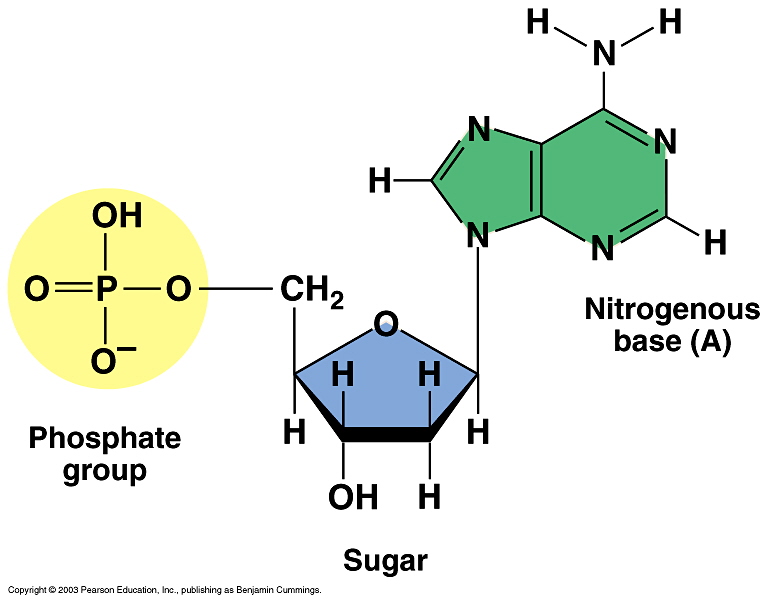
What is A?
Phosphate Group
Pentose Sugar
Nitrogenous Base
Adenosine Triphosphate

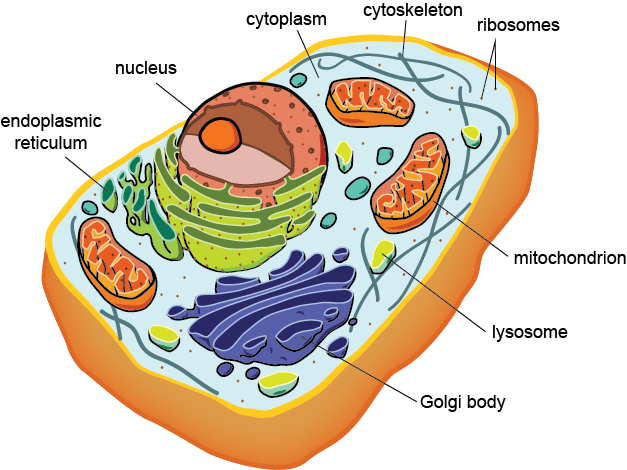
The following data was collected by observing subcellular structures of three different types of cells. How can you determine these are eukaryotic cells?
They have ribosomes.
They have membrane bound organelles.
They have DNA.
The have a plasma membrane.
Who discovered that all cells come from other living cells and had research that lead to the last major principle of cell theory?
Matthias Schleiden
Theodore Schwann
Robert Hooke
Rudolf Virchow

