wayground logo

Free Printable Worksheets

NEW

Font size

S
M
L
XL
Worksheets

U9: Viruses Review

Total questions: 37

Worksheet time: 3hrs 7mins

Name
Class
Date
1.
What part of a virus is the protein capsule that houses the genetic material (DNA/RNA)?
a)
tail
b)
nucleus
c)
capsid
d)
glycoprotein
2.
Which viral life cycle allows viral genetic material to lay dormant while the host cell reproduces?
a)
lytic
b)
mitosis
c)
lysogenic
d)
S phase
3.
Is a virus considered living or non-living?
a)
Living
b)
Non-Living
c)
Neither
4.
What is the first step of the virus reproduction cycle?
a)
The viruses genetic material (DNA) starts to take over the functions of the cell
b)
The host cell bursts open, releasing the new viruses
c)
The virus injects its genetic material into the cell
d)
A virus attaches to the surface of a host cell
5.
What is a way to become immune to a disease without first having the disease?
a)
antibiotics
b)
Anti-retroviral drugs
c)
Vaccinations
d)
Exposure Therapies
6.
Which can be treated with antibiotics?
a)
Virus
b)
Bacteria
c)
Mutagen
d)
Parasite
7.
What do viruses have in common with living cells? They both...
a)
store genetic information
b)
have chloroplasts
c)
use glucose for cellular respiration
d)
have endoplasmic reticulum
8.
True or False
The flu is caused by a virus.
a)
true
b)
false
9.
Antibiotics kill viruses
a)
True
b)
False
10.
What do viruses need to reproduce?
a)
they need genetic material
b)
They need a host cell
c)
They need  bacteria
d)
They need insulin
11.
What part of the virus is number 1?
a)
Capsid
b)
DNA
c)
Surface Markers
d)
Envelope
12.
What part of the virus is number 3?
a)
Capsid
b)
DNA
c)
Surface Markers
d)
Envelope
13.
Viruses are...
a)
prokaryotic
b)
eukaryotic
c)
non-living
d)
endospores
14.
How does a virus cause a person to develop the common cold?
a)
invades the host cell to reproduce
b)
removes energy from the host cell
c)
produces toxins in the host cell
d)
protects the host cell from bacteria
15.
When a virus invades a living cell, its _______
takes over the cell's functions.
a)
outer coat
b)
genetic material
c)
core
d)
cytoplasm
16.
One reason that viruses are considered to be nonliving is that they are not made of ______.
a)
protein
b)
viruses
c)
bacteria
d)
cells
17.
How could you describe the size of a virus?
a)
Smaller than bacteria
b)
Larger than a parasite
c)
About the size of a dime
d)
Smaller than a proton
18.

What is an epidemic?

a)

finding a vaccine for a widespread disease

b)

eradication of a widespread disease

c)

a widespread occurrence of an infectious disease in a community at a particular time.

d)

people freaking out over a disease being spread

19.
A(n) _____ is a virus that enters a bacterial cell.
a)
endospore
b)
decomposer
c)
plasmid
d)
bacteriophage
20.
Which of the following occurs right after a virus attaches to a host cell in the viral reproduction process?
a)
The host cell dies
b)
The virus dies
c)
The virus inserts its genetic information into the host cell
d)
copies of the virus are immediately released from the host
21.
A capsid is
a)
a structure that directly causes cell lysis
b)
the type of virus that attacks bacteria
c)
the genetic material of a virus
d)
the protein coat of a virus
22.
The genetic material of a virus is in the form of
a)
RNA
b)
DNA
c)
either RNA or DNA
23.
Most viruses do not kill humans. Why not?
a)
Viruses can only kill bacterial cells
b)
Humans have 100 trillion cells; viruses can't infect enough to kill
c)
Our immune cells hunt and kill viruses
d)
We have vaccines for all viruses
24.

What is the first step to both viral cycles?

a)

The virus attaches to a host

b)

the virus injects genetic material

c)

the host gets sick

d)

the cell is destroyed

25.

If Andy is feeling symptoms from a virus that he contracted, the virus must be in the

a)

lytic cycle

b)

lysogenic cycle

c)

the capsid bursts

d)

the virus becomes dormant

26.
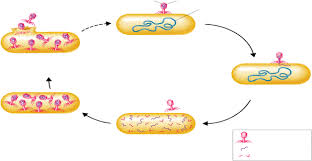
What process is this?
a)
phagocytosis
b)
lytic cycle
c)
lysogenic cycle
d)
formation of antibodies
27.

What happens in the lysogenic cycle?

a)

Virus goes in and leaves the host cell

b)

Virus quickly kills the host cell

c)

Virus injects the nucleic acid into the host cell, and the nucleic acid integrates into the host cell DNA and stays dormant for a long time

d)

Bacteria injects DNA into a host cell

28.

viruses are non-living because

a)

they cannot reproduce on their own

b)

they do not evolve

c)

they have no DNA

d)

they cannot be destroyed

29.
How could you describe the size of a virus?
a)
Smaller than bacteria
b)
Larger than a parasite
c)
About the size of a dime
d)
Smaller than a proton
30.

Which viral cycle takes the longest to show symptoms?

a)

Lysogenic

b)

Lytic

31.

What is the first step to both cycles?

a)

The virus attaches to a host

b)

the virus injects genetic material

c)

the host gets sick

d)

the cell is destroyed

32.

When the viral DNA becomes active in the lysogenic cycle, which life cycle does it enter?

a)

lytic

b)

lysogenic

c)

cell cycle

d)

DNA replication

33.

Which is the smallest out of the following?

a)

eukaryotic cell

b)

prokaryotic cell

c)

viruses

34.
What is shown here?
a)
Lysogenic Cycle
b)
Lytic Cycle
c)
Binary Fission
d)
Conjugation
35.
Which part of the virus contains genetic material?
a)
8
b)
4
c)
1
d)
3
36.
Virus contain what types of genetic material?
a)
Sometimes both DNA and RNA
b)
DNA only
c)
RNA, mRNA and tRNA
d)
RNA only
37.
Why don't antibiotics work if you have a viral infection? 
a)
Antibiotics only kill bacteria or fungi.
b)
The virus kills the antibiotics.
c)
Antibiotics are no longer effective against viruses.
d)
Virus invade and mutate the antibiotic so it is no longer effective.