
 Worksheets
March Test Review (Regulation and Communication)
Total questions: 68
Worksheet time: 46mins
Name
Class
Date
1.
An advantage of a complete digestive system over a gastrovascular cavity is that the complete system
a)
excludes the need for extracellular digestion
b)
allows specialized functions in specialized regions.
c)
allows digestive enzymes to be more specific.
d)
allows extensive branching.
2.

What type of transmembrane receptor is being shown?
a)
G-protein receptor
b)
tyrosine kinase receptor
c)
gated ion channel
3.
What is the name of the signaling molecule that triggers a transduction pathway?
a)
ligand
b)
GTP
c)
kinase
d)
phosphatase
4.

What type of transmembrane receptor is being shown?
a)
tyrosine kinase receptor
b)
G-protein receptor
c)
gated ion channel
5.
What is the name of the pathway that occurs when a signal is received and then converted into a cellular response?
a)
signal transduction
b)
biochemical
c)
catabolic
d)
anabolic
6.
What is the name of the molecule used in signal transduction pathways that readily diffuse and broadcast signals quickly?
a)
secondary messengers
b)
ligand
c)
kinases
d)
phosphatases
7.
What is the name of the molecule that is used in long distance signaling; travels from one gland to another location to trigger the signal?
a)
hormone
b)
neurotransmitter
c)
ion
8.
Hormones are used in ____ signaling.
a)
endocrine
b)
juxtacrine
c)
autocrine
d)
paracrine
9.
The 3 steps of signal transduction in order are
a)
reception, transduction, response
b)
response, transduction, reception
c)
reception, response, transduction
d)
transduction, reception, response
10.
Protein kinases activate other relay proteins by adding a(n) ____ to them.
a)
phosphate
b)
ATP molecule
c)
cAMP
d)
GTP
11.
Adenylyl cyclase is used in a G-protein pathway to
a)
cause ATP to form cAMP
b)
add a phosphate to a kinase
c)
remove a phosphate from a kinase
d)
attract a ligand
12.
cAMP and calcium are examples of
a)
secondary messengers
b)
hormones
c)
ligands
d)
enzymes
13.
Kinases are de-activated when
a)
phosphate is removed by a phosphatase
b)
GTP attaches to them
c)
ligand is released from the receptor
d)
apoptosis occurs
14.

What type of transmembrane receptor is being shown?
a)
gated ion channel
b)
G-protein receptor
c)
tyrosine kinase receptor
15.

The process used to split polymers; this is done by adding water
a)
Dehydration
b)
Hydrolysis
c)
Enzomatic
d)
Tetratonic
16.
A secondary immune response will be faster when...
a)
The individual has encountered the pathogen already
b)
The individual's macrophages are on high alert
c)
The individual has encountered the pathogen and has memory B cells circulating
d)
All of the above
17.
How does a person get immunity through PASSIVE immunity?
a)
you have been infected
b)
you have been vaccinated
c)
you made antibodies
d)
you got your mother's antibodies at birth
18.
The body’s nonspecific defenses against invading pathogens include
a)
antibiotics.
b)
mucus, sweat and tears.
c)
antibodies.
d)
Killer T cells.
19.

a)
A
b)
B
c)
C
d)
D
20.

a)
A
b)
B
c)
C
d)
D
21.

a)
A
b)
B
c)
C
d)
D
22.

a)
A
b)
B
c)
C
d)
D
23.
Which of the following is part of innate immunity?
a)
Neutrophils
b)
Cell-Mediated Response
c)
Inflammation
d)
Humoral Response
24.
The process of engulfing a bacterium or virus particle by a macrophage is known as
a)
Phagocytosis
b)
Pinocytosis
c)
T cell
d)
Dendritic cell
25.
T cells mature in the
a)
Bone marrow
b)
Thymus
c)
Blood
d)
Thyroid
26.
The protein that sits on pathogenic surfaces and elicits an immune response is known as
a)
antigen
b)
histamine
c)
antibody
d)
anticytosis
27.
Which cell primes B AND T cells?
a)
Macrophages
b)
Helper T cells
c)
Cytotoxic T cells
d)
Humoral cells
28.
What is the purpose of intestinal villi?
a)
to increase surface area for absorption
b)
to increase surface area for secretion
c)
to increase surface area for excretion
d)
to decrease surface area
29.
Homeostasis in the human body is often maintained by a:
a)
neutral feedback loop
b)
solar feedback loop
c)
positive feedback loop
d)
negative feedback loop
30.
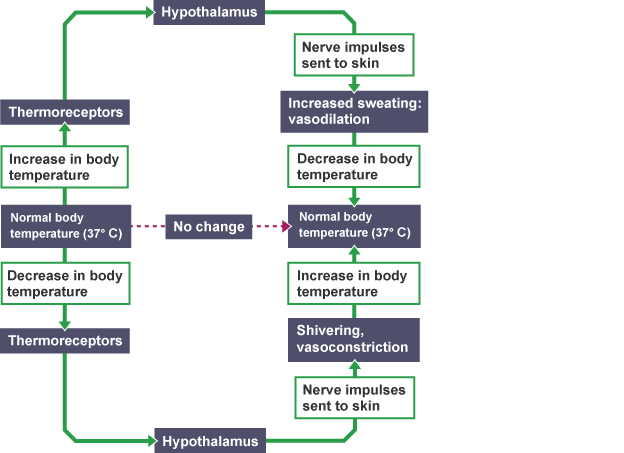
What type of feedback loop is shown?
a)
Positive
b)
Neutral
c)
Negative
31.
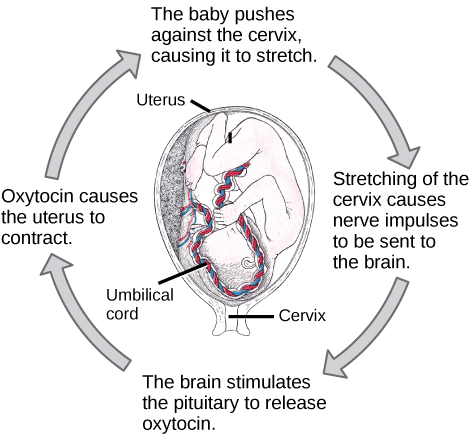
What type of feedback loop is shown?
a)
negative
b)
neutral
c)
positive
32.
As you get dehydrated, your blood becomes thicker and harder to pump. Your kidneys will respond by stopping urine production, sending the water from urine into your bloodstream to thin your blood back to normal level.
a)
Positive Feedback Response
b)
Negative Feedback Loop
33.
Rapid growth during puberty causes your body to release more and more growth hormones. As you grow, more and more growth hormones are released until puberty is reached, and then the hormones stop.
a)
Positive Feedback Response
b)
Negative Feedback Loop
34.
When glucose levels in the blood rise, your brain sends a signal to your pancreas. The pancreas releases insulin, which opens channels in cell membranes to allow glucose to enter the cell, lowering blood sugar levels.
a)
Positive Feedback Response
b)
Negative Feedback Loop
35.
Homeotic genes are commonly called
a)
Hoto genes
b)
Hox genes
c)
H genes
d)
He-Ge's
36.
A process in which cells became specialized in structure and function.
a)
Genomics
b)
Enzyme
c)
Differentiation
d)
Clone
37.
Induction by one group of cells from another usually involves changes in
a)
gene expression
b)
location
c)
formation of bone cells
d)
transcription of bicoid
38.
Absence of bicoid mRNA from a Drosphila egg leads to the absence of anterior larval body parts and mirror image duplication of posterior parts. This is evidence that the product of the bicoid gene
a)
is transcribed in the early embyro
b)
normally leads to formation of tail structures
c)
normally leads to formation of head structures
d)
leads to programmed cell death
39.
Is an octopus an ________.
a)
Osmoregulator
b)
Osmoconformer
40.
Fish gills use which of the following gas exchange mechanisms
a)
Clowncurrent exchange
b)
Concurrent exchange
c)
Countercurrent exchange
d)
Catcurrent exchange
41.

Which of the following gas exchange mechanisms is depicted?
a)
Clowncurrent exchange
b)
Concurrent exchange
c)
Countercurrent exchange
d)
Catcurrent exchange
42.
Which would excrete ammonia?
a)
fish
b)
bats
c)
humans
d)
birds
43.
Which part of the renal corpuscle is a ball of capillaries?
a)
Bowman's capsule
b)
Glomerulus
c)
Afferent Arteriole
d)
Efferent Arteriole
44.
What is the correct order of the steps of function within the nephron?
a)
Secretion, Reabsorption, Filtration
b)
Filtration, Secretion, Reabsorption
c)
Filtration, Reabsorption, Secretion
d)
Secretion, Filtration, Reabsorption
45.

What happens first in the inflammatory response?
a)
macrophages arrive and consume pathogens
b)
histamine is released by injured mast cells
c)
arteries to injury dialate
d)
veins from the injury constrict
46.

Destroy target cells and recognize cancerous cells
a)
Helper T Cells
b)
T cells for delayed hypersensitivity
c)
Suppressor T Cells
d)
Cytotoxic T Cells
47.

B Cells differentiate into memory cells and what?
a)
stem cells
b)
nerve cells
c)
helper cells
d)
plasma cells
48.
A nonspecific defensive response of the body to tissue injury characterized by dilation of blood vessels and swelling.
a)
immunity
b)
interferon
c)
immunization
d)
inflammation
49.
Lymphocytes are which type of cell?
a)
White blood cells
b)
T-cells and B-cells
c)
Nerve cells
d)
Red blood cells
50.
What part of a plant would have the lowest water potential in a plant?
a)
xylem of the leaves
b)
xylem of the roots
c)
roots hair
d)
mesophyll tissue of the leaf
51.
A hormone, like testosterone, that does not need a cell surface receptor to enter the cell is a -
a)
steroid
b)
non-steroid
c)
water soluable
d)
sebacous
52.
What type of hormone binds to receptor proteins on the surface of the cell and require secondary messengers?
a)
Steroid
b)
Nonsteroid
c)
Fat soluble
d)
Sebaceous
53.
What hormone reduces blood sugar?
a)
Insulin
b)
Glucagon
c)
PTH
d)
Calcitonin
54.
What hormone increases blood sugar?
a)
Insulin
b)
Glucagon
c)
PTH
d)
Calcitonin
55.
Which cells respond to hormones?
a)
Target Cells
b)
Endocrine Cells
c)
Exocrine Cells
d)
Muscles and Nerves
56.
How does immunity work in plants?
a)
inflammation of the infected site
b)
apoptosis of infected tissue
c)
activation of antibodies in the mesophyll tissue
d)
activation of immunity proteins in the surrounding cells
57.
What is the most likely cause of a protein shape change?
a)
change in the cytoskeleton attachment to the protein
b)
large quantities of carbohydrates in the area
c)
a change from a saturate fatty acid to an un saturated fatty acid in the protein
d)
change from a polar amino acid to a non polar amino acid
58.
Auxins cause ______; Gibberellins cause _______.
a)
plants to bend toward light; elongation in plants
b)
plants to bend away from light; dormancy in plants
c)
fruit ripening; break in dormancy
d)
plants to bend towards light; fruit ripening
59.
Which best describe why allergic reactions take place?
a)
exposure to allergen causes increasing amounts of histamine due to negative feedback mechanisms
b)
exposure to allergen causes formation of antibodies that trigger an amplifying response due to a negative feedback mechanism
c)
exposure to allergen causes ever increasing release of histamine due to a positive feedback mechanism
d)
exposure to allergen causes B cells to be activated and produce lots of histamine due to a negative feedback mechanism
60.
When epinephrine binds to cardiac (heart) muscle cells, it speeds their contraction. When it binds to muscle cells of the small intestine, it inhibits their contraction. Which of the following best accounts for the fact that the same hormone can have different effects on muscle cells?
a)
Cardiac cells have more receptors for epinephrine than do intestinal cells
b)
Epinephrine circulates to the heart first and thus is in higher concentration around cardiac cells
c)
The two types of muscle cells have different signal transduction pathways for epinephrine and thus have different cellular responses
d)
Cardiac muscle is stronger than intestinal muscle and thus has a stronger response to epinephrine
61.

This is an example of
a)
paracrine signaling
b)
synaptic signaling
c)
long-distance signaling
d)
all of the above
62.

G proteins are a family of proteins involved in transmitting chemical signals originating from outside a cell into the inside of the cell. G proteins function as molecular switches.
Investigations into the causes behind symptoms in Alzheimer’s patients have led to the hypothesis that the disease may be caused by excessive activity of IP3 second messengers in brain cells. When comparing cell samples of Alzheimer’s patients to those taken from the control group, which of the following pieces of evidence would support this hypothesis?
Investigations into the causes behind symptoms in Alzheimer’s patients have led to the hypothesis that the disease may be caused by excessive activity of IP3 second messengers in brain cells. When comparing cell samples of Alzheimer’s patients to those taken from the control group, which of the following pieces of evidence would support this hypothesis?
a)
A lower number of receptor proteins in the Alzheimer cell samples.
b)
A greater volume of endoplasmic reticulum membrane in the control group cell samples.
c)
A higher concentration of calcium ions in the cytosol of the Alzheimer cell samples.
d)
A lower number of activated proteins in the cytosol of the Alzheimer cell samples
63.
The term steroid describes both hormones produced by the body and artificially produced medications that duplicate the action for the naturally occurring steroids. All of the following describe steroid hormones EXCEPT:
a)
A. They bind with receptor proteins in the plasma membrane to trigger cellular responses.
b)
A. They are derived from cholesterol and are lipid soluble.
c)
They serve as ligands in signal transduction pathways
d)
A. They are exemplified by testosterone, estrogen and progesterone
64.
What is one effect epinephrine has on liver cells?
a)
uptake glucose to store as glycogen
b)
break glycogen down to release glucose
c)
decreases blood vessel diameter
d)
decreases blood glucose levels
65.
What is a phosphorylation cascade?
a)
travelling of hormones through the air
b)
travelling of hormones through the blood
c)
the removal of a phosphate
d)
a series of molecules that get phosphorylated
66.
The inflammation response is triggered by
a)
Histamines
b)
Anti-histamines
c)
Cytokines
d)
Interferon
67.
HIV attacks and kills which of the following?
a)
Plasma B cells
b)
Memory B cells
c)
Helper T cells
d)
Cytotoxic T cells
68.

A primary immune response is ____; and a secondary immune response is___.
a)
very important; less important
b)
very rapid; very slow
c)
slower; faster
d)
none of these is correct
100 %

